The Barricades

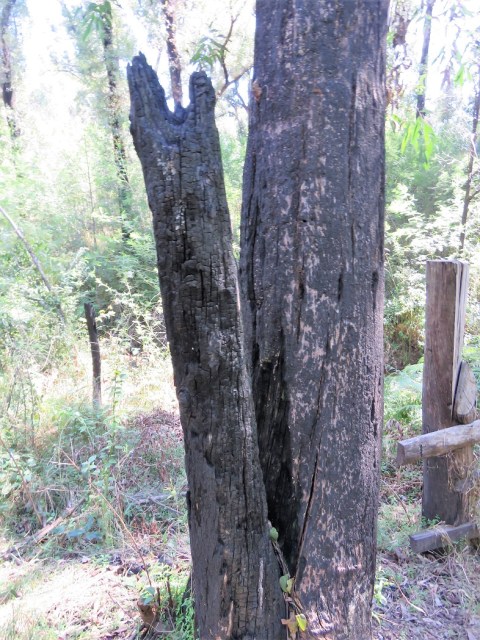
The remaining stump doesn’t look very large in the photo but the poor abies was between 60 and 70 years old.

I think we all breathed a sigh of relief when the last of the Cyclone Dovi major damage was cleared and repaired. The abies that fell over the high bridge in the park has been cleared; Lloyd has reinstated the stopbank which had been ripped apart by the tree roots and the he has repaired the bridge.  
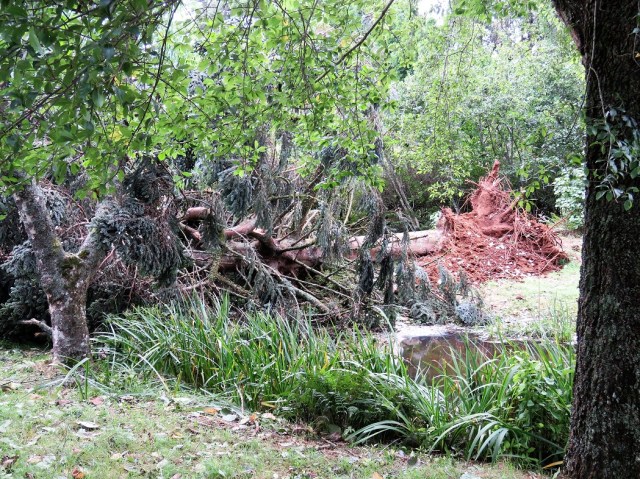
The bridge was beneath the tree

The challenge with the abies was what to do with it. Mark had no interest in the timber for firewood. We have plenty already and abies is a lighter wood that does burns quickly so was not desirable. Had it been somewhere with vehicle access, we would have given it away but it was too much of a challenge to try and get it back up the hill when the only access was by our baby tractor or Lloyd’s quad bike and trailer.

Installations, maybe.

The job of cutting it up fell to Zach. Given it had fallen right across the stream, we are lucky that we have had a dry late summer and autumn with low water flow because he spent a few days working around the water with gumboots that are no longer waterproof. He burned the foliage on site as he went. The wood was cut to manageable lengths. A few were used nearby as ‘installations’, we might say. Most of it, he carted halfway back up the hill to build what we have come to call The Barricades.

The Barricades

For readers not into musicals, this is a reference to ‘Les Miserables’. Of course it is. Zach is a fan of musicals and we have been been a Les Mis household ever since our second daughter played Little Cosette in the stage show at the tender age of 10.
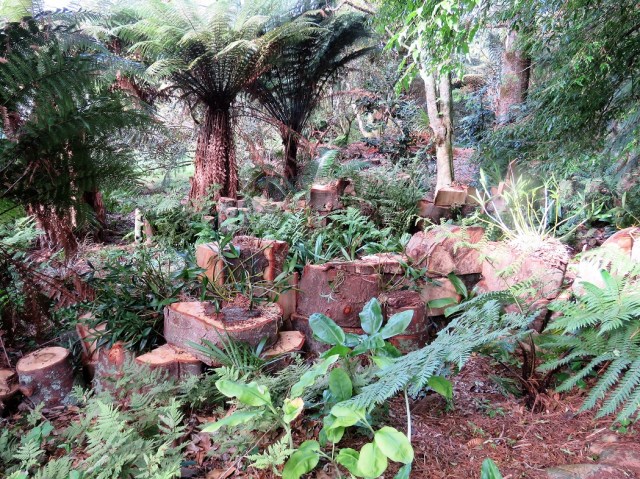
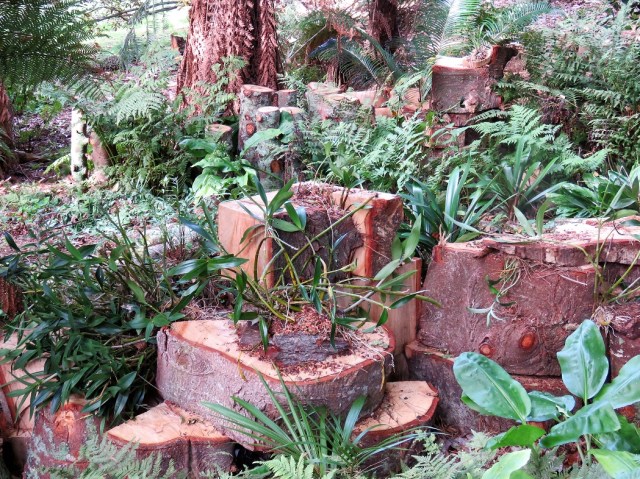
That is a Bardo Rose dendrobium freshly planted in the wood

Meet our barricades. Essentially, they are a way of dealing with surplus wood while giving some structure and height in a casual woodland area. Over the years, they will rot down but, in the meantime, they give all sorts of cavities in which to grow plants as well as being not so much a trendy hotel for insects, as an entire insect resort. Or condominium. Zach started with planting a few orchids in it and we will continue to add more plants as suitable candidates become available.
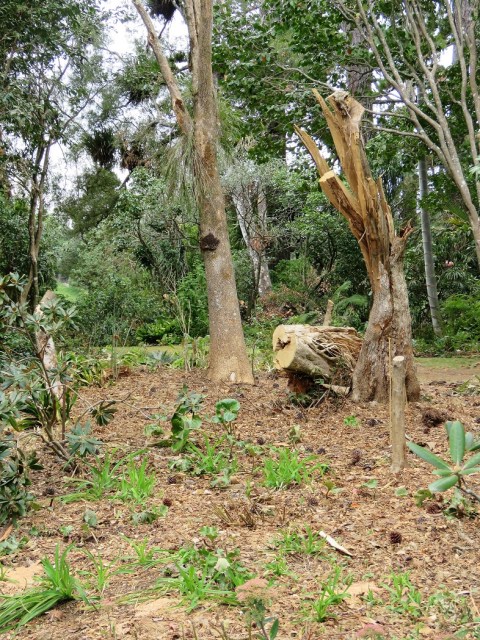
Early March after the initial clean up in the Avenue Gardens

Meanwhile, the rate of recovery in the Avenue Gardens has been rewarding. When Dovi hit, this area was completely covered by fallen pine and the lower canopy of jacaranda, camellia and cordyline. After it had been cleared, it was a bare wasteland with everything tramped into the ground by heavy boots dragging out the debris. We covered it in the woodchip mulch – of which we had small mountains heaped around the area and this was how it looked on March 5.
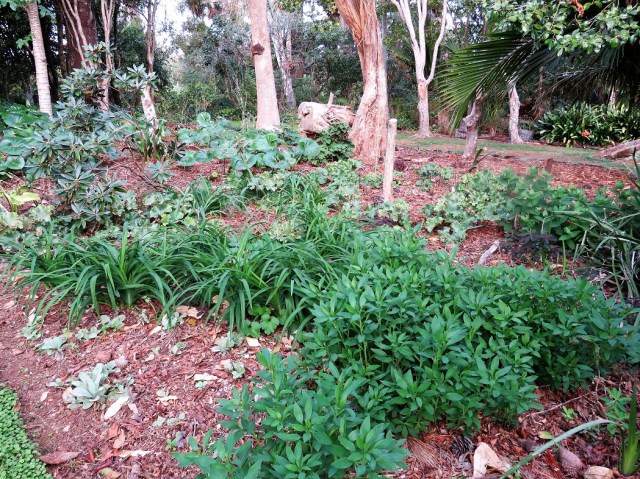
Early May. The poor jacaranda is unlikely to rally again but the rest is recovering.

Two months on, in autumn, it has already recovered to this point. We are still missing the middle canopy layer, but it looks as if the perennial groundcover will return afresh.
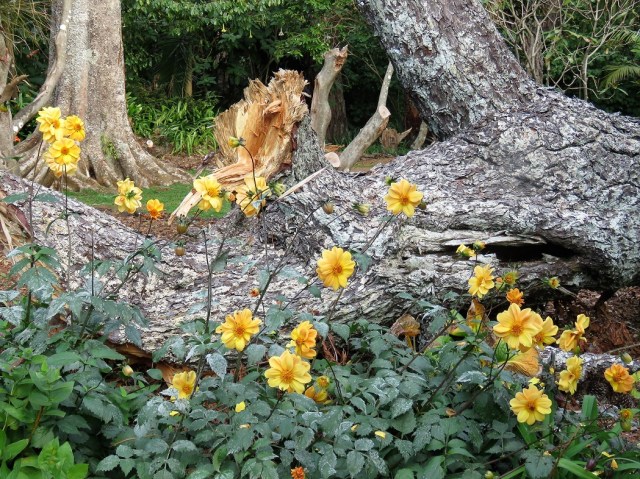
Further along the damage zone, the plants are already softening the length of trunk we decided to leave where it fell. In a few years’ time, Cyclone Dovi will just be a memory.

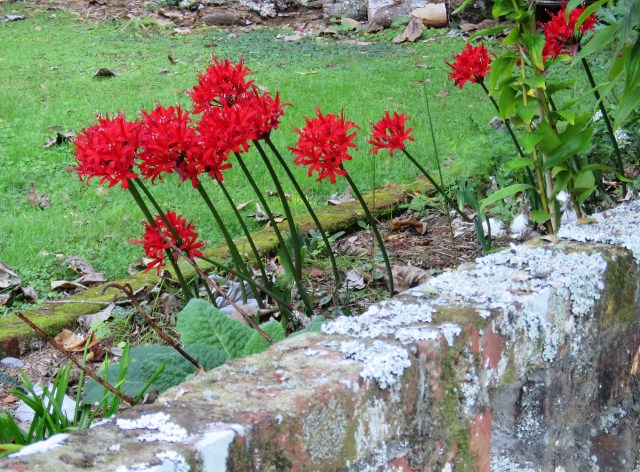
I wrote about Mark’s hippeastrum hybrids back in 2019. Another one has opened and is positively glowing in the Rimu Avenue. Everyone that has bloomed so far is red. It would have been nice to have had more variety, given that one parent is H. papilio. But what is more interesting is their random blooming. H. aulicum flowers like clockwork for us in September, H. papilio in October. These hybrids are popping up the odd flower any time of the year. It will take a few more years to see if they settle down to a predictable seasonal pattern but, in the meantime, it is quite delightful to come across unexpected, over the top blooms glowing in the woodland gardens.

Part two of our very recent trip to Australia with festoons of curtains, bushfire regeneration, she-oaks and a side of snake wisdom

Every single room was similarly festooned and all but one in lilac ombre – even the bathrooms. Acres of festooned fabric

From Ulladulla, we headed down to Catalina in Bateman’s Bay where our Air BnB was Something Else. With hundreds of metres of sheer curtains in lilac ombre festooned in every room and acres of large white tiles on the floor, it had its own style. Sydney daughter described it as having a Greek wedding vibe.

It is just over two years ago that the Black Summer fires swept through parts of Australia. Just -pre-pandemic in fact. I wrote this piece in January 2020. We had entered bushfire territory.

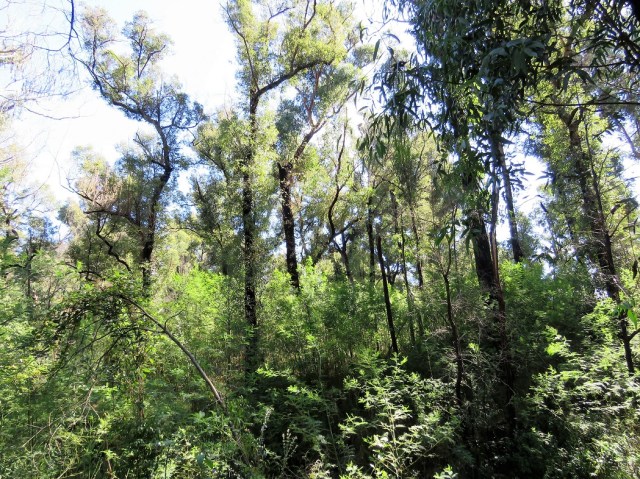
It is astonishing how quickly the Australian bush can regenerate – helped, daughters told me, by the fact that rains arrived not long after. That is by no means always the case but the area we were in was looking lush and green by Australian standards. “You can tell where the fires came through,” Canberra daughter said, “by the trees with black trunks with dense tufts of fresh foliage on short growths.” Those trees are mainly their native eucalyptus. We soon had our eye in for spotting fire damage and that was haunting.

Regeneration after the fires at Eurobadalla Botanic Gardens

The fires swept through Eurobadalla Botanic Gardens near Mogo on New Year’s Eve of 2019. Looking at the fire photos on line, there wasn’t much left and all the infrastructure was destroyed. These gardens are more what we call ‘nature reserve’ than ‘botanic garden’ but I don’t know how much of that is post-fire. Sydney and Melbourne both have botanic gardens that are more international in their plant collections; Canberra’s botanic gardens are based on Australian native plants and have a totally different feel. I would guess Eurobadalla has always been more focused on native plants but with the main efforts going into rebuilding infrastructure, the flora is more about regeneration at this time than showcasing a broad range of native plants.

Drifts of symbolic yellow wattle blooms
It must have taken a lot of community involvement to knit 37 000 of these

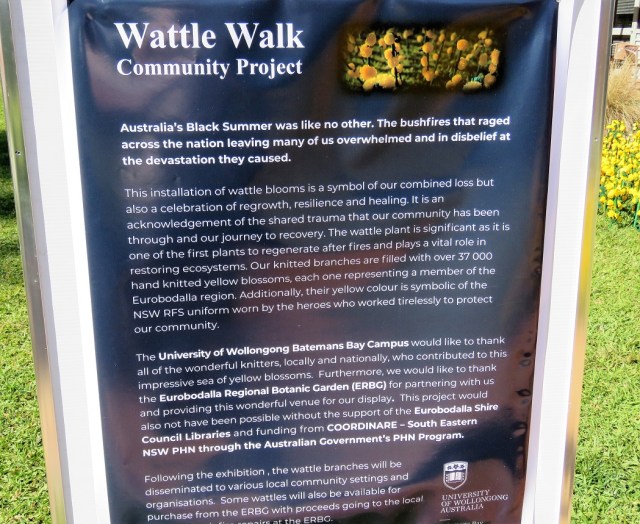
The more than 37 000 knitted wattles on the entrance lawn were both eyecatching (“Well, that is one way to get colour in the garden,” was Mark’s initial observation) but poignant in the extreme when we read the information board. Wattles, from the acacia family, are one of the first nurse plants to appear after fire. So these hand-crafted sticks of flowers were both an acknowledgement of the devastation experienced and a symbol of regeneration.  

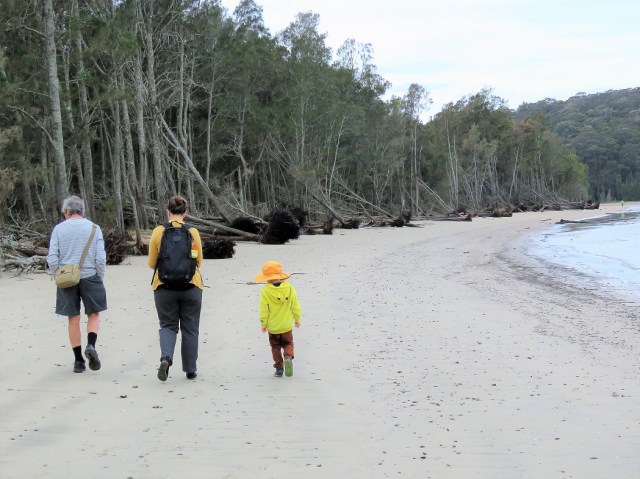
We went for a walk one grey, calm morning along a beach which seems to be part of a nature reserve by the Clyde River that reaches the sea in Bateman’s Bay.  

Three generations

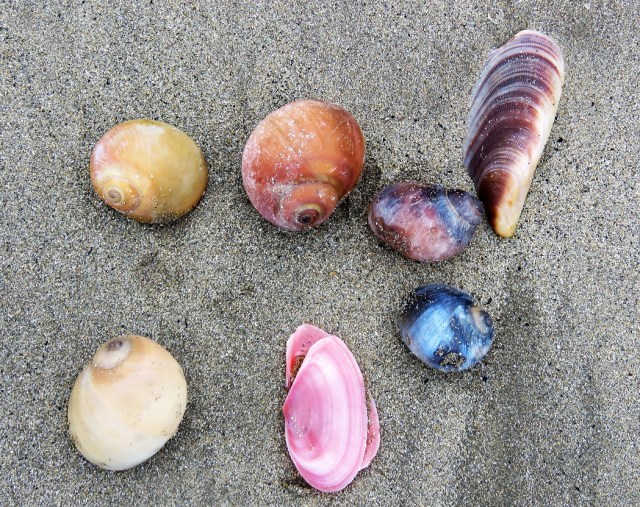
Elder daughter has a been a great picker-upper of unconsidered trifles all her life. It is only recently that I have dispersed most of her rock and shell collections from the back shed here. To my amusement, she has passed on this trait of gathering beach treasure to her small son. And I can tell you that the shells on this Australian beach were a great deal more varied and colourful than anything I have seen on a New Zealand beach. Small, but so pretty. I wanted to gather them myself. Daughter and son pocketed these small treasures to take home and that brought a smile to my face.

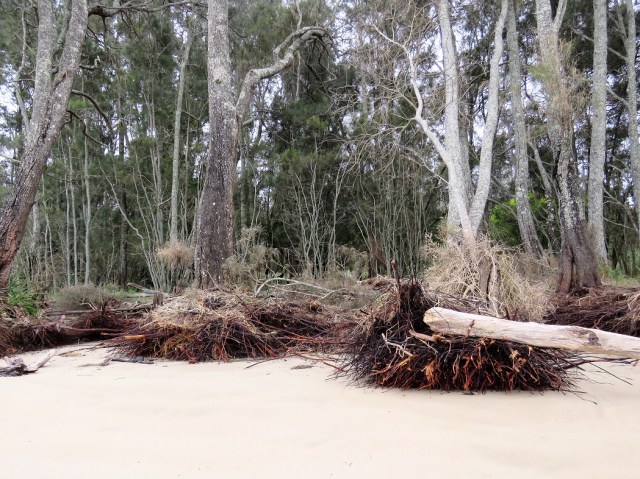
The beach was lined in what we call she-okes in this country. Excellent firewood, Mark says, despite being fast growing, brittle trees that can fall apart in our winds.  She-okes are Casuarina equisetifolia, native to Australia and up through the Pacific into Asia. They are not a tree of great beauty in form or foliage, being typical of that somewhat scrawny, scruffy, rangy look of much of Australia’s tough native vegetation. What was interesting about these plants was the role they were playing in breaking the force of the sea and their ability to grow in areas where they must get inundated by salt water on a regular basis. That said, the front row of trees had fullly exposed roots and were falling backwards on a frequent basis.

After a rewarding week of family bonding, we were jolly relieved to test negative at Sydney airport, on our arrival home and again five days later. Travelling in Covid times is a whole new ballgame but we are big fans of N95 masks.

Postscript: It gave me quite a jolt when I heard my daughter cautioning her five year old that we were moving through snake territory at Eurobadalla Gardens. This is not what a NZ grandmother expects to hear. For overseas readers, NZ has no snakes at all – not even in zoos. Australia, on the other hand, has a fair representation of the world’s most venomous snakes. NZ children are taught about personal safety measures in earthquakes and tsunamis. I assume many Australian children are raised being aware of safety around snakes and bushfires.
Given my ingrained fear of them, I snorted when I saw this tweet come down my Twitter line. In a world where many people pay lip-service only to the threats posed by climate change, I thought yes. Very much yes.

After more than two years – a trip away

The foreshore in Ulladulla

Our trip to Australia has been, done and gone. In pre-Covid times, a trip across the ditch was not a major one. For us it is just two flights with a total of about 4 hours in the air. Four hours can get you a long way in Europe but for New Zealanders, it gets us to our closest neighbour. We fly longer and further than anybody else to get to most places so it is not long haul until it is a 12 hour flight and that only gets us into Asia or Los Angeles.

But times have changed with Covid and this trip to Australia to reunite with our children felt like a major event. It was between two and three years since we had seen them in person and that was our focus. We met up in Ulladulla first, a beach town three hours’ drive south of Sydney. What a pretty coastline that is, full of attractive bays, golden sand and an unthreatening ocean – though it was too autumnal for any of us but the five year old grandson to go swimming.

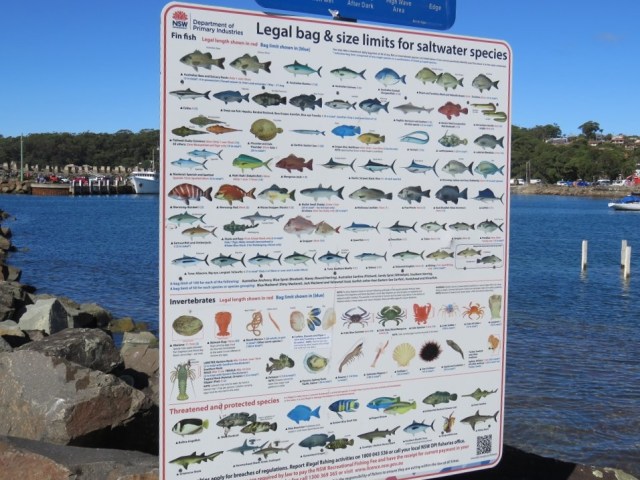
Look at that range of fish species! The quality of fresh fish on the eastern coast of Australia is exceptionally good, even down to beachside fish and chips.

Where we live in Taranaki, our beaches and coastline are grand and wild west coastline with unpredictable seas, big surf and vast expanses of dramatic black sand. That Australian coastline seemed benign and user-friendly in comparison. Ulladulla had a vibe that was vaguely reminiscent of Cornwall fishing villages to us.

We stopped on a walk to see what this man was doing beside a fish-cleaning station on the breakwater
He was attracting the ginormous stingrays in closer. It looks like a shadow in the water, a rocky area maybe, but I can assure you it was one of three excessively large stingrays attracted in close to shore by an easy feed.

The sight of the most enormous stingrays we have ever seen was a reminder that it is not as benign as it appears. I was not at all sure I would want to swim amongst monsters like that. The Australian Museum site tells me that ‘The Smooth Stingray is the largest of all Australian stingrays (Family Dasyatidae). It grows to 4.3 m in length, 2 m disc width and a weight of 350 kg.’ I have no idea if we were looking at smooth stingrays but it does confirm that my memory is not playing tricks on the astonishing size of the ones we saw.

Cordyline fruticosa – easy to propagate, easy to grow and right at home in areas with hot summers and mild winters

While the temperatures felt very similar to those we had been experiencing at home, the common garden plants told us that the climate is warmer than ours. We have seen Cordyline fruticosa (formerly C. terminalis) growing wild on the roadsides of Bali but unless you have a very favoured spot in NZ, preferably in the more sub-tropical north, it is a house plant here. It was in every second garden in that area of coastal New South Wales. What it lacks in subtlety, it makes up for with its exotic tropical vibe.

Those are NZ cordylines but I have never seen them looking that good in NZ

Australia has its own native cordylines but gardeners there embrace all manner of different species and cultivars and, galling though it is to admit it, our native NZ cordylines look better as garden plants there than here. That is because our plants get attacked by a native caterpillar – Epiphryne verriculata – which gives our plants a perpetually motheaten, chewed appearance.

Tibouchina – another indicator of a warmer climate than home

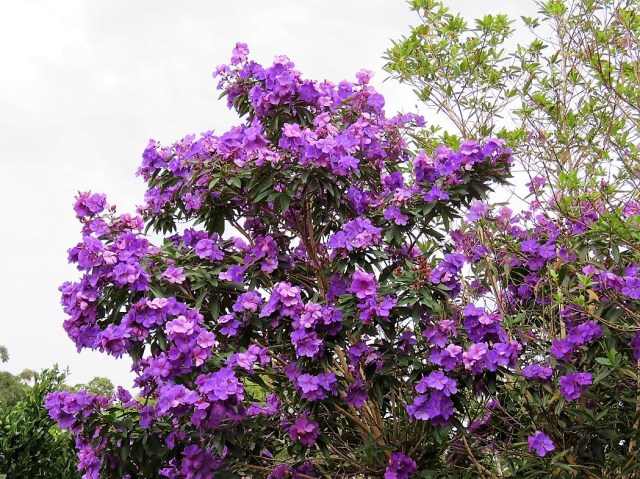
The splendid tibouchinas in full bloom also featured strongly. Commonly known as lasiandra in Australia, these are tropical plants originating from Central America – mostly Mexico, Brazil and the Caribbean. Again, these are conditions that can only be replicated in the warmest areas of northern NZ so we don’t see them like this in Taranaki. Some may think they are garish but there aren’t too many plants that are a blaze of glory in mid to late autumn.

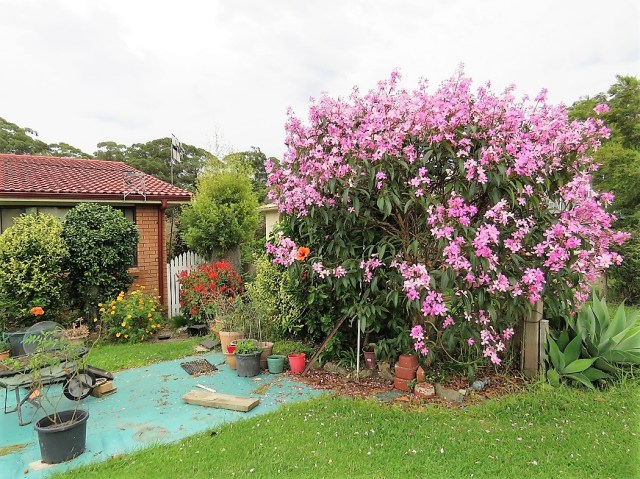
There did seem to be a choice limited to either purple or candy pink in the tibouchina range

While this pink one was highly visible from the road, I stopped to ask the garden owner if I could photograph it because I thought it may worry her to see a random stranger photographing the front of her place. I did take more arty photos of close-ups of the flowers, but I quite like it in the context of the whole front garden, which had its own flavour. The owner was so thrilled by my request, she took me round the back to show me the purple one above.

Australians love their sasanqua camellias and they were looking very pretty everywhere but I came home with not a single photo featuring them, so you will just have to take my word for it.

Another cordyline derived from NZ species but with the clean foliage they keep in Australia as compared to here. And lo, there is a sasanqua camellia – albeit a pretty ordinary variety.

After Ulladulla, we relocated a little further south to Bateman’s Bay. This was entering bushfire territory from the summer of 2019-2020, now referred to as the Black Summer. That was haunting but the story of 37 000 hand-knitted wattle flowers commemorating the event will have to wait for my next post.

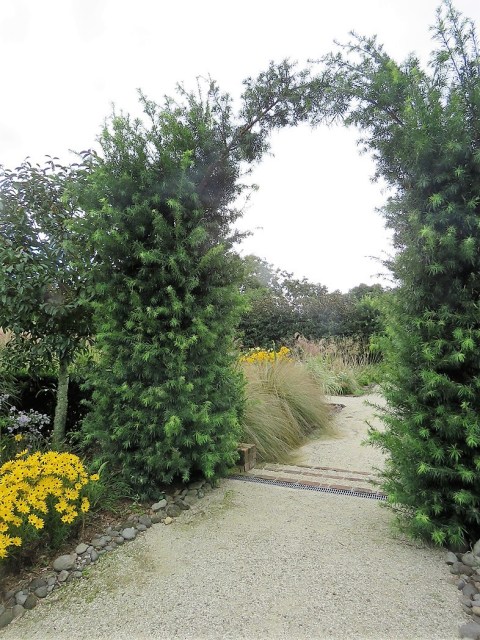
The Court Garden in early autumn

Forming the archway with Podocarpus parlatorei which leads into the Court Garden

Today, fingers crossed, all going well, negative RAT tests and no flight cancellations, we are winging our way across the Tasman to reunite with our three children and only grandchild, all of whom live in Australia. It feels momentous because it will be the first time we have seen them all for between two and three years. The small grandson is literally twice the age he was we last saw him. We are all meeting up in Bateman’s Bay, a few hours’ drive south of Sydney. I mention this because there won’t be a post next Sunday and I was chastised by a loyal reader for skipping a couple of weeks recently.

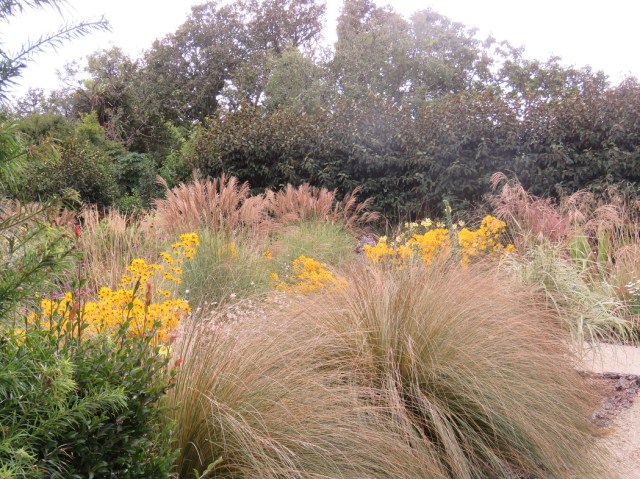
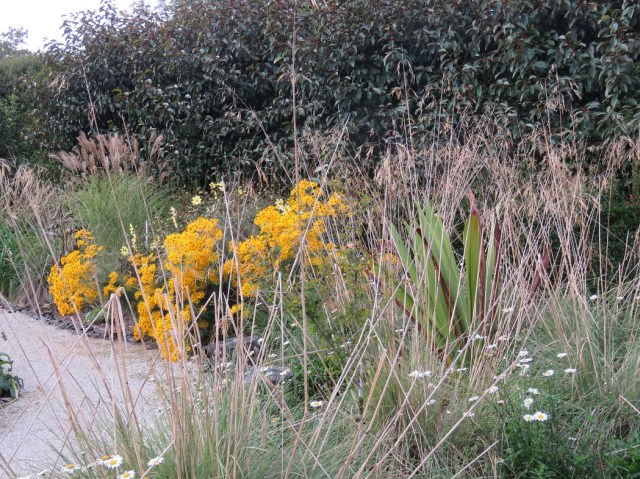
And a close-up of that view through the podocarpus archway – mostly Chionochloa rubra and helianthus

Just occasionally, I look at part of the garden and utter a sigh of utter joy and contentment. It is that glorious feeling that everything is just right, a vision realised at that moment in time on that particular day. When it is a garden that has been my vision, my plant selection, my plant combinations and largely my efforts, the feeling of deep satisfaction is even more rewarding.

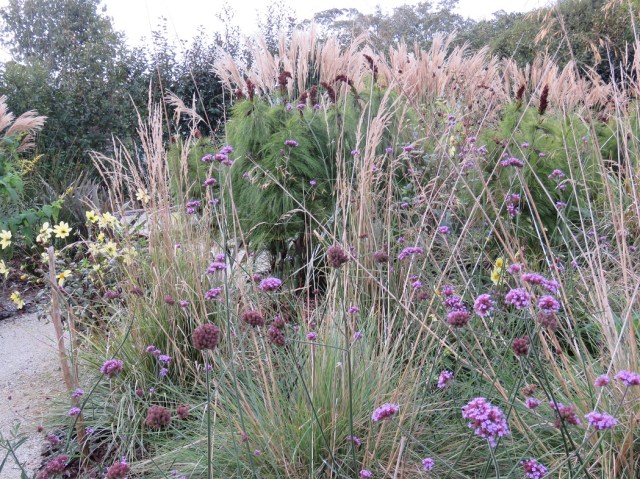
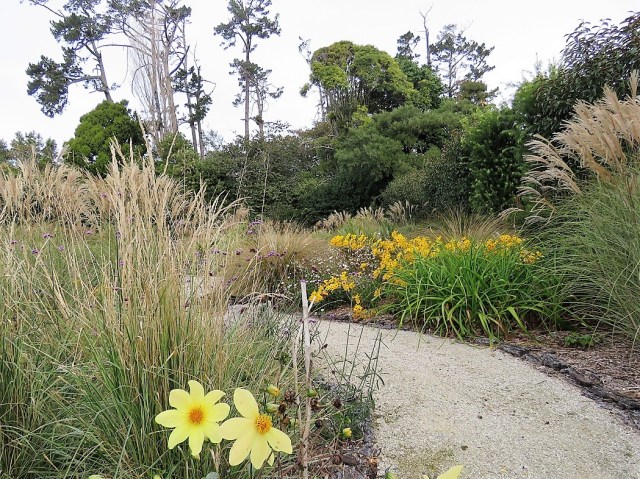
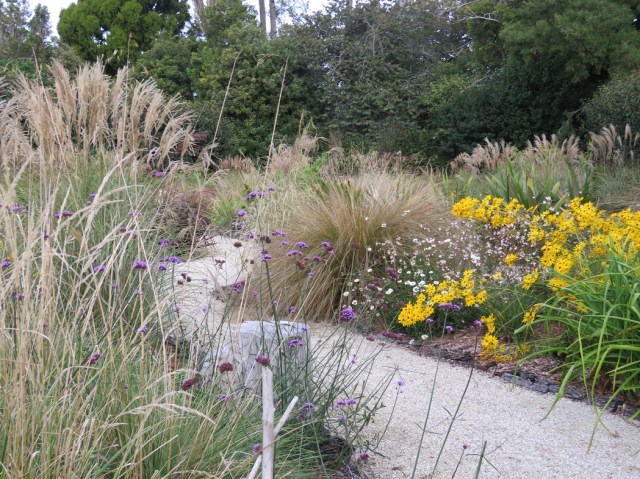
Calamagrostis ‘Overdam’ at the front with self-sown Verbena bonariensis, Elegia capendis with Dahlia ‘Conundrum” in the mid ground and Miscanthus ‘Morning Light’ at the back

I experienced that feeling this week in the Court Garden. While it is part of the new area we call the Summer Gardens, it really stars in autumn. I wanted this area to be a wrap-around, enveloping experience –  where we are IN the garden, not looking AT the garden. And this week, I felt that it had all come together.

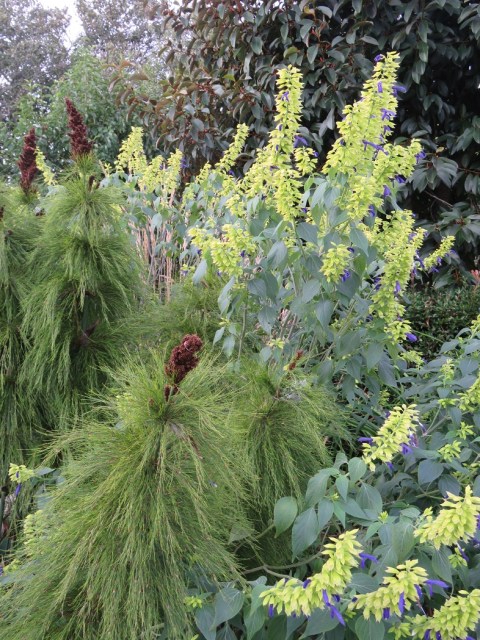
I like the combination of Elegia capensis and Salvia mexicana ‘Limelight’

Of course there are areas that I will tweak further. Zach has been reducing the size of the Elegia capensis and one of the patches of black phormium (flax) this week. I need to give the Chionochloa rubra more space if they are to be left to gain their full potential glory. I am still learning about which plants we will need to manage and control and how often this will need to be done. But this week I sighed with pleasure.

The concept works. It is an immersive experience. It is generally low(ish) maintenance – certainly lower than other areas of the Summer Gardens. It is very different to all other areas in our garden. The fact that it looks okay in winter, good in spring and summer but it really stars alone in autumn is a bonus.
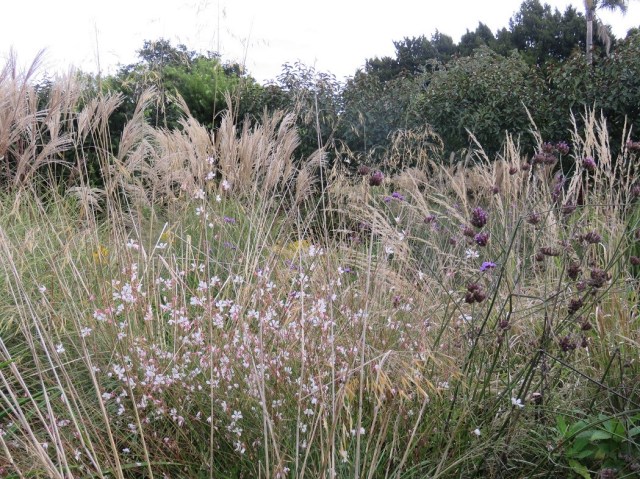
Gaura with Stipa gigantea and Miscanthus ‘Morning Light’

These photos were all taken in late afternoon on a grey day with lower light levels. It looks spectacular on blue sky days as the autumn sun is lower in the sky and highlights the plumage of the grasses in flower. On a windy day, it is full of movement but even on calm days, the slightest breeze will catch the tall plants and they will gently wave.

In fact, it works just as I hoped it would.

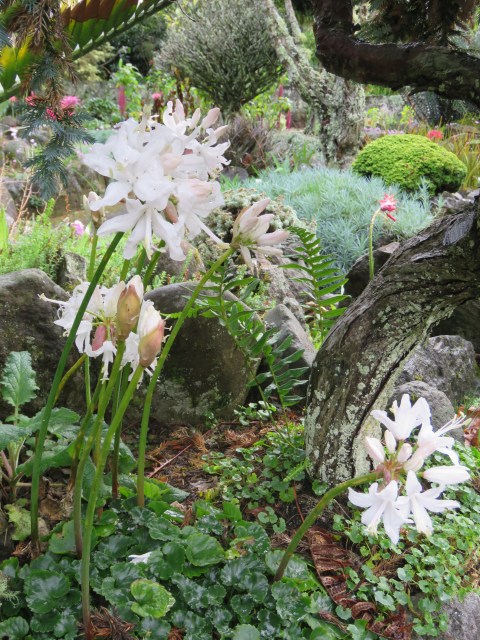
Autumn nerines

The autumn rockery this week

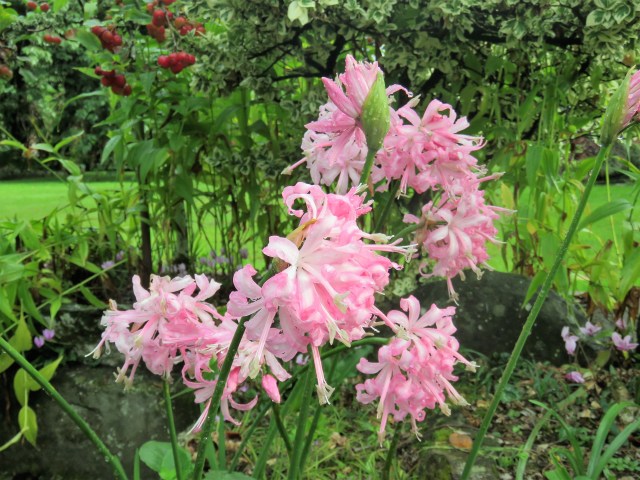
Look at the nerines. Autumn stars, these are.

We grow a few different species but what is coming into bloom now are what we refer to as the N. sarniensis hybrids. I will admit that I do not know what they were hybridised with. As they appear to have been popular in both Europe and Japan by the 1600s, I am guessing the genes are pretty mixed by now but dominated by the species, N. sarniensis.

It really is shocking pink or highlighter pink, brighter even than in this photo

All nerines hail from areas of southern Africa and there are currently 24 species recognised. Notwithstanding that origin, the common name internationally is the ‘Guernsey lily’ owing to that island in the English Channel adopting the flower early on as its own and establishing a cut flower trade with it. I have no idea if it is fact or legend that a ship carrying a load of nerine bulbs to the Netherlands was wrecked nearby and the bulbs floated to the shores of Guernsey Island and naturalised themselves on the coastline. It is a good story and bulbs had to get there somehow.

The history of nerines in cultivation seems to be pretty murky, maybe because it goes back over 400 years. I had always assumed – based on the photos of the Guernsey lily that appeared to be predominantly red – that sarniensis in the wild was red. Mark thought it was orange, based on Nerine fothergilla major (which has now been reclassified as sarniensis, just to confuse us further) but it appears that the colour may be variable in the wild.

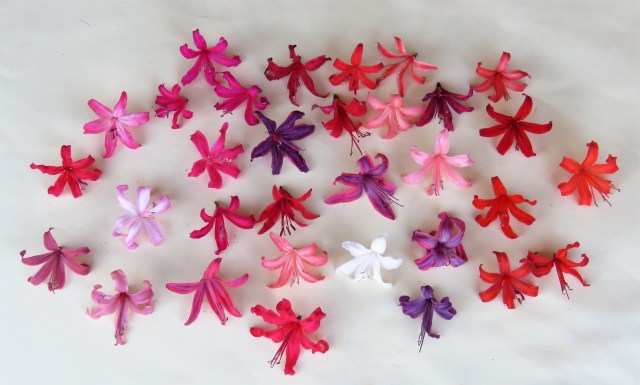
Our nerines range from pure white through pale pink, pink and white bi colours, mid pinks, coral shades, shocking pink, cerise, crimson, shades of orange and scarlet.

Ageing to blue purple tones

“Oh lord,” said Mark, looking at the purple ones on my flower lay, “the phone will ring next week with people wanting a purple nerine. Reader, they don’t open purple. Mark spent a bit of time crossing and selecting to get the blue and purple lines in the flowers and those ones age to purple. We never named any of them and we don’t know if other breeders have similar shades which they have put on the market, which would seem likely. Whether any are available in New Zealand is another matter.

Very few of our nerines have ever been sold commercially. We have a few named cultivars originally from the Exbury collection in the UK (where they have to grow them under glass), Felix Jury named a few but not many and I think Mark named one that we once sold. It is all a bit academic now because we just enjoy them in the garden and it doesn’t matter to us whether they are named cultivars or unnamed hybrids.

These nerines are deciduous and they put up their flower spikes before putting out the fresh foliage. I don’t love the foliage in spring when it is getting tatty and tired and we have some quite big clumps of them, but they make up for it in autumn. Because they have foliage through the winter, sarniensis nerines are frost tender and they struggle in cold, wet conditions. They need to be in full sun with sharp drainage and the large bulbs nestled into the soil but with their top half and necks exposed to bake in the sun. They are quite particular about conditions and won’t flower if they don’t like them. Nerine bowdenii which flowers later is much easier, hardier and less particular but only comes in pink, I think.