A step by step guide by Abbie and Mark Jury first published in the Taranaki Daily News and reproduced here with permission as a PDF.
New Outdoor Classrooms are uploaded fortnightly.

A step by step guide by Abbie and Mark Jury first published in the Taranaki Daily News and reproduced here with permission as a PDF.
New Outdoor Classrooms are uploaded fortnightly.

The large chicken netting peacocks in the meadow at Hilliers were both whimsical and charming
Would we consider having an exhibition in our garden during Rhododendron Festival, the sculptor asked. It is pretty last minute but we replied in the affirmative, though rather regretting the missed opportunities in the official programme which had long since been printed.
We have tended to be a bit iffy and sniffy about sculpture in gardens and it wasn’t until we saw it at Hilliers and at Wisley in England that we found a perspective we could live with.
The key issue is quite simple. In our eyes, gardens are about plants and they should be the stars. Even garden design is primarily a vehicle to carry the plants and to enhance the viewing experience. Drop a sculpture into a garden and in most cases the created object made by a human becomes the dominant feature. The plants and garden become the backdrop. That is fine if sculpture is your interest and you merely want a pleasing outdoor venue to display a collection. As long as the piece is placed well, the garden setting can enhance it considerably. But the reverse is rarely true and takes a great deal more skill.
Gardens are more usually dominated or taken over by the sculptural statement. If you doubt this claim, walk around a garden which has a significant sculptural installation. Do you look at the sculpture or the garden? I bet your bottom dollar that you look at the sculpture first (and longest) and the garden setting second but the detail of the garden slips into the background.

When we visited Hilliers famed gardens and arboretum near Winchester earlier this year, there was a sculpture exhibition in place. And even we, pretty dedicated as we are to the plants and gardening side, looked in the first instance at the sculptures. Don’t get me wrong. We really liked some of them and it was here that we figured that our personal tastes lean more to the organic forms which represent shapes in nature. This was a large exhibition with many artists involved so it lacked the cohesion and vision which are part of a solo display. It was also temporary and that was when we decided that there is a world of difference between permanent installations and short term exhibitions. The latter can add a great deal of interest to the experience of the visitor (which is why we said yes to the sculptor who approached us) without the commitment of permanence.

The RHS Wisley gardens just outside London had some charming, large, woven willow creations placed strategically in parts of the garden which were otherwise a little empty, almost barren. There is something about the ephemeral nature of woven willow which ages gently and will in time disappear entirely, making it fit easily to the surroundings. The whimsical nature of these works added appeal. But these were hardly Serious Sculpture or High Art – large woven toadstools and pieces of fruit don’t quite rank up alongside massive Henry Moore pieces.
In the end, garden sculpture is about personal taste and our personal tastes lean more to smaller scale, environmentally sympathetic whimsy which can gently blend in to our garden, rather than dominate. Others prefer much bolder pieces which shout out a statement and where the garden and environment curtsey to the power of the piece.
From what I can see from his list, Rangitikei artist Steuart Welch from Cannock Forge is bringing to us pieces from both ends of the spectrum – big bold statement pieces which require a truck to move and some which represent the whimsical aspect of his nature. We are really looking forward to seeing the effect of placing such strong pieces in our garden and learning first hand how to tread that line between enhancing a vision and dominating it. The works will remain in place throughout our Rhododendron Festival until the second week of November.

More likely to be veltheimia bracteata than capensis
Indubitably veltheimia, but whether bracteata or capensis for the species is a bit open to debate. In fact we may even have hybrids between the two though that does not seem to be widely mentioned as an option. The flowers can look a little like a cross between a red hot poker (kniphofia) and a lachenalia on steroids. The pink form is more common and it is such a robust performer that I am inclined to think it is the easier bracteata. The yellow form with pink blush, called Rosalba, is much rarer and sought after. We had thought that this was the species capensis but it flowers at the wrong time and is such a reliable and strong performer that it is more likely to be predominantly bracteata. We also have a creamy yellow veltheimia which is touchy, difficult, fussy and doesn’t thrive at all which is a shame because the colour is purer than Rosalba.
Whatever, these big bulbs from South Africa (members of the Hyacinthaceae family) are a little tender in constitution for cold areas because they are in growth during winter. For many years, they have been perfectly happy in the narrow dry house border which gets all the morning and midday heat but only occasional rain. In recent times we have found that they can be successful grown in open woodland and indeed bracteata is referred to as a forest lily in South Africa. It is truly remarkable how many wildflowers of that country have come to form the majority of interesting bulb material grown in our gardens here. If you acquire veltheimia seed, it germinates easily but is best sown fresh

The flowers on Pearly Shadows are at least two weeks early this season
The disconcerting aspect about the pale pink froth of Prunus Pearly Shadows this week is that it normally happens around Labour Weekend which is still two weeks away. The flowering is early all round the garden this spring. So the drifting pink petals like snow flakes on a breeze may all be over by the time our garden festival starts at the end of the month. At least the new growth is an attractive and distinctive bronze though hardly as pretty as the flowers.
Pearly Shadows is a Japanese cherry with very full, fluffy double flowers. While Felix Jury named it, he did not breed it. The tree is too good just to be a chance seedling so it is a fair bet that it may have a proper Japanese name in Japan but nobody has ever been able to tell us what it is.
Pearly Shadows has a very useful shape as a tree, being like a capital Y which gets the upper branches out of the way. Some other Japanese cherries tend to grow more in the shape of capital T with low, spreading branches. A Y shape makes a better tree to line a driveway than a T shape.
Japanese cherries are pretty as a picture and make a quick growing impact tree but they are rarely long-lived in local Taranaki conditions. We are too damp and they can develop root problems and up and die unexpectedly. They also have a tendency to develop witches broom which can be seen as very dense foliar growth with no flowers. The witches broom will take over the tree if you don’t stay on top of it and cut it out in summer. By that stage, the entire tree is in full leaf and unless you have marked the offending sections, you will probably have forgotten which bits to take out.
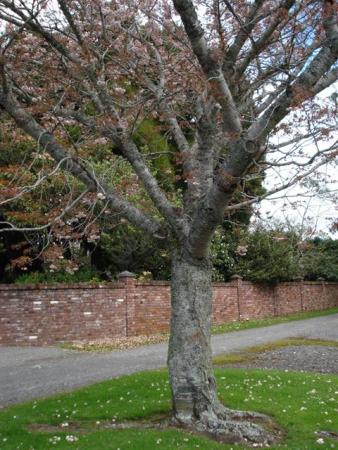
A useful Y shape for a driveway tree

