Magnolia Diary 11, 9 September 2009

Click to see all Magnolia diary entries

Click on the Magnolia diary logo above to see all diary entries

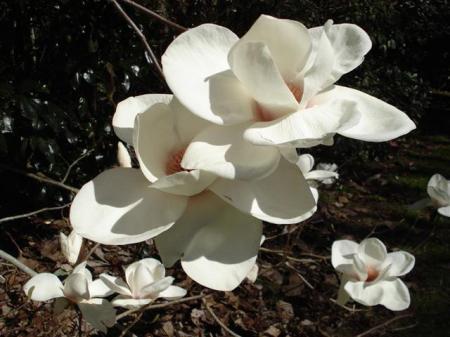
Magnolia Serene, the last of Felix's selections to flower each season

Magnolia Serene, the last of Felix's selections to flower each season

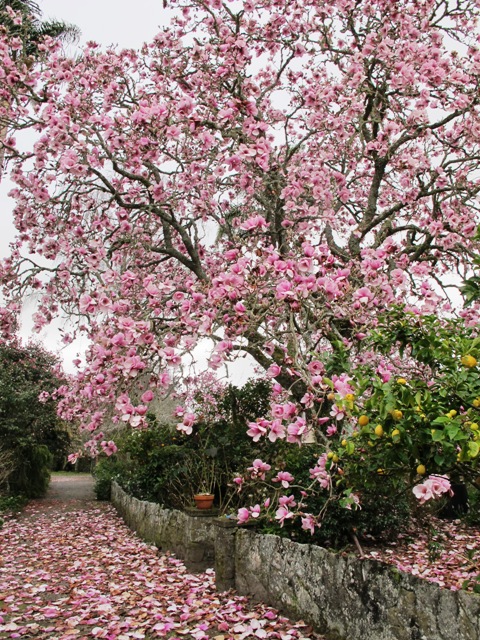
Our magic spring has continued with no wind. A magnolia flowering season with a bad weather factor of only two short lived storms is a good season here. Though I am told that in the south of the province, a series of severe frosts have taken out most of the season’s display. In the deciduous magnolias, Burgundy Star flowers on and is still looking good whereas Felix’s series (Iolanthe et al) are now past their peak. Iolanthe will continue on for weeks yet, but not in her full glory. Serene is still opening. This is one variety that we have been surprised has not had more recognition overseas. Good pink colour, flower form and size, flowers later but still on bare wood and a tidy, well behaved tree. Being liliiflora x Mark Jury, it has reasonable hardiness.

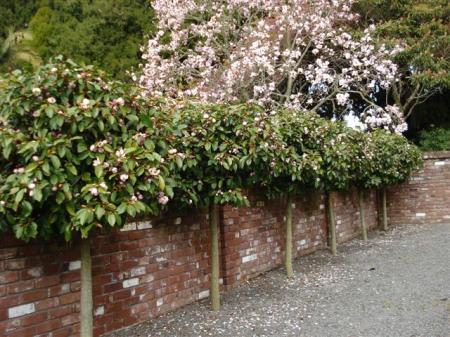
Lollipopped Fairy Magnolia Blush with Magnolia Iolanthe behind

Lollipopped Fairy Magnolia Blush with Magnolia Iolanthe behind

It is full on michelia season. Fairy Magnolia Blush continues in flower and the lollipop row on our frontage is looking good. They were planted in quite harsh conditions (compacted old driveway, in some cases) about five years ago but haven’t minded a bit. I give them a light clip twice a year to retain the shape but otherwise they are left entirely to their own devices.

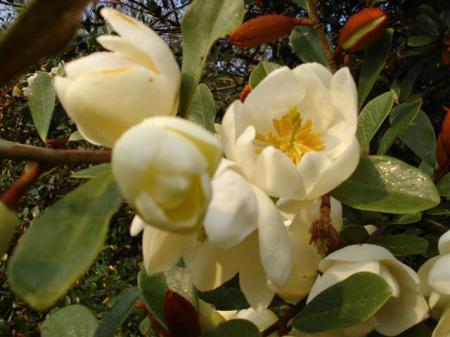
Mark’s Honey Velvet is in full flower. This is a Magnolia dianica (syn: Michelia yunnanensis) selection and every nurseryman, woman and dog has their own selection made now, so easy is it to raise seed. All we can say about Honey Velvet is that it has a honey cream coloured flower (rather than white) of good size, wonderful bud set, longer flowering season than some and good dark foliage. And it does not appear to defoliate in a cold, wet spring as some of the dianicas do. Other than that, we can’t get too excited about what is just a species selection.

Honey Velvet, Mark's dianica selection

Honey Velvet, Mark's dianica selection

We can and do get excited about the michelia breeding programme and the increasing range of deeper flower colour and size we are starting to see as Mark continues down the track of ever more complex downstream crosses. We can see real progress here but that, alas, is all we can say publicly. It was a bit of a red letter day here yesterday as Mark decided that he was happy to give the go ahead on another deciduous magnolia. Mark has only ever named three magnolias in a breeding programme which has built on his father’s work and thus spans close to five decades now with many hundreds of magnolia plants raised. So to make the decision on a fourth one is no light matter. It is still a long haul from here through final trialling and production before it ever gets anywhere near the marketplace but all we will say officially is that this one is not red.

Magnolia diary 10, 7 September 2009

Click to see all Magnolia diary entries

Click on the Magnolia diary logo above to see all diary entries

We are trying to decide whether the magnolia flowering this year has been a little earlier or whether we have been wrong in the past when we talk about peaking in the first week of September. It is an open verdict but certainly our early reds peak in July and August. While we still have plenty in flower, the best has now passed for 2009. Leonard Messel and our white stellata flower on. While they lack any substance in flower form, they certainly make up for it in prolonged flowering and there is charm in their spidery simplicity.

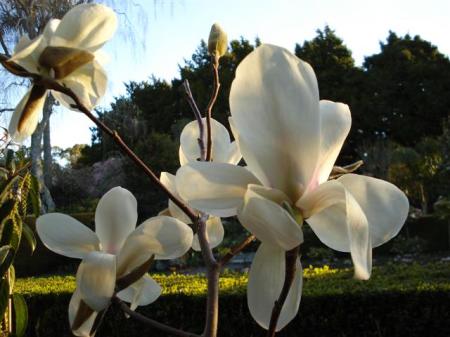
Lotus, the unsung hero in the big white class

Lotus, the unsung hero in the big white class

Even the nursery plants of Lotus have flowered this year

Even the nursery plants of Lotus have flowered this year

Burgundy Star continues to look fantastic in our carpark area. On the tree, it certainly looks the purest red of any of our red varieties so far. But it is the whites we have been looking at in recent days. Manchu Fan flowers on and, for our money, is unsurpassed as the best performing white goblet type for small gardens. Mark went through the Esplanade Gardens in Palmerston North (about three hours drive south from us) last week and Manchu Fan looked equally good there. Manchu Fan is an American hybrid from Todd Gresham. But for larger gardens, it is Lotus that we have been having a second look at in the whites. It looked particularly good in the Esplanade too and it has been superb in our park. We have even had nursery plants setting good flowers this year. Lotus is rather the unsung sister of Felix’s series of lennei alba x Mark Jury hybrids, coming in behind Milky Way and Athene. We didn’t promote it as enthusiastically because while it has a perfect flower form, we thought it took longer to settle in to flowering and considered Milky Way to be a better commercial plant. Now we are thinking that we have underestimated Lotus and it is a quiet achiever that can hold its own in the big white class.

Mark calls it the Fab Ab series in our North Garden

Mark calls it the Fab Ab series in our North Garden

The current overall winner in the big white class are the seedlings in our North Garden that Mark has started referring to as the Fab Ab series. I am not sure that I wish to be immortalised as Fab Ab but we are certainly having another look at these big bold whites which are performing well year in and year out.

More a murky khaki than clean and green

Our geographic isolation works to our advantage environmentally. But our clean and green tag has more to do with a very small population than with a high level of environmental awareness. Many of us have a long way to go before we can claim to be green and clean at a personal level and some have even further to go than others. It would be good if the gardening norm here embraced sustainability and sound environmental practice. I think it is described as gardening with the environment, not in spite of it.

A feature last week on the gardening pages of our regional newspaper highlighted an increasing awareness of environmental issues in public sector gardening. Followers of organics have also embraced sound practice at a personal level. But sitting in the middle is the vast majority of the population, including, alas, a fair proportion of gardeners.

Most of us accept clean and green as a statement of fact for New Zealand. A clean atmosphere, yes. Overall, we enjoy what must be some of the cleanest and freshest air in the world. But once you hit ground level, it is a different story. Yes, some people are extremely clean and green, but others, and they are large in number, could not care less.

Living where we do in the country, I can tell you that all that litter, almost without exception, is thrown out of car windows. It is nothing for us to collect over a supermarket bag full of inorganic rubbish just from our own stretch of road verge. An entirely unscientific study a little farther down the road suggests to me that on average, there would be a visible piece of plastic, glass, tin or similar every three metres on both sides of the road. Added to that is a whole lot of rubbish that has been cut to pieces whenever the verges are mowed. That is a lot of rubbish.

The weekend rubbish accumulation at the corner

The weekend rubbish accumulation at the corner

Down at the crossroads, there is a district council-sanctioned horror that is nothing short of bizarre. Founded on a belief that the vast majority of people will play the game, there is a rubbish collection point. The rules are that rubbish must be in approved bags with appropriate stickers and recycling will be collected free. No rubbish is meant to be left there before Sunday. The reality is that there are far too many people who couldn’t give a toss as long as the rubbish is not outside their house. From Saturday morning onwards, a veritable tsunami of assorted rubbish bags builds up, often ripped and with the contents falling out. Get a wind and it blows around the area. On Monday morning, the rubbish contractors come along and pick up the rubbish that meets regulations. What remains does not seem to be anybody’s responsibility, although from time to time, somebody will do a clean-up. Would I want to own one of the four properties around that corner? No. I can’t think windblown plastic and polystyrene are great for cows, and the recyclable light plastic bottles are also scattered widely. We open our garden to the public and get a fair number of overseas visitors. If they come at the weekend, they get to pass the unedifying sight of a small rubbish tip beside the road that would give anywhere in Asia a run for its money. Frankly, it is disgusting.

Straight after the rubbish collection on Monday morning - the pink stickers say why these bags were not collected.

Straight after the rubbish collection on Monday morning - the pink stickers say why these bags were not collected.

The current row over the use of 1080 also belongs to this environmental discussion. Yes, there are pros and cons on both sides, but what its use indicates is a high tolerance level and official sanctioning of the mass application of poison as the lesser of two evils. 1080 enters the food chain, as we well know, but at least it kills quickly. There are various over-the-counter poisons that are uncontrolled and readily available in this country. Cholecalciferol is one we learned about last year to our grief. Our little dog Wilfred took two weeks to die from slow poisoning and while final results were inconclusive, we are sure in our minds that we were dealing with secondary poisoning. The widespread use of rat poisons is questionable. Selling slow-acting poisons for vermin over the counter with no controls and no monitoring is no longer acceptable in large parts of the developed world. Not only do we use a scary amount of it here, but even many environmentalists will argue in favour of unleashing such toxins into the environment.

Home gardeners have seen a sharp reduction in the availability of many chemicals in recent years and given the often cavalier attitude to handling them in our gung-ho pioneer country, that is a jolly good thing. But our gardeners still have access to many sprays that are now tightly controlled overseas or simply no longer available. It could be that at least one reason for the increasing attention to organics in the developed world is that government regulation has removed most of the alternatives. If you can no longer buy fungicides or insecticides and the only available herbicide is glyphosate, then you have to look to other ways of managing garden pests.

The spray we have been talking about here most recently is copper. Now, in the scheme of things, copper is useful and the occasional seasonal application is unlikely to do any harm to the wider environment. What is disturbing is to see frequent and regular applications of copper every two or three weeks in the mistaken belief that it is safe. While copper is a natural trace element, it accumulates rather too well in soils and can reach toxic levels quite quickly. One useful measure for a home gardener is earthworms. If you are a regular user of copper and you don’t have many worms, that is an indicator of toxic levels. I would advise all gardeners to err on the side of caution and minimise its use. If you want to know more, try doing a search on http://www.sciencedirect.com. There is quite a bit of international research being done on the build up of copper residues in the soil as a result of repeated spraying.

Routine spraying used to be advised as a preventative measure, even for home gardeners. In this day and age, the much more advisable philosophy is to avoid application of chemicals where possible and, if you are going to use sprays, even simple copper, only use when needed, not according to some sort of timetable. In this case prevention is not better than a cure.

We can not continue to rely on this country’s geographic isolation to keep our environment clean. Gardeners espouse nature and beauty and celebrate the growing of plants so it seems a real contradiction when we employ practices which are suspect and dodgy. I am not sure that there is a whole lot of difference to throwing your rubbish out of the car window. I would rather our country was clean and green than murky khaki.

Flowering this week – Magnolia Iolanthe

Iolanthe - unsurpassed this week

Iolanthe – unsurpassed this week

Yes, I admit it we are rather dominated by magnolias at the moment but at this time of the year we live and breathe them and the current all-round-simply-astounding plant has to be the original Magnolia Iolanthe. It is a tree of grand proportions after nearly fifty years and in full flower, it really can take your breath away. We describe it as the original Iolanthe because it really-o truly-o is the first plant, grown from a seed of a controlled cross by Felix Jury. A controlled cross is a deliberately managed hybrid, as opposed to a chance seedling. He heeled a number of the resulting seedlings into his vegetable garden, intending to plant them out to beautify Waitara but Iolanthe popped open a flower. And even that first flower indicated it was pretty special. So special in fact that the plant remained where it was heeled in and these days Mark is moving the vegetable garden rather than attacking the tree. All other Iolanthes around New Zealand and the world have been propagated in the first instance from the tree that graces our driveway.

We still rate Iolanthe as a top variety in the soft lilac-pink and cream colour range. It has a very large flower and because it sets flower buds down the stem, the flowering season is long. If one set of blooms is damaged (the hail storm on Tuesday last week wasn’t great and nor was the follow up last Sunday), within a week a fresh set of buds opens. And there is a second flowering in summer. We did once see Iolanthe plants being sold in a garden centre with labels describing it as a small tree to two metres. I don’t think so, but if you have sufficient space, Iolanthe is unlikely to disappoint..

The inspiration for the name came from the late Iolanthe Small, the dedicated plantswoman who spent the better part of her lifetime working in the Fernery at Pukekura Park.

September 4, 2009 In the Garden

Spring is officially here though for most of us, the advent of spring came last month. While cooler inland areas will continue to get a few frosts, in coastal areas we would be unlucky to get frosted now.

  • A reminder to hard prune rhododendrons (including vireyas) now if you are planning to do so. Don’t delay. Prune, feed, mulch then cross your fingers and hope.
  • If you have had enough of winter pruning, you can lift and divide dahlias now. In colder parts of the world, these get lifted every year and wintered under cover but here we tend to plant them once and leave them. Overcrowding can cause the plants to fall apart in full growth so thinning out the tubers every few years is helpful.
  • If you haven’t lifted and divided evergreen grasses, at least give them a brush up to take out the unsightly build up of dead foliage in the middle. You can use a sturdy leaf rake, small fork or your hands – but if you are using your hands, wear gloves to avoid leaf cuts (the equivalent of paper cuts.)
  • There is an open verdict here as to whether the failure of daffodils to flower is due to growing them in ground which is too fertile (so they put on lots of leaf and no flower – also a sign of too much nitrogen in the ground) or whether it is the effect of the narcissus bulb fly laying its eggs in the crowns of the bulbs last year. If you find hollowed out and rotting bulbs at any stage, or if you dig them when dormant and find large white maggots in the centre, then you have narcissi fly in your garden. They are difficult to beat, though I have seen Mark, like his father before him, stalking them in the rockery.
  • Potatoes, peas and carrots can all be sown directly into the vegetable garden. It is the very last chance for onions, be they red, brown or shallots, if you want a good crop. Last chance also for garlic. Green crops must be dug in now to give them time to start breaking down before the Great Labour Weekend plantout. Experienced veg gardeners are starting with seeds of summer crops such as tomatoes, cucumbers, melons, pumpkins and the like to get a jump start but you do have to sow these in trays and pots and keep them under cover for a while. Inexperienced gardeners will probably buy the baby plants they need from the garden centre late next month.
  • Early aphids are appearing already. Get onto them early with pyrethrum or an organic soap spray to avoid an exponential population growth. Flyspray does at a pinch. It is pyrethrum based though made synthetically these days rather than from the daisy. Dead head hellebores to stop the aphids setting up home in the spent flowers.