Welcome rain!

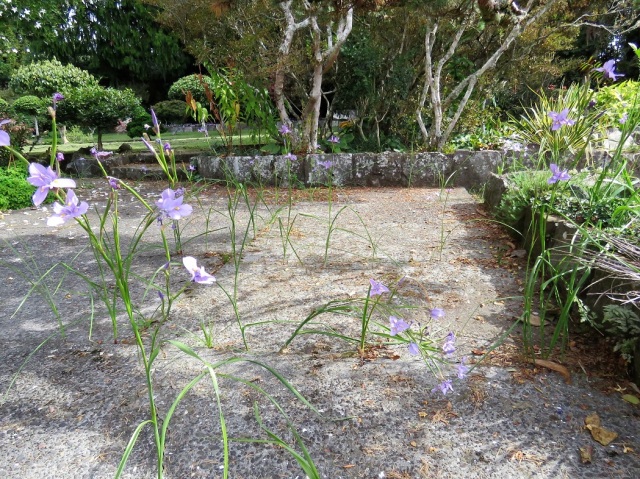
The weight of the water is bringing down all sorts of flowers – in this case Gloriosa superba

It is raining! 40 ml in the latest report from Mark on Saturday afternoon and it looks as though there is plenty more to come. The advent of rain is not usually something we get excited about, on account of it being so regular. We have, as I often say, a climate here with high rainfall and high sunshine hours. We would generally expect somewhere just over 100mm or 10 cm in January. I think we only had one passing rain event this January and it didn’t do anything more than temporarily dampen the dust.

We never have to worry about watering the garden, except Mark’s vegetable garden. We don’t have an irrigation system and about 90% of the garden can’t be reached with a garden hose. It is not usually an issue and it would be ludicrous to garden on the scale we do with an irrigation system. Where necessary, we can cart the occasional bucket of water but that is only for particularly stressed plants. I am sure come Monday, if it is still raining, we will be wanting it to stop but right now, it is a welcome relief.

Who orders plants in mid-summer? Why me, of course but I am saved by the rain.

It is just as well the garden is getting a comprehensive drink because a small order of plants arrived on Thursday and I was wondering how long I would need to wait before it would be safe to plant them. In our day, mailorder plants were the mainstay of our business and we sent off thousands of orders over the years.  I only mention this because I was so impressed by the brilliant packing and condition these sturdy plants were in when I received them (from Seaflowers Nursery, for those who are wondering). I wouldn’t normally order plants for delivery in high summer but I had a discussion with Kate from Seaflowers about whether the first flowering on our Ratibida pinnata was in fact a Ratibida or whether it may be Rudbeckia laciniata so I ordered both to compare. I am now confident it is Ratibida but also pleased to have the other for the garden.

Ratibida pinnata. The flowers have since opened more to show the coned centre that is also seen in echinaceas and some rudbeckias but it was a bit wet for me to get another photo

I had photographed a fine white echinacea a couple of weeks ago when I visited the flower graves at the Te Henui cemetery and thought I could use them. When I saw it – or something very similar –  on the online list, I added 3 of it but I am now thinking that maybe I should have ordered 15. Mark keeps reminding me we are not getting younger and maybe we could be extravagant in taking short cuts to get the effects we want now.

The white echinaceas in the cemetery which saw me ordering Echinacea purpurea ‘Happy Star’ which may or may not be the same but is certainly similar
This shiny cup is Mark’s for the year, even if he never get to hold it

Mark has been awarded a cup! A very shiny cup, although this photo may be the closest he ever gets to it. In these trying times of pandemic, travelling to the UK to receive it in person is right out of the question. It is from the UK’s prestigious Royal Horticultural Society and it is the Jim Gardiner Magnolia Cup, awarded annually to recognise the international contribution of the recipient to the genus Magnolia. I think Mark may just be the fourth recipient so far and the company is very select. While it is a niche speciality, he feels genuinely honoured and it made our week. The citation references his “development of high-quality hybrids, now regarded as garden classics and the introduction of the Fairy series. Gardens across the world are richer thanks to your dedication, discernment and creativity”.  That handsome accolade is one we get to keep as personal, even if the cup remains back in its UK home.

Not at all in the same league, I have my first garden column in the new, glossy Woman’ magazine coming out. It has just gone to print so presumably it is the March issue. I am not a great magazine reader, unless I am waiting for the dentist, but I rushed out to buy a copy of this one to get a feel for it and promptly felt nervous. It has a fine line-up of women writers as contributors, including a younger generation whom I hold in very high regard. We will see how things progress in that quarter.

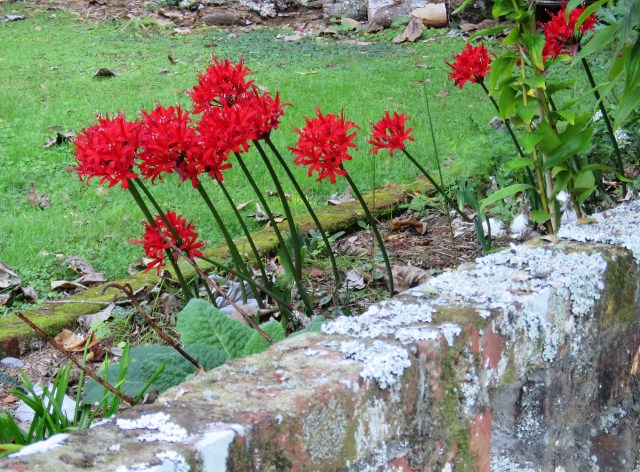
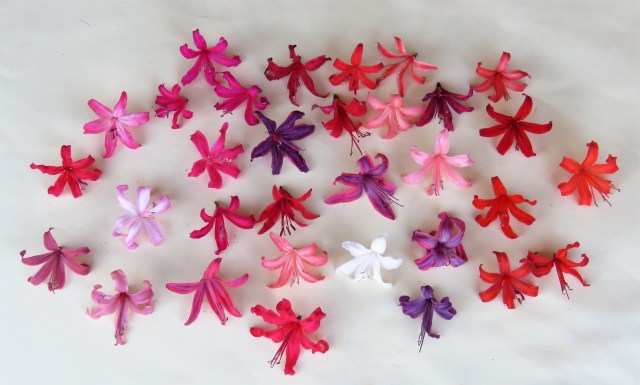
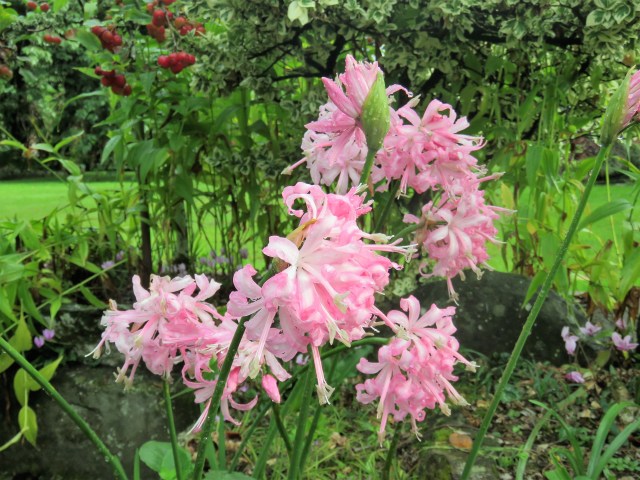
The somewhat unregarded belladonna

Disconcertingly, the first belladonnas are open. It is like the clarion call of autumn when the bulbs start blooming. You will find me over in a corner of the garden crying, “No! No! It is only the start of February! We are not ready to be confronted with the earliest harbingers of autumn quite yet. Wait til the end of March, please.” But the plants care not one whit for our wishes. They will follow their seasonal triggers.

A moderately controversial opinion, in New Zealand at least

The convolvulus is potentially a bigger problem than the agapanthus

We like roadside agapanthus in our area. The sight of blue and white in abundance is a summer pleasure. It has become one of our wildflowers.

Why controversial? I have watched comments on Twitter in recent weeks, railing against the horrors of agapanthus and what a ghastly plant and flower it is. This happens every summer. One tweeter even declared that ‘nobody born after 1972 can bear agapanthus’. At least, I think it was 1972, or thereabouts – presumably the birth year of the tweeter. Reader, I was born somewhat before 1972 and it felt like an ageist attack.

                I grow old

                I grow old

                I shall watch my agapanthus blooms unfold

I get that some people don’t like agapanthus and that it isn’t the world’s greatest plant to inherit en masse in a garden. What I don’t understand is the level of visceral hostility, the intensity of emotion expended on a plant that is moderately benign and consistently blooms in summer. I don’t engage in these Twitter diatribes but I did want to ask what they would prefer to see – mown or sprayed roadsides bereft of flowering weeds? Did they think agapanthus worse than convolvulus, montbretia, woolly nightshade, fennel, chicory, kniphofia, hydrangeas, canna lilies, pampas grass or many other plants that escaped onto our roadsides? Why single out agapanthus?

These plants are likely to stay on the roadside, rather than moving across the fence onto farmland

Given the huge amount of agapanthus we have naturalised in our area, I can say that I have not seen it invading farmland. It is not like pampas, woolly nightshade or montbretia which will colonise new territory the moment your back is turned. Because the seed is so large, it doesn’t spread itself around on wind and does not appear to be spread by birds. Nor does it spread below ground so it doesn’t tick the invasive boxes in our book. It increases from the base rhizomes and by seed but the heavy seed drops near the plant. It can be spread by water so maybe take care and eliminate by waterways and drains if you are worried about spreading it further. We get out and deadhead our roadside agapanthus.

Agapanthus used to be promoted because it is such an easy-going plant, tolerant of full sun and shade and it is useful in retaining loose soils on banks which could slip if left bare. It is not caustic and it is pest-free. It isn’t an exciting plant when not in flower, but I welcome that expanse of blue and white blooms in summer. I guess it is that very adaptability that has made it a pariah, a noxious weed, some declare, that needs to banned, NZ’s worst weed, even, in some eyes.

Showing my age, apparently, I have agapanthus in the garden

I like it enough to have selected a good dark blue form from the roadside which I brought into an area of the summer gardens where tree roots made the ground somewhat inhospitable for choicer perennials. After all, I was born before 1972. I deadhead after flowering before the seed has ripened, putting the spent flower heads in deep shade (not the compost heap) and we root prune the clumps in winter to stop them getting too large. But then, I also like wild fennel enough to have used that in the summer borders, too.

If you do happen to have giant clumps in your garden that you want to get rid of, you need to understand that it is immune to the common herbicides you can buy over the counter. It is most likely you will need to dig it out but don’t make the mistake of trying to dig it all out in a massive clump. First sharpen your spade. A sharp edge makes a huge difference. Then start slicing through the clump from the outside, removing it in manageable pieces. It is not deep rooted and the base of the clump (the rhizome) and the roots are fleshy, so easy to slice.

Don’t put the bits straight on the compost heap because most will grow again. Cut the leaves off – those can be composted. If you are doing it in high summer – like now – turn the remains of the clump – all the white bits – upside down on a dry surface so the roots face the sun and dry out. In cooler months you can stow it under cover so it dries or pile it in a black bin bag and lie that on concrete in the sun so it heats up and composts.  I have taken all of the above steps and it is not that hard.

Mark has just suggested that he thinks you could get away with slicing it off right at ground level (the rhizomes are usually sitting above the ground) and leaving the roots behind. It is not like alstromeria, tradescantia or montbretia where every piece left behind will grow again. We haven’t tried this approach but if you want to, you may be able to achieve agapanthus elimination with a heavy knife or meat cleaver. Just go back and check from time to time that nothing is sprouting afresh.

We rate the montbretia (Crocosmia x crocosmiiflora) as a worse weed than the agapanthus. It is certainly harder to control, let alone eradicate and it spreads like wildfire

There are many worse plants to eliminate than agapanthus but we are happy to stick with the plants we have and just keep them under control.

Alstromerias

Edited: after information received yesterday, I realised I had a senior moment and some of the information in the original post was incorrect.

I don’t have a big collection of alstromerias and the tall ones can be bothersome as garden plants but I do quite like them. When I gathered them up, I seem to have about ten different ones, all ‘acquired’ as I say. This is not a plant family I have felt the need to go out and buy.

Why bothersome? They have a tendency to spread if left to their own devices. Some may call them invasive. They are difficult to eradicate because any parts of the fleshy tubers left behind will grow again. But the big problem is that the tall ones that I favour need staking. The stems are rarely strong enough to hold them up on their own.

I don’t like the murky pink with yellow thrid from the left but the remaining ones are all pretty

Alstromerias are much favoured as a cut flower, but I don’t often cut flowers to bring indoors. Every window in our house looks out onto gardens so it seems a bit unnecessary to bring flowers indoors to die. We don’t feel the need of house plants either. Alstros are sometimes called Peruvian lilies and the family tree does trace back to the lily group but their homeland is not limited to Peru. There are many different species found widely throughout South and Central America. The ever-handy Wikipedia tells me that most of our garden plants are hybrids between winter-growing species from Chile and summer-growing species from Brazil. They certainly have a long flowering season.

Some years ago, the ‘Princess lilies’ group hit the shelves in plant shops here and I sniffily dismissed them as part of the dwarfing down of fine big plants to make something like traffic island bedding plants. I never even bothered to look at them. Then I was given a white form and my dismissive attitude continued but I divided it up and planted it out. For the next two years, they still looked like tidy, traffic island, bedding plants to me. I didn’t like them and I still don’t. *Dot plants*, to coin a phrase from early Alan Titchmarsh.

Intermediate-sized ‘Summer Sky’ at the back, a ‘Princess lily’ at the front

Until yesterday, I thought my intermediate-sized white alstros that were delighting me this summer were that Princess series dot plant putting itself on steroids. In self-defence, plants that are dwarf in different climates can surprise us in our benign conditions and romp away well beyond their predicted size. But it was a senior moment on my part. I had forgotten entirely that a gardening friend gave these to me last year. It turns out there is a whole other alstromeria series that has been released internationally – including NZ – and these are from the Paradise Summer series. This one is, apparently, ‘Summer Sky’.  They are an intermediate size and generally strong enough to hold themselves up.

‘Summer Sky’ from the Paradise Summer range

I looked up both the ‘Princess lily’ and  ‘Paradise Summer’ series and both seem to have come from Dutch breeders. No surprises there. The Dutch do a lot of plant breeding and especially in the area of flowers for floristry or mass plantings.

Probably ‘Indian Summer’ from the Paradise Summer range

Two gardening friends have waxed eloquent about the merits of an orange flowered one with burgundy foliage. I think it is probably ‘Indian Summer’ and likely the same as this one I photographed at RHS Wisley some years ago. I can see it is an excellent performer but I think it is a bit garish, a bit ‘look at me! Look at me!’ for my taste. But maybe I could use it in the sunny borders. It is from the Paradise Summer series too. I may have to take a closer look at the other selections available in this group because there is a whole range of colours now available.

Finally, two bits of advice about alstromerias. Firstly, they benefit from being deadheaded. As long as your plant is well rooted in the ground, the advice from the professionals is to grab the spent flowering stem and tug the whole thing out of the ground rather than cutting it. The same goes for picking them. It is easier than cutting each stem and it leaves a cleaner plant.

Secondly, plant the tall varieties in groups, not drifts. I managed to get around all my clumps in the twin borders this year with stakes (forked pieces of dead yew branches in this case which become invisible, unlike bamboo stakes) and that has largely worked well to keep the flowers up. Where I planted them in drifts in the Iolanthe garden they are chaotic. Zach asked me recently if I had any advice on how to stake them and I didn’t. As soon as it rains, we will dig them and consolidate them into clumps that can be staked.

There is always room for improvement in gardening.

The pink is an alstromeria and when viewed close up, it is a sprawling mess that defeats any staking, let alone invisible staking

Focusing on the detail – Glenys is back

For the past eleven years, the gecko we call Glenys has made regular summer appearances

Glenys is back. When she first appeared in 2011, Mark initially named it Elvis (“In the Ghetto”, gecko, geddit?). A kind enthusiast from the herpetological society advised us that it was almost certainly a pregnant female, hence the name change. He also identified her as Hoplodactylus pacificus and was as excited as we were by our observations of a breeding female here.

Overseas readers may be baffled by our excitement at having resident geckos but they are rarely spotted here, not unlike our two species of rare bats that nobody I know has ever seen. We only have three native reptiles – skinks are common enough, everybody knows about tuataras but the geckos are shy, retiring and not seen widely at all.

I assume we have several resident geckos, or at least three. For Glenys to be pregnant, there must be a Mr Glenys around and a couple of years ago we had two sunning themselves on the dead pine tree. We think the second, smaller one must have been Glenys’s daughter.

Hoplodactylus pacificus but we call her Glenys

This is a summer sight. NZ geckos are most unusual in that they give birth to live young – usually just two and apparently they look like matchsticks on legs. The pregnant females use the warmth of the sun to incubate the young which is why we only see Glenys in summer, out in her discreet sunbathing spot. Geckos have a long life span – anything from 20 to 50 years but I guess it is hard to measure the life span of geckos in the wild. Glenys may be with us for a while yet. If she lives to 50, she will out-live us.

I skipped my usual Sunday post. I didn’t think many would notice (thanks, Jane in Australia). I just couldn’t think of anything to say around the start of a new year. We all hope 2022 will be better than 2021 and 2020 but the signs are not good. In New Zealand, it is like living with the sword of Damocles poised above us. We are on track to achieve the impossible – the elimination of Delta (just 14 cases of community transmission across the whole country yesterday although the number yo-yos up to the 40s some days) but Omicron is hovering in the wings, looking for its chance to unleash itself. We know that but the longer we can stave it off, the better prepared we will be. These are not easy times we are living in, even less so for those in Australia, France, UK, USA and other countries near paralysed by this latest wave. I find thinking small, looking at detail and the natural world keeps me focused and reduces the catastrophising.

All I have to offer is the detail, in this case of Glenys. We have to be sharp-eyed and quiet to spot her; she can disappear back into her hidey-hole beneath the bark in a flash at sudden movements or loud noises.  

That is Glenys, pretending to be a bit of bark on her tree. We tread quietly around this area.

Toasting the end of 2021 with wild hibiscus flowers

Like so many others, we had a quiet new year at home. To be honest, we tend to favour quiet new years at home so I can not claim this is due to keeping ourselves safe in these Covid times. Neither can I be trumpeting the usual happy new year greetings. With Omicron knocking on our border doors, I feel all we can do is hope that 2022 will be better for us all than 2021. To those of you with Omicron already swirling all around you, may you stay safe and well – or at least recover quickly and completely if it catches you. This is a year of modest hopes and expectations.

If you look closely, you will notice the red flowers in our glasses of bubbly. These came in a small jar, labelled ‘Wild Hibiscus Flowers in Syrup’, part of a Christmas package of goodies from our Sydney daughter. These are new to us although, looking on the internet, I am guessing more urban readers who lead sophisticated lives which involve cocktail bars and upmarket restaurants may have met them before. My local supermarket – Waitara New World – does not run to stocking wild hibiscus flowers in syrup, being more utility in character.

Being a gardener, I had to look up these wild hibiscus. Hibiscus sabdariffa, common name roselle, is native to West Africa but now widely distributed across the tropical and subtropical world. It was popular in the West Indies by the 1500s and in Asia by the 1600s. It is the calyx of the flower – in other words, the cup part that holds the petals of the flower – that is gracing our drinks but its early popularity will have nothing to do with drinking bubbly or cocktails. It is one of those enormously versatile plants. The calyxes are eaten both fresh and preserved in sweet and savoury dishes, the stems and leaves used as vegetables and seasoning, both cooked and raw, in Africa the oily seeds are also consumed while in Asia, the plant is harvested commercially for the fibre that is extracted from the stems. But wait there is more. It is a traditional herbal remedy that contains anti-oxidants, used to treat many ailments from cancer to heart problems.

In the wild
Not in our garden, but Mark is now wondering if the seeds are available in NZ

When the petals are still attached to the calyx, the plant looks just like a typical hibiscus with the darker centre containing the stamens, surrounded by a single set of petals, mostly white, flushed pink or pink but there are red forms.

I do not think our eleven calyxes in a jar of syrup are going to cure any of our ailments but they are deliciously fruity to eat after consuming the drink.

On another topic, I usually photograph the towering Trichocereus pachanoi against a blue sky. But as the evening draws in, the flowers open fully and the scent hangs heavy in the air even several metres from the plant. Night-scented flowers are usually an indicator that the plant is pollinated by moths.

Trichocereus pachanoi towering in the evening light

Go well. Stay safe.