Three books (one of which has absolutely nothing to do with gardening)

Almost to the day, it is two years since we first went into lockdown in this country, when we realised – well, most of us realised – that Covid was real and like nothing we had dealt with before. Life changed for most of us. Lynda Hallinan’s book ‘The Joy of Gardening’, came out late last year but appears to have its genesis in the earlier lockdown days. It is a book firmly anchored in our Covid present.

I have written before of myself that ‘I garden so I have a lot of thinking time’. The same is true of Lynda. Most of us know her as an irrepressible, bright, bubbly person who is genuinely keen on gardening and plants. This book is more intimate, more reflective at this time when our focus is closer in, more defined by our immediate environment as we try to make sense of a world that has changed.

There is a soft focus to this book, quite a bit of nostalgia and thoughts about what gardens and plants mean at a personal level, leavened by the author’s irreverent humour. There are lots of of romantic, soft-focus photos by Sally Tagg but we know these are just mood-setters because all the photo captions are banished to the last two pages of the book and then just recorded as plant names. That is a case of a book designer thinking that the look is more important than reader convenience. That aside, it is a beautiful hardback and I do love me a book with a built-in book marking ribbon.

Lynda is a journalist and it shows. She has an immensely readable style and the words flow with confidence. While divided into ten sections (Making Memories and Love & Loss are two), each section has a number of separate pieces loosely related to the theme. It means you can pick up the book and read a page or two and it stands on its own. I have been known to refer to this as loo reading but you may prefer to think of it as coffee-break reading. It can detract from a sustained reading session because those short bits are so short and snappy but there is a surprising amount of good information included. I think it is a charming book, best savoured in smaller bites and particularly relevant at this time.

I know very little about Ethiopia which only seems to reach our news when there is famine or civil war. It did of course give us Haile Selassie with the odd spin off of the Rastafarians but well before that, it was an ancient civilisation where humans were first recorded in modern form and an early Christian nation. It is also one of the fastest expanding economies in the world today, with a predominantly rural population. This has led to major deforestation which is the subject of a book by Kieran Dodds titled ‘The Church Forests of Ethiopia’.

It is predominantly a book of photographs of the local people and the environment in Amhara Province with a lot of aerial shots showing the agricultural deserts where the only remaining native forests are patches of green surrounding churches. The Tewahedo Orthodox Christian churches are a distinctive round shape like domes or saucers and the reason why the small patches of remnant forest around them survive is because they are sacred. Think miniature gardens of Eden in a desert. It is a unique landscape.

The book is a fundraiser to support the organisations and groups involved with replanting to extend the existing forests and particularly creating links between the forested areas which enables native animal and insect life to move from one area to another. You will be supporting critical environmental work if you buy this book but also, you may enjoy having this rather gentle pilgrimage through the church forests of Ethiopia in your bookcase. The one thing it lacks is any information on what the dominant native plant species are but I guess if you want to know more, you could Google ‘woody flora of dry Afromontane areas in Ethiopia’.

Ukraine bus shelters and yes, we may well wonder if they are still standing

Nothing whatever to do with gardening, but a book I felt belonged in my bookcase in a totally random manner is ‘Soviet Bus Stops’ by Christopher Herwig. It is what it says – a collection of photographs of bus shelters throughout the former Soviet Union. These shelters date back to a time when private cars were a luxury, when the dreary conformity of the Brezhnev years spanned the era from the 1960s through to the start of the 1980s. This is apparently known as the time of stagnation and these bus shelters are a memorial to the triumph of individual creativity and flamboyance in a repressive regime.

Architects, artists and designers could unleash themselves – within a budget – and unleash themselves they did with marked regional differences and varying materials. I feel I owe it to Ukraine to show their shelters which are charming but not of the same level of flamboyance and scale as some other areas – favouring form over function as one of the brief introductory essays says. There aren’t just a few of these bus shelters, there are many although I am not sure yet whether I feel the need to buy the second volume of this odd phenomenon.

It is a quirky little book but also a record of the triumph of human spirit, even more so in the context of what is happening in that part of the world right now.

What on earth were they thinking at the time in Kyrgyzstan?
and indeed in Kazakhstan

In partnership with Nature

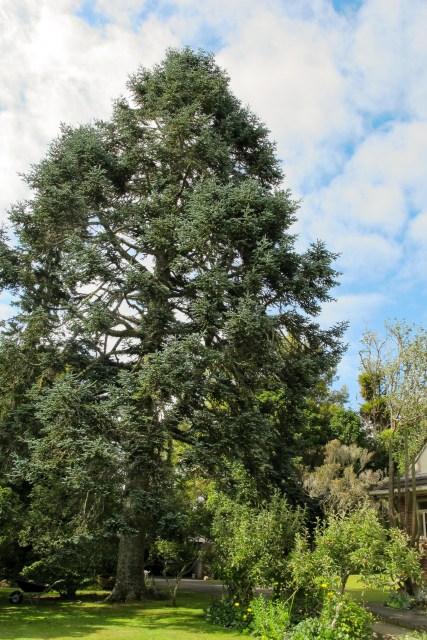
Mark counted more than sixty rings in the cut trunk so the abies must have been planted around 1960

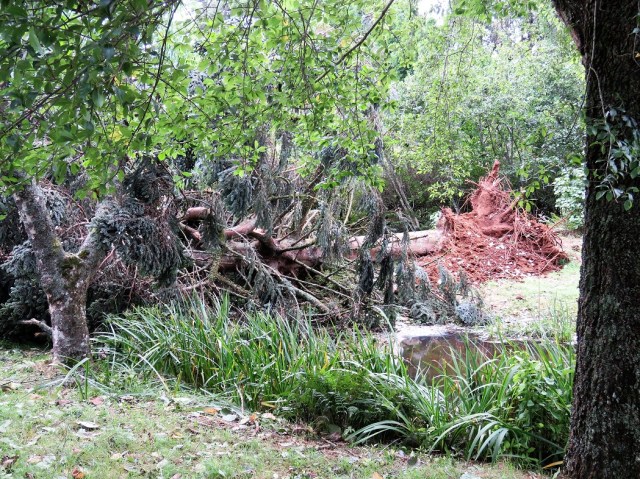
The clean-up from Cyclone Dovi is continuing here at a cracking pace. Zach started on the large, fallen abies in the park and has almost finished it. We were relieved to find that damage to the bridge beneath is minimal. A few more centimetres to one side and it could have wiped out most of the bridge. This would have been a problem for us, had it twisted the metal chassis beneath the bridge timbers.

Wisteria Blue Sapphire on the bridge has been hammered but will recover, the azalea has been extensively damaged but should also recover and Magnolia Lotus on the right lost some branches as the abies fell but the bridge just had railings broken.

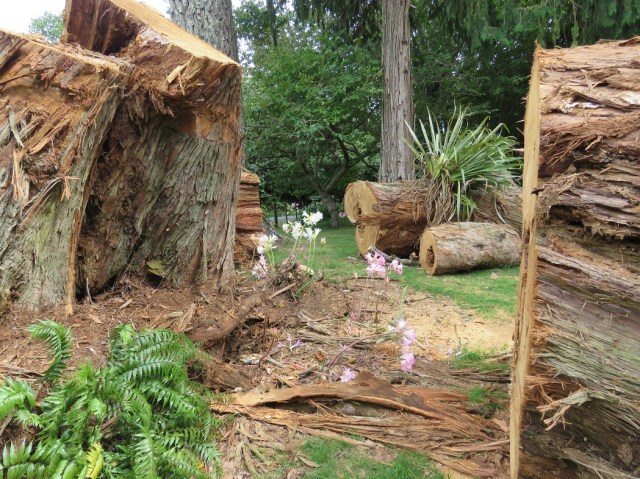
Because it is right at the bottom of the park, dealing with the debris is an issue. Mark was not interested in the timber for firewood. We burned the Abies procera we dropped a few years ago but it proved to be a very light timber and we have better options. Access issues mean it isn’t practical to offer the wood to people who are less picky about their firewood and we don’t want to haul the whole lot out with our baby tractor, so creativity is required.

We debated about hiring an industrial-grade mulcher to deal with all the branches and foliage but decided in the end to burn it nearby. It leaves a dead patch in the grass but that can be resown and will disappear in a year or so. It is less work than having to disperse a mountain of wood chip in an area where we don’t need mulch.

But what to do with the lengths of trunk that can’t be left where the tree fell across the stream?

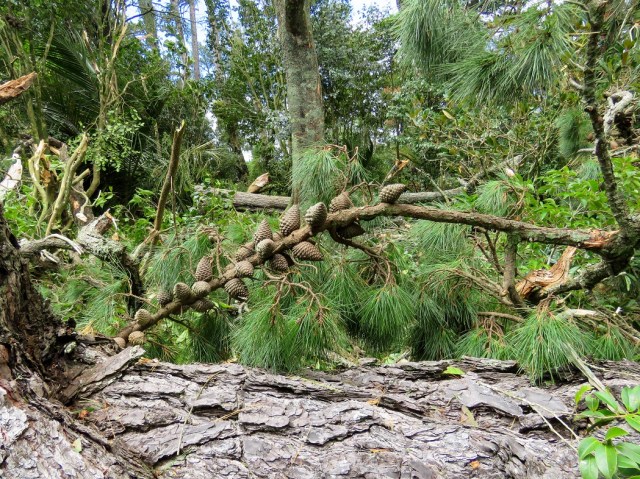
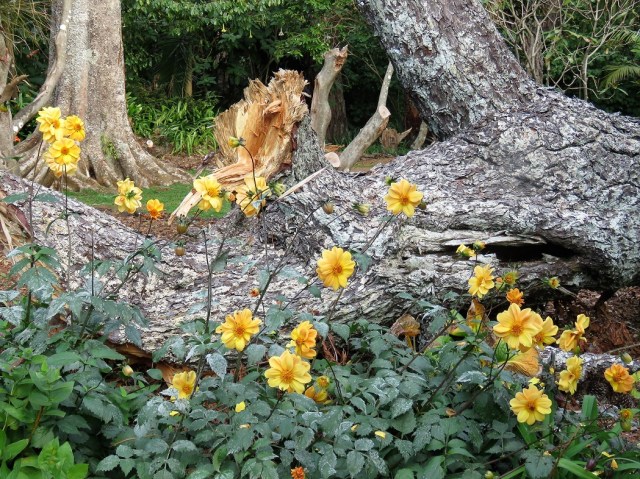
I like the shape of this fallen pine tree that perched itself up on its side branches like some freeform crocodile or giant lizard. It is decaying so it will drop at some point but that is fine.

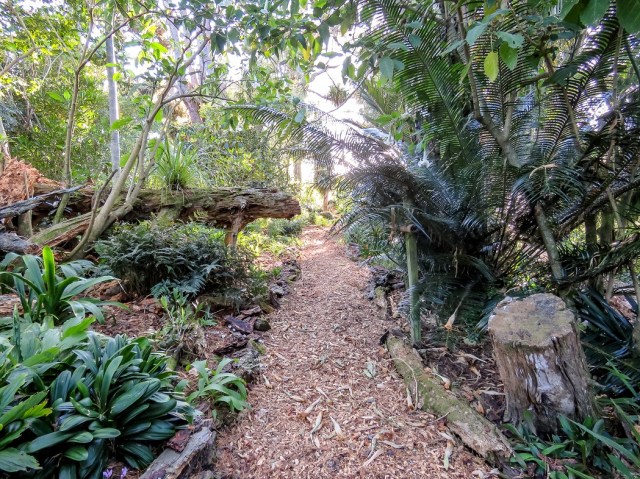
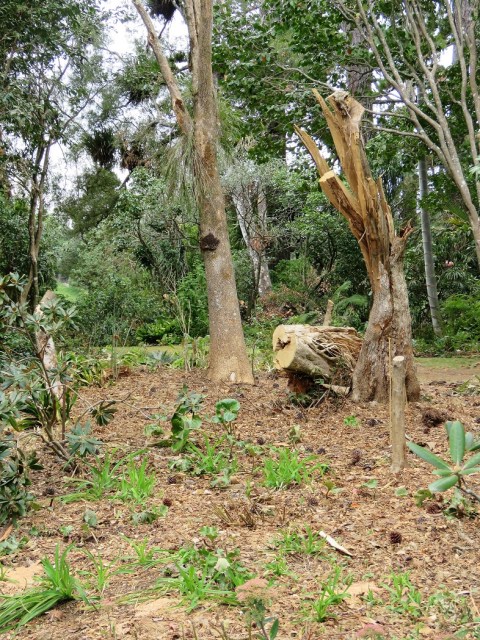
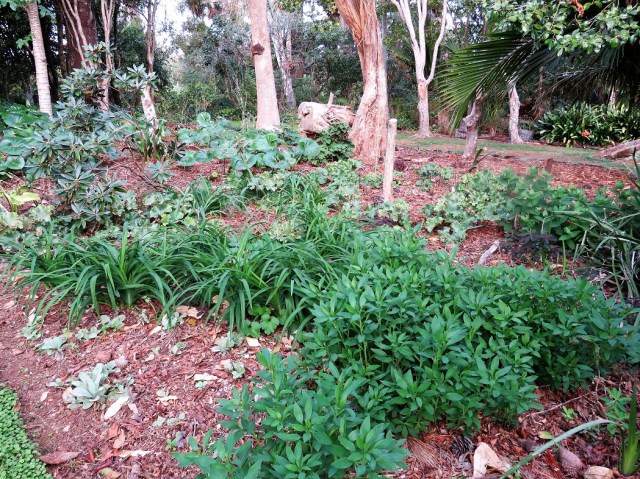
We re-use a lot of fallen material here. Suitable thinner lengths of branches are sometimes used to edge garden beds and borders where appropriate. Where we can, we clean up fallen trees, reducing them just to the main trunk and then garden around them. Over time, they rot down and start to disintegrate but that is part of the long-term cycle.

This was a substantial length of pine tree that fell and then rolled into a most convenient position on the edge of a path.

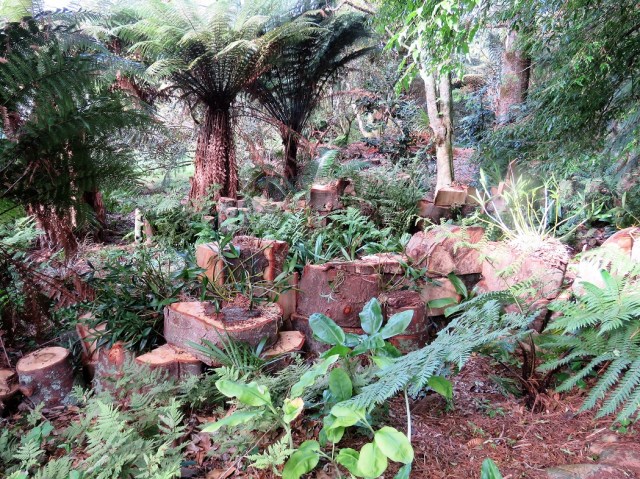
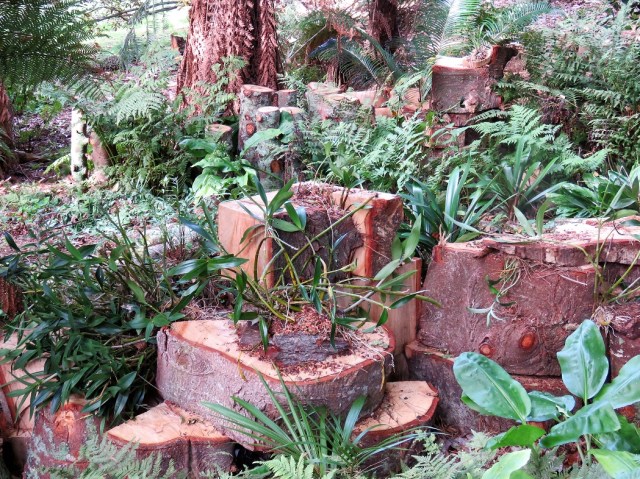
Where this is not an option, we will cut the trunks to manageable lengths, take out what we want for firewood and place the rest. Other gardens may have sculptures and installations that are clearly made by human hands; we have casual installations of wood, sometimes as stumperies and sometimes just as low-key placements.

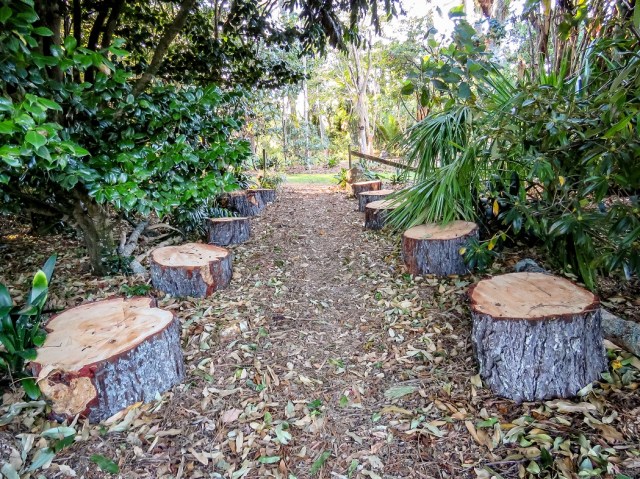
Defining the path with pine tree sections

We have already placed the pine lengths from the Avenue Gardens that were surplus to firewood replacements. At least some of the abies is destined for another use – giving height and structure to a rather casual area of planting. This is an area that has no name yet, where the Avenue Gardens transition down the hill to the park – I wrote about it once on blurring the transition from well-tended gardens to more laissez-faire outer reaches. We may have to come up with some shorthand name rather than referring to it as ‘the bit beside the steps coming down from the Avenue Gardens to the Mangletia insignis”.

Stacking lengths of abies to use in a different area

This is Mark’s vision. Neither Zach nor I can grasp yet what he has in mind, although Zach has carted abies lengths to this area in preparation. Zach and I are pretty good on placing individual bits as punctuation marks in the garden but not on creating entire structures. We will both watch and learn as it happens. I have every confidence in Mark’s skills in this endeavour

Felix used ponga logs and stumps to create his section of what we now call the Rimu Avenue

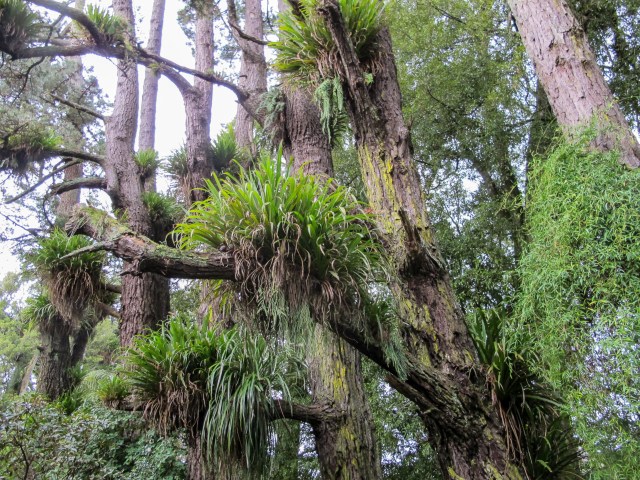
Our feature Rimu Avenue is essentially a stumpery, created as a pragmatic solution to enable plants to grow in dry shade where the enormous trees above are sucking all the goodness and moisture from the ground beneath. They are a naturalistic, raised bed solution. The oldest section was created in the 1950s by Mark’s dad, Felix and he used ponga logs and stumps (NZ tree ferns, for overseas readers). These are remarkably durable – still serving their purpose after 70 years.

Mark used whatever timber he had to hand when he doubled the length of the Rimu Avenue to give both structure and raised beds

When Mark doubled the length of the Rimu Avenue 20 years ago, he was disinclined to go out to the bush to harvest ponga so he used what we had to hand – a bit of ponga but mostly lengths of trees that have fallen here.

A simple feature. It will only last a few years because it is just a section of banglow palm trunk but it will decay gracefully

Somewhat unintentionally, our labour saving strategies are creating a theme throughout the entire garden – the re-use of fallen timber to create focal points, casual structure and different environments for plants as well as stowing lengths of fallen or felled trees in a way we find aesthetically and environmentally pleasing. It has been happening here for years. Cyclone Dovi has just accelerated it.

It all decays over time but don’t we all?

I see the date on this photo is 2004, probably very soon after Mark asked Lloyd to bury the upturned plum tree stumps to make a natural feature
In 2022 – today in fact – those stumps are getting ever smaller and less of a feature but that is part of Nature doing what Nature does.

A small kingfisher, autumn bulbs and cyclone recovery

Does anybody else feel they are living life day by day, waiting to see what else life will throw at us? Oh, most of you? I thought so. As I heard somebody on the radio saying yesterday, the pandemic has hit pretty much every corner of the world and it ain’t over yet. Add in the invasion of Ukraine, the very real threat of a nuclear war in Europe, the appalling flooding in northern New South Wales and it makes our experience with Cyclone Dovi seem minor.

Little Beaky the kingfisher or kōtare

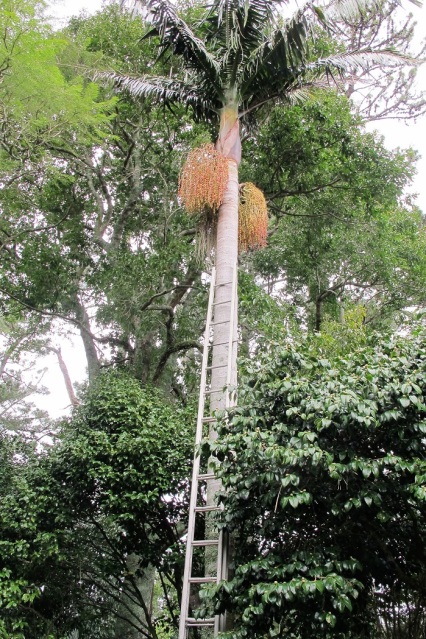
I have to focus on the little things in my immediate physical world to keep me sane. Meet our little kingfisher or kōtare. Zach found it on the ground on Tuesday and it had clearly fallen out of its nest-hole high, high above in the Phoenix palm. Zach named it Queenie but told me the next morning it had changed to Beaky. I can only assume that these are pop culture references which I am too old to understand.

For such a small creature, Beaky had a very loud voice and on Wednesday, it spent a lot of time calling to its whanau (family) above. At times the mother would reply so she knew where it was and we hoped she was feeding it.

Beaky’s family nest was a hole high in the Phoenix palm

Thursday – no sign. No bird. No noise. I hoped Beaky had not been taken by a feral cat or stoat. Zach bravely declared that he was sure the tail feathers must have grown sufficiently for Beaky to fly but I had my doubts. Zach was right.

On Friday, the sound of loud kingfisher squawks drew me back to the area where I saw a little kingfisher perched in an adjacent tree. As I watched, it flew over to the Phoenix palm and then back before flying a little more confidently further afield. Was it Beaky? It is a bit hard to tell when it is up in a tree but it was a baby kōtare, clearly new to flying and managing to make a great deal of noise so I think it was likely to be Beaky who may just be the noisiest, small kōtare of all time. I hope it was.

The gum tree or eucalyptus at our gateway with the rootball and base standing upright again. The belladonnas are not bothered by all that has gone on around them

On the cyclone clean-up front, we have made good progress. In a difficult operation, the arborist dropped what remained standing of the giant gum tree at our gate, removing also the broken branches – called swingers – caught up in an adjacent tree and in danger of falling onto passing cars. This involved getting in a large truck with a hiab to lift down sections safely but also meant that they could stand the base of the main trunk upright again which is way more pleasing visually. I got out the tape measure – it is about 2 metres across near the base so that is a pretty huge chunk of timber to fall.

In the Avenue Gardens

The main damage in the Avenue Gardens has been cleared. It remains to be seen how much of the herbaceous underplanting returns in spring. The whole area was densely planted and lush until three weeks ago. I am hoping Mark is thinking his way into deciding what we can replant for the middle layer of shrubs and small trees that were taken out. That is his area of expertise.

The next path over from the areas of damage and all looks well with the new surface

Because so much of the material was mulched on site, we have used some of that fresh woodchip to cushion the paths, which gives a nice, soft surface to walk on. We still have a small mountain of mulch left but it was important to get the big piles off the garden before they heated up more and cooked the herbaceous material beneath.  

Moraea polystachya in the rockery

More autumn bulbs are opening every day. While I love the bulbs in the rockery – all the Cyclamen hederafolium, Rhodophiala bifida, Haemanthus coccineus, Leucojum autumnale, Moraea polystachya, sternbergia, Colchicum autumnale and the first of the nerines amongst others – there is something particularly engaging about the brave cyclamen and colchicums flowering in wilder conditions in the long grass in the park.

There is a resilience and an element of surprise with bulbs that will naturalise in more challenging conditions.

Hit by Cyclone Dovi

One of the wide grass paths in the Avenue Gardens

We weren’t worried when the warnings came through that Cyclone Dovi might hit land in New Zealand. We are in the middle of vast ocean and mostly these storm events end up passing by. Besides, we are well sheltered here and it can be howling a gale elsewhere and we are relatively calm.

We were wrong last Sunday.

This was the base of the giant gum tree at our roadside before

Cyclone Dovi hit us with the worst winds we have ever experienced. The peak lasted for hours and was frankly terrifying and sounded as though we were surrounded by roaring trucks. Believe me, we were grateful that two years ago we dropped the one tree that would threaten our house if it fell. Our house came through Dovi unscathed.

and after with half of it split off and the other half lifting the ground around and needing to be felled

The first big tree I was aware of falling was the massive gum tree (eucalyptus) at our gate. It was around 170 years old, planted by Thomas Jury in the 1870s. We were lucky it fell inwards and not across the road. There is still a dead half of it left, leaning against the next tree and it will have to be felled with some urgency. The specialist arborist is currently thinking his way into how best to do that safely.

The sheer size of many of these trunks is daunting

We didn’t dare walk around the property but I was standing on the doorstep when one of our largest pines broke off in two pieces causing massive damage as it came down in the Avenue Gardens. Because it came down in two pieces, it effectively did the same amount of damage as two trees falling. The jacaranda which had a splendid flowering this summer is now a broken stump and pretty much all the mid layer of trees and shrubs in the area have been taken out.

That was the pine that did the most damage. There are another two massive pine trees uprooted, also in the Avenue Gardens. Even though much larger with all the trunk and roots – up to 45 metres of tree each – their damage is more localised and they have fallen in places where we can leave the bulk of the trunks.  Mark just about wept the next day when he found the handsome abies in the park had also fallen.  

This abies, outlined in red
The high bridge in the park is beneath the abies

That was just the big trees. There are branches and smaller trees down but they seem minor in comparison.

There are three roads that give access to our place. As the initial fury abated, I drove around to make sure none of our boundary trees had fallen to block the road. I had walked out earlier to the road and found passers-by efficiently dealing to one of our branches without even coming in to tell us. How handy to live rurally where people just happen to have chainsaws. It was the last road open and to drive it meant driving under power lines further down the road which had a tree resting on them.

The road to the left at the bottom of our place – not our tree or power lines, thank goodness.
And the road to the right down the bottom of the hill. Again, not our trees or power lines but this repair was a major that took several days
The only road left open with a minor tree suspended on the power lines. This was the one that took our power out for 36 hours.
Practical passers-by dealing to an immediate problem. This was the only major branch of ours that fell onto the road.

Mark and I were completely numbed for the first two days by the sheer enormity of the damage. It wasn’t helped by having no electricity and when the power goes out, we lose running water. Like most rural people these days, we depend on electric pumps to get water to the taps. 36 hours without water and electricity is difficult but everything looked more manageable when they were restored.  

Starting the clean up in the Avenue Gardens. That was a complex woodland, herbaceous planting beneath. Note the use of ‘was’.

Our arborist and his apprentice gave us priority and were here by 8am on Monday. Lloyd and Zach have thrown themselves into the task of cleaning up and we are making progress. There is a long way to go but at least we are not in as bad a situation as we were last Sunday.

The Avenue Gardens on Sunday
Same view by Wednesday, we had it to this stage but that is only the paths cleared, not the gardens

Three things I have learned this week: firstly that it is harder to have no running water than no electricity.  Never have I been so grateful that we are a five loo establishment…

Secondly, when people are in in immediate shock at what has happened, well-intentioned comments from Pollyannas are not helpful. Comments like, ‘look at this as a new opportunity’ or ‘at least nobody died and your house is not damaged so it could have been worse’ carry a high irritation factor. We do not need to be told that. The time comes soon enough to look forward but it takes time to process what has happened first.

Thirdly, in a crisis and its aftermath, people are very kind. I can get Pollyannaish over that. More than once, the kindness of others, including strangers, has brought tears to my eyes.

I took this photo of the beautiful elaeocarpus tree with its buttressed roots last week
That skeleton in the centre of the photo is what remains of it this week

It has been a tough week but the final word probably rests with the neighbour who had walked over and was talking to me at the back doorstep when the largest pine snapped and fell before our eyes. “This is a taste of what is to come in the next 20 to 25 years,” she said. Climate change. I fear she is right.

Wednesday, three days on, and progress is being made

Postscript: Technically, Cyclone Dovi is usually described in NZ as either ‘ex-tropical cyclone Dovi’ or ‘the remnants of Cyclone Dovi’ which means it is way more intense when cyclones hits full force on Pacific islands. I have to keep reminding myself of this. I looked up the difference between a cyclone, a hurricane and a tornado and it is geographic. South of the equator we call them cyclones, north of there they are called hurricanes except north west where they are often called typhoons. So now you know.

Post postscript: I saw screen shots of extreme right conspiracist chat pages who worked out that Cyclone Dovi = C Dovi and – OMG – C Dovi is an anagram for Covid. To them, this is proof of a conspiracy by our government to create a cyclone event to try and dislodge the ‘convoy occupiers’ blocking roads in Central Wellington and taking over Parliament grounds.  So now you know that too.                                                                                                                                                                                                                           

I offered free firewood and pinecones on a local Facebook page and the firewood disappeared very quickly. Mark and I are amused at just how many older men there are in our local area who still have chainsaws and time on their hands.

In a world gone mad, there are flowers

The cheerful yellows and oranges from the summer borders

I was going to finally get around to tabling three books that recently came in to my life, but I found I was too distracted. It is a weird feeling to be part of history unfolding minute by minute in this strange new world in which we are living.

In a country that is 95% eligible fully vaxxed – 96% eligible first dose only – and tens of thousands choosing of their own free will to get a third dose every day, the motley crew currently occupying what used to be the lawn in front of our Parliament and dominating our airwaves and social media just seems … bizarre. To have swastikas, nooses, talk of Nuremberg 2, guillotine imagery, even, on display with declared intentions to kill politicians, media, health practitioners, civil servants and – extraordinarily – architects and engineers all sentenced to execution in their absence – it is all too bizarre for me to process in my brain.  What have the architects and engineers ever done to that mob? And how many of us actually believe that our Prime Minister eats the foetuses of babies? Alas some do, though nobody in my personal circle, I am pleased to say.

Really? I mean really?

Try getting over 90% of New Zealanders across the political spectrum to agree on anything and yet that number of us chose to get vaccinated and to wear masks and physically distance to keep others safe even before widespread mandates  and vaccine passports were introduced. Far from being a divided nation, I have never seen us so united; the loud messages from the disaffected few just don’t compute for me.

I am, however, greatly amused at the Speaker of the House of Representatives, first ordering the sprinklers on Parliament’s lawn to be turned on overnight to drench the protesters who are defying the trespass orders served on them. Then last night, he ordered speakers to be set up blasting the music of Barry Manilow (sorry, Barry!), the Macarena and Covid 19 vaccination messages on a 15 minute loop to annoy protesters. I am surprised he didn’t include Rick Astley on that irritation tape but I love living in country with a sense of humour.

The blues and whites currently in flower in the Wave Garden

In the face of all this and a wet day, I made a couple of flower flat lays. Ephemeral these may be, I find the gathering of flowers and laying them out in pretty sequence is very soothing to my troubled mind. Maybe it is a shame I don’t do Instagram?

Aster novi-belgii ‘Professor Anton Von Kippenberg’ looking how it should

Gathering all the blues and whites from the Wave Garden, I could not help but notice – again – the sorry state of the dwarf blue aster which goes by the fearsome name of Aster novi-belgii ‘Professor Anton Von Kippenberg’. It should be a uniform sea of blooms covering the foliage and dancing with bees and butterflies. Alas, it is falling apart in the middle. It should have been dug and divided immediately after flowering last year when it was starting to show the first signs of splitting. It will be done this year and put on a two yearly cycle. We will dig the lot and replant about one third of them at the most.

But pull the camera out further and I am ashamed to admit this is how it is looking this year

The thing about learning to garden with perennials is working out by plant variety which ones need individual attention, be it staking, dead heading or dividing on a regular basis. Some do not improve with age at all.

You will find me hiding in the garden. It is balm for the soul in these times.