The appropriately named buxus blight

Buxus blight, fortunately not in our garden

Buxus blight, fortunately not in our garden

One of the frequently searched articles on our website is a piece I wrote a while ago on buxus blight (aka: why is my box hedging turning brown and looking as if it is dead and what can I do to resurrect it?) Given that we are a bit sniffy about box hedging here, it seems ironic that we are apparently seen as a source of information on the matter. Mind you, in deference to the level of interest and concern from others about both the short term look and the long term viability of their box hedging, I have been taking a slightly more than desultory interest in the whole matter.

You too can google it if you have some level of computer literacy and it is likely that you will come to the same conclusions from the international research and the anecdotes that I have. There are certain incontrovertible facts: it is a fungus called cylindrocladium and its rate of multiplication does not appear to be temperature related – in other words, it will multiply quickly in cold temperatures too. Most fungi thrive in warm, moist conditions but nasty buxus blight appears to be quite well adapted to cool and even dry conditions. The fungi spores are long-lived and can survive for years on dead leaves.

There are around 30 different species of buxus originating from Europe, Asia, the Americas and even North Africa. I have been told by individuals that the Asian forms from Japan and Korea (Buxus microphylla and microphylla var. koreana or Buxus sinica) don’t get it but the scientific evidence does not back this up. It is likely that the personal anecdote is based on the fact that in one particular location, this type of buxus is not showing signs of infection. That does not mean it won’t be affected in another location and the research says none are immune. The bottom line is that I wouldn’t be ripping out affected sempervirens (and suffruticosa, the very low and slow form used as an edger is still a sempervirens variation and is particularly susceptible) and replacing it with a different species of buxus, be it from Japan, Korea or anywhere else. I would be wanting to use a totally different plant family altogether.

You will know if you have buxus blight. Small dead patches are more likely to be dog urine or an accidental whiff of glyphosate. Buxus blight is simply devastating. The dead patches spread rapidly and do not show any willingness to regrow.

The first bit of bad news is that if you have buxus blight already, you will have to spray endlessly, for the rest of the buxus life, to keep the blight at bay because you won’t ever eliminate all the fungal spores. You can manage some level of control but the days when all your handy little hedge needed was clipping twice a year are over.

The second bit of bad news is that if you live in an urban area and do not yet have buxus blight, it is probably only a matter of time before you will get it because the fungal spores are easily dispersed by wind, so will gently spread throughout built up areas where there are host plants at regular intervals. You can reduce your chances of getting it but you are doing a King Canute number.

The good news is that if you live in the country and none of your neighbours have buxus blight, you may be able to keep it out because the spore don’t seem to be travelling quite as far as, say, camellia petal blight spore which have been tracked up to 5km. But quarantine your garden. Don’t bring in buxus plants or cuttings from other places unless you are 100% sure that the source is isolated and free of blight. Propagate your own additional plants at home. The international advice is that you should routinely quarantine all buxus plants brought in from other sites until you are sure they are free from blight. The problem is that quarantining plants at home is difficult. They need to be confined to a shed, glasshouse or nova house for an extended period of time and few people have the facilities to quarantine effectively which means that if by any chance the plants or cuttings you have brought in are harbouring the fungi, even if you try and keep them separate the spore will spread. Easier by far to seal your garden borders and not admit any foreign buxus. They are dead easy to propagate at home for even the most amateur gardener.

If you have masses of box hedging or topiary in your garden that you want to try and keep, you probably have to accept that it is going to take more work. Don’t let the hedge get too dense – there appears to be a connection between the ability of the plant to shed water quickly and slowing the fungal spread. Avoid overhead irrigation. Keep thinning the plants so they are not too dense and get as much of the build up of dry leaves and sticks out of the centre as possible to allow more air movement. There is some evidence that copper sprays will at least slow down the fungal spores and copper may be kinder to the environment than most anti-fungal sprays. It may be worth trying sulphur sprays too because sulphur has anti fungal properties. An all round rose spray may be effective if you are willing to treat your buxus hedge like your hybrid tea roses.

The big problem is what you can use instead of the infinitely useful buxus. There are three stand out characteristics of buxus. Number one is that you can keep it looking tidy on two clips a year and it does not grow too fast. Number two is that if you hard prune back to bare wood, it will resprout so you don’t end up with woody legs. Number three is that it roots so easily it is a doddle for the home gardener to produce and correspondingly cheap(ish) to buy. And we could add numbers four and five– that it is long lived and a good dark green. We are of the general opinion that hedges should be green. The problem is finding a substitute which meets all the above characteristics. Lonicera and teucrium are cheap and clip well but grow so rampantly that you have to clip frequently to keep them looking sharp. Small leafed camellias and totara clip really well and resprout from bare wood but are not easy to propagate so are much dearer to buy . Some of the small leafed hebes may clip well (but some don’t so you have to get your variety right) and root easily but are not always long lived. Pittosporums grow too well and get too tall too fast and tend to be a pale green in colour, not the desired dark shading. And they have larger leaves. Corokia can get a bit bare over time. Griselinia tend to have large leaves. Taxus (yew trees) are notoriously short lived in our climate because the roots get phytopthera. The biggest gap of all is the lack of a clear replacement for the dwarf suffriticosa which is used where a low edger is desired.

There is no like for like swap for box hedging. In the end, if box hedging features large in your garden and you have to cut your losses on it because of buxus blight, you may be wiser to go back to the drawing board and look at garden plans which don’t depend on clipped and well behaved little hedges for structure. We are mulling around the role filled by buxus hedging and will return with more thoughts on this in the future.

August 21, 2009 In the Garden

  • What a difference some glorious early spring weather makes. The worst of winter is indubitably over and we can celebrate rising temperatures and longer days, safe in the knowledge that our winters are very short by international standards. But do not be lulled into thinking summer is just around the corner. We can and will get relapses to cold and dreary weather.
  • But it is countdown now and the pressure is mounting in the ornamental garden and as far as the winter pruning goes. If you have been planning on moving any established trees or shrubs, stop procrastinating and get on to it as soon as possible. It can be very stressful for the plant and you want to give them time to settle in to their new location. Move as large a root ball as possible and prune back the top structure to reduce stress levels.
  • You have not run out of time yet for safe planting out of trees and shrubs generally, but the sooner you can get it done the better. If you garden on sandy or light soils near the coast, you will dry out quickly as spring advances.
  • Kiwifruit should have been pruned by now. Select out last summer’s long canes to be the fruiting wood for the coming season. Cut out all the weak and old growths and confine the plant to a limited number of strong fresh canes. It is usual to tie these down to a wire or similar support. The same pruning principles apply to raspberries, which should also have been pruned but your top priority should be grapevines if you have not yet done them. The bleed and leak badly if you prune them once the sap has started moving again – which it will be doing soon.
  • Get right onto digging in green crops to the vegetable garden so they have time to break down and start decomposing before you embark on the big planting for summer harvests. If you let your vegetable garden go over winter, you can dig all the weeds in as a green crop but take the time to go round first with a bucket and remove seedheads. The leaves and roots will rot down and add goodness to the soil but the seeds won’t and you will be encouraging a harvest of them if you fail to remove them.
  • You can be sowing carrots, peas, summer spinach, onions and broad beans directly into the garden at this time. Give the onions and garlic top priority in planting. New potatoes can be planted safely.

Magnolia Diary number 5, 19 August 2009

Click to see all Magnolia diary entries

Click on the Magnolia diary logo above to see all diary entries

Magnolia Felix Jury

Magnolia Felix Jury

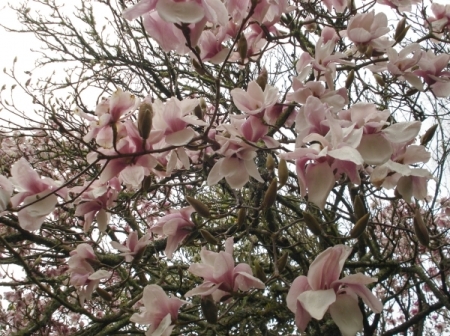
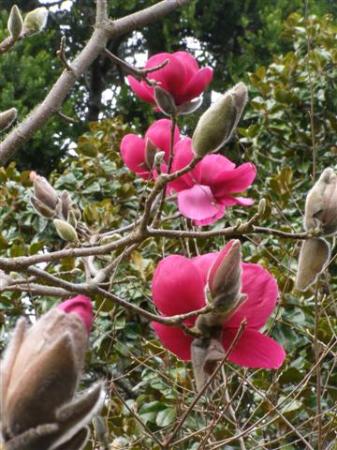
When Magnolia Felix Jury first flowered, it was pretty clear that Mark had taken the step that his father, Felix, had been aiming for with his earlier breeding of Iolanthe and Vulcan. Here was the big campbellii type flower on a young plant with strong colour. Mark named it for his father, even though it may be seen as a slightly unexpected memorial for a man who was a quiet and modest person and of slight stature. The magnolia is none of these. It is large flowered, robust and simply spectacular.

What was even more gratifying for us on our recent trip to the United Kingdom was to see how very well Magnolia Felix Jury is performing there. We walked into the Garden House in Devon and there in pride of place at the entranceway was a fine specimen. It was in leaf but Mark still recognised it instantly. The head gardener confirmed that it is in such a prime position because it performs so spectacularly well and we found that in a number of other gardens around the country. To say that Mark was quietly chuffed is a bit of an understatement. There is no certainty that plants which perform well in New Zealand will be equally good overseas.

Magnolia Felix has been described as a giant pink cabbage on a stick

Magnolia Felix has been described as a giant pink cabbage on a stick

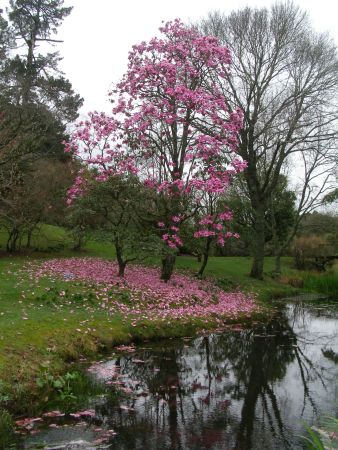
It is difficult to get full tree shots of magnolias, and especially for the original Felix which is planted in a grove of seedlings, but this plant in our park is about 12 years from cutting.

Felix Jury in our park

Felix Jury in our park

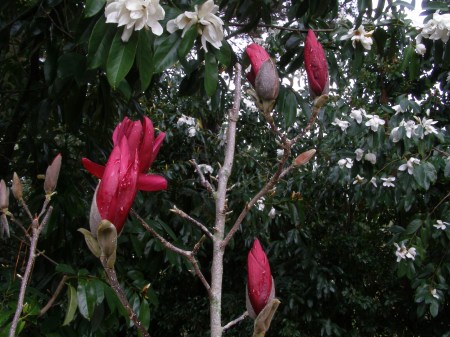
Black Tulip is also in full flower and it seems that this will be a good season all round here for deep colour. There are various theories internationally as to what affects the depth of colour but most seem to be anecdotal rather than scientific. We just feel that some years here we get better colour than other years. New Zealanders tend to take the red magnolias for granted and don’t really understand that the deep colours are unusual internationally.

Magnolia Black Tulip in full flower

Magnolia Black Tulip in full flower

Magnolia Diary number 4, 16 August, 2009

Click to see all Magnolia diary entries

Click on the Magnolia diary logo above to see all diary entries

Magnolia Lanarth - now past its best

Magnolia Lanarth - now past its best

One night of rain and Magnolia Lanarth is in decline for the season. Passing over. We don’t mind that Lanarth looks a picture of perfection for such a short time but we can understand that it is a problem for people who live on small sections and who prefer prolonged flowering.

sprengeri diva - great from a distance

sprengeri diva - great from a distance

Campbellii has peaked too but in front of our campbellii tree, Sweetheart (a Caerhays Belle seedling raised from a Ron Gordon plant and named by Peter Cave) is just opening and is very much pretty in pink. Sargentiana robusta and various stellatas are also opening. Sprengeri diva is in full flower and looks great from afar, but floppy and a tad scruffy when viewed close up. We need more substance in blooms in our conditions with wind and heavy rain.

Michelia doltsopa is flowering around the district. The form in our park was named and released by Peter Cave as Rusty but we have never sold it. Quite simply, we think it is too large. Sure, our plant is only around 10 metres tall – but it is a good 20 metres wide. By my maths, that means that Rusty takes up around 300 square metres of land area. That is a large plant growing from a central trunk and not suckering.

We intercepted the neighbours out sniffing on a morning amble yesterday (and diverted them to coffee). All Mark’s doltsopa hybrids are coming into flower and indeed the fragrance is delicious from the road as well as in our garden. The neighbours were wanting the full on scented experience, having detected it even while driving home.

Fairy Magnolia Blush

Fairy Magnolia Blush

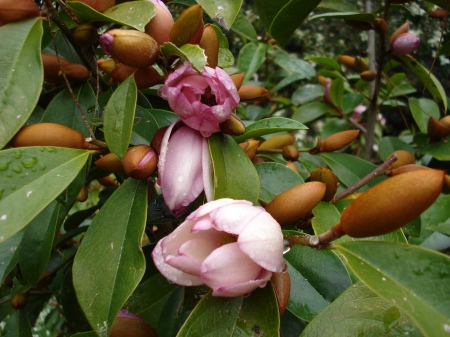
For the domestic garden, Mark’s first michelia hybrid to be released is opening its flowers. Fairy Magnolia Blush is reasonably compact (and clips well) with distinctive pinky purple flowers of reasonably large size. This cultivar is on the NZ market and will become available overseas in the next few years.

The first flowers on Burgundy Star. Doltsopa seedlings behind.

The first flowers on Burgundy Star. Doltsopa seedlings behind.

The row of stock plants of Mark’s Burgundy Star are opening their first flowers though the original plant in our carpark is hardly showing colour. In our opinion, in the proper reds Burgundy Star takes the cake so far.

Prunus campanulata

campanulata (Small)
Most people call these flowering cherries and locals tend to take them for granted, unlike those people who live in colder parts of the world where they can not be grown. The ones flowering now are the Taiwanese or Formosan cherry (although only readers over about sixty will recall when the island of Taiwan was still Formosa). They range in colour from mid pink through bright sugar pinks to cerise or carmine and almost red. The reddest form on the market just happens to be called Prunus Felix Jury. We have a series which come into flower over a period of weeks and at times it can seem as if the trees are erupting with feeding tui. While it is hard to take a census (the birds won’t stay still long enough), it is common to find about 20 in one tree at any hour of the day. We think we must currently have at least 50 resident tui.

The downside to campanulatas is that some forms can seed down badly. If you are within a few kilometres of the national park or a nature reserve, make sure you search out forms advertised as sterile (in other words they don’t set seed). These late winter flowering cherries combine well with the early magnolias and because they are not a heavy looking tree, you can often tuck them in nearby so their mass of small flowers contrasts with the over the top magnolia blooms of campbellii or Vulcan. Campanulatas appear to be more disease resistant and healthier in our climate and are not susceptible to witches broom.