
A modern, small format version of classic Redoute’s Roses, this is not although it tries to be. It is a collection of 50 botanical paintings of roses with facing page of information (a bit of history, catalogue style description and a little interpretation but nothing of note that has not been written elsewhere). But the success of this book was always going to rest on the charm and quality of the flower paintings. Unfortunately the quality of printing in this book, which appears to be privately published, is so poor that it is impossible to judge whether the artist has any talent or not. The paintings are on a grey background, washed out of colour and defintion and so fuzzy they must be out of focus. It seems a shame to go to all the effort to produce a book only to end up with such a dreadfully disappointing result.
Exisle Publishing ISBN 9780908988921Magnolia Diary number 7, 26 August 2009

Click on the Magnolia diary logo above to see all diary entries
A short but fierce storm last night was a good reminder why we value firmer flowers and thicker petals in our magnolias. Nothing floppy and loose was ever going to survive hail, strong wind gusts and 3.2cm of torrential rain in a very short space of time. We were relieved this fine morning to discover that the main casualty was to shorten the season of plants which are past their peak already. Iolanthe came through almost unscathed, despite flowers which measure up to 25cm across.
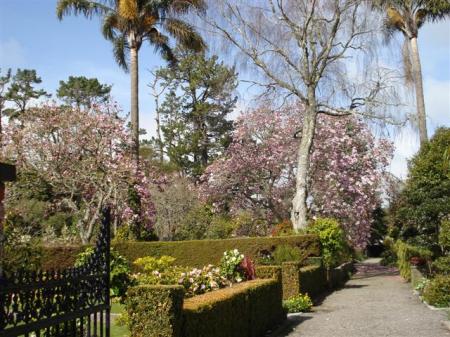
The original Iolanthe this morning
Of all the magnolias here, the original Iolanthe remains the one with most impact at its peak. Mind you, that is a combination of size and location and a weekend visitor asked us to consider the effect Magnolia Felix Jury will have when it reaches that size. We hadn’t quite thought of that.
The original Iolanthe grows half way down our house driveway and now reaches around ten metres high and ten metres across. The leaf and petal drop is prodigious but the impact of Iolanthe in full flower is so astonishing that we do not mind the clean up. Nor has Mark complained about having to move the vegetable garden due to the increasing shade. The tree takes precedence.

Magnolia Iolanthe after the storm
Back around 1960 when Felix did his first run of magnolia hybrids, he heeled them into the vegetable garden, planning to plant them out to beautify the local town of Waitara. But Iolanthe flowered and the very first flowering was so astonishing that the plant has remained in situ ever since. Iolanthe is soulangiana Lennei x Mark Jury and here was the full sized campbellii flower on a very young plant. The colour was not quite the pink Felix wanted but it was a huge breeding step. Iolanthe also flowers down the stem so, of all the magnolias here, it has one of the longest flowering seasons stretching over many weeks. As with many of the soulangiana types, Iolanthe will put up some summer flowers as well.
For the record, as we understand it, the magnolia sold as Eleanor May is a reject Iolanthe sister seedling. It was used as root stock at Duncan and Davies because it was easy to strike, vigorous and healthy and it was referred to as Mark One. Back in those days, Duncan and Davies made an effort to select clonal root stock best suited to individual varieties but such attention to detail is a thing of the past. At some point Duncan and Davies sent out some failed grafts under the name of Iolanthe whereas they were in fact root stock. The person who named this cultivar bought it from a garden centre, noticed when it flowered that it was different to Iolanthe so took it upon himself to name it. In fact he had no right to name it. He only owned the one plant he purchased; he did not own the cultivar itself so it was not his to name. On its day it is a good performer, as many of our sister seedlings, reject cultivars and also rans are good on their day but it is inferior to Iolanthe and we do not consider it should have been named. We take particular exception to Eleanor May ever being attributed as a Jury hybrid. As far as we are concerned, it is escaped rootstock.
Magnolia Diary number 6, 23 August 2009
Click on the Magnolia diary logo above to see all diary entries

The view from the corner today
Winter may have struck early and cold here this year, but at the other end of the season a magical spring has arrived early. With no wind and fine sunny days, temperatures are now reaching up to 18 degrees celsius and the flowering is terrific. The early campbelliis have been and gone, as has Lanarth, Vulcan is just past its peak, sprengeri diva is flopping, sargentiana robusta and Sweetheart are at their peak. Felix Jury looks fantastic as does Black Tulip. The soulangeanas and mid season hybrids are all opening, including our newest release, Burgundy Star.
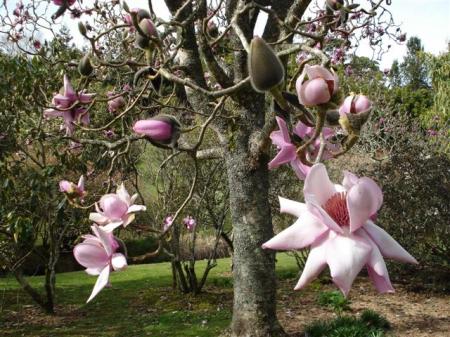
Mark Jury – first flowers this season
Felix Jury’s main output using the magnolia he named Mark Jury are all in the early stages of opening, as is Mark. Manchu Fan is opening – this hybrid performs really well here for us in the reliable, smaller growing white goblet class. Ruby, planted next to Manchu, is pretty ho hum here, as is Rustica Rubra. But then we tend to prefer solid colour in our magnolia flowers, rather than the pale insides to petals and that is just a matter of taste.
Starwars is opening on our roadside boundary (our road verges are astonishingly beautiful at this time of the year). Starwars was bred by the late Os Blumhardt and we were enormously impressed with how good it looked in the UK and Europe. In fact we wished we could claim it as ours. But here it is best in its bud stage. While it flowers very well, the tree is a rather large grower and the flowers lack good form when fully open and the petals lack substance. It was far more a stand-out plant in Europe than it is here.
The also-rans can be as impressive as any named variety on their day, and if they aren’t they get chainsawed out PDQ. You can’t name everything and to get a magnolia on the market means there are many (very many) reject seedlings. We keep chuckling at Baby Tulip which is basically Black Tulip shrunk down in size to be a shrubby stellata type of bush covered in baby dark tulip flowers. It is not good enough to name and release, but it is a little cutie which is a contrast to the enormous flowers opening on the likes of Iolanthe, Atlas and Felix Jury.
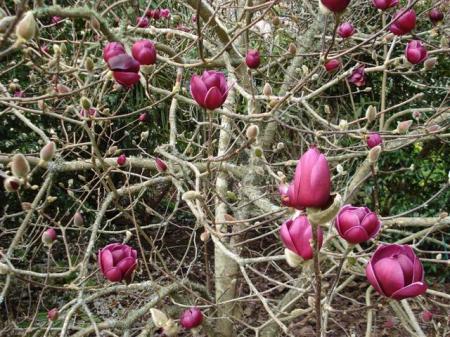
Referred to here as Baby Tulip
Edgeworthia papyrifera and the monarch butterfly

Click on the logo above to see all Flowering the week entries

Wintering over in the neighbourhood - the monarch butterfly
The flower is Edgeworthia papyrifera (syn: chrysantha), often referred to as the yellow daphne. Botanically they are related although papyrifera makes a large deciduous clump and the very long leaves appear after flowering. While scented, it lacks the knock-out fragrance of most daphnes but it makes a stand-out shrub at this time of the year. We have seen the red-orange flowered form in Europe but as far as we know it is not yet available in this country. The bark of this edgeworthia is used to make a high quality paper.
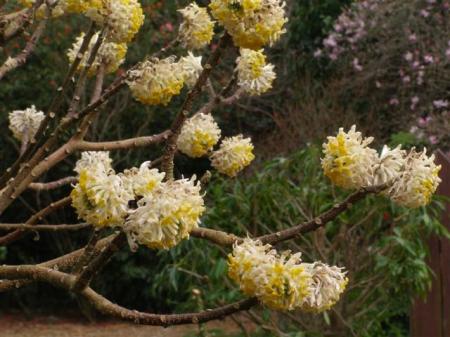
Edgeworthia papyrifera, often called the yellow daphne
The monarch butterfly is a minor personal triumph for Mark and we are delighted to see so many feeding on the edgeworthia. For some years, Mark has been sowing swan plants and managing them to encourage late crop monarch butterflies which are more likely to winter over here. Such is his determination that he sowed in excess of 1.1 km of swan plant seed last summer (that is 1100 metres if you measure out each single row end on end) to add to his other established swan plantations. In fact, for once the feed supply exceeded the demand of the caterpillars. This is one of the advantages of winding down the open ground production in the nursery – having well cultivated ground to sow straight into. Now he is increasingly targeting feed plants for the butterflies and we are hoping that surrounding neighbours who are also graced by our monarchs will do the same. This season’s first crop of monarch eggs are being laid and Mark even found a large caterpillar which had wintered over. We expect a bumper number of monarchs this year.
New Zealand has an abundance of interesting moths but they tend to be beautiful in a very understated manner. We are rather short on butterflies here, so the international monarch (which arrived here naturally so can be classed as native) is highly prized.
Rhododendron spinuliferum
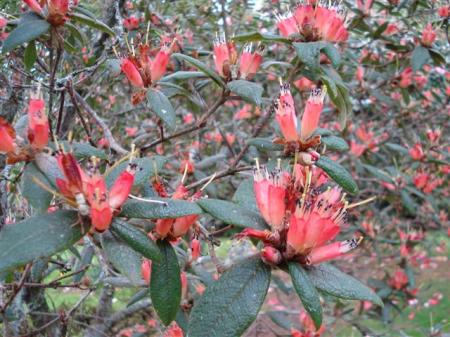
Spinuliferum is a most unusual rhododendron which doesn’t even look like one although it is a species which occurs naturally in the wild, in this case the highlands of Yunnan in China. Its blooms are curious clusters of stamens, protruding from narrow tubular flowers in brick red and apparently full of nectar. Its common name is the Firecracker Rhododendron and it does resemble an old fashioned Double Happy. We like it because it flowers for a very long time in late winter, it has a light almost floating look to a mature plant and it stays healthy in our climate. In fact it is right at home here and might as well be a native plant. Above all, it feeds the waxeyes and tuis and its branches can almost dance with the birds flitting through it.
 Tikorangi The Jury Garden