
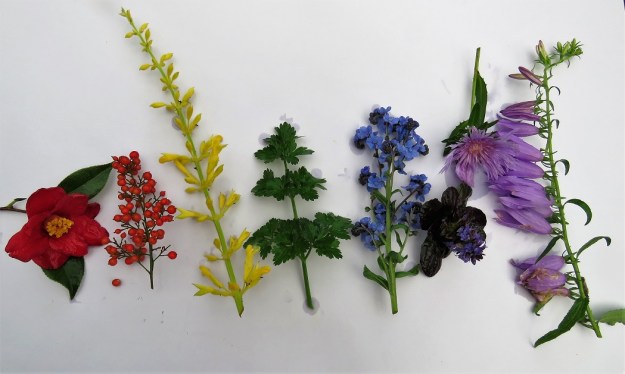
Left to right: a camellia seedling beloved by a tui, Nandina domestica berries, Salvia madrensis, parsley, perennial forget me not, Ajuga reptans, stokesia and a late campanula flower spike
It was a throwaway comment from Mark that started me on my solstice rainbow. “Really, June is the month that we have the least colour in the garden,” he said as we stood looking at some bloom or other. And he is right. Come July, we have early magnolias and michelias, a whole lot of camellias, snowdrops and early narcissi are opening and there is plenty to keep our spirits high in the coldest month of winter.
We like flowers. Yes foliage and form are important in the garden. Of course they are but for us, they are the backdrop for flowers not an end in themselves. We prefer to be surrounded by colour.
I may have been listening to the Rolling Stones “She’s a Rainbow’ for a touch of nostalgia. I mention this in case you want a sound track for this post.
ROY G BIV as many of us learned in our childhood.
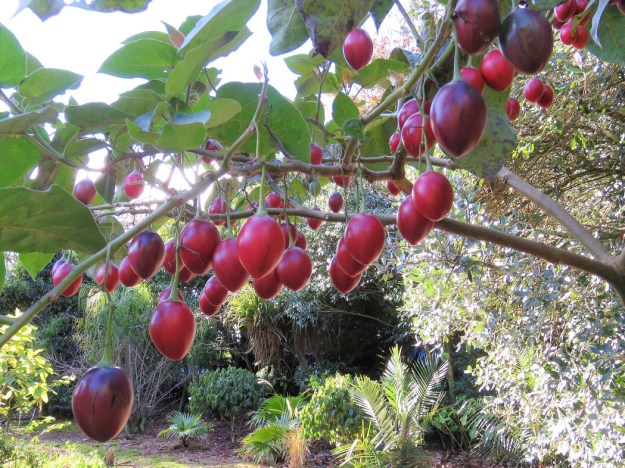
Tamarillos ripening on the bush
For red, may I give you the tamarillo plant – self-seeded but cropping very generously. It is another of those fruits from South America that we have taken over. Botanically Solanum betaceum, some of us are old enough to remember when they were still called tree tomatoes. True to form, it was a New Zealander who dreamed up the name tamarillo back in the late 1960s. I did not know until now that the wild forms are commonly yellow or purple and the red form we regard as the norm is another NZ creation dating back to the 1920s. I feel we may have hijacked this fruit in a manner similar to the kiwifruit which is actually Chinese. So now you know, too.
There were many other reds including camellias, vireya rhododendrons and the eyecatching red seedheads of both the arisaemas and clivias but I will stay the course with just the tamarillo. 
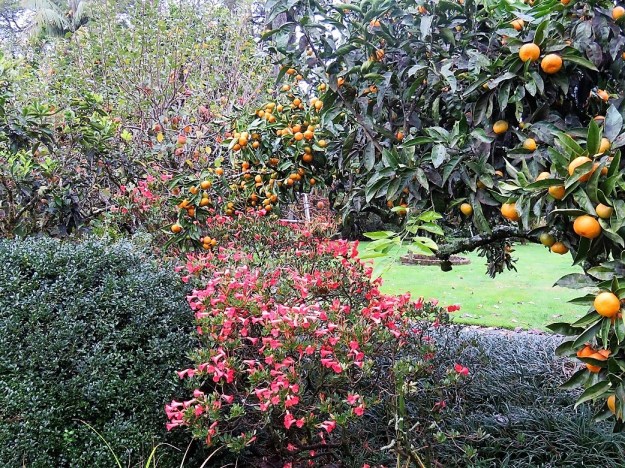
Orange – it was a close-run thing with the kniphofia (red hot pokers) and the nandina berries but for a big hit of orange, it is impossible to beat the mandarin tree. Okay, so the photo of the tui in the mandarin tree with the starburst of Cordyline australis ‘Albertii’ is an old image but it is still one I love and have so far failed to capture again since I upgraded my camera.
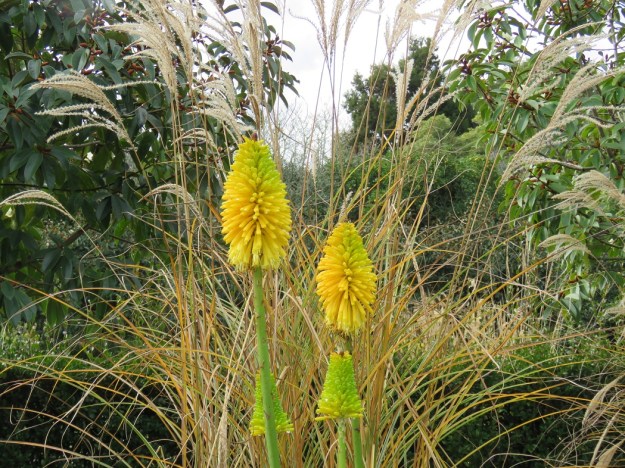 Yellow I will give to the kniphofia. This one, Mark retrieved from one of our fenced shelter belts where a neighbour had been dumping his garden rubbish so that was a find. I like the clarity of the yellow as a garden plant, maybe even more than the orange forms.
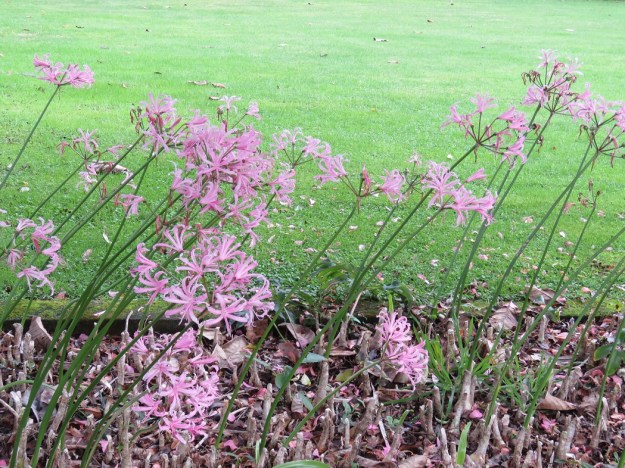 Green. Where to start? In our climate we are green all year round. Not for us the white of snowbound winters, nor the unrelenting grey of climates where the sunshine hours plummet in winter and the sun barely rises over the horizon. Nor the soft beige-golden tones of a dry climate like Canberra. We are verdant green all year round. It is why dairying is so successful in this area. You are meant to be looking at the green lawn, not the late flowering of Nerine bowdeni. Unlike colder and drier climates, lawnmowing continues all year round here, though once a fortnight suffices on the house lawns in mid winter.
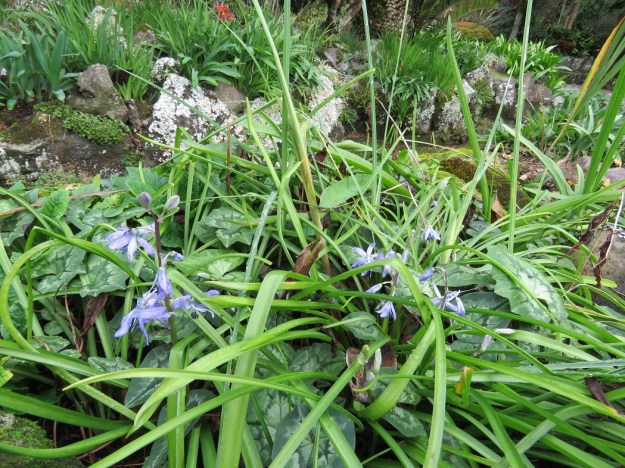
Some scilla, or squill, with a ratio of foliage to flower that is too high to make it a great garden plant
I struggled somewhat with the blue, indigo and violet end of the rainbow colours. Much as I love blues in the garden, there aren’t too many at this time of the year and it seemed a bit taunting to feature our blue-as-blue winter sky on a sunny day. Instead, one of the early scillas is already in flower. It is one of the obscure species where the foliage to flower ratio is somewhat too high. I once unravelled the different species we grow but failed to commit the details to memory. I failed even to remember where I recorded the details. I see there are anything up to 90 different scilla species and all I can say is that a fair few of them seem to be more showy than this one.
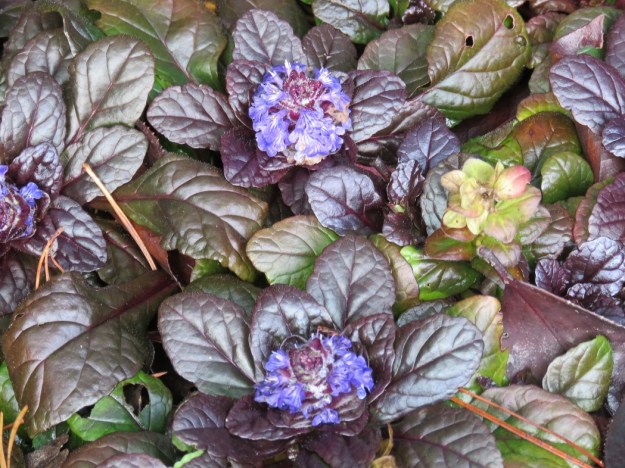 Indigo – just the ajuga which is perhaps an under-rated groundcover for woodland areas. The deep blue is a bonus with the dark burgundy foliage. What is indigo even doing as a colour of the rainbow when you think about it?
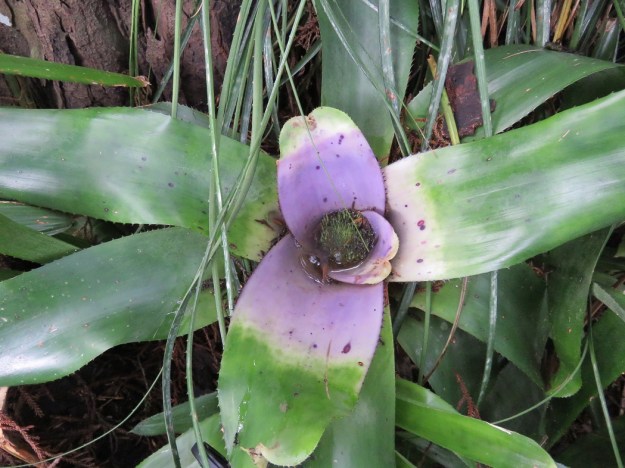 And finally to violet and while I entertained the violet hues of the stokesia that flowers all year round for us, I settled on a bromeliad with an indubitably lilac centre at this time of the season. Is it a neoreglia? Feel free to correct me. Bromeliads are not my forte.
Confining myself to the rainbow hues left out all the pink and white blooms. We have a lot of pink and white in mid-winter but my foray into the pretty world of marshmallow tones will have to wait for another week. I may buy a packet of marshmallows to focus my thoughts on this very topic. I can not think that I have bought marshmallows since our children grew past the age of toasting them over a fire and that is a long time ago.
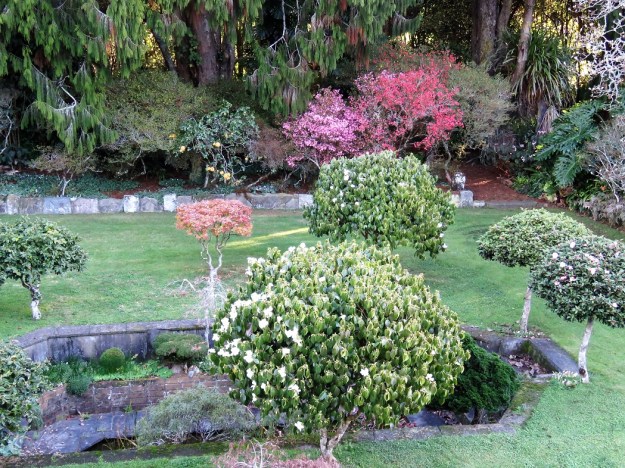
A midwinter view from an upstairs window. Azaleas, a vireya rhododendron, cyclamen and herbaceous begonia all in flower and camellias coming into bloom.
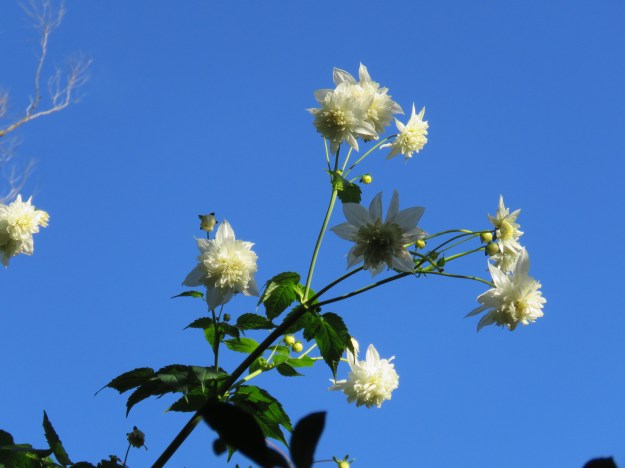
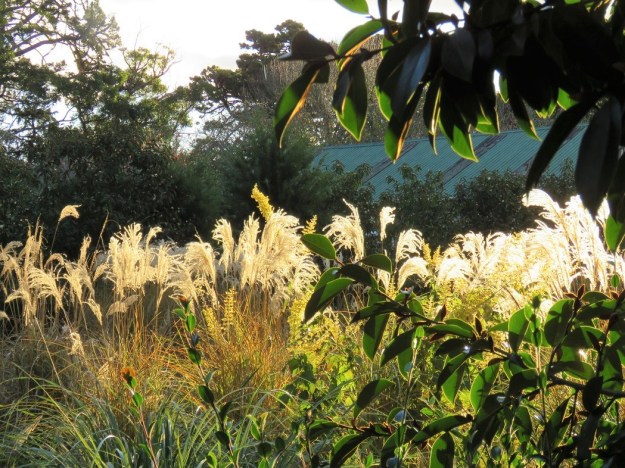
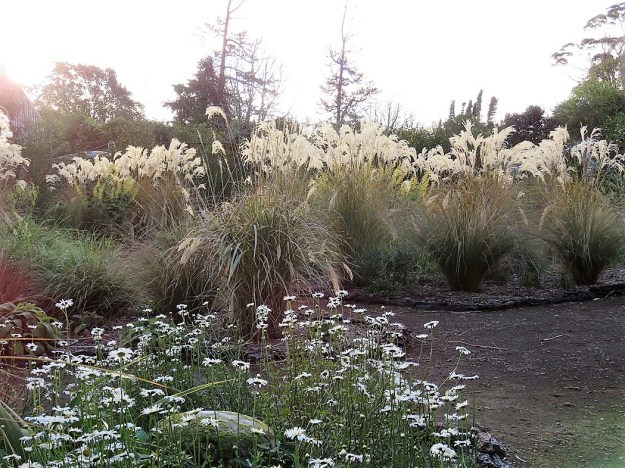 We are now well into what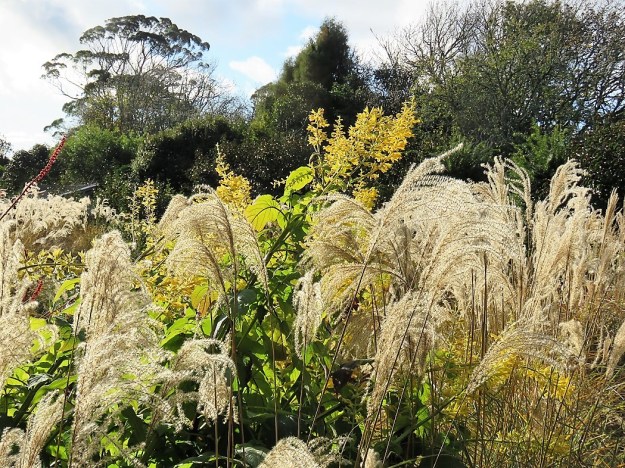
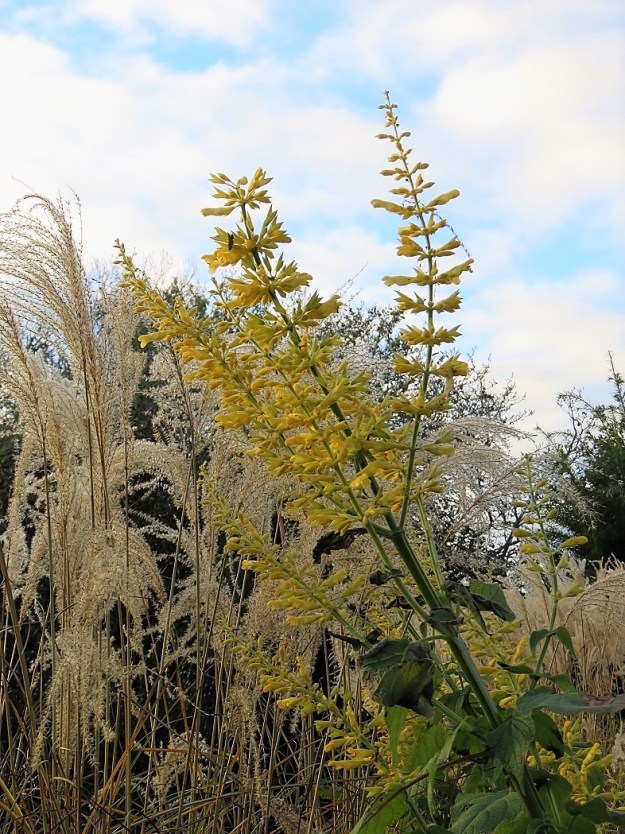 I have finally found a place where this large yellow salvia can grow with sufficient space and it is a late autumn – early winter highlight. We have never had a name on this variety so if any readers can identify it for me, I would be grateful. It stands a good two metres tall so it is a large plant to accommodate. *** Now identified as Salvia madrensis, thanks readers.
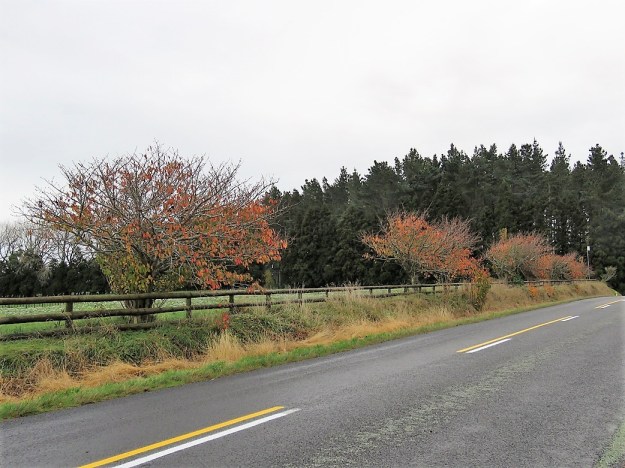 Many years ago, neighbours planted a row of flowering cherry trees on their roadside. Mark and I were discussing how long ago and he thought somewhere over 30 years, maybe even more. I recall when they first went in and they struggled for at least the first decade. There used to be quite a few more but these are the survivors.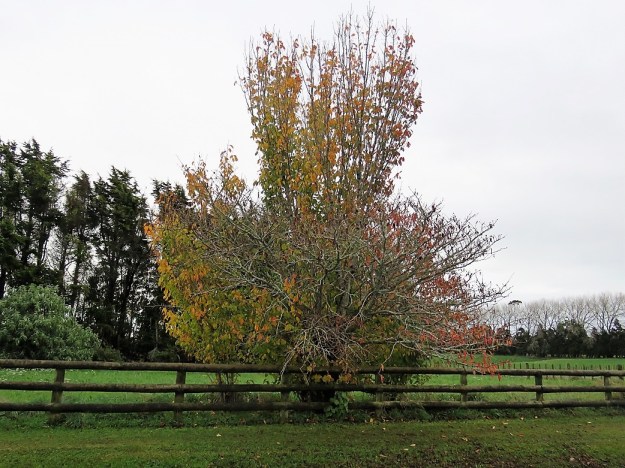

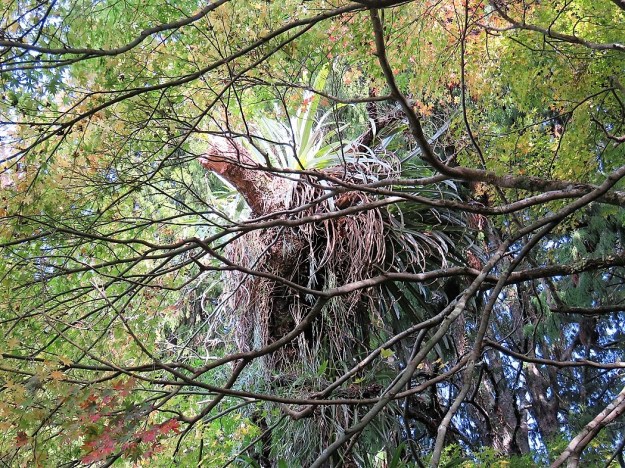
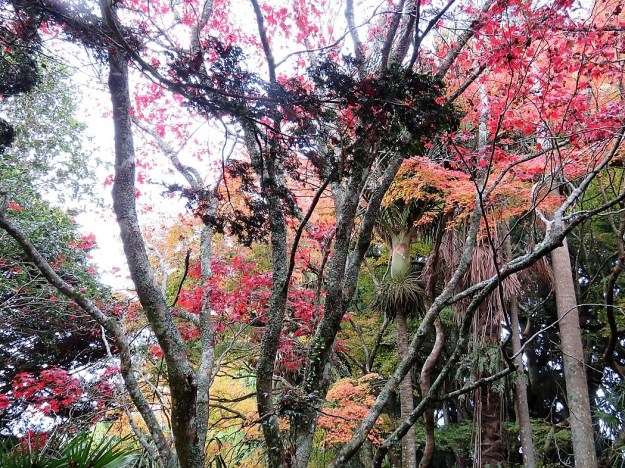
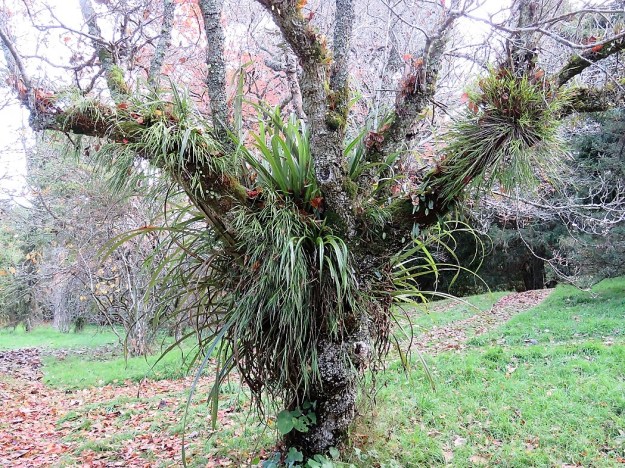 I was quite taken by this sight of epiphytes on a cornus tree down in the park. It is a natural occurrence here that
 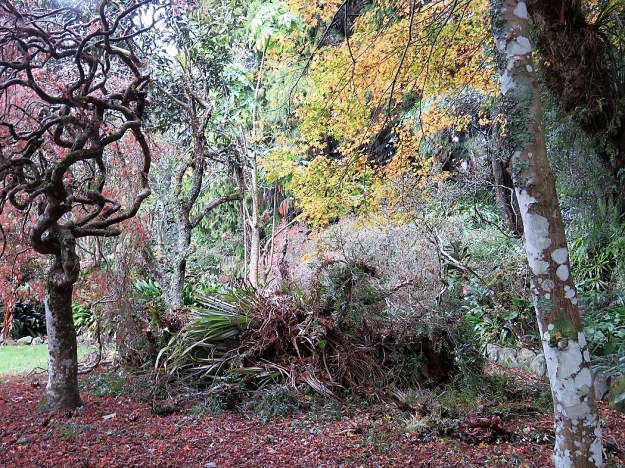 Mark then asked me if I had seen the maple lawn. I hadn’t but there was the result of a branch on high collapsing under the weight of epiphytes, clipping the maple tree for which that small enclosure is named.
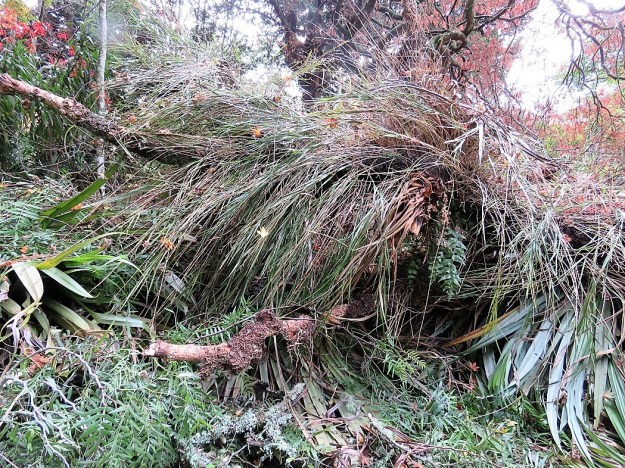 What you are looking at is somewhere close to three cubic metres of collapsed branch and epiphytic growth so there is a lot of it to clear. We had been watching that branch but as it was a good eight metres up and almost certainly rotten, the dangers of trying to remove it were potentially greater than leaving it to nature to take its course.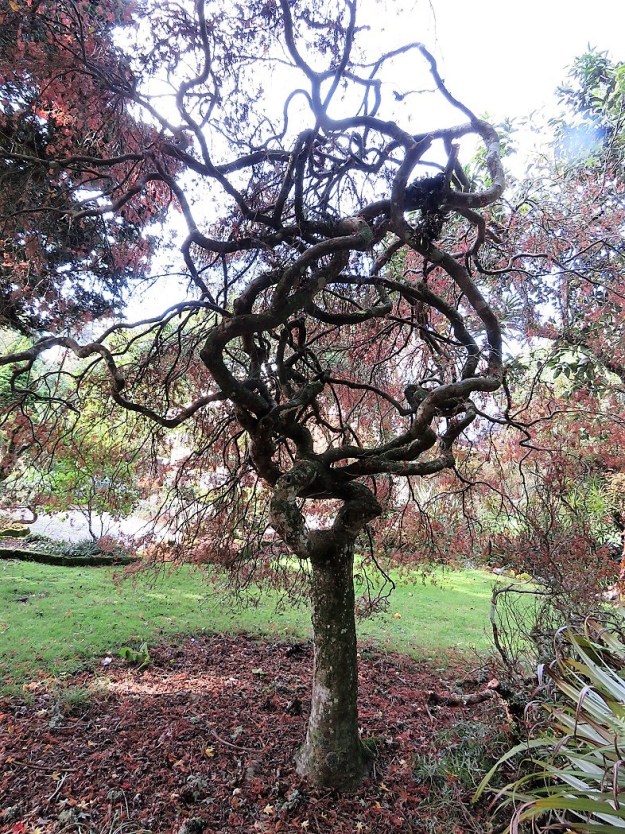
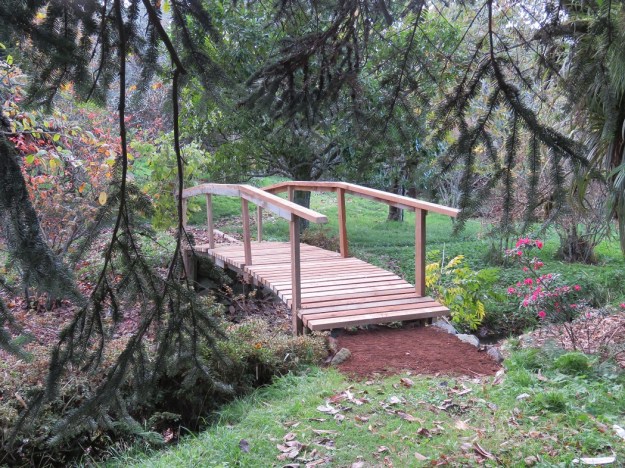



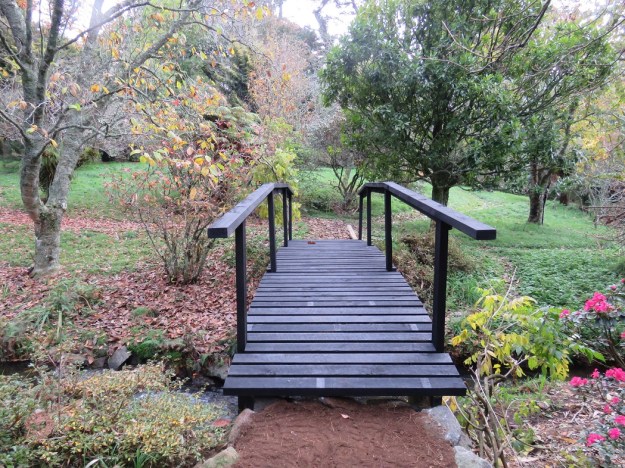
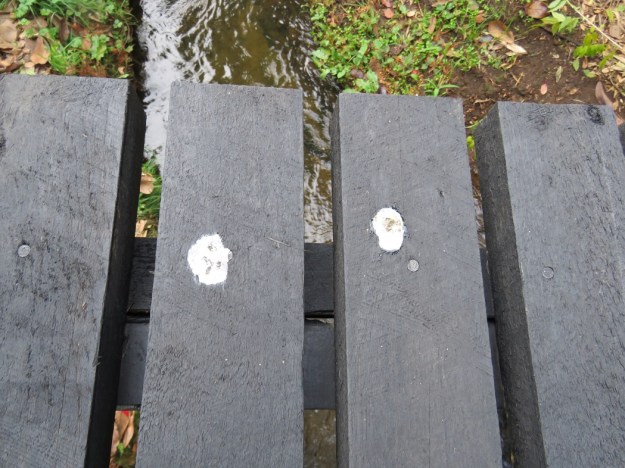 I hadn’t factored in the rather stark contrast of bird poop on the black surface but I am sure it will all find its natural balance over time. We have yet to tie the wisteria canes back in and that, too, will soften the sharp black lines. And one of the wisterias is white ‘Snow Showers’ so that will distract from the bird poop when it is flowering.
 Tikorangi The Jury Garden