Another week in the garden of Jury

Subtitled: Rain! At last! A study in a sparrow’s nest, waterworks, the raspberry coop, tamarillos and an update on the new grass garden.
It is mighty unusual for us to get excited about rain in our climate. But a good rain last night was certainly a relief. It has not been a particularly hot summer but it has been a dry one. We do not irrigate our garden. Nor should anybody else, in this day and age when we are realising that water is a precious commodity. Garden to your conditions. Grow what flourishes in your climate. Target watering only to what needs it to survive and produce, not the whole area.  But I digress. The rain last night, in addition to the 9 ml we received last week, is very welcome.

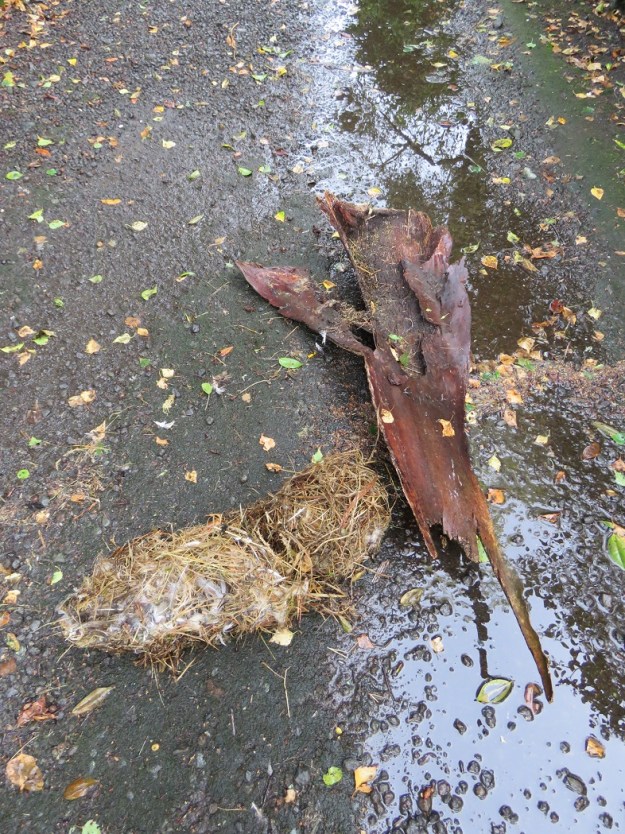
It also brought down more of the old sheaths clinging to the Queen Palm (Syagrus romanzoffiana)  We describe this particular specimen as being an entire condominium of nesting birds, mostly sparrows. As each sheath falls, so too does a spent nest. In this case, it appears there were two families of sparrows squashed into the same apartment. Sparrows may be a common and unpopular little bird here (Oi! England! Do you want your spadges back? We could do a two-for-one deal and throw in Mrs Tiggywinkle and her large family) but their nests are soft, feather-lined creations of great charm. When you think how small these birds are, creating a cosy, safe place for their offspring’s first weeks is a major effort. What is more, they have to repeat the process every year.
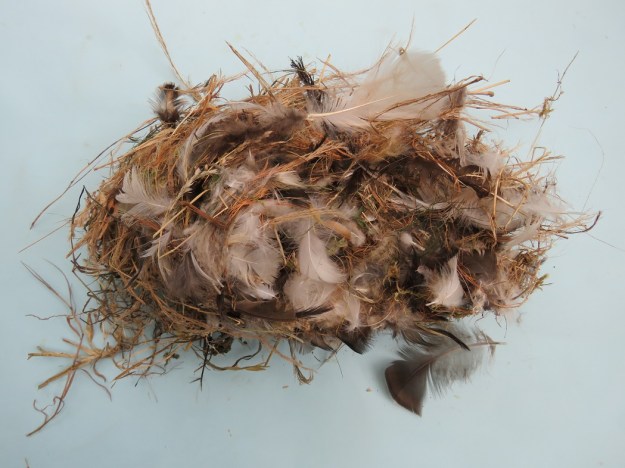
It disintegrated in the fall from a great height but look at how much work the little sparrows put into creating this one-season masterpiece

As I wrote last week, we have decided we will reopen the garden this year for the 10 days of the Taranaki Garden Festival. Work in preparation has already begun. I tackled the raspberry coop. Mark marvelled that he did not think it had ever looked as tidy, including back in his father’s day. Lloyd was terribly impressed by my weekend’s efforts. It is a very old pipe and wire netting cage which is scheduled for removal but not for another year or two. We call it the raspberry coop because it houses a very productive row of raspberries but it was the sad, neglected blueberry that forced me into action. It was limping on with its cropping when I saw a photo of a commercial bush that was way more impressive. Maybe ours would do better with some care and attention, I thought. So I fed it, gave it compost as well, cleared everything else around it and mulched it. I am hoping for great things next year. The coop also houses seven geriatric dwarf apple trees. With feeding and mulching, I am hoping they may become venerable, rather than geriatric. They date back to the 1950s and we still have a collection of varieties that were popular back in those days – Sturmer, Golden Delicious, Spartan and others of that era.
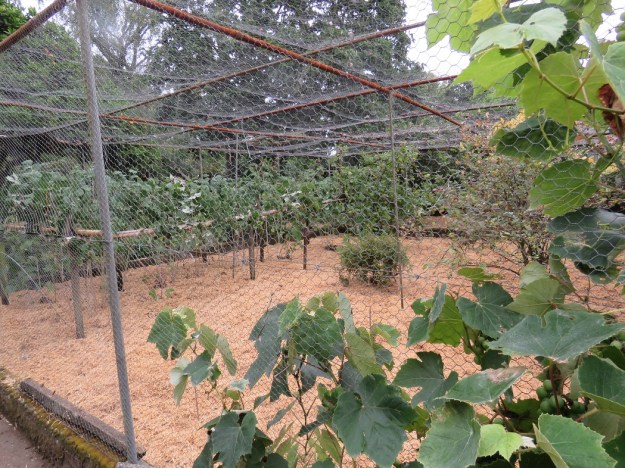
Never before has the raspberry coop looked this smart

The raspberry coop is on the margin of the Iolanthe garden that I have been working on transforming to a perennial meadow and if visitors are going to be looking at that, I felt that a weedy, unloved raspberry coop was not a good look at all. Now I just have to keep it this tidy and free of weeds.
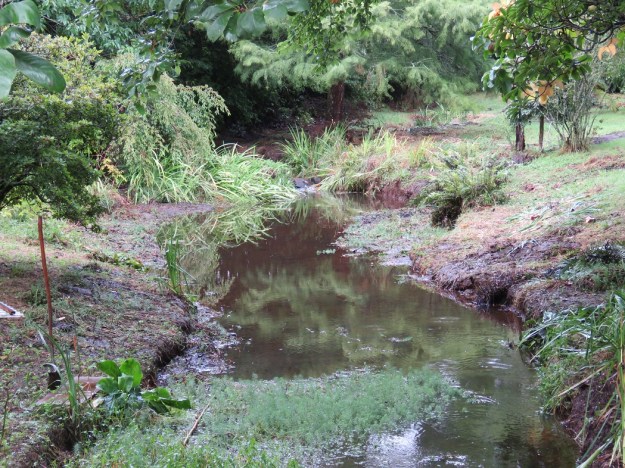
A work in progress on what used to be the big pond. The water level is way up after last night’s rain

Lloyd has been slogging it out this week, carving out a stream channel through the large pond that had silted up and become choked with water weed. It is an area where the digger did not have sufficient reach to enable him to do by machine. I did not think to take my camera down to record the simple system of floating platforms and boards that has enabled him to walk on water (well, floating mats of weed, really) to cut it up and haul it to the side so you will have to wait until next week for handy hints on how manpower can achieve what machinery cannot. Some weeks, that man is worth his weight in gold. We are only days away from being able to put the water back down the channel and that will be a celebratory conclusion to a major maintenance task.
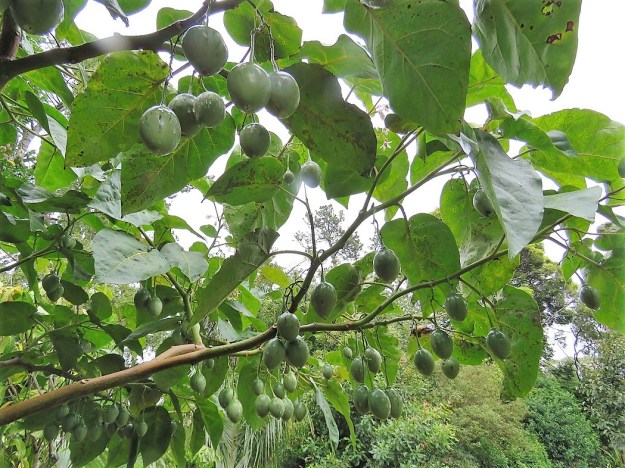
A great crop on the self-sown tamarillo
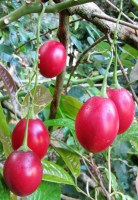
Ripe tamarillo fruit

We know this South American fruit as a tamarillo in New Zealand, formerly a tree tomato. I doubt that many people know it by its botanical name – Solanum betaceum but there seem to be plenty of other names for it around the world. ‘Tamarillo’ is another case of NZ renaming a fruit to increase its marketable qualities (like ‘kiwifruit’). For us, it is a bit like the Cape gooseberry and passionfruit – short-lived but able to pop up around the place from seed. We didn’t plant this specimen, it is a volunteer and it is carrying a great crop this year. Those hanging fruit will not be ripe until they turn red. It is not my favourite fruit but it adds variety to our diet and can be used in both sweet dishes and as part of a savoury salad. Mark’s father used to like it with a little chopped onion on wholemeal toast but it is more common to peel them and serve them with sugar.
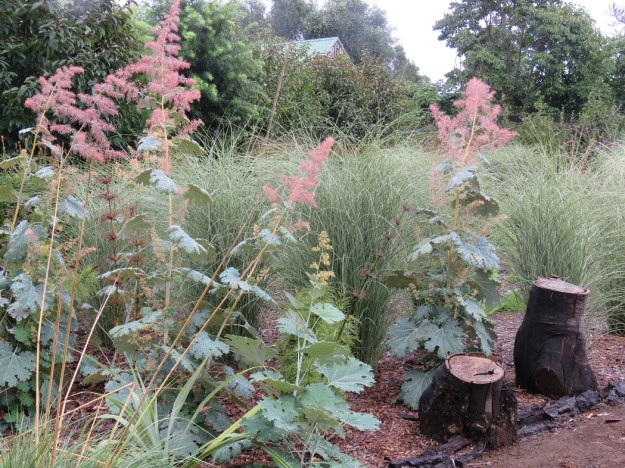
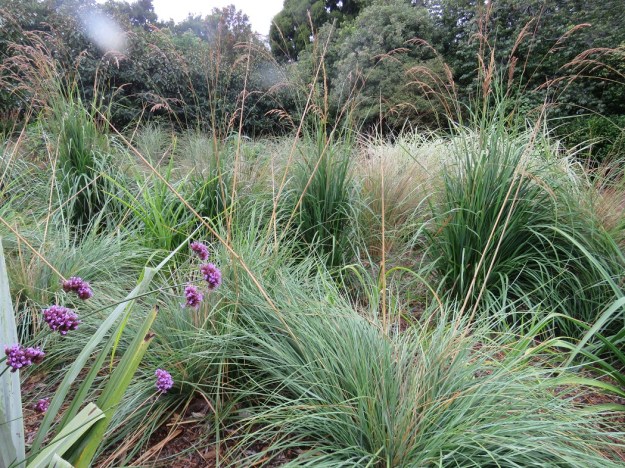
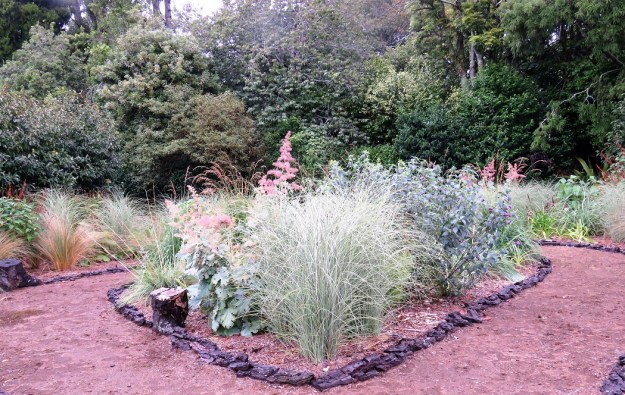
Finally, I give you the latest photos of my grass garden, planted at the very end of May, just nine months ago. I am really delighted with it. Mark is a flower and colour man and wistfully asked if I intended to add more colour. I defensively reeled off all the flowering plants in it (pale apricot foxgloves, Verbascum creticum, Inula magnifica, salvias red, yellow and blue/green, daisies, evening primrose and more). It turns out he was discounting white flowers. What he really meant was colour. The answer to that is probably not. I am fine with it growing just as it is. It is getting the immersive atmosphere I want and to stand or sit amongst it when there is a breeze blowing is the pleasure I hoped for. It is very different to any other part of our garden.
Reopening the garden after seven years

The Rimu Avenue

It’s official, more or less. We are reopening the garden later this year but just for the ten days of the Taranaki Garden Festival.  If you have been hoping to visit, those dates are October 30 to November 8. After seven years of being closed, it feels the right time to open again but for strictly limited periods of time.

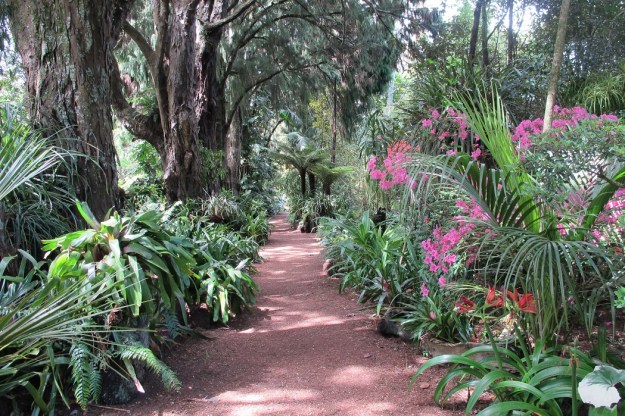
The old garden remains more or less as visitors from past times may recall – the Rimu Avenue, sunken garden, rockery, avenue gardens and other house gardens.

No longer mown park, now a meadow

The park has been transformed to a meadow over the past seven years.

Opening the new summer gardens for public viewing

The new summer gardens are ready to be seen. We refer to these individually as the borders, the court garden, the caterpillar garden, the Iolanthe garden and the lily border (although the lily border will just be lily shoots in November). Collectively, these are close to an acre of sunny gardens planted predominantly in perennials.

We will offer a series of garden tours and workshops to be scheduled at that time – details to follow.

There will be no plant sales – we are well and truly over that and no longer produce any plants except for our own use or as part of Mark’s plant breeding programme.

We are hoping to be really busy for those ten day and it will be a pleasure to meet some of the regular readers of this site.

A last resort – getting in a digger

I have commented before that water in the garden can involve quite a bit of work, be it still water, treated water or running water. And water has had us busy this week.

The mill wheel bird bath can become a breeding ground for mosquitoes in summer

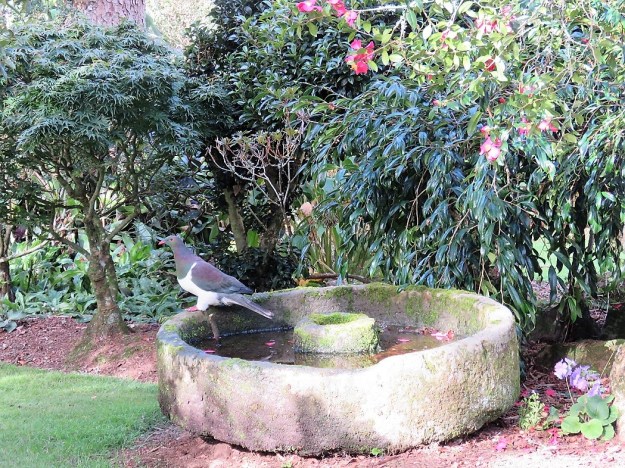
We have treated water – a swimming pool. Once that is up and running for the season, it doesn’t take much to keep it clean because we have a salt filter on a timer. We have still water – two pond features with goldfish and an historic mill wheel which serves as a bird bath. The problem with the mill wheel is that, without fish in it, the mosquitoes breed up within about three days so we have to drain it and replace the water often over summer. True, mosquitoes breed up anywhere there is still water, even in the bromeliads (and we have quite a few of those). But the mill wheel is close to our bedroom window so I blame that for the incursions of nasty, blood sucking critters in the night.

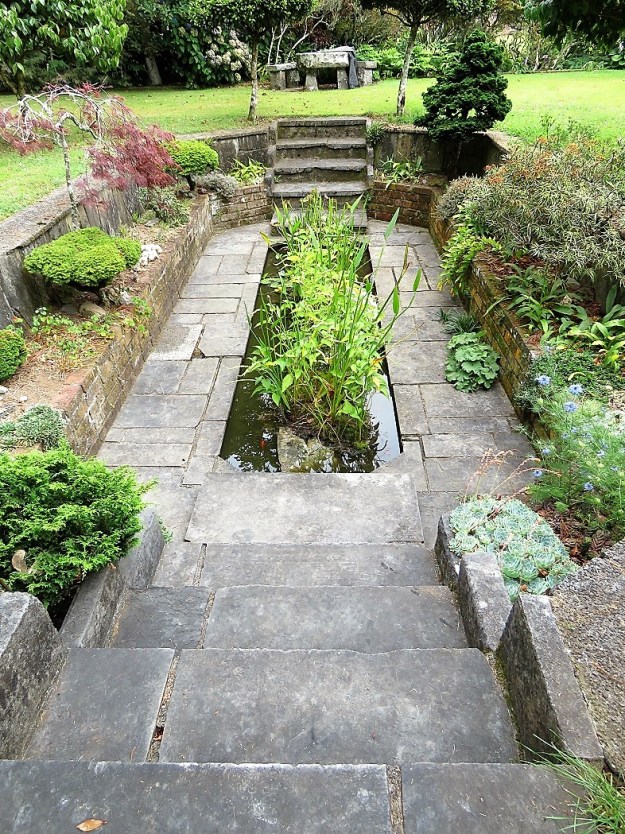
I cleaned out the excessive growth of the aquatic plants in the sunken garden this week. Goldfish stop this from being infested with mosquito larvae.

The goldfish ponds are relatively easy care. I go thorough a couple of times a year to scoop out the build-up of rotting detritus and to restrict the growth of the aquatic plants and we have to top them up with water in dry spells. The pond at the bottom of the sunken garden is too shallow so it evaporates quickly and we often get algae spreading that needs scooping out with a sieve but it is all pretty straightforward.

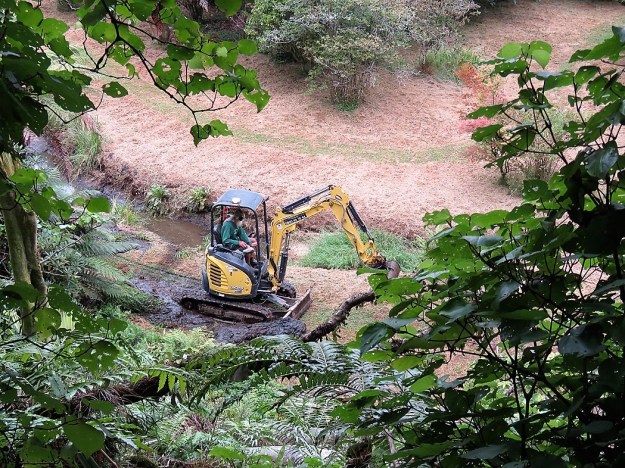
A last resort – Lloyd on the digger. You can see the mat of grass that had established on the choking silt.

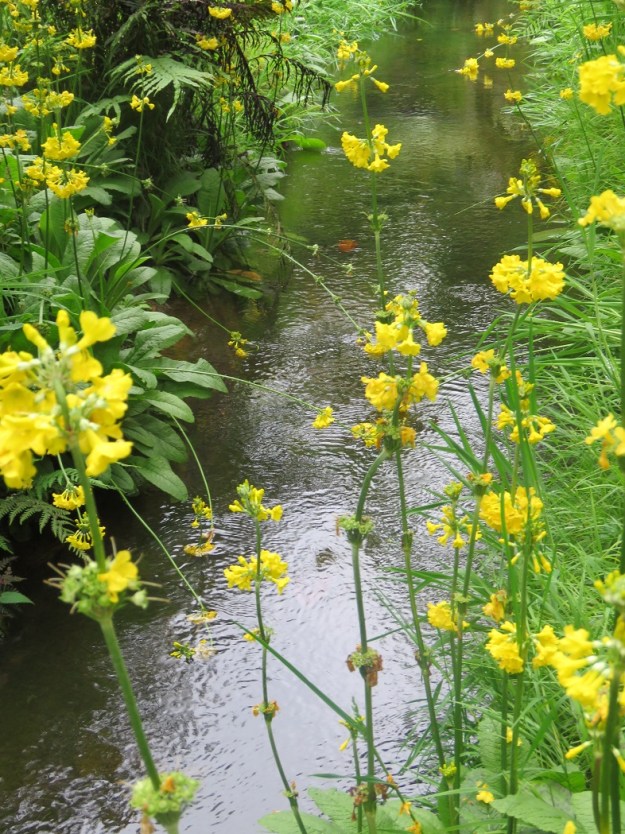
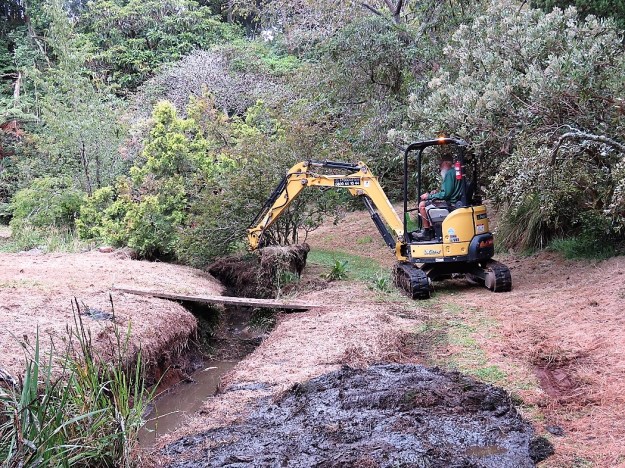
Running water – the stream in the park – is nowhere near as simple to maintain. This week, we admitted defeat and hired a digger. We haven’t put a digger through the stream for about 25 years and it is an absolute last resort because it destroys the entire eco-system. Generally, we can get away with going through with a long-handled rake and drainage fork every couple of years to haul out the excessive growth of choking weeds – back breaking work but kinder to the environment. This time it was beyond that and the issue was the excessive build up of silt. We were at the point where the stream was turning into a swamp with little water movement.

There were four reasons for this state of affairs and only one of those was caused by our management. The water that flows looks clean enough to the naked eye. As Mark observed, it is a good example of how a visual assessment is not an accurate guide to water quality. Because it flows through farmland upstream, the silt loading is high. It runs dirty every time it rains and and over the years, the silt dumped on our stretch had built up. It also carries a very high nutrient loading from farm runoff and that means we are battling water weeds all the time. Then when the culvert at the corner was replaced last summer, it involved earth works on our place and the soil was not compacted so there was a major collapse during a flood. That reduced the water flow through the park by at least 50% with the water going over the weir and down the flood channel instead. Digging out that silt bank blocking the stream was too big a job to do by hand.

Neither Mark nor I were game to try driving the digger but fortunately Lloyd is not afraid of machinery though cautious by nature.

The fourth problem was of our making. When we decided to manage the park as a meadow and reduce mowing to just twice a year, we also stopped strimming the banks of the stream. With the build-up of silt and the greatly reduced water flow, the grass had invaded the river and formed a mat that was too heavy to dig out by hand. Hence the digger. We can’t get a big digger in because of access restrictions and the placement of many trees and shrubs so Lloyd spent two days quietly and cautiously working his way round the areas that could be accessed safely from the cab of the little digger. Its reach is not long enough to scoop the two ponds we have so they remain an unresolved issue at this stage. We are thinking we want to create a channel for the water and turn the ponds into bog gardens but the details of how we manage that transition are not quite clear yet. Natural ponds are even harder to maintain than the stream and we think it is time to draw the line beneath having those.

Mark will probably plant trees to shade more of the stream. When water is shaded, it stops the rampant growth of choking water weeds and it is much easier to stand on the bank and rake out what is there.

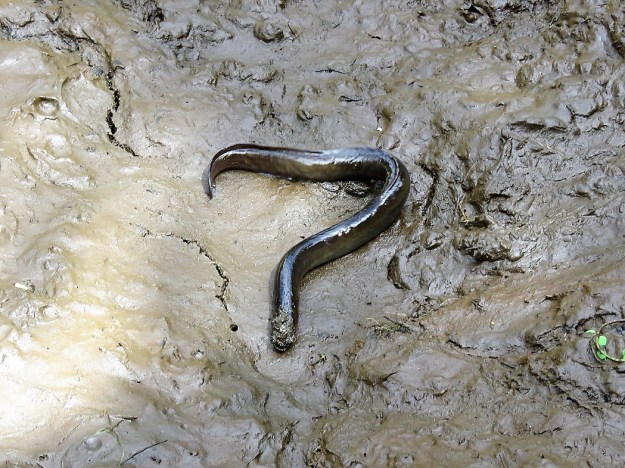
This was just a small eel that appeared a little disoriented at finding itself on dry land. I helped it find the water again.

I have a vested interest in this. I have found that it is easier to weed the stream by dropping the level (which we can do with the weir and the flood channel) and getting in the water to clear it. It is a very muddy procedure but easier on my back than doing it from the bank. I started doing this last week before we decided to get the digger. I cleared one stretch of several metres but I can never get in that water again. The next day, I was back again, this time raking from the bank just down from that area I had cleared. And lo, there was a very large eel undulating through the shallow water. I am always aware of my tendency to hyperbole so I didn’t want to exaggerate its size but Lloyd spotted it sunning itself the next day and estimated it to be about 80cm or more in length with a girth behind its head of close to 50cm in circumference. I knew we had eels. I had to head one in the right direction to get back in the stream and I have seen many small ones. But that is too large an eel for me and there may well be more than one of them that size. I am scared of eels.

The aim is to manage the stream without needing to resort to a digger again – at least in our lifetime.

Summer thoughts

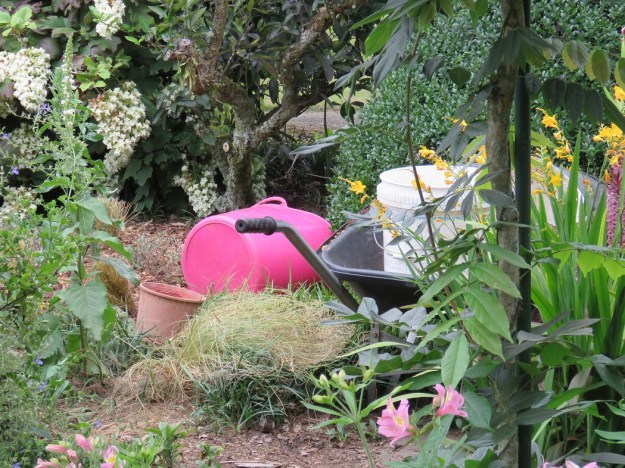
“I thought I saw you bent over, working in the garden,” Mark said. “And then I realised I was talking to a pink bucket.”

I went looking for the pink jacket made from Nana’s old bedspread and I found a whole lot of pink  clothes that the elder daughter does not wish to part with so has left here. Most i sewed for her 20 to 25 years ago and most are recycled from fabric Nana had used or stored, although I can not take credit for the pink prom dress on the right!

In self-defence, he would like it known that he was some distance away at the time. And I would like it known that I would not be seen dead wearing skirts, shorts or trousers in that shade we refer to as highlighter pink – on account of highlighter pens. Mark’s late mother had a penchant for that hue in both clothing and, occasionally, soft furnishings. When we moved in to the homestead, we found one such relic – a nylon quilted and frilled bedspread in bright pink. Our elder daughter was 16 at the time and took a liking to the colour so I made it into a quilted jacket for her, to be worn with a rather small pink brocade skirt also made from some repurposed fabric left behind by her Nana. Amusingly, she has kept onto it and it hangs in the wardrobe of her old bedroom here with other favoured clothes from her youth. It is like a trip down memory lane every time I look in there.

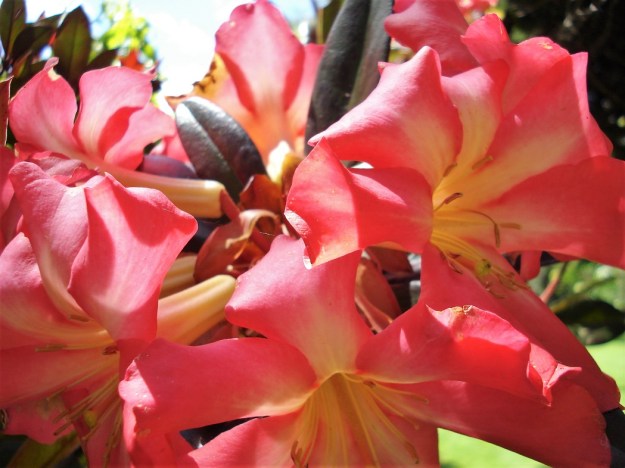
Vireya rhododendron Pink Jazz

It was this passion for pink – bright pink – that led Mark to name a bright pink and yellow vireya rhododendron for her. He prefers descriptive names for his plant selections and rarely names them for people (the notable exception being the magnolia he named for his father, Felix Jury). When he does, it is by allusion. So, our JJ’s vireya was named ‘Pink Jazz’ – Jazz being the name her friends called her. Each time it flowers in the garden, I smile at the memories. (And, to pre-empt enquiries, we have no idea if it is still in commercial production. It is not one we kept any control over so other nurseries can produce it – or not- as they choose.)

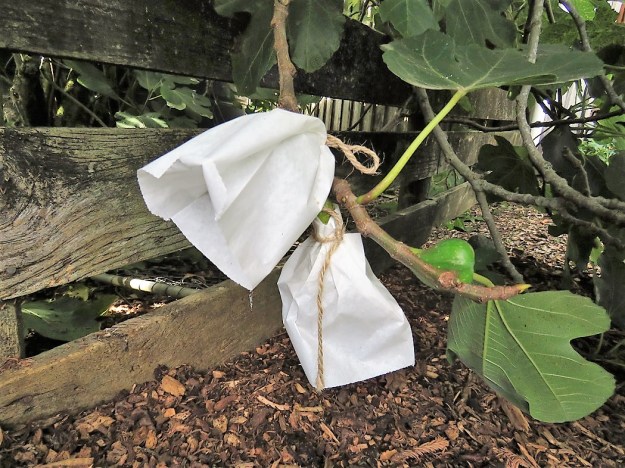
I had been admiring the crop of figs that was coming along nicely. Our fig tree carries two crops – the first ripens in mid-summer and the later crop only ripens in autumn if we get a good season. But when I thought the first ones may be ripe, I looked closely and the crop was greatly reduced. The birds are not as fussy as we humans when it comes to savouring the delights of a fully tree-ripened crop.
Bagging figs so they can ripen on the tree before the birds get them

Now I am bagging the individual fruits. In a nod to growing concerns, I have shunned the white plastic bags with the bottom cut off and freezer ties we have used in the past. This year, the fruit are individually bagged in paper (no need to cut the bottoms off with paper, Mark told me after I had done the first few) and jute string so fully degradable if any land on the ground. It takes a bit of effort but the rewards of tree-ripened fruit warmed by the sun make it worthwhile. I must put some good camembert or brie on the shopping list. Is there anything more delicious than a platter of ripe figs, soft brie, my fresh grapefruit jelly made this week, walnuts and homemade oat crackers?

It is high summer here and Lloyd has started to mow the meadow. We have learned from our experience that in our verdant conditions, we must mow twice a year – once in high summer and then again in late autumn. The grass loading is just too great to deal with if we only cut it down once a year, as is recommended practice from places where conditions are harder and grass growth is a great deal less.

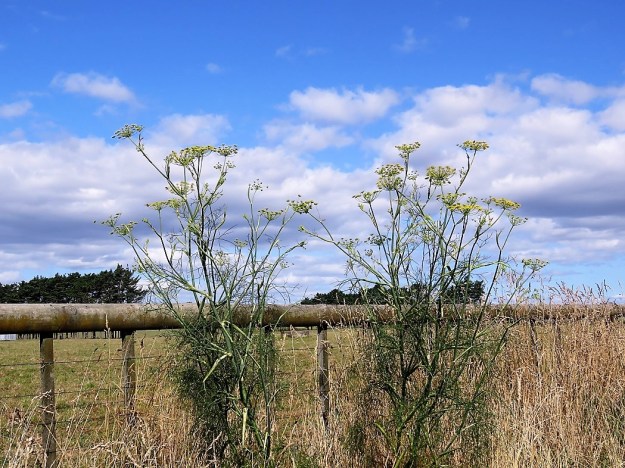
Fennel, not a ‘yellow lace-cap hydrangea’

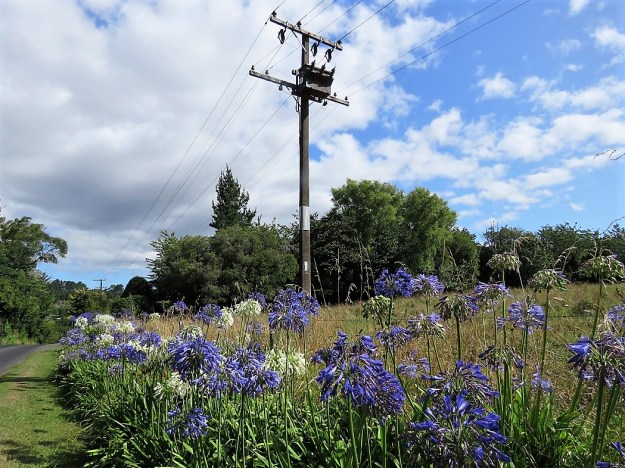
The roadsides in our area are full of flowers at this time of the year – crocosmia, hydrangeas, agapanthus and fennel in particular. Whether you see these as weeds or wildflowers is entirely a matter of personal opinion – it is a bit like the glass half-full or half-empty scenario. I stopped to photograph the wild fennel and agapanthus because it reminded me of the English summer visitors that arrived one year. I have told this story before so apologies to long-term readers who may have read it earlier. These visitors wanted to know what the ‘yellow lace-cap hydrangeas’ and ‘giant bluebells’ were that they were seeing everywhere. I managed to identify the former as fennel but could not for the life of me think what the giant bluebells were – until I drove out our gateway and it dawned on me that they were the lowly agapanthus that is so happy in local conditions that it has naturalised itself. Agapanthus is not generally favoured as a garden plant in most of NZ – too common, more often seen as a weed. But in midsummer, our roadsides are glorious when they bloom.

The maligned roadside agapanthus


Some flowers of summer


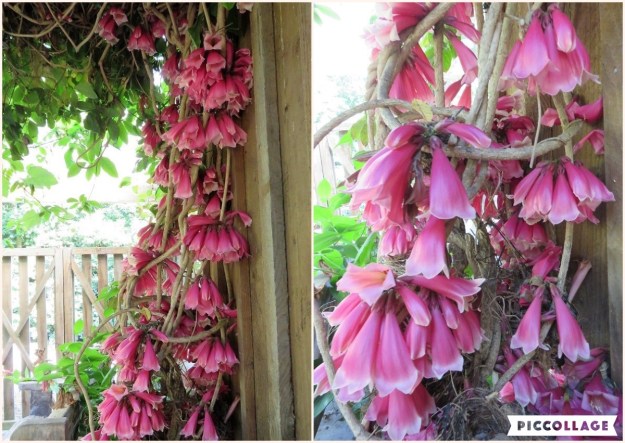
Tecomanthe venusta at its best 

I have been busy gardening all week so all I have to give you this weekend are summer flowers. The New Guinea Tecomanthe venusta has never bloomed better than this week. The vines are simply smothered with its pink trumpets and I had trouble getting a photo that does it justice. True, it is not the prettiest pink to my eyes, but with all its blooms sprouting out from bare wood, it is spectacular. We have it growing under the verandah on our shed because it is a tropical climber and we are warm temperate, not tropical. For much of the year, it serves as the repository for the birds’ nests I pick up around the place. 

Mummified rat in a nest

If you can get over the somewhat grotesque aspect, the mummified rat found in a blackbird nest is a little haunting. I found it like that.

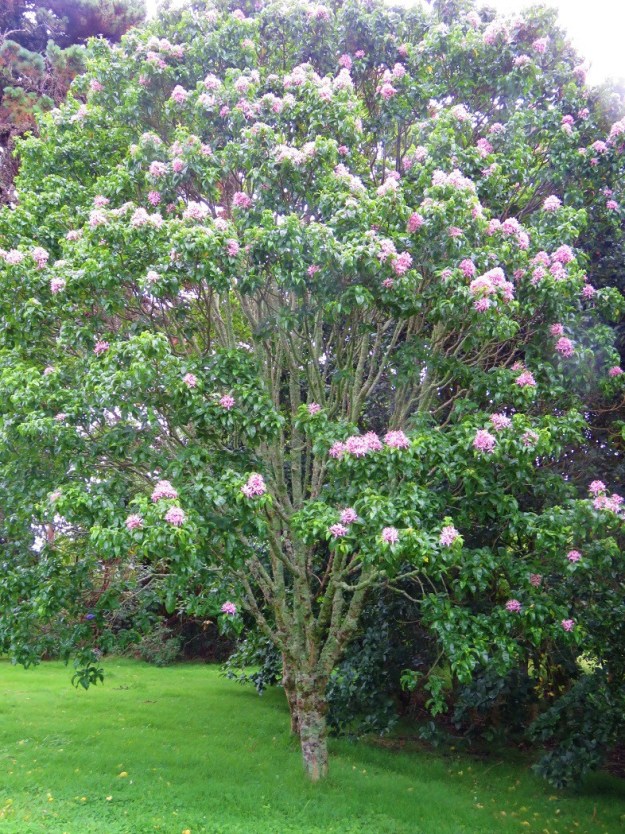
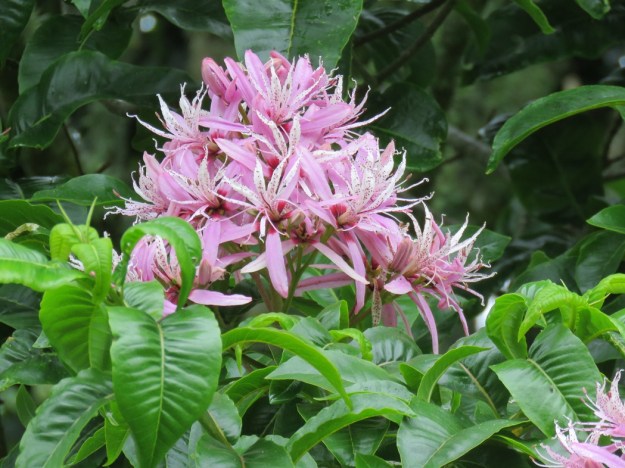
Calodendron capense 

Not an aesculus, a calodendron

Across the southern hemisphere, it is the south east of Africa that gave us the cape chestnut or Calodendron capense. This is another plant that probably prefers a drier climate and few more degrees of heat than we can give it but some years, it pleases us with a really good season in bloom. Even before I found its common name of cape chestnut, I noticed the similarity of the blooms to the aesculus, or horse chestnut. The edible sweet chestnut, by they way, is a different plant altogether, being Castanea sativa. It is not even a distant relative though there is some botanical heritage shared between aesculus and calodendron so the latter should really be the Cape horse chestnut. I haven’t found any advice that it is any more edible to humans than the common horse chestnut.

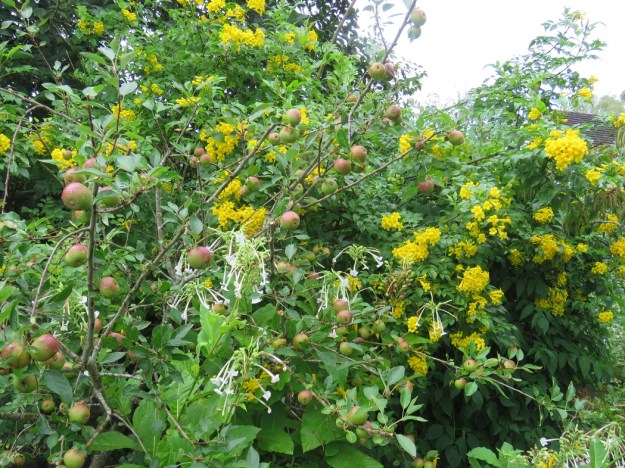
Tecoma stans – with apple tree and nicotiana in the Iolanthe garden 

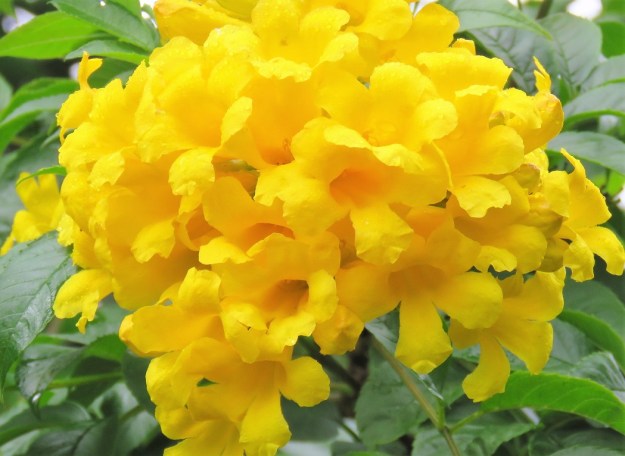
Tecoma stans – it is very yellow.

Tecoma stans is also from southern and central Africa and it is coming into its own now it is well established and has some size. It is growing in the Iolanthe garden where I have been working and because I have spent most of my time on my knees in that garden, eyes faced downwards, it was the bright yellow fallen blooms that first caught my eye. I had meant to photograph the falling blue of the jacaranda flower carpet but I left it a bit late so this is the best I can offer.

Jacaranda to the left, tecoma to the right – fallen flowers

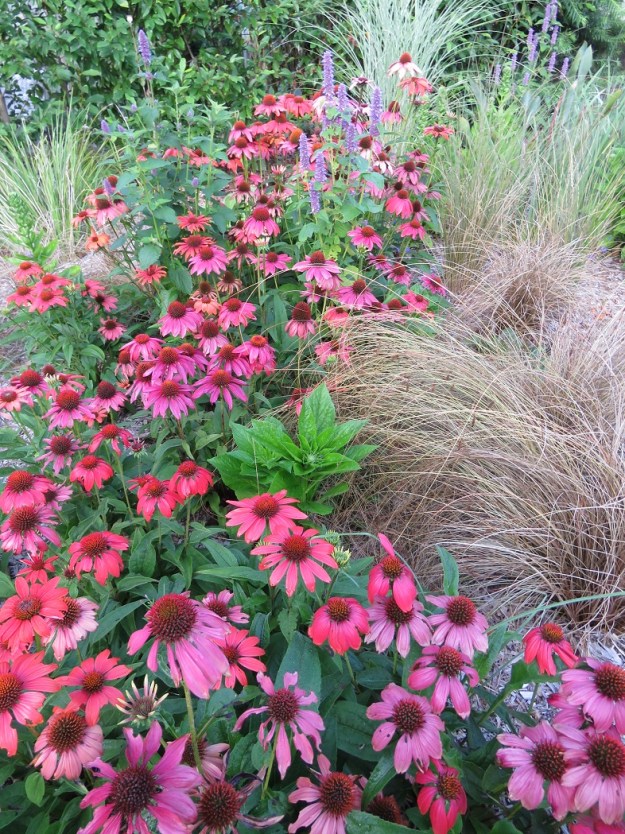
The echinaceas have been slow to come into their own this summer. Some were set back when I did a certain amount of digging and dividing of large clumps over autumn and winter but the main problem has been the rabbits. They never touched them in the previous two years but developed a taste for them in spring when they started coming into growth and it took me a while to notice.

Mark has been waging war on the rabbits this summer. Every evening he heads out with our useless fox terriers – one too old and deaf to be any good on rabbits and who just likes to feel a part of things these days and the other who has never really caught on to how to hunt. Dudley hangs around waiting for Mark to shoot them. “Come on Dad, hurry up.” He appears to think he is a retriever, not a terrier. Mark is simply gobsmacked at how many he has shot in recent weeks – around 23 in just one area of the garden that is probably only an acre or two in total. They are spread over the rest of the property – in fact, right across Tikorangi we are told by others – but they aren’t wreaking havoc there on the same scale as in the house gardens.

Mark is on a mission, the fairly useless dogs don’t want to miss out on potential excitement but fail to honour their terrier heritage

Next spring, I will be out with the blood and bone in early spring at the first hint of growth on the echinaceas. We beat the bunnies on the lilies though I admitted defeat and moved the campanula that they took down despite my best efforts. I will win on the echinaceas.