Win some, lose some

Alchemilla mollis in my garden

I photographed my patch of Alchemilla mollis for my friend, Chris. He, too, had admired the acid yellow froth in English gardens and wanted the same effect in his own home garden but found his efforts were not rewarded. This is as good as I can get it here.

Alchemilla mollis at Blooms of Bressingham in the UK

I do not understand why it never seems as lush. It originates from southern Europe so is presumably not dependent on winter chill. though maybe there are chillier areas in southern Europe because it certainly seems to perform better in cooler places with lower light levels. I even wondered briefly if what we grow in New Zealand as A. mollis is in fact its smaller cousin, Alchemilla erythropoda. But apparently the latter is much, much smaller so I guess not. It is A.mollis, but not as northern gardeners grow it.

Do not laugh at this poor little specimen of a veronicastrum. A lot of effort has gone in to getting it to this stage. The bamboo stakes were part of rabbit protection when it was even smaller.

I have written before about our single, solitary specimen of the blue veronicastrum, V. virginicum, which we have nursed through from seed to its second summer. It is even setting flower buds. It is just that the plant is only 20cm tall when it should be hitting two metres in bloom. It is clearly not a rapid grower and I wonder if northern gardeners buy established plants to start with. It is a common, hardy, American plant and nowhere in the international literature do I see mention of it being difficult to establish.

This was more the effect I was hoping for – at Le Jardin Plume in Normandy

This stronger blue veronicastrum, which will be a named form, was used by Piet Oudolf in Trentham Gardens near Stoke-on-Trent in the UK

We sourced two different packets of seed which disconcerted Mark when he came to sow them because they were so fine he got out his magnifying glass to check that he wasn’t just sowing dust. Despite being a professional at dealing with seed and going to the trouble of stratifying them in the fridge, he only ended up with this one, solitary plant. Time will tell whether it gets more strength and grows large enough for us to divide it. In the meantime, Mark is trying it from cutting as well. It is a plant we would like to use in our summer gardens but I would have expected it to be a little more enthusiastic in its second summer. In fact, I thought it would be a lot more robust and vigorous.

Astrantias are another mainstay of English summer gardens that we have tried and failed with. They flower and then just fade away. Heucheras are another plant that we have given up on. Once planted out in the garden, the lush nursery specimens just quietly sat and languished, failing to thrive. There is no substitute for trialling plants before investing too much money, time and energy on using them on a larger scale.

Scadoxus multiflorus ssp katherinae naturalising in our woodland

But I mustn’t moan. We do have our successes. I am pretty sure some successful growers of the aforementioned perennials would look with awe and envy at our summer display of Scadoxus  katherinae. We will have only started with a few bulbs, possibly just the one at the very beginning, and we certainly didn’t plant this large swathe in the woodland. They have just gently seeded down and spread a little more year by year without ever causing a problem. They have very large bulbs (of a similar size to a belladonna) which sit close to the surface and stay evergreen with that large, lush foliage for much of the year.

Gloriosa superba prefers full sun and has also gently spread itself around

Ditto the Gloriosa superba, at times a little more problematic with their natural seeding. They are one of the types of tuber that finds their own depth in the soil and they bury themselves really deeply. This can make them difficult to get out if they are in the wrong place. But when they bloom with that lovely reflexed shape, it is like having fiery coronets in the garden.

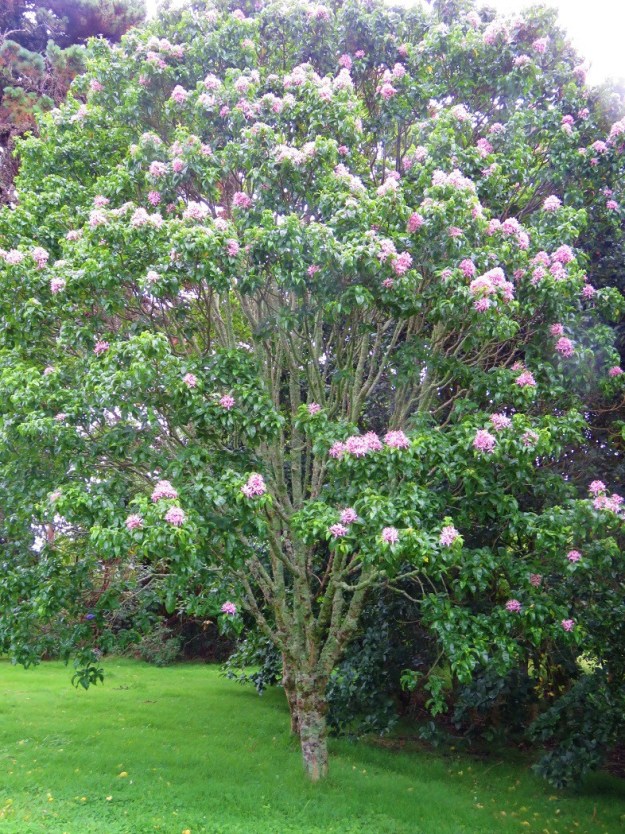
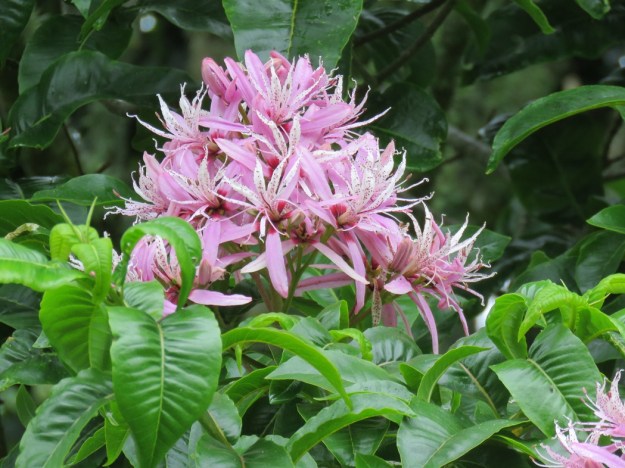
Jacaranda! In Tikorangi! We are not exactly within its normal climatic range of conditions

The jacaranda tree is having a good flowering this year, albeit not as spectacular as in drier, hotter climates. I love jacarandas so to have one that blooms in our conditions is a great pleasure. Blue flowered trees are not common when you think about it and the carpet of fallen blooms beneath is also a delight.

Pretty much the only flower I cut to bring indoors and one stem fills a vase and scents a room. We have hundreds in the garden.

And we are into the season of the auratum lilies. I pick some to bring indoors to scent the house and truly, they are gorgeous. We have hundreds of these in the garden AND NO LILY BEETLE IN NZ! For this we are truly grateful and thank our tough border control. Their peak blooming over the next weeks will more than compensate for the absent astrantias, hopeless heuchera, anticlimactic alchemilla and the very disappointing veronicastrum.

Aurelians, Asiatics, Auratums, Orientals and other flowers of the graveyard

‘High Tea’

‘High Tea’ on the left and a yellow Oriental to the right

I went back to the Te Henui cemetery this week to take my gardening friend some of the giant albuca she wanted. The dedicated volunteers keep the whole place blooming all year round but it was the lilies that caught my eye this week. One lily in particular was standing sturdy and straight with no staking and reaching a heady height of maybe 1.8m. “What is it?” I asked. “It’s an Oriental, she said. “I bought the first one from a bulb outlet and it is called ‘High Tea’ and the rest came in a mix of Orientals that I picked up at The Warehouse.”

The yellow one next to it was clearly an Oriental – and a very pretty one at that with good yellow colouring for one with Japanese auratum lily in its parentage. ‘High Tea’ had me puzzled and then I realised it was very similar to one we had at home that I relocated last year. I hadn’t noticed it before the previous summer but Mark and I had discussed it when it suddenly produced a fairly spectacular performance. Neither of us have any recollection at all of acquiring it in the first place or planting it in its original location. Mark took one look at it this morning and said, “It is an Aurelian”.

This took me down the rabbit hole of looking at lilium groups. Does this matter to the home gardener? Not at all. You can happily grow plants without knowing anything at all about their origins or relatives. But it is a bit like doing crosswords – some of us like the challenge and find it interesting trying to work out the genetic lines and the different groups.

Left to right: a typical Aurelian trumpet in soft orange, one of Mark’s Aurelians in yellow with larger flowers and better scent, an early auratum bloom at the back with its flatter flower, in front the Asiatic which resembles ‘High Tea’, and late blooms of Lilium regale on the right with a deep pink form which may or may not be regale but is an Asiatic.

We grow a lot of Aurelians and auratum lilies and they are a strong feature of our summer gardens. But neither of us were at all sure what the definition of an Oriental lily was. It turns out that Oriental is a broad term that takes in a whole lot of hybrids between different species but the dominant genes come from Japanese lilies. They flower a little later in the season and they usually have the best fragrance. L. auratum that Mark and his father before him have done quite a bit of work on to get a range of good garden plants here would be classified as falling within the Oriental group even though they are just variations on the one species.

What makes the cemetery yellow Oriental interesting is that it the result of an effort to get yellow auratum hybrids. Auratums come in shades of pink, white and red so the yellow has been introduced from a different species and will have involved some sophisticated hybridising techniques.

A very good yellow as far as auratum hybrids or Orientals go

Trumpet lilies from the wider Asian area have the catch-all term of Asiatics. They are not renowned for their scent, but we have a lot that are scented. They also have finer foliage and flower a little earlier in the season.

The Aurelian group is a blanket term for hybrids with L. henryii in their parentage. So all Aurelians are Asiatics, but not all Asiatics are Aurelian. Once you get into these larger groupings, the breeding can be very complicated involving several different species and hybrids.

So Mark was right that ‘High Tea’ is not an Oriental and it may indeed be an Aurelian. It is certainly an Asiatic.

Dierama

The graveyard is a splendid backdrop for plants. Lots of framing of small pictures that are a delight. Flowers this week included Dierama pulcherrimum which the internet and I know also as angel’s fishing rod but a social media follower declared was in fact fairy’s fishing rod on account of Tinkerbell but the detail eludes me. I like the graceful form and the gentle way the blooms age.

What we call calla lilies are not lilies at all. They are zantedeschia from Africa. I pulled most of mine out because they were too shy on flowering and not worth the space in the garden but this patch was doing well in the graveyard. The gardener in me wanted to rogue out the stray orange one. If the flowers look familiar, it is because they are the same family as the common arum which is a noxious weed in New Zealand.

Romneya couteri

The beautiful white flower that looks as though it is tissue paper is the Californian tree poppy, Romneya coulteri. It is one of those plants that is either extremely happy and inclined to become rampantly invasive or it is unhappy and it dies. Our attempts to grow it resulted in its death.

Beautiful, ethereal gaura floating like butterflies.

I assume this is false valerian (Centranthus ruber) but I will stand corrected if my assumption is wrong.

This local graveyard remains one of the very best places to see a huge range of flowers and some charming and well thought out combinations.


Raspberry nostalgia

There is only so much disaster news I can cope with. Usually I find solace in the flowers and trees of the garden. Yesterday, as I picked the raspberries, it was nostalgia that struck me in a huge, sentimental wave. One of the better aspects of growing older is that the store of memories grows greater with each passing year and sometimes I find myself drawing out past memories that I have not thought about for a long time. Though my raspberry memories flood back every year as I carry out the harvest here.

The summer of 1969 was a seminal event in my teenage years – the first experience of adult freedom. We grew up earlier then. I was only fifteen when, with my three best girlfriends at the time, we organised a summer stint fruit picking. We would rather have been picking cherries or apricots but it was a raspberry orchard in Beaumont, Central Otago, that was willing to employ us. In those days, orchardists provided basic accommodation and meals for their seasonal workers. In this case, it was a boys’ bunkroom and a girls’ bunkroom.

The picking of the raspberries. I think we were paid 45c a box. That is yours truly at the front.

Kate, Pippa, Clare and I thought we would have a great time – get suntanned, lose weight and earn money. We had a great time but none of the rest was the case. It rained. A lot. The raspberries went mouldy on the vines. The orchardist wife catered lavishly for us. With fresh scones, raspberry jam and cream on offer every morning and afternoon tea, I think all of us put on weight. The money was scant. Based on the kilo and a half of raspberries I am currently harvesting every second day, I think those wooden boxes probably held about 10lb or 4 ½ kilos. From memory, we were paid 45c a box. I remember working out that if the weather held and I picked as fast as I could until there was no more daylight, it was possible to pick eight boxes in a day. Even back then, $3.60 a day for close to 10 hours work was not great money.

Suffering from cabin fever in the rain, we persuaded Kate – the oldest one in our group and the only one with a driver’s licence – to requisition her mother’s car. Her parents were particularly amenable even when they were not best pleased. Four girls, cheap petrol and a Ford car. I have photos of the time taken on my Box Brownie camera. Very democratic, those photos were. One of each of us at Kate’s parents Arrowtown holiday house, then posing at the top of the chairlift on Coronet Peak (Pippa had the most model potential, I had all the glamour of a sack of potatoes) and heading out to the Beaumont pub for a celebratory dinner.

Posing on Coronet Peak. It may have been mid summer but it was still alpine.

Clare, Pippa and I had all sat School Certificate that year and the results came out in January. Kate was a year ahead of us at school. On the day the results were released, we clustered around the one phone in the house to make the all-important calls. I think I am right to say that a combined total of 200 across the top four subjects constituted a pass overall. The school we attended had set a mark of 330 as the point where they encouraged a student to skip the next year and go straight into the final year of schooling. Clare and I were aiming for that and to this day, I still feel a sense of guilt that Pippa’s relief at passing fairly comfortably (from memory, I think she got 246) was eclipsed. At 336, I met the school criteria for promotion (this is why I was only 16 when I started university a year later). Clare achieved a massive 372 and went on to study at Cambridge University. Memories can be oddly specific.

Ready for a celebratory dinner at the Beaumont pub. I am top right. Kate’s mother’s car and the bunkhouse also included, along with the shadows of the photographers with Brownie Box cameras.

I can’t remember what we ate at the Beaumont pub celebration on the day although I can still picture the setting in my mind. What I remember most is that they sold us a bottle of Gimlet, even though the legal age for drinking was still 21. Times were different. Gimlet was an early premix of gin and lime. Given our ages, I am guessing we diluted it with lemonade. With hindsight, it was just as well that Kate, as our driver, was a very modest drinker because the rest of us were certainly very merry, though not paralytically drunk.

Harvesting the raspberries always makes me think back to that summer of freedom, youth and naïve innocence.

In a sign of the times, Kate made contact with me through Facebook after a gap of maybe 40 years and honestly, social media has some very good points.

Spot the difference

I was going to write a piece this week shouting that now IS the very time we should be talking about climate change, aimed at the Australian prime minister, Scott Morrison, who left his burning country to holiday in the cleaner air of Hawaii, declaring that now is not the time for knee-jerk reactions to a major drought and extreme fires and neither is it the time to talk about climate change.

But the majority of Australians voted that man and his government in this very year and I decided that maybe I would leave it to those voters to reflect upon their collective decision and respond to their own environmental crisis. Instead I will focus on flowers.

Hydrangea petiolaris, resplendent in full sun, although it has its roots on the cool side of the fence. Most climbers appreciate a cool root run.

Both the common climbing hydrangea, H. petiolaris, and the less common Schizophragma hydrangeoides are in full bloom here and I have never lined them up side by side to compare them. We produced both commercially in our nursery days but concentrated more on the allegedly more refined and desirable schizophragma. What were the differences, I wondered, in visual terms?

Hydrangea petiolaris to the left and the white and pink forms of Schizophragma hydrangeoides. Petiolaris looks creamier because it is an older flower grown in full sun. 

Not a whole lot, was the answer when I lined them up. The pink form of the schizophragma is  indubitably a different colour – rosy pink sepals, not white. H. petiolaris has more fertile flowers (the central tiny blooms on the lace-cap) and somewhat smaller outer petals (ray florets or sepals). It makes it appear a little bit heavier perhaps, than the light dancing of the sepals on the schizophragma. The hydrangea also has larger leaves overall. All of them have a light scent with a slight variation between the two species but nothing of great note.

Schizophragma hydrangeoides ‘Roseum’

Botanically, there is a difference. They are distinct species, though from similar parts of the world (woodland Asia, particularly Japan) and liking similar conditions. Schizophragma is nowhere near as common as H. petiolaris and has the reputation of being slow to establish. But I planted that petiolaris many years ago and it took several years to reach its stride, too. Mark reminds me that the reason he went for the schizophragma over petiolaris was because the latter would not set flowers on young plants.

Schizophragma hydrangeoides

Plantspeople and those with refined visual sensibilities will pick the difference. I prefer the lighter, more ethereal look of the schizophragma. But overall, I concluded that Mark’s ‘man on a galloping horse’ analogy applies. A man (or woman, presumably) passing on a galloping horse would not pick the difference. To be honest, most gardeners wouldn’t either. They are both lovely at their peak and well behaved as far as climbers go.

Seasons greetings 2019

Meri Kirihimete

Merry Christmas

As another Christmas arrives, please accept my very best wishes for a safe and happy time to all readers and followers of this page. While we settle in to our version of a New Zealand Christmas (yes, the raspberries will ripen in time and the fresh peas are ready to be harvested for the day), I spent a rainy day this week gathering one of every white flower I could find in the garden to contrast with the homegrown strawberries. I did not feel the need to buy Christmas nuts this year since we have diligently applied ourselves to gathering and drying the macadamia harvest. 

But my heart goes out to our neighbours across the Tasman Sea in Australia. With unprecedented bush fires, drought and extreme temperatures, the simple pleasures of a temperate Christmas – or even a wintry one with or without snow in the northern hemisphere – seem irrelevant. Our three children all live on the east coast of Australia, fortunately in urban areas so not in physical danger except from the appalling air quality in recent weeks. Like many New Zealanders, we are tracking the devastating impact of catastrophic fires and it is so far beyond anything we experience in this country as to be incomprehensible. All we can do is watch from afar and hope that people stay safe. Kia kaha, Australia.

Abbie 

Assembling the bits in one place