Seasons greetings 2019

Meri Kirihimete

Merry Christmas

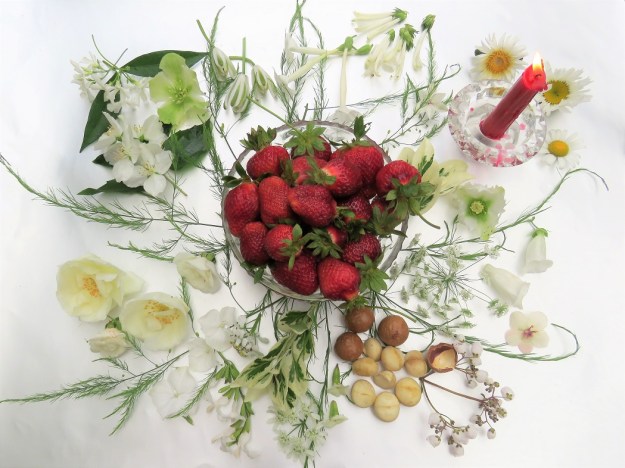
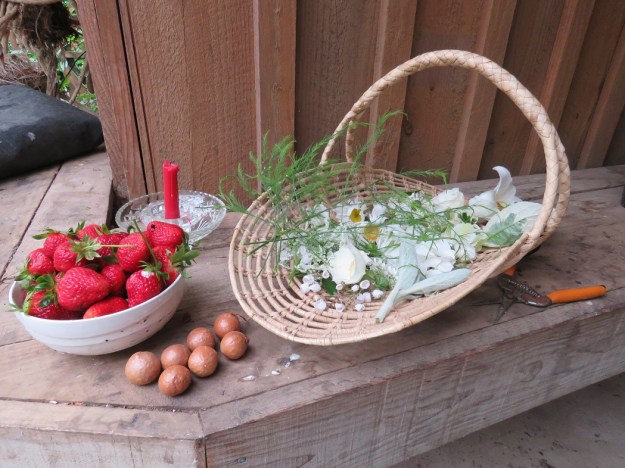
As another Christmas arrives, please accept my very best wishes for a safe and happy time to all readers and followers of this page. While we settle in to our version of a New Zealand Christmas (yes, the raspberries will ripen in time and the fresh peas are ready to be harvested for the day), I spent a rainy day this week gathering one of every white flower I could find in the garden to contrast with the homegrown strawberries. I did not feel the need to buy Christmas nuts this year since we have diligently applied ourselves to gathering and drying the macadamia harvest. 

But my heart goes out to our neighbours across the Tasman Sea in Australia. With unprecedented bush fires, drought and extreme temperatures, the simple pleasures of a temperate Christmas – or even a wintry one with or without snow in the northern hemisphere – seem irrelevant. Our three children all live on the east coast of Australia, fortunately in urban areas so not in physical danger except from the appalling air quality in recent weeks. Like many New Zealanders, we are tracking the devastating impact of catastrophic fires and it is so far beyond anything we experience in this country as to be incomprehensible. All we can do is watch from afar and hope that people stay safe. Kia kaha, Australia.

Abbie 

Assembling the bits in one place

From the nurseryman’s pen – the yellow pohutukawa

Metrosideros excelsa aurea

The much more common red Metrosideros excelsa

The yellow pohutukawa are flowering in my home town of Waitara. Metrosideros aurea. This is not without a tinge of sadness because the four biggest and best specimens on the bank of the Waitara River were felled – in our opinion unnecessarily – by a stubborn regional council despite a strong community effort to try and save them.

The letter reproduced this year in NZ Gardener

I have written about the yellow pohutukawa before, but my interest was piqued by a 1968 letter reproduced in the September issue of the New Zealand Gardener magazine. The letter writer was Victor Davies, who headed the powerhouse nursery Duncan and Davies and who was responsible for introducing the tree to mainland New Zealand by putting it into commercial production. I think we can take the letter as the most accurate historical record of that process.

It is interesting reading it 50 years later and realising how much times and attitudes have changed. The tone is a bit redolent of the old blankets, beads and muskets method employed by early colonialists to get down on treasures held by indigenous people. That is not a criticism of Sir Victor. It is just the way things were done.

A surviving yellow pohutukawa in Waitara

Sir Victor heard about the tree and was greatly interested because all the known pohutukawa on the mainland were shades of red. He could see the commercial potential of a yellow one so he tried repeatedly to get plant material. He thought he was successful when he managed to get somebody to send him scion wood. When the plants flowered five or six years later, they were all red. This may not be a surprise to many of us. In his own words, “After complaining, the reply I had was that as the tree was tapu they would never get any more material for me.” Personally, I think he was lucky to get a reply but his use of the word ‘tapu’ back in 1968 was interesting because not many Maori words had been incorporated in New Zealand English back then. ‘Tapu’ translates, more or less, to sacred. The yellow pohutukawa were a taonga – a sacred treasure to the original people of the land.

Undeterred, Sir Victor kept trying. Through a third party, a ‘friendly’ Maori was found who supplied material for twelve grafts – six red and six yellow. Allegedly, supplying the mix of red and yellow scions circumvented the tapu restrictions. Hmmm. Pretty dodgy, that.

Sir Victor goes on to say that they raised many thousands of seed and they all flowered true to type without any variation so the yellow form was deduced to be a stable species. I am sure the nursery would have sold thousands of plants too but not a single cent would have been returned to the original owners of the sacred tree.
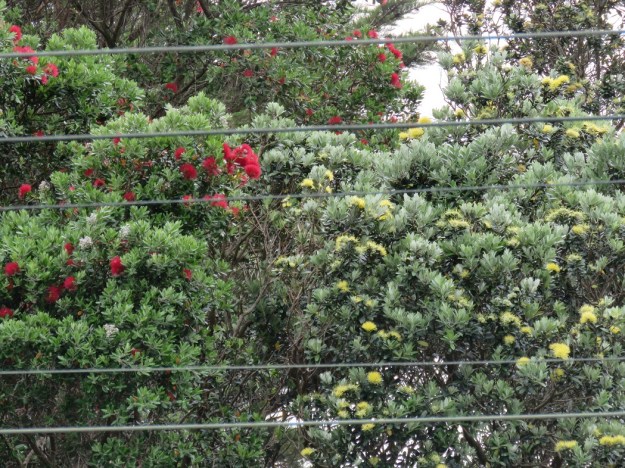
The red pohutukawa make better landscape trees but the yellow is certainly an interesting variant, plus power lines

Some of those trees were planted in Waitara, the closest town to Duncan and Davies Nursery and the surviving plants are what I photographed yesterday. Victor Davies was renowned for many traits, amongst them his remarkable sales ability. And the 1968 letter is headed “The Golden Pohutukawa” and he describes the flower colour as “dull gold”. There is a marketing ploy. Not gold, pretty lemon yellow. It is certainly lovely viewed close up but it doesn’t show out in the landscape as do the more common red forms, Metrosideros excelsa.

Christmas is coming and the red pohutukawa are widely known as the New Zealand Christmas tree.

Way up high, where the birds fly

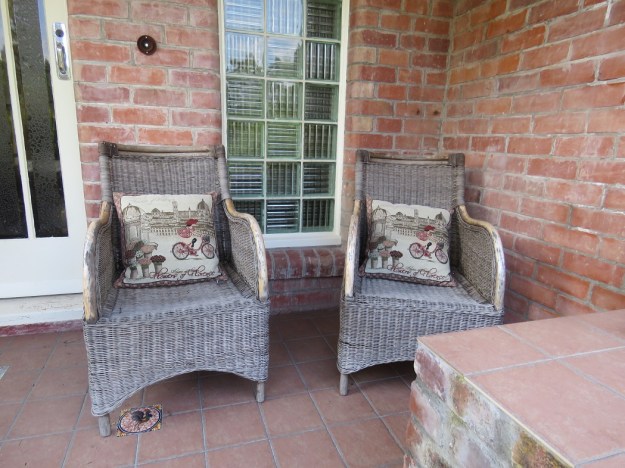
There is an entire ornithological condominium in the Queen palm at this time of the year. We know this because it is also the time of year when we retire to our Darby and Joan chairs on the front porch for the pre-dinner drink, As we sit gazing out to the garden, the flurry of feathered activity in that particular location is unmistakeable. There is a lot of coming and going.
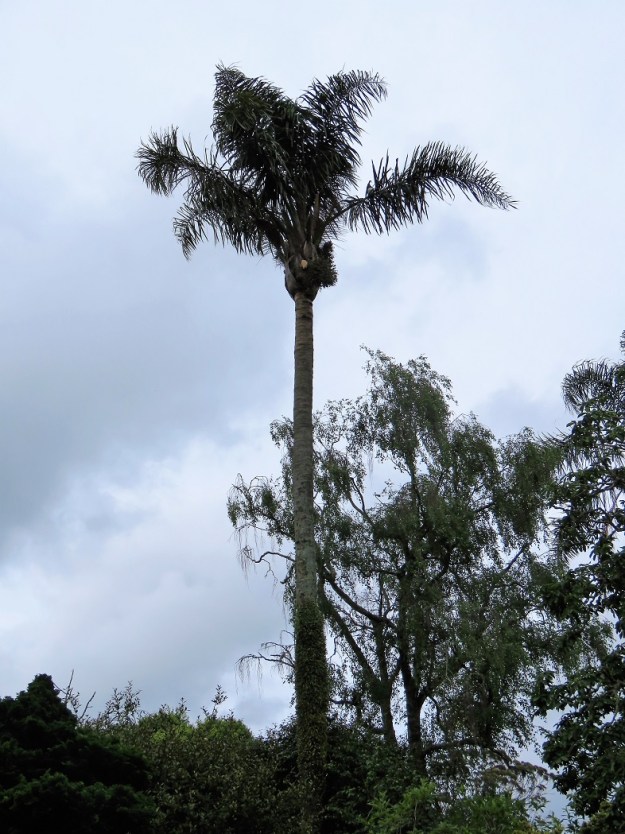
The palm is Syagrus romanzoffiana, a fine South American variety.

Syagrus romanzoffiana

The nests are way up high – a good fifteen metres or more. Sadly, when fledglings fall or are pushed out of the nests, they can not survive that drop and we get a few fatalities lying around the base of the tree. But every year, we are surprised by just how many birds are occupying their nest apartments way up high. Mark has better identification skills than me so I will take his word for it that there are miners, starlings and sparrows nesting in amongst the fronds but we have not managed to work out how many of each there are. These are all birds that have been introduced to New Zealand.

The rent collector

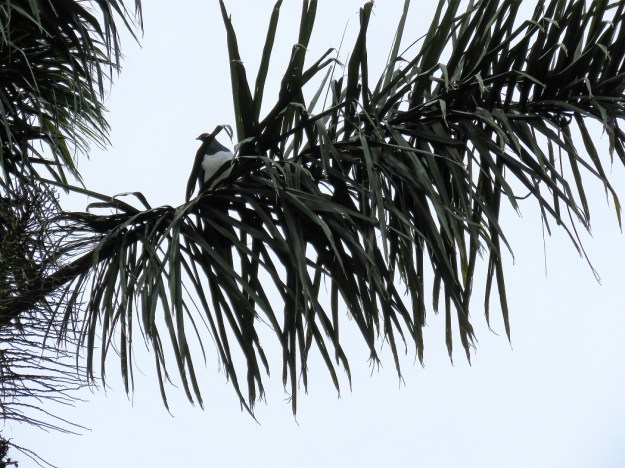
But what is the kereru doing there, I asked him as I zoomed the camera in on the unmistakeable figure of our native wood pigeon.  Quick as a flash came the reply: “Collecting rent.”

Our Darby and Joan vantage point


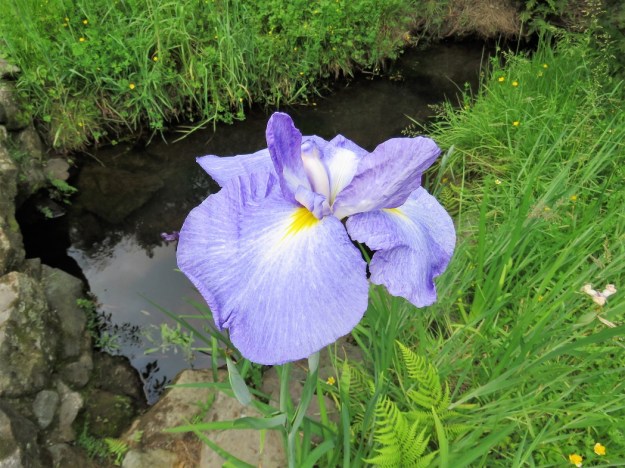
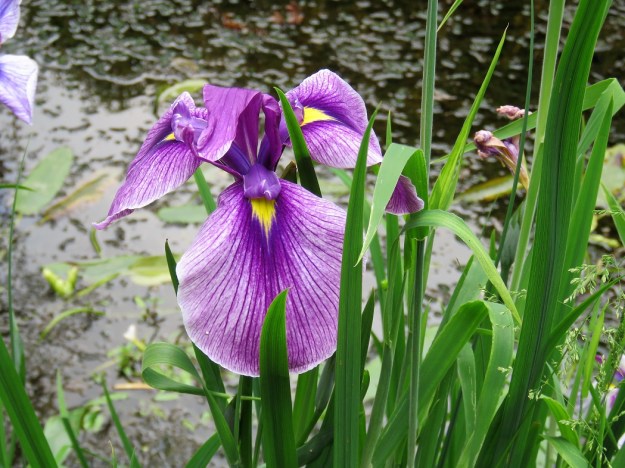
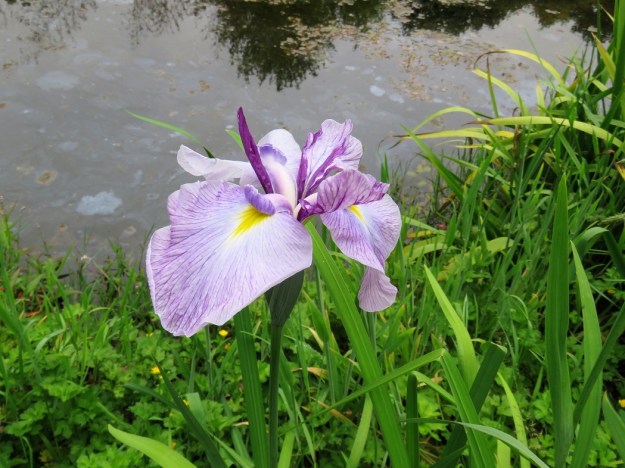
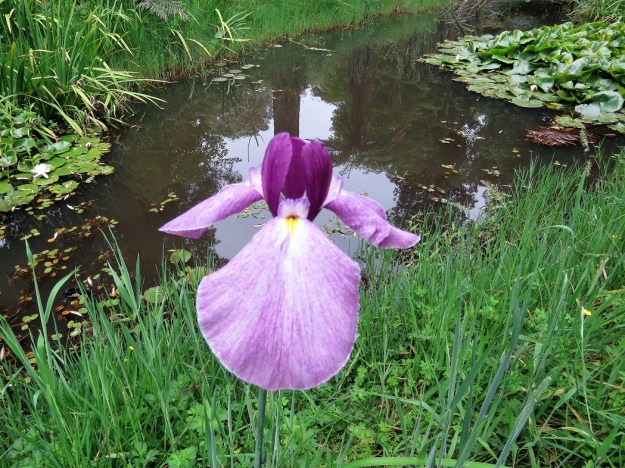
Down in the water meadows, the Higo iris bloom

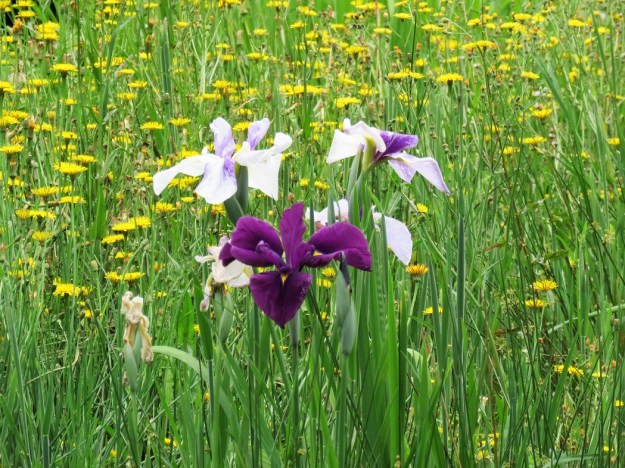
Higo iris float above a sea of dandelions in the Wild North Garden

I really like that the Japanese Higo iris are such a big feature of our December meadows yet they almost certainly descend from the Japanese quest for a perfect, single bloom as a focus for contemplation. It is such a wonderful contradiction – that quiet refinement, simplicity and elegance that the Japanese traditionally bring to flowers generally and the wild abandonment of our Tikorangi meadows.

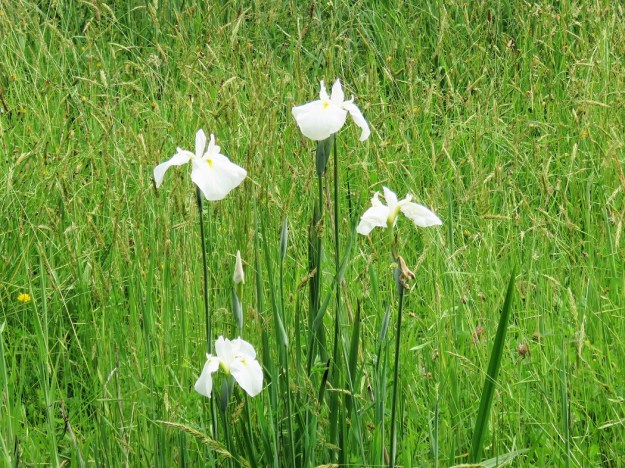
Smaller flowered, white Higo in the park meadow

Higo are not a separate species of Japanese iris. They are hybrids, bred over 500 years, originating from Iris ensata. There are three groups of iris from these breeding lines – Edo, Higo and Ise but the best known are the Higo. Our Higo were given to us by Auckland plantsman, Terry Hatch of Joy Plants, and apparently originated as wild collected seed. Mark had a discussion with Terry about wanting to try naturalising Higo by the stream but the finely bred, named cultivars were not sufficiently robust to survive in a situation of benign neglect. Terry offered up a tray of about 700 germinated seedlings which seemed a bit of overkill at the time. Now we bless him every year. Not all 700 survived, I hasten to say, but we had plenty to play with.

and a much larger flowered white Higo iris 

The blue is less dominant than the purple shades of Higo 

Because our plants are all seedlings, we have a fairly wide range and some clearly show their I. ensata heritage. Others are pure white, pink, almost pure blue and the whole range of violets, purples and lilac.

More Higo iris

I see the oldest plants are now in their ninth year or so of being planted on the banks by the stream and ponds and they perform reliably every year. Given they have stiff competition and receive absolutely no care or intervention, that makes them very robust plants. I tried some in a mixed border at one stage but they were too strong a grower with leafage that swamped out surrounding plants during summer and autumn so I removed them.

Can we have too many Higo iris?

A few years ago, I planted the last of the neglected pots from the nursery down in the area we call the Wild North Garden and this year, some are starting to bloom. They are much more rewarding than the Louisiana iris we grow where the leaf to bloom ratio is too high.

Seedling variation in the Higo iris

From mid to late November through until Christmas, the flowering of the water iris is such a delight. Like over the top butterflies, they float in the air above a sea of buttercups, dandelions, daisies and wild grasses and they truly make my heart sing.

In the park meadow. The Wachendorfia thyrsiflora with its tall yellow plumes has a death sentence on its head – too free with its seeds to keep it by a waterway 

The Wild North Garden – I am waiting for more Higo iris to bloom

Seven long years to bloom and then it dies – Cardiocrinum giganteum

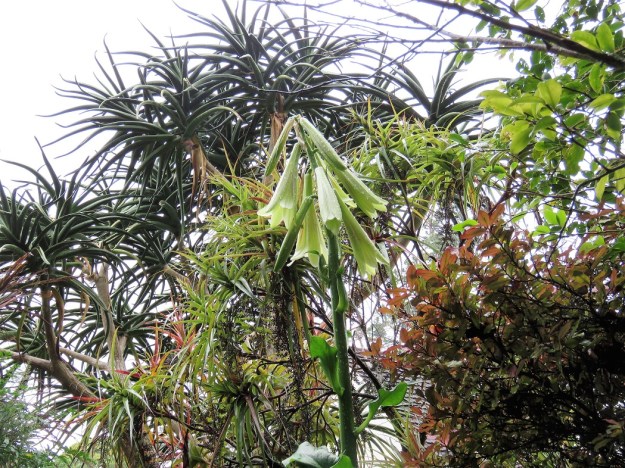
The giant Himalayan lilies are coming into bloom. Cardiocrinum giganteum. It is the biggest of the lily family, hailing from areas like Tibet, Bhutan, Assam, Myanmar, Nepal and Sikkim.  It feels a bit of a triumph that we now have this bulb naturalised here. We haven’t planted any for many years and just allow them to grow where they pop up from seed.
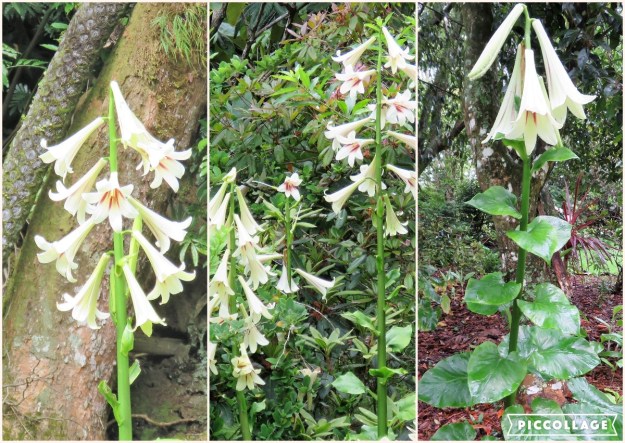
The largest lily of them all – Cardiocrinum giganteum

These are not lilies for the home gardener on a small urban section. The flower spikes often reach three metres here and have been recorded at up to five metres. Fortunately, the stem is such that they can hold themselves up.

Usually six years of foliage and in the seventh year, it puts up an astounding flower spike

The main obstacle for most gardeners is that the bulb takes about seven years before it flowers and then it dies. Fortunately it makes offshoots around the main bulb as well as setting seed but those offshoots can take another five years minimum before they flower and the seeds take seven years. These are not lilies for the impatient gardener. And, while very fragrant, the flowers are a long way up so unless you have a grove of plants flowering at the same time, you are unlikely to get the benefit of scent. In the intervening years, they just form a clump of large, heavy textured, heart-shaped leaves that are reasonably anonymous.

Typically, these plants need cool, open, woodland conditions with soils which never dry out and are rich in humus. Those are pretty specific conditions.

The top photo is one of those really, seriously peculiar plant combinations that are a characteristic of many New Zealand gardens – a self sown Cardiocrium giganteum from the Himalayas, flanked on the right by Pseudowintera colorata (commonly known here as the mountain horopita or pepper tree) with Dracophyllum latifolium behind (both NZ natives) and then what we know as Aloe bainseii but is now, apparently, Aloidendron barberae – the tree aloe from southern Africa. It is a veritable United Nations of plants here.