Farewell Noble Fir

Abies procera glauca – a handsome tree in the wrong place

Farewell Blue Noble Fir. The Abies procera glauca is no more. This was not a decision we reached lightly. The tree was almost as old as our house, planted in the early 1950s. It started life here as a pleasingly pyramidal tree in the rockery but when it soon showed that it was not going to remain suitably compact, Felix moved it to a new location beside the driveway. It was placed so it did not block any sun from the house, though it did cast shade over the washing line. And it grew and grew.

Abies procera cones – several barrow loads fell every year

Abies procera is native to USA, particularly north west California and Oregon and it can grow to 70 metres high, some recorded even at 90m. I do not think Felix checked its potential height when he planted it or he would have put it down in the park. In its 65 years here, it reached maybe 25 metres and it was not stopping growing. Mark began to express anxiety about it several years ago. It took me a while to come around to the idea of removing such a handsome specimen. As it grew taller, its spread also increased and Mark was getting worried that the enormous cones – up to 20cm in size – would soon start falling on our fragile roof tiles. They would crack every tile they hit. We have never had either person or vehicle hit by a falling cone but that is more by good luck than good management, given its prime location.

Oh look! There it is in the rockery in the 1960s before being moved further (but not far enough) from the house

More worryingly, the weight of the tree was on the side closest to the house which meant that if it came down, it would fall on the house. It would, in all likelihood, demolish much of the house. With growing experience of falling trees here and mindful of the high probability of increasingly severe and frequent weather events, it just wasn’t a risk we were comfortable taking any longer. We have many trees, some very large, but this was the only tree that threatened the house.

This was a job for a specialist Because of its sheer size, its location close to the house, surrounded by some rather special plants we wanted to save, stone walls, pond, septic tank and other considerations, it was going to need to be dismantled and taken down branch by branch. We discovered we had an arborist up the road and asked for a quote. The price came in at considerably less than I had feared and we crossed our fingers that he knew what he was doing. He did.

The location and flat grown meant a cherry picker could be used, for the lower 17.5 metres at least

The operation took two days. On the first day, he used a cherry picker with a reach up to 17.5 metres to remove almost all the side branches and foliage. Goodness, the cherry picker makes an arborist’s job much easier, faster and presumably safer. We watched in admiration as he was able to control dropping branches in the few, available clear spaces before he had to move onto roping and then lowering larger pieces by winch. It was only the top eight metres he had to do by climbing into the tree.

On day two, he dropped the last length of stripped trunk in one piece. He and his assistant – on this occasion, his wife – cleaned up as they went, chipping the branches and foliage so that we now have two truckloads of fresh garden mulch. When he left at the end of day two, everything was cleaned up except the wood that is to be split for firewood. All the mess had been raked up and the paved areas cleaned with a leaf blower. The total damage was limited to holes in the lawn where heavy branches had hit and one camellia that is a little smaller than at the start. Given the tight space he was working in, we were super impressed.

If anybody local wants a skilled (and cheerful) arborist, contact me. We are happy to recommend him.

For those of you curious about the firewood: yes, there is plenty of it but it is really just like soft pine so fine for burning but not top quality.

Picea omorika is the narrow tree in the centre. It, too, will have to be felled before it falls of its own accord

The Picea omorika still has to be dropped. Again, we hesitated but it will fall too, and probably sooner rather than later. It is a good example of a tree that was not kept to a single leader in its infancy. It grew with three trunks. Two have split out in storms in recent years, which is why we think the remaining trunk will also go. If we get it dropped, the damage can be controlled and I can still keep the essential bottom two metres to which the washing line is tied.

Alas poor kereru

We certainly felt sad to fell a mighty Noble Fir. We felt even sadder when on day two of the process, a kereru (our lovely native wood pigeon which is regarded as vulnerable, though not endangered) flew straight into an upstairs window and died. We had wondered why birds did not hit those windows when they hit the other upstairs windows, but now realise that it must have been the proximity of the tree that slowed their flight. I went to town the next day and bought a curtain rail and sheer curtains to screen the windows. While we would prefer not to have screened windows, the threat to birds from our double-glazed windows which turn into mirrors on the outside, outweighs our personal indoor preference. Bird strike is not a problem when windows are open because of the change in angles, so we hang screening curtains on curtain hooks and rail (as opposed to curtain wire) so they can easily be pulled to one side when the windows are open.

Maybe the key point of our late Abies procera, is that when planting trees, it pays to look to the future – not 20 years but 50 or more. A miscalculation by the previous generation can leave a vegetable time bomb for the next.

Trees – some for removal, some that should never have been removed and one that is not going to be removed

Abies procera – sadly, reluctantly for the chop. I took this photo from our bedroom window – imagine the impact of this tree crashing into the house.

Trees have been much on my mind this week. Tomorrow an arborist team is due in to take down the Abies procera close to our back door, limb by limb. I shall take photographs and report on progress next week. It is a large and handsome tree but the risk of it falling so close to the house is now just too high. It could potentially take out most of the house.

The good burghers of Mount Albert in Auckland have whipped themselves into a frenzy this week over the planned removal of 345 exotic trees from the recreational area that they know as Mount Albert but more correctly referred to as Ōwairaka. I had a look at the list of trees marked for removal and while there are a few that may be of merit, most are banksias, eucalypts, cherries (likely seedlings of P. campanulata), willows and olives. All have their place, but they are probably not worth getting too upset about. The plan is to replant with natives to extend the native trees already growing on the site.

Talk of removing exotics to replant with native species is enough to wind up some sectors of the populace with talk of ‘PC gone mad’. And indeed, I felt a little defensive myself. I am, after all, a Jury and our defining tree is the exotic magnolia. But then I read this piece on The Spinoff and I decided that I did not need to have an opinion on this matter. Those iconic landscape markers referred to as ‘mountains’ in Auckland – defunct volcanic cones that are definitely small hills now as opposed to proper mountains – are privately owned by iwi of Tāmaki Makaurau and they generously allow continued public access to this land. They are not public reserves. These maunga have spiritual and sacred significance for Maori and if they want to clothe their land in purely native trees and re-create the pre-European landscape for these landmarks, that is their right and that should be respected.

I can not help but suspect that some of the loudest voices may come from people who would happily fell a tree on their own land because it casts shade, breaks up concrete or drops acorns that are, allegedly, dangerous. That last link leads to a story of another application in Auckland to remove a protected oak tree that was clearly growing for many, many decades before the current house was built so the owners must have known the protected tree was there when they purchased the place. They want to remove it and are offering to replace it with… (drum roll, please) a feijoa which is more a shrub than a tree. Personally, I would have thought that fallen feijoas would be more hazardous than fallen acorns.

All I can say is that Urenui has changed a little since we lived there. The hair house used to be a craft shop and the Ngati Mutunga offices were the local convenience store.

Our eldest child came home for a visit this week, bringing our only grandchild with her. He is only three so we had several days out and about, combining adult and small person interests. A fish and chip lunch at a nearby seaside settlement named Urenui was on the agenda. This was for purely sentimental reasons. We used to live in Urenui and it is where our children spent their early and middle childhood years so it is a place full of memories.

The grandson’s enthusiasm for swimming waned somewhat in the face of light rain and a chill wind but we looked across to the riverside reserve that bounded our old property. It is eroding. Of course it is. Much of New Zealand’s coastline is eroding and even 25 years ago when we left, the erosion potential was fully understood.

It was for precisely that reason that Mark planted pohutukawa trees at generous spacings along the river reserve. He did it properly – first getting permission from the Council and then involving local residents in the planting in order to establish some sense of community ownership of the trees. And he selected cultivars with different flower colours – albeit all shades of orange and red – to give variety and interest. The wide spacings were so that they would not block residents’ water views. Mark’s plan was that the trees would act both as markers for the eroding bank and also provide some stabilising against that very issue. Pohutukawa (Metrosideros excelsa) are particularly well adapted to growing right on the coast with massive root systems which can stabilise crumbling banks.

Mark’s pohutukawa forming a buttress against the erosion caused by tidal rise and fall

It must be at least 15 years ago that Council decided, in their wisdom, to remove some of the trees and relocate them to Waitara. The official story was they were *saving* the trees from falling into the river but we knew that was a nonsense. It is far more likely that a local or two complained that they were starting to block their views because the removals were randomly spaced.

I distinctly remember that a tree was removed from this spot and oh, look. It has eroded so badly now that it needed a rock retaining structure installed to protect the road

One or two trees were removed from this stretch

and more erosion further along the bank.

Ironically, as we ate our fish and chips across the river, we could see the surviving trees that Mark planted and it is clear how well they are retaining the banks around them. Where the rock retaining wall has now been put in on the corner is the exact spot where one of the trees was removed. I remember this well because Mark and I went out to have a look at the time and the tree removal had already damaged the bank and it was visibly crumbling. If they had left the tree in place, it might well have saved the need to install a rock retaining wall instead.

Prunus Pearly Shadows a week ago

and the petal carpet beneath two days ago.

Finally, I give you the delight of falling pink snow – the petals of Prunus Pearly Shadows this week. The flowering has been a little later this year but the charm does not fade with familiarity. It is on the edge of our visitor carpark. Even though no fewer than three cars have reversed into this tree over the years, we have no plans to remove it. It is extremely visible and in a large space so we put the unfortunate incidents down to driver inattention.

Six years on: meadow update

It is six years to the very day since we closed the garden to the public. And that means it is six years since we started to experiment with turning the park into a meadow. Up until that point, we mowed it all year – no easy task because it is undulating terrain across about four acres filled with specimen trees and shrubs and a stream. The areas that could not be mown – the stream banks and steepest gradients – were kept short with what we call a weedeater in New Zealand but many others know as a strimmer. It seemed important to maintain a similar level of control to that seen in public parks, even though this is a private garden.

Iris sibirica, Primula helodoxa and loads of buttercups

Six years on, how do we feel? We love it. It often makes my heart sing in ways in which the previous tight control of grass growth did not. It is a different mind-set altogether.

How it was, all mown, trimmed and tidy up until six years ago 

and how it looks today

We weren’t at all sure how it was going to work out. This is good dairying country which means we have verdant grass growth all year round, unchecked by summer droughts and winter cold. We have to mow grass twelve months of the year to keep it under control. And decades of gardening predicated on very tight weed control is hard to overcome. The love of meadows is inextricably linked to a higher tolerance for what are commonly called weeds. Buttercups, daisies, dandelions and Yorkshire fog, we have in abundance.

As it was before 

and as it is now. The orange azalea died and we removed the yellow flag irises on the grounds that they are a noxious weed by waterways

We were inspired to experiment with a softer edged, more romantic approach to gardening by our trips to the UK in particular, allied to growing concern that our approach to gardening carried a carbon input that was closer to a heavy hoof-print than a foot-print. We haven’t set about systematically measuring any increase in wildlife but we like to think that the changed approach is far kinder to nature. And as we age, we are also considering the labour input to the garden, given the fact that we have no plans to move off the property to a more suitable retirement home. We’d rather spend our energies on more constructive gardening activities than endlessly beating grass into obedient submission.

It is not a gardening style that will appeal to everybody. It is not neat and tidy. It does not show off man – and woman’s – ability to control nature to make it conform to the tight standards of suburban gardening. Some may look at it and think that it is uncontrolled, allowing the place to ‘go back’, although that is far from the truth. Meadows in the garden need management. It is not a question of just stepping back and letting it go. We still take out certain weeds, we mow paths, we manage the growth by mowing twice a year (in January and July), plant to enhance the richness of the meadow mix, we keep certain plants free from the rampant growth – so we keep an eye on it but with a much lighter hand.

As it was all mown (and scalped in places) with our much loved dog of the day, Zephyr

There is a problem with the frequent floods bringing unwanted weeds down from upstream which can then get established in the long grass before we have even spotted them. The war against wandering jew (Tradescantia fluminensis) and montbretia (Crocosmia x crocosmiiflora) will be without end unless upstream residents eliminate them. I am not keen on the docks and there is a nasty carex I dig out. But that is a smaller price to pay than trying to control every plant escape except paddock grass.

Just two years ago, our son cleared both big ponds of water weeds 

and already, they are back with a vengeance. Time to stop fighting them?

The next issue for us is to decide what to do with the two big ponds Mark put in back in the early 1990s. Our son raked them out last time he was home a couple of years ago but they are now congested with water weeds again. I have gone through every few years and raked the weeds out of the stream but it is heavy work and my back no longer appreciates it. All three of us here nurse our backs and wrists these days. I am now thinking that we live with what nature gives us. The stream flows well all year round so maybe we should just let it determine its own path and allow the ponds to silt up and return to bog or swamp. The irises, lysichitons and primulas are happy in bog conditions so maybe we are better to just concentrate of enriching the natural bog gardens rather than trying to keep a larger body of water visible. The stream is high in nutrients from dairy farm run-off (we can tell this by the particularly bright green shades of the weeds growing beneath the surface, as a water ecologist pointed out to us) so the water weeds will continue to thrive.

In another six years time, we may well have mega bog gardens but time will tell.

Rhododendron Barbara Jury 

Rhododendron nuttallii x sino nuttallii in the park meadow

Knitted smallgoods!

Away from gardening for this post. Our local town of Waitara never fails to surprise me. Over the last four decades or so, Waitara has suffered the fate of many small towns with a decline in retail outlets. Most of the main street retailers seem to be either takeaway food outlets or charity shops now with a fair representation of empty premises. So it was that  I had failed to notice the window display in the disused butcher’s shop. Knitted meats!

Red saveloys, larger brown salamis and strings of sausages – pink for uncooked, appropriately beige for pre-cooked barbecue ones

I may have laughed out loud. Here is whimsical folk art on the main street. The windows were pretty dirty and the light conditions were less than ideal, but I offer the best of my photos for your amusement. I think it was the strings of sausages (both raw and precooked and labelled as such), saveloys and salamis that amused me most.

Others may be more impressed by the mince. Or maybe the bacon or chops. All presented on clear plastic trays and covered in cling film as the real produce usually is. It all just seemed like an idea off the square to fill an empty display window but with a debt to historical context. Waitara grew to be more than just a coastal cluster of houses because it had a huge freezing works (meat killing and processing plant). First started in 1881, the permanent closure of the works in 1997 dealt a body blow to the town which took well over a decade to recover from the shock and disruption.

The window on the other side of the locked door contains an eclectic mix of seaside accoutrements plus penguins. A knitted diorama, no less. This may appeal more to children but it was the unexpected cultural and historical context of the knitted meats that took my fancy.


Tikorangi Notes: a folk art garden, bearded irises, macadamia nuts and a bit of advice

Pat and Brian’s garden 

Either Pat or Brian – or both – like a bit of symmetry in places

I called in to see a local friend and as we walked around her garden, I figured that what she creates is a form of folk art. Hers is a heavily ornamented and decorated garden and regular readers will know that this is not my style at all. But I find Pat’s creative instincts charming in context. Many of her garden pieces have a story to them and they all have meaning for her. She doesn’t just buy something and place it in the garden. She repurposes, restyles and recycles items that others would dump and they bring both her and her husband a great deal of pleasure.

Rusty old cream cans repurposed to grow air plants 

Washing machine bowls reused as strawberry planters

Pat does not know the names of any of her plants and she has no botanical curiosity. But, and it is a big but, she has an eye for good plants and she has always been willing to buy plants that take her fancy. While she may not know the names, there are some interesting plants and a wide variety within her garden.

Above all, I think I like her garden because there is personal joy in it for both her and Brian. It is not a show garden but they keep it very tidy indeed because that is how they like it. I have been into a few gardens in my time that I would describe as joyless places, done for show and admiration from others, but more like a chore for the owners than a source of personal delight. Give me Pat’s folk art instead any day.

My blue-purple bearded irises are all in bloom. We are not bearded iris territory – they are better in drier climates with hotter summers than we get – and it is not easy for me to find good places for them. I was given a number of excellent named varieties several years ago but I see I only have one variety left and I have lost the name of it. It has a large flower and is very pretty, arguably much more so than the smaller flowered, robust one that forms most of my patch. But that is looking at the blooms as specimen flowers. Grown as a bed of several square metres, the plain Jane, utility variety is a way better performer. The big powder blue needs staking or it starts to lean and then the blooms get damaged very quickly. There is a lesson there if you are buying bearded irises. If you want to grow them as single specimens and are willing to stake and support them, then go for the big flowers if that is what appeals to you. If you want to do a bed of pretty colour, choose smaller flowered varieties that can stand up straight on their own.

Decorative pink racemes of macadamia flowers. The white flowered forms we have are nowhere near as eyecatching. 

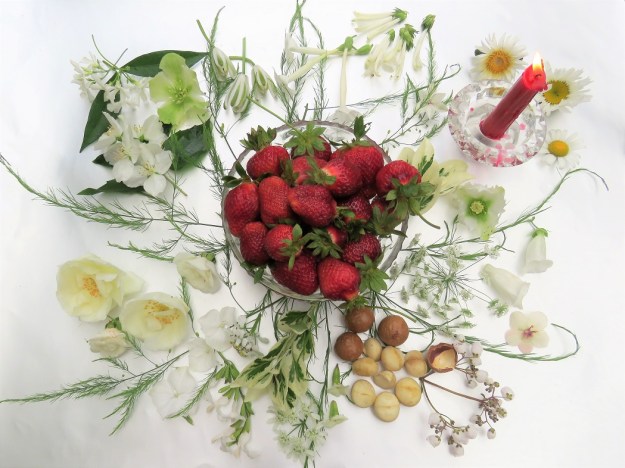
Our macadamia trees are flowering and the nuts are dropping. There are reasons why these nuts are expensive to buy and it is to do with the cracking of them, I am sure. Astonishingly, the rats can bore into the rock-hard shells but it takes careful positioning and a sharp hammer blow for humans. We have tried a range of different macadamia nut crackers but they are tedious to use when you have to load the nuts one at a time and then separate them from their shells.

A simple mat but a gamechanger when it comes to cracking macadamia nuts

I love social media. It makes my world larger, as I say. It was Twitter that delivered me a recommendation last week that is a game-changer when it comes to cracking macadamia nuts. Get one of the doormats with round holes in it, was the advice. We just happen to have what I assume is calf matting that serves the same purpose – holding the nuts in place so they don’t skitter away or worse – fly into windows and break them (this has happened before). Now, we can crack up to 100 nuts at a time and have them stay in place. True, it takes 100 hammer blows to crack 100 nuts but then lift the mat, remove the kernels and sweep away the shells and Bob’s your uncle. I am picking up the falling macadamia nuts with a great deal more enthusiasm.

Finally, two pieces of seasonal advice. In New Zealand, the weeding round right now (that you may or may not be doing but we certainly are) is arguably the most important one of the year. The weeds are romping away but not many are setting seed yet. If you can get them out now – right now – you will reduce future weeding. And get mulch onto any bare soil before it really starts to dry out. That will also contribute in a major way to stopping more weeds from germinating.

We don’t clip many plants but this little camellia collection makes a focal point at our entry

If you are pruning or clipping, keep a close eye out for birds’ nests. Our feathered friends go to a huge amount of trouble building nests and while I may moan about the sparrows and blackbirds, there is something very sad about committing the ornithological equivalent of infanticide. We are currently doing the annual clip and shape on the camellias and michelias that we like to keep as defined forms. Hedges were done last month.

Mine No Yuki received her annual trim this week