More on belladonnas

Needing a break from a garden task, I wandered around with my flower basket, curious as to how much variation there is in the belladonna flowers still in bloom, given that ours are all seedlings. A fair amount, it turns out, in colour and size. This was not an exhaustive survey into the average number of blooms per flower spike, variations in flower form and length of time in bloom. There are limits to how interested I am in this particular genus.
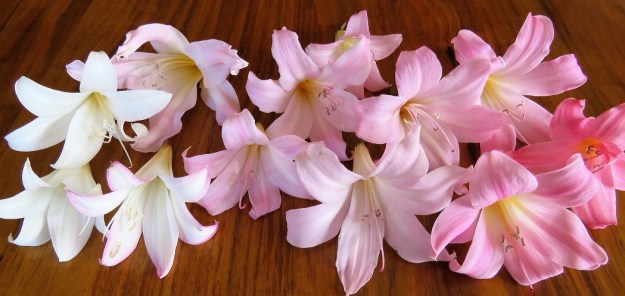
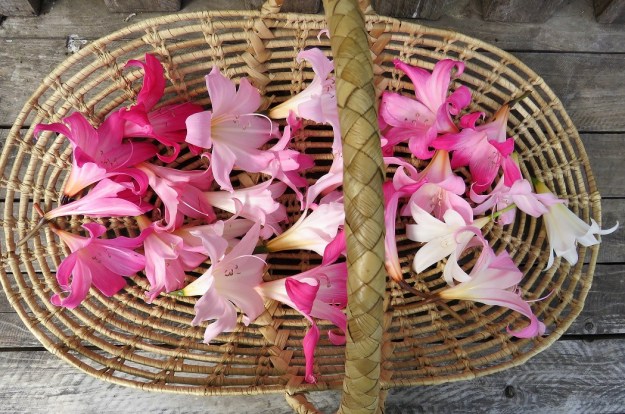
Paler hues – 3rd from left has quite a sweet picotee edging. The one on the hard right was a noticeably different colour verging on more apricot tones – presumably the yellow throat bleeding colour further into the pink

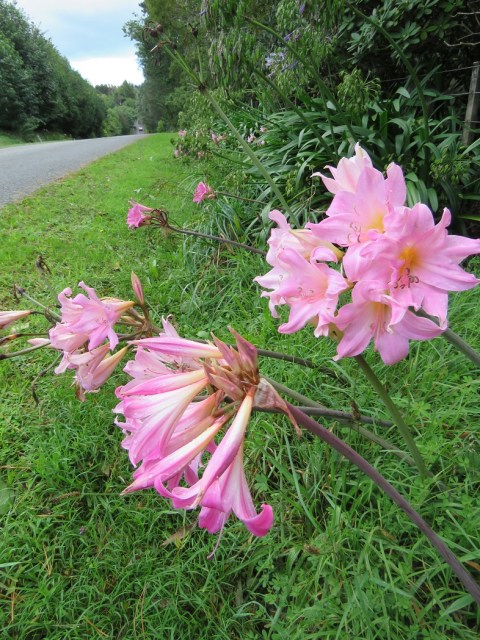
There were a few interesting breaks – the palest form with pink picotee edging, the one which appeared to be developing apricot tones rather than shades of sugar pink, a big deep cerise one with an attractive white star within the trumpet. Some plants have noticeably larger blooms but, as with many plants, this can make the flowers more vulnerable to weather damage and often with fewer flowers to the truss. There is always a trade-off in the plant world.
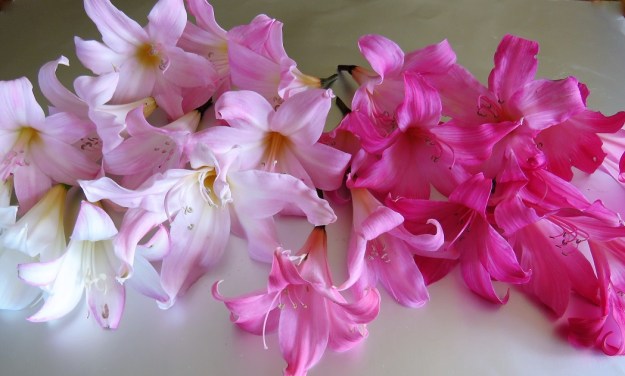
The deepest coloured forms – cerise almost getting to red – tend to be later flowering and are  the only ones that we have ever had picked by passersby. But that was years ago. These days our road verges are so steep that there is nowhere safe to stop and nowhere to walk so the flowers are safe. It is an ill wind, I guess, though we would prefer more hospitable road verges and slower traffic.

There is only one single species in this family of Amaryllis belladonna but clearly that species is variable within itself. I am not sure that there is a great future for them other than as casual clumps on road verges or in wilder areas of the garden. Lovely though they are on their days, their blooming season is brief, they form large clumps of large bulbs and hang onto their foliage for a long time before it dies off untidily. They don’t lend themselves to the flower garden where they will swamp anything around them and take up a lot of space for their 10 days or so of glory.

  • From the Cape Province of South Africa.
  • Known as ‘naked ladies’ because they put up their flower well before the foliage appears.
  • Summer dormant.
  • Prefer to grow with their necks above ground so they can bake in the summer sun.
  • Thrive on benign neglect and can be left undisturbed for many years.

The end of the long, hot summer is nigh

Belladonnas – a roadside flower for us

Summer continues here with temperatures in the mid to late mid twenties during the day, and often not dropping much below 17 at night. That is celsius, of course. With our near-constant high humidity, it feels hotter. Dry heat is easier to live in. But we are not complaining. Last summer never really arrived and we would have been lucky to have a single day where temperatures reached 25 or 26, rather than the three months so far this year.

Our belladonnas range from pure white through pretty pastel pink to sugar candy pinks and all shades between

What is interesting is that while the temperatures haven’t really dropped, the garden is starting to tell us that autumn is coming. The belladonnas are already past their peak, Cyclamen hederifolium is in full bloom  as is the tiny, dainty autumn snowflake, Leucojum autumnalis. Moraea polystachya has started its blooming marathon.Even the first nerine has opened and I spotted a flower on an autumn flowering camellia – C. microphylla. Haemanthus coccineus is out and the exquisite Rhodophiala bifida have already been and almost gone, their lovely trumpet blooms touched with gold dust now withering away for another year.

Cyclamen hederafolium seed down happily for us now

Some plants are triggered into growth or blooming by temperature, some by seasonal rain (we can do the South African autumn bulbs so well because we get summer rain, even in a drought year such as this has been) and some are triggered by day length. While our weather conditions are still indubitably summer, the day length is shortening and these plants are programmed to respond.

We don’t get sharp seasonal changes because our temperature has quite a small range from both summer to winter and day to night. It will be another three months before the trees start to colour. But the garden is coming out of its summer hiatus and entering autumn, whether we are ready or not.

Stachys Bella Grigio is giving up the ghost. Whiffing off, as we say.

Some plants just like to confound you. I wrote earlier about Stachys ‘Bella Grigio’, the startling white, felted variety that was so happily ensconced in a new garden. Booming away, even. It was setting so many offshoots that I thought I would be able to carpet many square metres by the end of the season. Well, it was an ‘upanddieonyou’ after all. It has been upping and dying like mad in the last weeks. Otherwise known as ‘whiffing off’ here.

I dug up a couple of wilting plants to see what was going on. They are dying from the top down. Their roots are fine. As an aside, if you are puzzled by why a plant is clearly dying, basically they die either bottom up or top down so it is always interesting to carry out an autopsy. Each of these plants was carrying 30 or more offshoots. I took off the ones with roots and have tried replanting them and I thinned out the offsets which had not yet established their own roots because it looked a bit as if the plants were smothering themselves to death in their desire to reproduce. There was no sign of insect infestation.

“It’s probably climatic,” Mark said. His thinking is that we are too humid and it has been particularly so this summer, whereas that felted white foliage is usually indicative of alpine plants. I think it is varietal. I have heard too many stories from others who have experienced specimens of this plant thriving, established and growing well before suddenly keeling over and dying. I cleaned up two plants and replanted the offsets out of curiosity. If I have to do this every year to keep these plants alive, then I am afraid I will decide very soon that it simply is not worth the effort.

We have mown the meadow for the season. Well, Lloyd has. With our special sickle bar mower, imported from Germany. We are still learning how to best manage the meadow in our conditions and Mark thinks that we are leaving the mowing too late and that it would be best done soon after Christmas for the first mow with a follow up in autumn. Maybe next year.
Mark has just declared that the sickle bar mower is otherwise known as the primary herbivore here. He has been reading about eco-systems and wondering what we could be introducing to NZ, given that our primary herbivore, the moa, is now extinct.

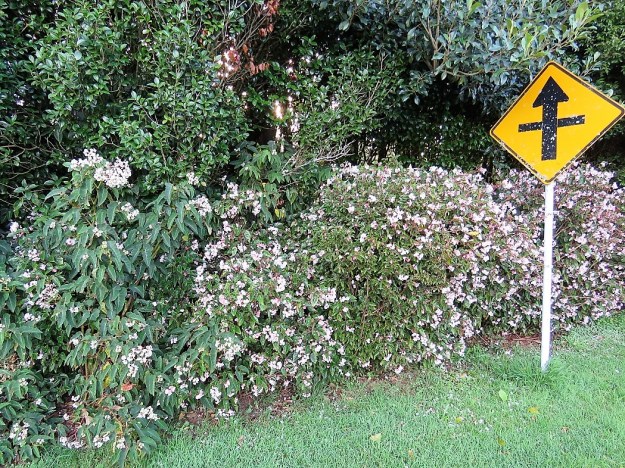
You can tell our climate is mild. We have begonias as a roadside hedge.

Requiem for a tree

Mark and Dudley inspect

I may have been a little premature in my post this morning that expressed relief that we had escaped so lightly from ex-tropical Cyclone Gita. We are still discovering damage but nothing to eclipse the mighty fallen gum tree on the neighbour’s farm.

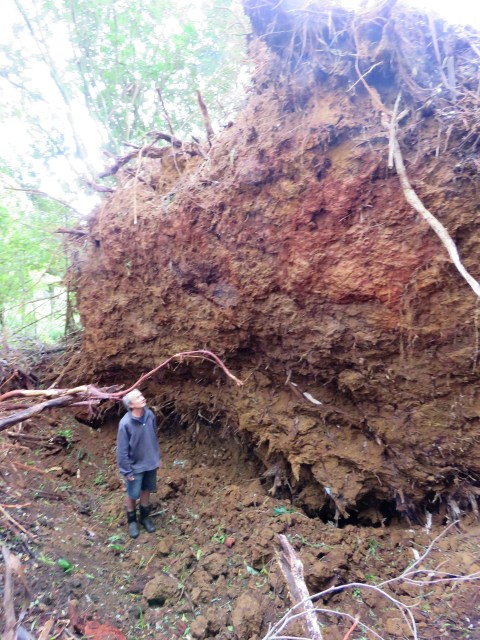
Mark climbed down into the hole to give some sense of scale to the uprooted root ball

We know some of the history of these trees because they were planted by Mark’s great grandfather back in the 1870s. It seems likely that they were part of government-supplied seed or plants to trial alternative timber options for this recently settled colony. The early pioneers had already felled most of the accessible mighty kauri trees. We have a few gum trees, Pinus muricata and radiata dating from the same time, along with our remarkable rimu trees. He was a tree planter, was Thomas Jury, and this land had already been cleared of its native tawa when he took ownership.

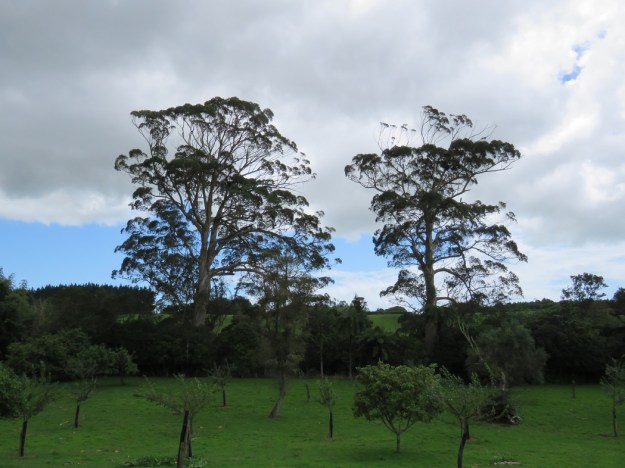
Still standing

It isn’t clear why this tree fell. It was of a similar size and stature to the left hand tree and in a sheltered position. The winds were very strong but it is not as if these eucalypts have dense canopies of foliage which act as a sail in the wind. But there is a sense of sadness to see a mighty tree lying on the ground.

It must be said that the sadness to see a bit of family history gone is tinged with relief that this one is not our problem to clean up. It will be no mean feat chainsawing up this monster of twisted hard wood, even if the yield will be a mountain of good firewood.

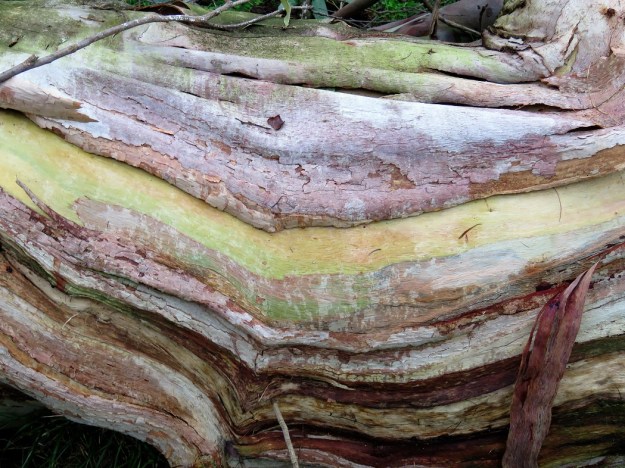
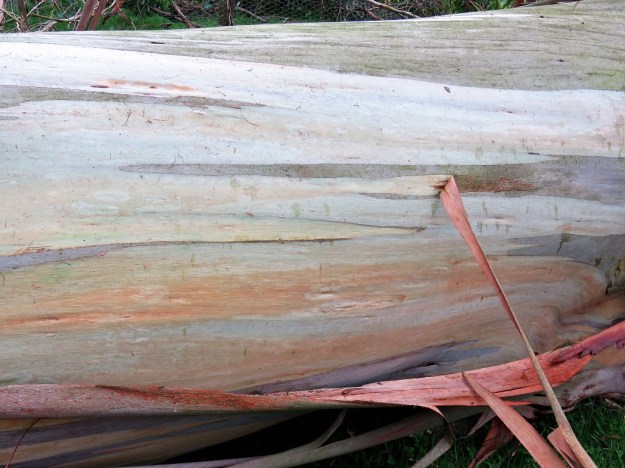
Beautiful bark on many of the eucalyptus species

The latest casualty in the ongoing saga of treemageddon

Alas poor schima, we knew you well. In early spring you would drop all your leaves in one big whoosh (and there were A LOT of leaves because you were a large tree) and startle us for a few weeks with remarkable lime green fresh growth. You were a way finder for garden visitors. We could point you out – “see the lime green tree – you will find the sunken garden in front of that”. In early summer you covered yourself with small white blooms but no more. True, we had noticed that you were not looking too healthy on one side but now you are gone. Awkwardly – getting you down is a challenge because you are resting against other standing trees but our gratitude that you fell the way you did is great. Had you fallen the other way, you would have brought down the power lines to our house and that would have been A Major Repair.
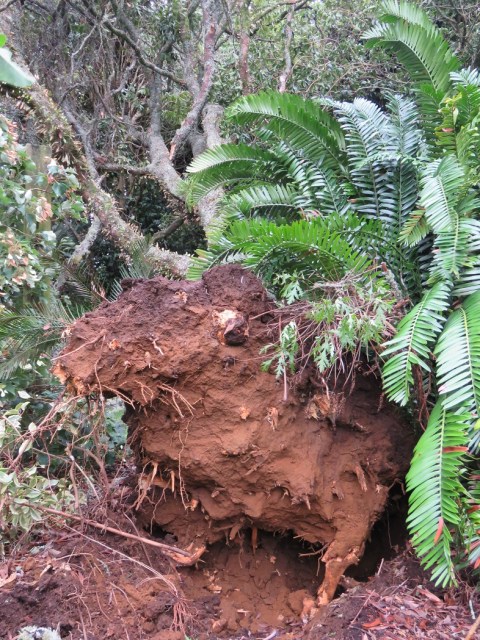
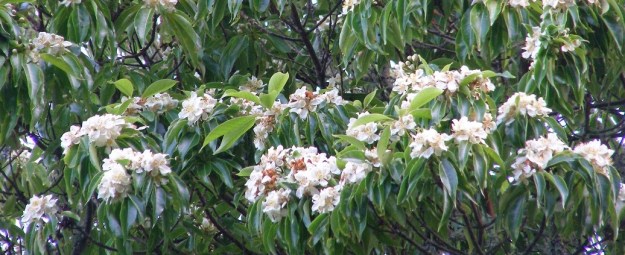
A root ball close to 2 metres across

The catalyst for the fall was ex-Cyclone Gita – the ex is because it was no longer of the same force that hit the Pacific, particularly Tonga. Pity poor Tonga. It must have been simply terrifying and the damage to that island is vast. Cyclones usually peter out before they reach New Zealand but this one kept barrelling on, though losing its intensity. It was still fierce enough, as bad as we have known when it comes to wind here. We are grateful that the damage is just the one big tree and a bit of smaller stuff down. And grateful that our electricity is back on after a 19 hour power cut, unlike about 5000 homes still waiting to be reconnected after two nights and more than a day without power. We are even more grateful that we have our own deep water bore as half the district on town supply has now run out of water – their taps are the merest trickle or totally dry and water tankers are trucking in supplies. It is harder to manage without running water than electricity. That is one thing I learned. It is a sobering reminder of how dependent most of us are on infrastructure which is not always as robust as we might think.

At least Mark has a spare Schima wallichii ssp noronhae that he can plant out. The fallen specimen was coming up to 60 years old and that root ball is close to 2 metres across. It will leave a big hole to be filled.

Before the fall

Give me colour, please.

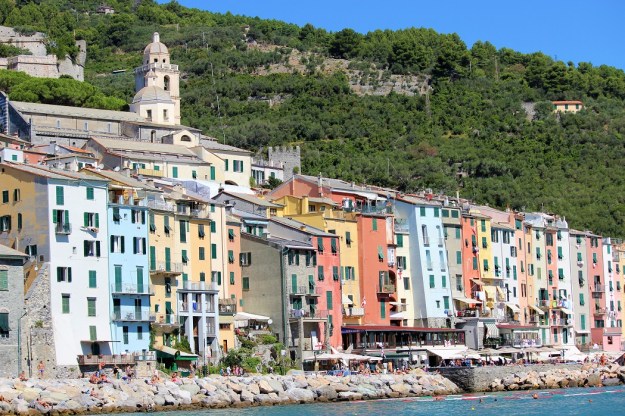
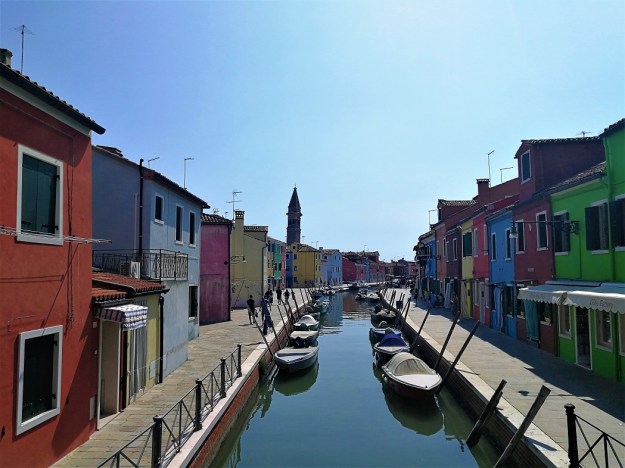
Burano, near Venice. Photo credit: Nigel Somerfield

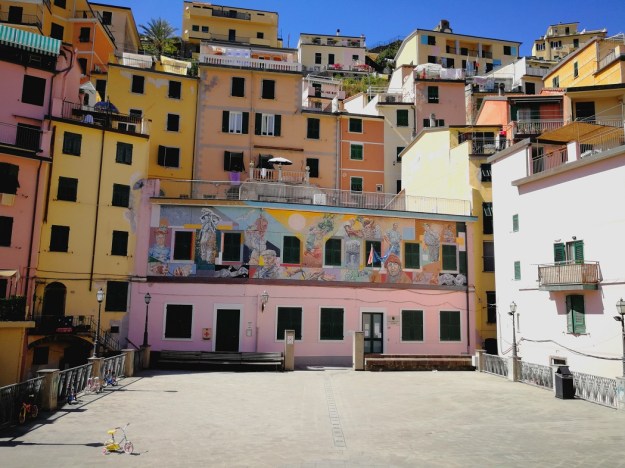
May I share a postscript to my earlier posts about colour in Italy and the greying of New Zealand? These are not my photos but shared by a family member on Facebook. Look. At. All. That. Colour.

As this country battens down the hatches, preparing for the extreme weather event that Cyclone Gita may deliver today, it is very grey out my window. Well, grey and green really as I look at a green backdrop of trees and shrubs and a grey sky. Were I living in the city – pretty much any New Zealand city these days – the landcape would be an unrelieved view of grey sky, stormy dark seas, and real estate grey, interspersed with charcoal and taupe.

Porto Venere. Photo credit: Kate Somerfield

What is worse, to my mind, is that while New Zealand’s obsession with grey has been driven by the real estate sector and the holy grail of resale value, I have heard whispers that council planning officers are now entrenching it into practice by requiring certain new building projects be what is now described as ‘colour neutral’ – translated as shades of grey. I fear for the future. Real estate agents will nail their colours to the mast of whatever sells but council officers are more inclined to dig their toes in and entrench the new absence of colour as ‘best practice’. We may face a dreary future. The cheerful red roofs of New Zealand’s past may be an historical memory at best.

Riomaggiore town square. Photo credit: Nigel Somerfield

But look, just look at the joy of a mishmash of colours in Italy. Doesn’t it make you want to smile? Have you ever gone into a modern New Zealand suburb or even looked out an aeroplane window at suburbia as you flew in to land and smiled at the colour lifting your spirits? No, I didn’t think so.