

Kniphofia, combined here with tall growing Campanula lactiflora, in the classic, long herbaceous borders at Hilliers Arboretum in Hampshire last June
The path back to social acceptance is somewhat more difficult for plants which have become the wildflowers of our roadsides, sniffed at as weeds although pretty enough on their days in flower. I am not convinced the agapanthus will ever recover from this lowly position in New Zealand life but the moptop hydrangea has already undergone a revival. The red hot poker is not as ubiquitous as the derided agapanthus, so maybe there is hope. In times past there were plans for it to be a great deal more common, in one area at least.
Back in the early 1980s when a cabinet minister fell out with his leader and was demoted, he came up with a clever plan to catch public attention. It was Derek Quigley, if my memory serves me right. He wanted to plant up our roadsides thematically, to pretty-up the main roads for tourists. So Canterbury, the home of grace and tradition and the place of his electorate, was to be planted in flowering cherry trees. Classy. I am afraid I do not recall what, if anything, was suggested for the Waikato. But poor old Taranaki – its roadsides were to be planted in red hot pokers if the fallen cabinet minister had his way. He was no horticulturist.
The only reason I remember this piece of folly was because of my late mother-in-law’s horror. She was given to telling very long stories and this one took many kilometres over a long car journey. The highly abbreviated version is that when she was a child, the only sex education she received was to be given a book. Something akin to the Flower Fairies of sex education, I think, for in that book Mother was portrayed as a blushing violet. Father, as quick thinking readers may have already deduced – Father was a red hot poker.
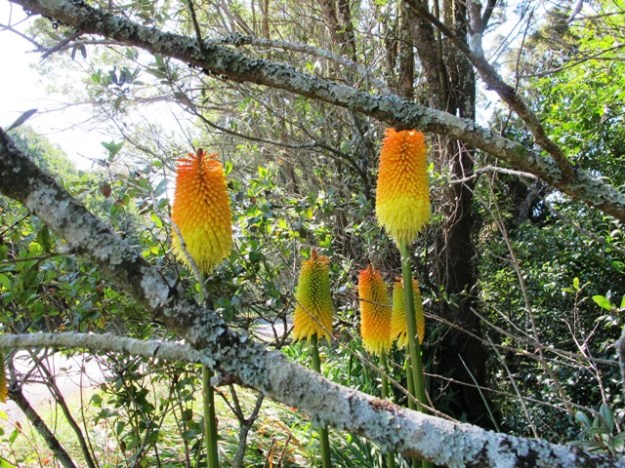
Maybe it is time to bring the red hot poker off the roadside and back into gardens as a valued plant
But we do not garden in isolation and I can tell you that kniphofia – for that is their proper name – are now trendy plants again overseas. They are easy plants that lend themselves to inclusion in herbaceous plantings, both traditional and contemporary. We saw them used extensively in the modern perennial plantings we looked at in Britain last year, valued for their upright, vertical flower form. We also did a short tour of public plantings in Canberra at Christmas where kniphofia are being mass planted to soften the urban landscape. They are a great deal more versatile than most of us realise in this country.
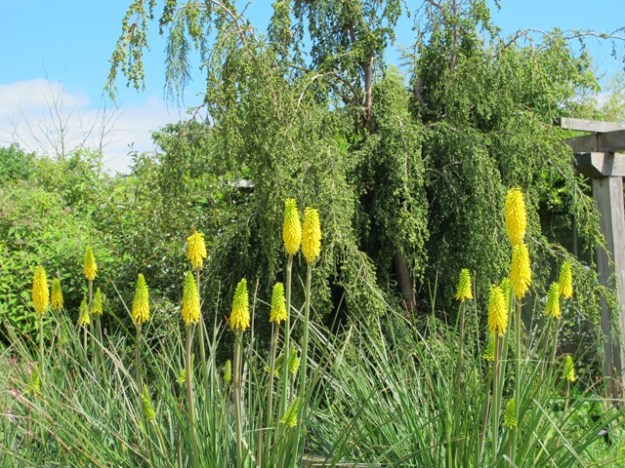
This attractive yellow and green kniphofia with much finer foliage fitted well in the looser plantings of Wildside Garden in Devon
If red hot pokers have unfortunate connotations for you, try calling them by their other common names of torch lilies or knofflers. I am quite taken by the knoffler epithet. If nothing else, consider the fact these flowers are particularly rich in nectar and make a significant contribution to feeding both birds and insects. There are a fair range of different knoffler cultivars already in the country, although you may need to seek out specialist perennial nurseries to find named cultivars.
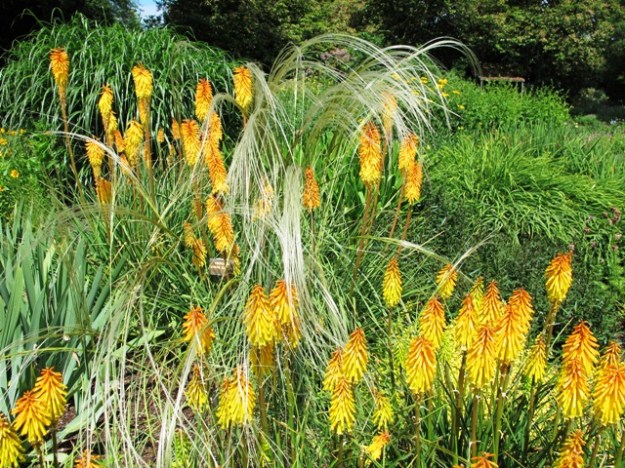
Kniphofia combine well with the grasses much favoured in modern perennial plantings – seen here at the display gardens at Blooms of Bressingham in Norfolk
First published in the Waikato Times and reprinted here with their permission.
 Garden Lore: standard bay trees
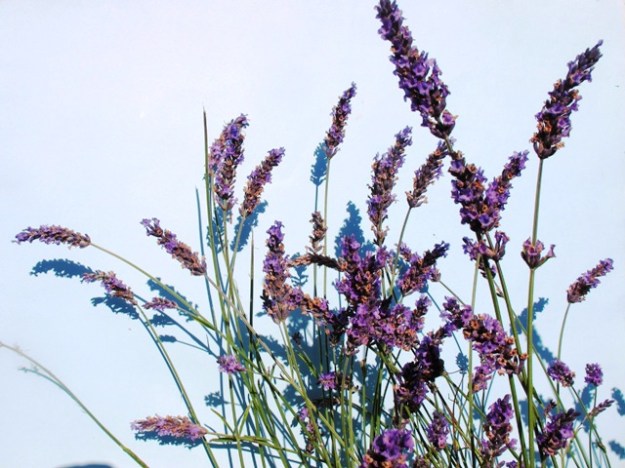 If it were of any use, every day the gardener would fall on his knees and pray somehow like this: “O Lord, grant that in some way it may rain every day, say from about midnight until three o’clock in the morning, but, you see, it must be gentle and warm so that it can soak in; grant that at the same time it would not rain on campion, alyssum, helianthemum, lavender, and the others which you in your infinite wisdom know are drought-loving plants – I will write their names on a bit of paper if you like – and grant that the sun my shine the whole day long, but not everywhere (not, for instance, on spiraea, or on gentian, plantain lily, and rhododendron), and not too much; that there may be plenty of dew and little wind, enough worms, no plant-lice and snails, no mildew, and that once a week thin liquid manure and guano may fall from heaven. Amen.”
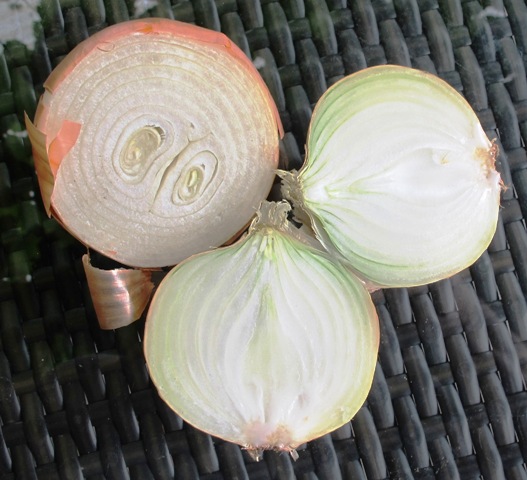 1) Twin scaling is a way of increasing the number of bulbs more quickly than by other usual methods. A single bulb can yield up to 30 or more baby bulbs (bulblets) over a period of a season. It only works with proper bulbs – not corms, tubers and rhizomes. Bulbs need a base plate and a layered construction to be twin scaled – eerily similar in form to the common onion shown here.
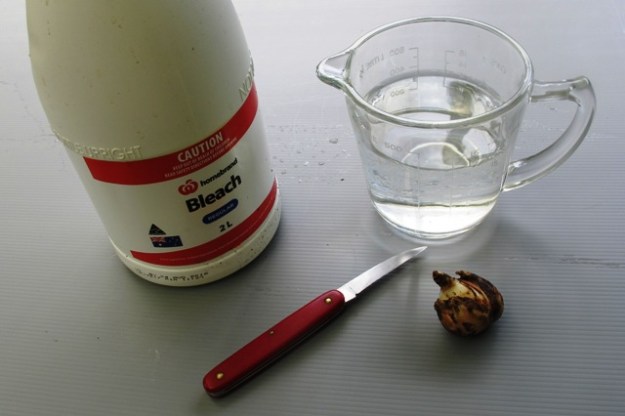 2) Twin scaling works well for bulbs such as narcissi (daffodils), crinums, galanthus (snowdrops), nerines, amaryllis, hippeastrums, lachenalias and some lilies. Wash the bulb and remove any outside coating and old roots. Make up a weak solution of household bleach – about 1:10 bleach to water – and dip the sharp knife and bulbs. Clean working conditions and hygiene are important to prevent disease and the transfer of any viruses.
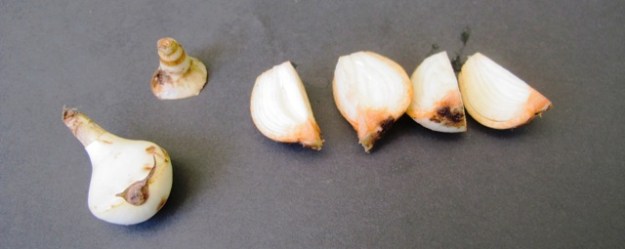 3) Remove any offsets already formed, making sure you keep some of the base plate with them. The base plate is where the roots grow from. Cut the top third off the bulb (both offset and top are visible to the left in the photo). Cut the main bulb into quarters or eighths, depending on the size of the bulb. Each piece must have some of the base plate remaining attached. The larger the bulb, the more sections you will get.
 4) Peel off two scales together, attached to some of the base plate. Keep your knife clean and sharp so you can cut through the base of each section more easily. It does not matter if you have three or more scales but if you do not have part of the base plate, the process will not work. A bulblet will form between the two scales on this base plate.
 5) Plant the scales in a pot or tray filled with seed raising mix. Press them down deeper than in the photograph until just the tip is visible. Water them in and keep the tray in a warm, reasonably dark position. The bulblets will form through the autumn and grow away in spring so it is best to twin scale when the bulb is freshly dormant. It is too late to twin scale autumn flowering bulbs because they are already starting to grow but you can do the spring flowering ones which includes narcissi such as this bulb.
 6) If you lack the confidence to take each section down to two scales, you can stop at step 3 where you have cut the bulb into quarters or eighths. As long as you look after them, most sections will grow away into healthy, independent bulbs. It is probably easiest to start with a large bulb while you gain confidence. Most bulbs propagated by twin scaling will take at least two years to reach flowering size, sometimes longer.
