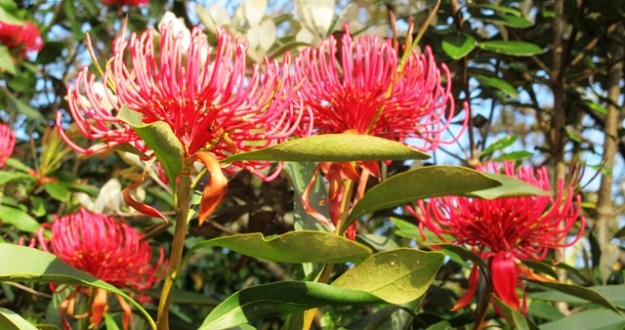
Tulips from Crete – T. saxatilis
Tulips. They are Dutch in origin, aren’t they? Well no. The original tulips are no more Dutch than I am, but the modern hybrid tulips largely originate from the flat home of dairy, dykes, windmills and clogs. And in a love affair spanning 450 years, the Dutch have made this plant family their own.
We don’t grow many tulips in our own garden. The showiest by far is a tulip from Crete – T. saxatilis. Most people are surprised to find that there is a tulip from that Greek island because, after all, tulips come from Holland, do they not? In fact the species in the wild – and there appear to be somewhere between 70 and 100 different species recorded – do not originate from anywhere in Northern Europe. Instead, stretching from Southern Europe, through Northern Africa, the Middle East and spreading overland from Turkey to north western China, tulips have a wide territory. Many of them favour mountainous areas with hot, dry summers and cold winters and therein lies the hint to the problems people can have with getting the modern hybrids to flower past the first season in their garden. Most need a much greater winter chill than we can give them here.

Some species – we just don’t know which one
We have three different tulips in the garden. The Cretan species is wonderfully easy-care and increases gently and reliably. I love the unlikely contrast between the lilac pink and bright gold. Then we have a pure yellow one which is inclined to nod its head. Mark thinks it may be a hybrid, not a species, though I am unsure of how he reached this conclusion. It never increases but it does at least return each year. And we have a small flowered, small growing species of unknown origin. Charmingly understated, might be the descriptor.

Indubitably tulip, but we have no name on it and it never increases.
I am not the world’s greatest fan of modern tulip hybrids but concede I am in a minority. I have toyed with the idea of bulk buying bulbs of one or maybe two selected cultivars to drift through areas of the garden. A swathe of pure white tulips or maybe clusters of a deep wine colour might add to the early spring herbaceous plantings even though they may be a little clichéd. But I prefer to spend money on bulbs which have a life-span beyond just one season. I can’t bring myself to treat tulip bulbs as a disposable commodity. It seems a shocking waste of money, resources and effort.
I was a bit surprised to find that even in the UK, tulips are often treated as annuals because their repeat performance is patchy at best, despite the fact that their winters are much colder than ours. Tulip bulbs are much cheaper to buy there which may be a factor.
It is not that these hybrids all die after flowering for the one season. They just decline and flowering diminishes considerably in subsequent years unless you go to the trouble of lifting them, separating the offsets, chilling them and replanting in fresh ground. That is a lot of effort. Holland apparently produces fresh tulip bulbs by the billions each year, so I guess there is an insatiable demand from people who do keep replenishing supplies.
The early variegations and novelty breakthroughs were almost certainly caused by virus which, while giving variety, also weakens the plants over time. Nowadays, the variegations are the result of genetic breeding and selection, and considerable effort has been made to get rid of the debilitating viruses. Most of the modern hybrids descended originally from T. suaveolens, which we do not have in our garden here.

I went looking for a photo of tulip fields in Holland and found instead this one of tulip fields in Japan, pretending they are in Holland!
The history of tulips is fascinating but not without debate. The earliest cultivation of tulips was apparently recorded 1000 years ago in Persia. How and when they arrived in Northern Europe is disputed, but they appear to have been taken there in the mid 1500s. By 1637, what is now called “tulip mania” had hit Holland. Single bulbs could command fabulous prices – reportedly as high as 10 times the annual income of a skilled craftsman. But it was not just the wealthy plant collector who coveted these flowering plants. They had become an investment commodity, priced way beyond their actual value. This extraordinary situation has received a lot of attention because it was the first recorded instance of rampant, economic speculation on a product but there is ongoing debate about the extent and the detail. Economic data from 1637 is always going to be a little sparse and sometimes unreliable. Whatever, it makes a good story and “tulip mania” has entered the lexicon as a term for a freakish economic bubble, such as the sub-prime mortgage bubble in most recent times.
Going back to garden plants, in their simplest form tulips are generally cup-shaped and can face upwards or downwards. Essentially they all have strappy foliage and while it looks as if they have 6 petals, botanically they have 3 petals and 3 sepals. Ten times an average income seems an awful lot to pay for one of those.
First published in the Waikato Times and reprinted here with their permission.


Garden lore – spring pruning 

* Tikorangi folk will be thrilled to see that, like Arnie, Greymouth Petroleum are back! They sure are back. Be reassured that we, here at Council, understand your concerns about safety issues at the entrance to their lovely new Kowhai C site but we are right across safety issues. All of us here at Council are well briefed on their Traffic Management Plan and there is no danger at all. It is perfectly safe.


* The good folk at Venture Taranaki tell us they are well down the track of preparing their report on the economic benefits to Taranaki of flaring and night lighting sites. Local residents will be well aware that these activities have the positive benefit of lowering their household power bills. There are many other benefits and Venture Taranaki expect to be able to quantify the financial and employment benefits that accrue from the companies’ generosity with flaring and night lighting. Local residents may not realise that a side benefit of flaring is, reportedly, a reduction in flying insects and as a result the risk of a malaria or Ross River virus outbreak in Tikorangi has been greatly reduced.
* Even we at NPDC have been astonished at just how quickly Greymouth Petroleum have been able to improve your local countryside. It took just one and a half days to change it from this boring and dull country road (shown to the left), into this lovely new scene shown below. You hardly know they are there, do you Tikorangi? This is the incredibly small environmental footprint they have.


*
We have heard a few mutterings that some residents may not be happy about the establishment of a semi-permanent single men’s camp with the access on little Stockman Road. My, oh my, what whingers some people are. Such camps are commonplace in the outbacks of Australia and Tikorangi is just as remote. There haven’t been any problems with the camp at Mangahewa C site and we see its relocation to Stockman Road could be a positive move for the community. And of course if somebody wanted to build a hotel on Stockman Road, we would approve it so a single men’s camp is not so different. What could go wrong?


• We know that Tikorangi residents were united in their opposition to the Kowhai C site but we have GOOD NEWS. We have halved the number of gas wells Greymouth Petroleum can drill on this site. They are only allowed to have four wells – to start with anyway. This is a win-win situation. They win. And in the future, if they apply for a variation to their consent, they will likely win again.
• Greymouth Petroleum have asked us to assure residents that they have not forgotten their undertaking to NPDC councillors on June 11 that they will be setting up a blog, holding community meetings and sending out community newsletters to keep you folk informed. They have just been such busy little beavers that they haven’t had time to do it yet. However, they do want everybody to know that they are very, very sorry about the incident back on March 17 when one of their loads took out the power supply to Tikorangi. They assure us that this was a fully compliant load and they are sure that there were pilot vehicles. Somewhere. Of course we understand that little accidents can happen.
• We have had positive reports that the large loads on your roads are a special attraction for the preschoolers in the area. And some dads, too. Isn’t it just so cute how the appeal of big rigs never fades? You can tell your littlies that there is plenty more to come so the excitement will continue.
• An innovative initiative is about to start as we want to teach Tikorangi residents that their roads are safe and that local children will be well looked after if they return to using the free school bus service. This will have the added benefit of reducing traffic on the roads if parents stop driving their children to school instead. “Keep left” will be the slogan. There is plenty of room in the drain for pedestrians, cyclists and horse riders. Wear gumboots if it is raining. Just stay as far left as you can because some of these are very large vehicles and the bigger they are, the more important they are.
• New Plymouth District councillors want us to tell you what a wonderful day they had on their tour visiting the companies and they thoroughly enjoyed the hospitality. They are sorry they couldn’t fit in the residents on this recent familiarisation tour, facilitated by Tikorangi’s very own elected representative, Cr Craig MacFarlane. But they were reassured by the companies that any negative impacts on residents are grossly exaggerated and claims of increasing industrialisation of your district are nothing but hyperbole. They saw this for themselves so that is good news. You will be reassured by this and no doubt you will all be voting to re-elect Cr MacFarlane in appreciation of his sterling efforts on your behalf.