Tag Archives: Abbie Jury

The merits of mulch

Homemade compost - our preferred garden mulch

Homemade compost – our preferred garden mulch

Mulch, dear readers, mulch now. Mulch well and you will be grateful later.

There are good reasons to mulch. In areas prone to drying out over summer, a good layer of mulch put on now will contribute to retaining soil moisture levels later. You don’t want to be mulching when the soils have already dried out because, equally, it acts as a barrier to stop water being absorbed.

Mulching also keeps down weeds and hugely reduces the amount of summer weeding that is required. There are two provisos. You need to clear the area of weeds first. Mulch won’t kill existing weeds. It just discourages germination of all those seeds lurking in the soil waiting to spring forth when the time is right. It also makes it much easier to pull out those that do penetrate through the layer. The second proviso is that you need to be using a weed-free mulch and many home compost mixes won’t have achieved that state.

Avoiding soil splash is another benefit. In areas of heavy rainfall (and some of us can get downpours akin to the tropics, albeit without the warm temperatures), bare soil splashes back up and this can spread disease amongst vulnerable plants. Soil splash also makes vegetables dirty. Mulch acts as a cushioning filter.

Depending on your choice of mulch, it can act as a soil conditioner and add valuable carbon content. Some will gradually break down as worm and microbial action incorporated it into the soil. Obviously this is only true for organic matter. We are big fans of organic mulches here, less so of inorganic options like limestone chip or gravel. But no matter what you use, a mulched garden looks better than expanses of bare soil. It is the experienced gardener’s not-so-secret weapon. You won’t find many good gardeners who do not mulch regularly.

So what to mulch with? Our number one preferred option is compost, homemade compost in fact. It does three jobs in one hit. It mulches, it feeds the soil so that we rarely have to use other fertilisers and it looks unobtrusive. But then we do not want a mulch that looks obvious. It is a tool, not a display in itself.
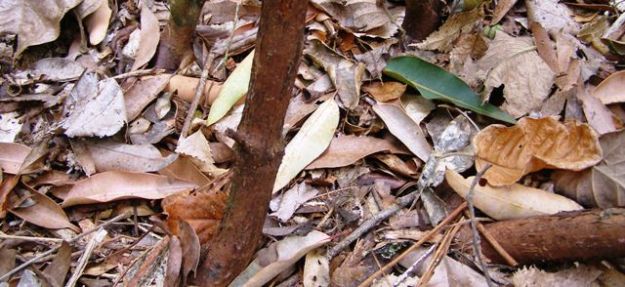
Leaf litter can be untidy but makes a good mulch

Leaf litter can be untidy but makes a good mulch

The second choice mulch here is leaf litter. We don’t waste any organic material. If it doesn’t get composted, then it gets raked into a back area to gently decompose and darken, before being raked back out around plants. Leaf litter can be untidy but it is good in less formal areas.

Then there is fresh wood chip. We own a good sized mulcher so we generate a fair amount of wood chip from the garden debris that is too large to go into compost. Calf shed shavings and sawdust also come into this category. When fresh, all these materials have to be used as mulch but not dug into the soil or they will rob the nitrogen as they break down. Laid on top and exposed to the elements, the decomposition happens slowly and naturally and should not cause problems. If you are going to use sawdust, just make sure that it is never, ever tanalised (you will poison your soils) and be prepared for a few months of a somewhat alarming orange appearance.

Old wool carpet and newspaper (weight the latter down) can be used as mulch if you don’t mind the look. We do mind, so we don’t go down that track. Just make sure the carpet is 100% wool and not synthetic and keep to newspaper – leave the glossies out with the recycling.
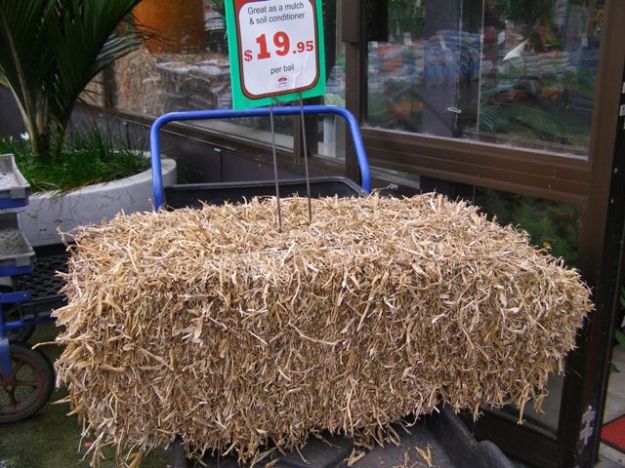
Pea straw may be a better option for the vegetable garden than the ornamental garden

Pea straw may be a better option for the vegetable garden than the ornamental garden

If you need to head off to the garden centre to buy your mulch, you will often find pea straw on offer. While this is a traditional mulch, if you are not in a pea producing area, consider its carbon footprint. It blows away unless you keep it damp. It is a myth that it helps fix nitrogen in the soil – that capacity is in the pea roots and all you are buying are the tops. Aesthetically, I think it looks fine in the vegetable garden (especially if it is all around high-producing strawberry plants) but I am less keen on the look in ornamental gardens. A bale should cover around 6 square metres of area.

Granulated pine bark is often favoured. Try and get it pre-composted. Compounds in the bark stop it rotting down too quickly so it lasts a surprisingly long time on top. It is a discreet looking mulch but it adds no fertility. If you have a big area to cover, buying it in bulk will save money. A cubic metre should cover around 15 square metres.

You need a layer of 6 to 7 centimetres to be effective. You will often see 10 cm recommended but that is pretty deep. Finally, try not to pile the mulch hard in on the trunks of woody plants. It doesn’t matter around perennials but trees and shrubs run the risk of collar rot.

The mulching effort now will reward you further down the track.

First published in the Waikato Times and reprinted here with their permission.
Garden lore

“Hoeing: A manual method of severing roots from stems of newly planted flowers and vegetables.”

Henry Beard, American humorist.

003 (2)

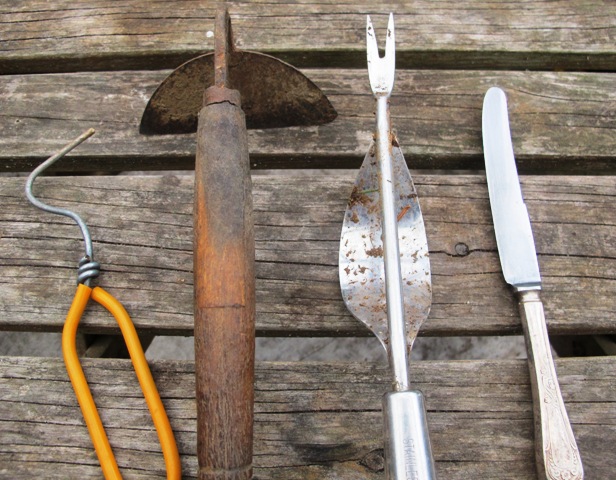
I am a big Wonder Weeder fan. These are the best implements I know for hand weeding, especially in tight spaces. Because the action is to hook out the weeds, it is possible to do it with minimum of disturbance to surrounding plants. It still amazes me that something so simple, indestructible and effective has remained cheap. I own several because they regularly end up going through the compost heap. I have no commercial interest in these but I see you can buy them on line – three for $15 (including delivery) at wonderweeder.co.nz and some garden centres sell them.

Others swear by the Niwashi which is probably somewhat more expensive and less happy about going through the compost. This is a small hand-held hoe. It severs the plants from its roots which will be enough to kill most, but not all, weeds. It is also better than a trowel for cultivating the soil in smaller areas. You need at least a 12cm space between your plants or you will sever them in the process.

For flat weeds in the lawn, or very deep rooted plants like dock, there is nothing to equal the lawn weeder which can hoick plants out, roots and all, in one simple move. If you don’t want a small armoury of specialist weeding implements, an old table knife does the trick once you have mastered the different hand actions required.

First published in the Waikato Times and reprinted here with their permission.
Cumulative Effects (of Petrochemical Development)

Side by side newsletters

Side by side newsletters

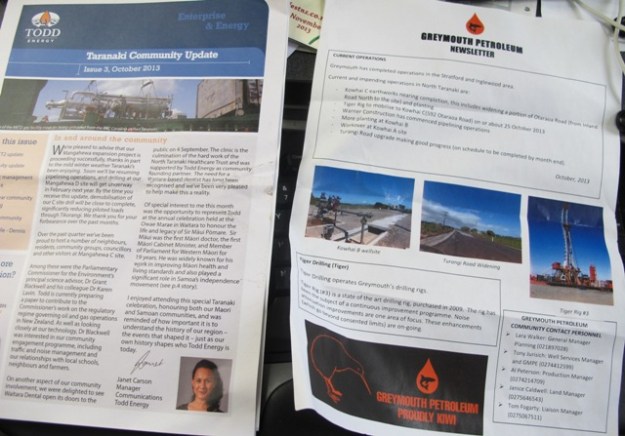
Two newsletters arrived last week followed up by two circulars to Tikorangi residents – well, one letter and one memo. The difference in style between *our* two petrochem companies operating here is pretty stark.

And side by side letters both appeared in the letter box yesterday

And side by side letters both appeared in the letter box yesterday

But it is the list of current activities that is scary.

Greymouth Petroleum:

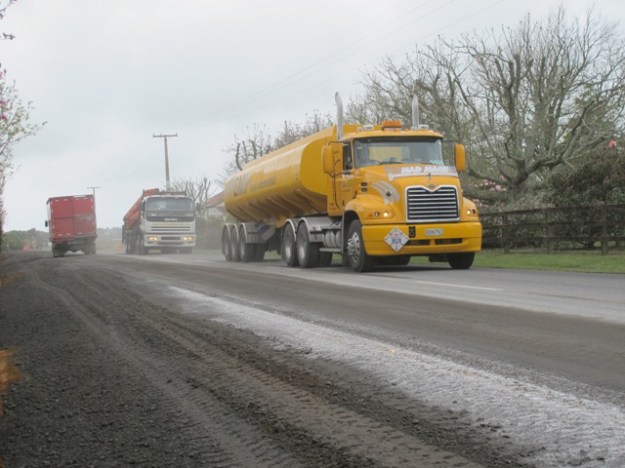
1) Construction of Kowhai C site. That is the site that this community spoke up and said we did not want so our District Council helped Greymouth Petroleum by consenting it in secrecy and not addressing community concerns, including Otaraua Hapu whose rohe that site is in. Greymouth did not even acknowledge this community’s concern.

Greymouth's yellow tanker on their new stretch of Otaraoa Road

Greymouth’s yellow tanker on their new stretch of Otaraoa Road

2) Roadworks related to Kowhai C site.
3) Pipeline construction.
4) Drilling rig is coming in to Kowhai C site starting October 26 (‘approximately’ 75 truck movements).
5) A workover is coming to Kowhai A site. This presumably involves a workover rig.
6) Roadworks to the Turangi A, B and C sites.
7) Work is apparently going to start on Ohanga B site shortly. Epiha A is already constructed and presumably ready to drill. Urenui A is apparently planned. Turangi C is not yet constructed. There is talk of extensions to Kowhai A site.

Another day, more traffic here

Another day, more traffic here

Then if we add in Todd Energy’s activities:

8) Fracking and flaring on Mangahewa C site
9) Site works on Mangahewa E site
10) Still more construction of infrastructure facilities on Mangahewa C starting in November.
11) Mangahewa Expansion Train 2 (MET2) construction continuing at McKee.
12) Pipeline construction (includes using a helicopter).
13) Roadworks on Otaraoa Road to improve access to McKee.

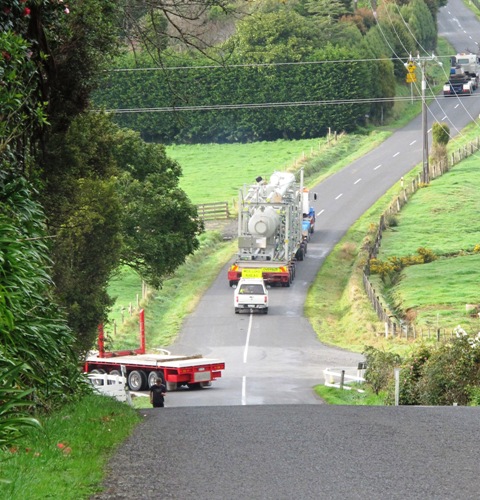
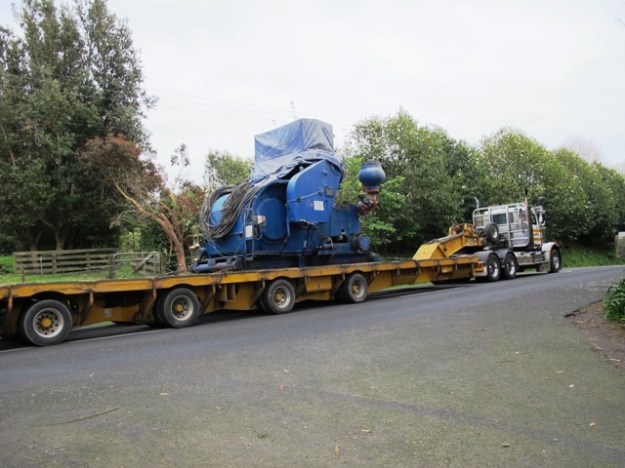
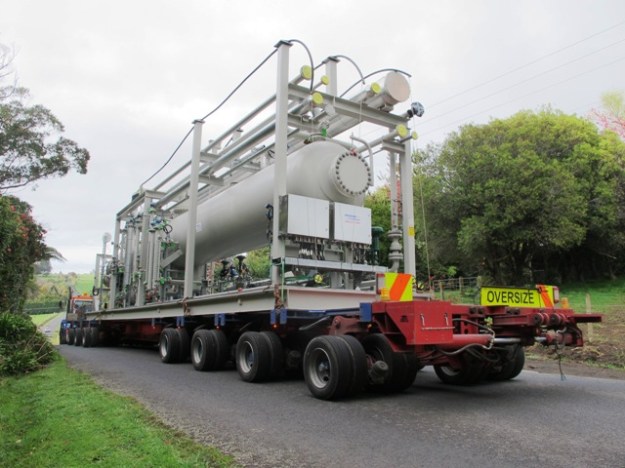
This is what a rig move looks like, but multiply by between 75 and 95 loads

This is what a rig move looks like, but multiply by between 75 and 95 loads – though not all are on trucks this large

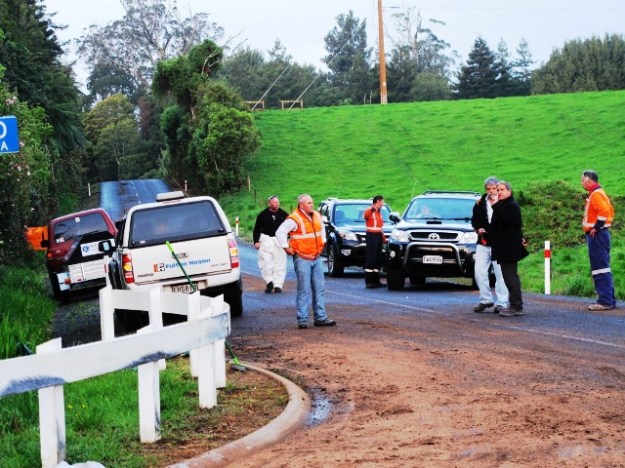
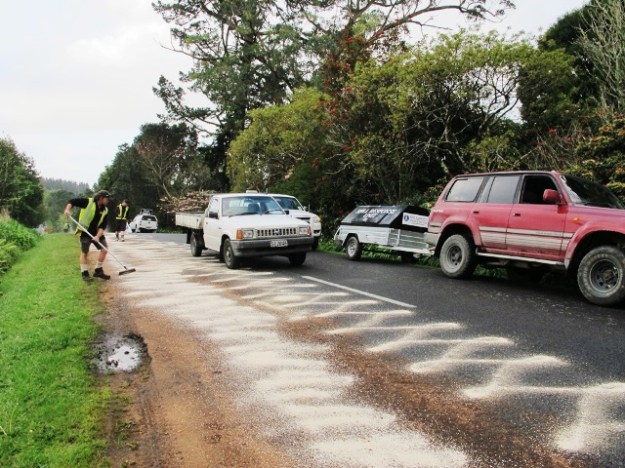
14) The rig was moved out of Mangahewa C site over the past few weeks. This involved many heavy loads and a small matter of an oil spill last week (right along our two road boundaries here, in fact).

Bit of an oops with a spill on the road outside our place

Bit of an oops with a spill on the road outside our place

048

Permanent tanker movements continue from most sites and from McKee. All of these activities generate noise and heavy traffic.

All year we have been trying to convince New Plymouth District Council that they must address cumulative effects when a range of petrochemical activities are taking place at the same time. But nothing has happened and in the meantime the activity ramps up further.

Tikorangi is apparently the most heavily explored and developed petrochemical area in the country. It used to be a highly desirable and charming little rural community. Now it is reeling. And still more is planned.

Is Tikorangi to be the blueprint for other areas, given this government’s belief that salvation lies in oil and gas development?

Just another load for the MET 3 construction at McKee passing our place

Just another load for the MET 3 construction at McKee passing our place

Plant Collector: Dendrobium Bardo Rose

Dendrobium Bardo Rose

Dendrobium Bardo Rose

Out there in the world are legions of orchid aficionados who are typically possessed of technical knowledge about this plant genus, the most complex and varied of all plant groups. I take one peek in to the details of orchids and get completely lost. But when it comes to orchids suitable for the garden, I can recommend the dendrobiums from Australia. There are many different dendrobium species. Some are tropical and only suitable for glasshouse culture here. But the obliging ‘Aussie dendrobes’, as we refer to them, sit happily in woodland conditions needing no care or attention at all. In early to mid spring, they spark into flower and this pink one has nigh on fifty flower spikes. The flowers are much smaller than cymbidiums and the whole clump only stands 30cm high at the most.

Bardo Rose is the grex name (more or less a collective noun) for all dendrobium hybrids which are falcorostrum x kingianum. We have both those species growing here as well but this pretty pink one is a hybrid between the two. Each flowering spike has 20 or more perfect little orchids which measure about 3cm x 3cm. Other dendrobiums we grow are in pure white (including the aforementioned D. falcorostrum) and shades of yellow.

I do not know if dendrobiums are sold commercially. All ours came from the Orchid Society who are renowned for their generosity. These folk will also be able to advise which ones are fully hardy – and some are. Critical issues in growing these plants include excellent drainage, good light levels but dry in winter so under evergreen trees seems to be a good location.

First published in the Waikato Times and reprinted here with their permission.

Better in theory than practice – planting street berms in edibles

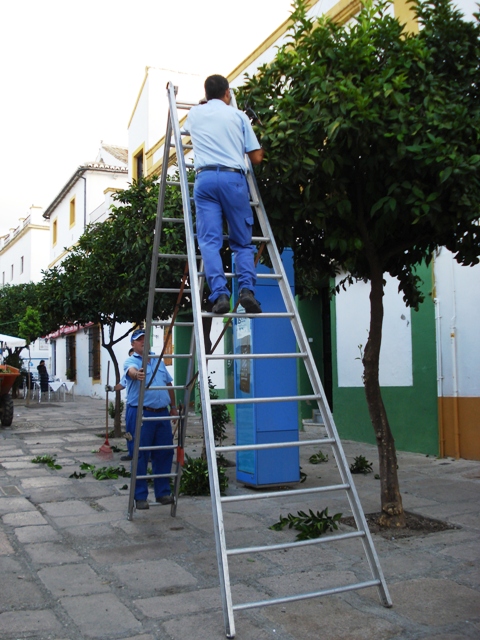
Street plantings of orange trees in Cordoba

Street plantings of orange trees in Cordoba

I have been following with some interest the debate about Auckland’s road berms and the transfer of mowing responsibilities to the closest house occupants. I can’t think that I have ever lived anywhere with road berms that Council mows so my sympathy is limited for those who are railing against having to take responsibility. Road berms are community spaces that stop our urban areas from being too grey and congested.

The debate about alternative uses was more interesting. I was amused by the wit who suggested that a creative approach could solve the lack of new housing space in Auckland. Indeed, if you look at contemporary Japanese domestic architecture, I feel sure there is potential for space-saving apartments to be constructed on some of the wider berms. Though I can already hear the cries of protest from the adjoining landowners.

Often I hear the claim that berms should be planted out as community vegetable gardens and that all street trees should be fruit trees for the benefit of residents. It is so easily said and on the surface it sounds such a good idea but there are reasons why this is not so popular with powers that be.

Starting with the vegetable garden berm idea – how are you going to stop every passing dog from urinating on your plants? Or worse. Just watch a dog being taken for its walk and you may lose enthusiasm for growing vegetables out in a public space very quickly. Is the berm to be fenced to keep out wandering dogs? This rather defeats the whole notion of common space when ownership is claimed by way of a fence.

Unless your berm is at the end of a very quiet cul de sac, there are issues with automotive pollution, not to mention road splash. Okay, the lead content of our petrol has dropped dramatically from where it used to be, but I am not too sure about wanting to eat plants which are grown with full exposure to petrol and diesel fumes. And road spray on wet days is likely to be introducing more contaminants.

Then there are all the issues of ownership of the produce when it is on public land. How happy would you be if somebody came along and harvested your entire potato crop just as it hit its peak – or worse, before it has? And if one or two key individuals do not take ownership of the garden and manage it, soon it will descend into an unsightly mess which is a great deal worse than a bit of rank grass.

Vegetable gardens on the berms are not that easy. This is not to say it can’t be done, but it is not a universal panacea and it will take a lot more individual effort than mowing.

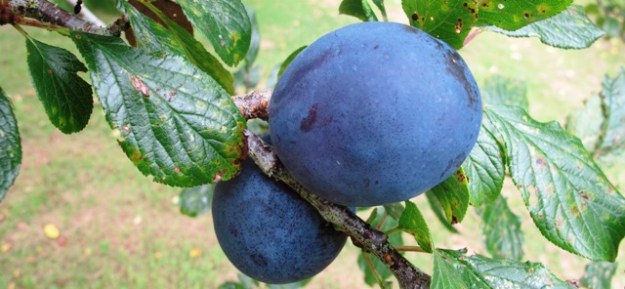
Plums - more likely to feed the birds than the human populace

Plums – more likely to feed the birds than the human populace

So, fruit trees as street trees? I really do not envy any Council staff who are faced with decisions on street trees but I applaud their valiant efforts to plant up our urban areas. Street trees have to be able to grow in exposed conditions, sometimes highly polluted. They need to have small leaves which decompose quickly so they don’t block all the drains. Their root systems are vitally important (don’t want to break up sewers or sealed areas but they need to be sufficiently well rooted not to blow over) and so is the ultimate shape of the tree. They need to be more upright than wide spreading. On top of that, if they are too desirable, they are vulnerable to theft when young and they need to be able to grow with a minimum of attention and no spraying.

That is a pretty big list already and that is just off the top of my head. There are probably more criteria than that. So tell me which fruit trees match those sorts of criteria. If it was easy, I am sure we would see it done more.

I have seen oranges used as street trees overseas – table oranges in Sorrento in Italy (tourist town, though, so maybe less inclined to be nicked) and bitter Seville oranges on the streets of Cordoba in Spain. The ones in Cordoba were harvested commercially, I found out. Citrus are not high maintenance trees but they still need spraying with copper and they are vulnerable to borer.

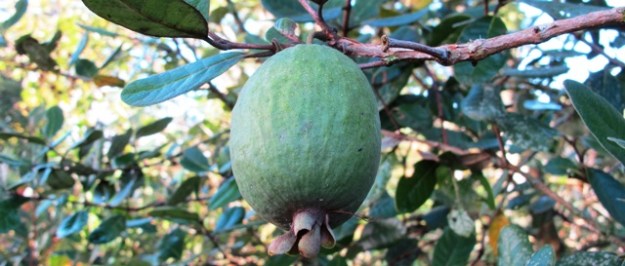
Feijoas! Definitely an option for road verge plantings

Feijoas! Definitely an option for road verge plantings

The best option I could come up with here is feijoas. They require next to no care and are reasonably wind tolerant. The fruit is peeled before eating so street pollution is not such a problem. Apples, pears, plums – all need care and are more utility than attractive. They are not even utility if they are uncared for and don’t crop. Plums are more likely to feed the birds than humans.

I think street trees are street trees. It is not a situation that lends itself to an ill-thought out philosophy that they should all be fruit trees in suburban areas as a matter of principle. I can only see it working where an adjacent householder takes responsibility for the trees and that includes dealing with theft and vandalism. It’s a nice idea in theory.

I admit, however, that I yearn to live somewhere with street plantings of oranges.

First published in the Waikato Times and reprinted here with their permission.