
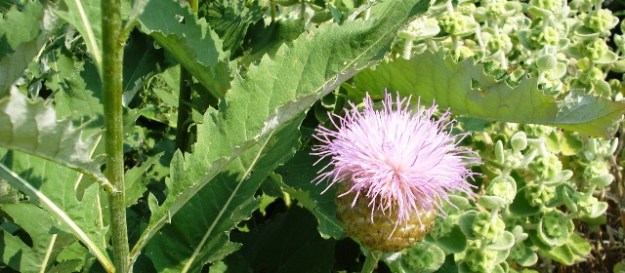
Plant options for dry conditions- at Beth Chatto’s Garden.
Have we reached a point where the emerald green sward of lawn in the midst of drought is a badge of shame, rather than a symbol of pride and good management?
The current extended dry spell has focussed my train of thought on inappropriate gardening styles. As I walked around Christchurch a few weeks ago, I marvelled at just how many sprinklers were running and how many property owners were out holding hoses and watering their ornamental gardens of an evening. At the time, I wondered why this city of keen gardeners were so determined to ignore their Mediterranean-style summers and slavishly pursue an English style of gardening which, in their conditions, relies entirely on irrigation.
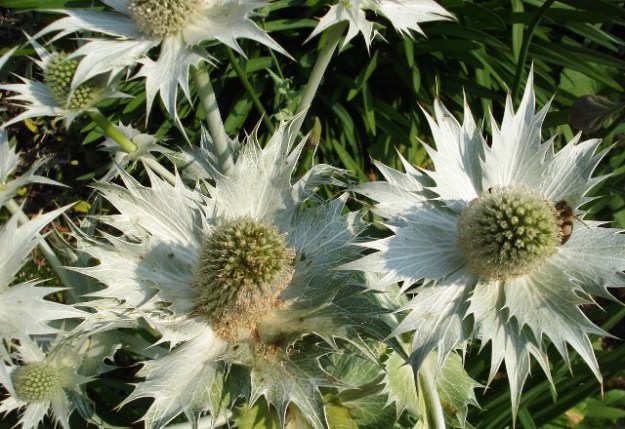
Eryngiums – another plant option for dry conditions
The deepening drought conditions here in the north should be raising red flags for gardeners who rely on summer watering. Where I live, drought is pretty much unheard of – until this summer at least. But much of the Waikato was in severe drought a few years ago and there are warnings coming from meteorologists that these are likely to become more common. Maybe it is time for thinking gardeners to lighten their heavy hoof prints on the planet and actively explore other ways of creating beautiful and pleasing gardens without following what are, at times, downright bad environmental practices. A clarion call, no less.
Lawns are a major offender. Frankly, I regard watering your lawn as an indefensible waste of a scarce commodity. Perfect green lawns are a value we have adopted, almost without question, from American suburbia. We have elevated the lawn to a pedestal way beyond its actual position in life which is to offer a useful area upon which to play and entertain and to provide a negative space (an empty space) to act as a foil which highlights ornamental plantings. A lawn should be a functional tool, not an end in itself.
Watering hedges is similarly dubious in my books. If you have to water your hedge to survive, you have chosen the wrong plant in the first place.
I also put permanent irrigation systems throughout gardens in the same category. If you are having to water your garden all summer to achieve the effect you want, then I think you should be going back to the drawing board and looking at different gardening styles.
We watched a BBC Gardeners’ World programme recently on the Royal Horticultural Society gardens which includes Hyde Hall in Essex. The head gardener there commented that their annual rainfall was less than Jerusalem. We have been to Hyde Hall and while they certainly irrigate many of the ornamental gardens (and probably the lawns, too), the dry garden was a revelation to us.
Not far from Hyde Hall are the famed Beth Chatto Gardens and it was Mrs Chatto’s dry garden which astounded us with its magic when we visited. She is gardening in similarly dry conditions and her dry garden is on an old river bed so with even less moisture retention.
We wanted to come home and try a dry garden but alas, in a climate where we regard three weeks without rain as a drought and where we have an annual rainfall level about eight times higher than those areas of Essex, it is never going to work here. We failed on the photography stakes in those two gardens. I took plenty of photos of wonderful colour combinations in perennial plantings at Hyde Hall (gifted colour combos, even, though my photos are average) but it is the special magic of the dry gardens at both locations which has stayed in our memories.
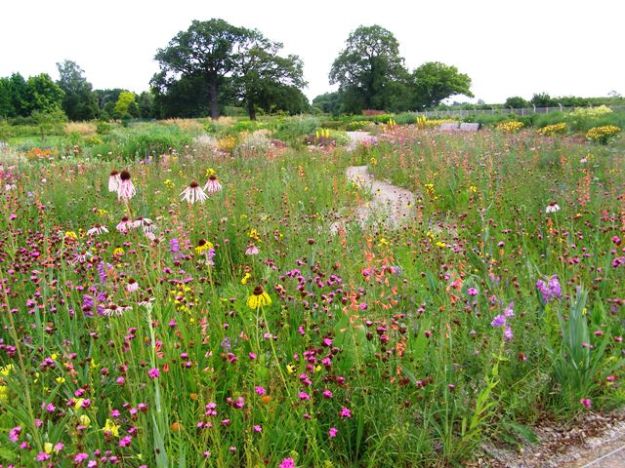
Missouri meadow garden at Wisley – simple magic in 2009
Wisley Gardens in Surrey to the south are also very dry and they were showcasing a different style of dry gardening in their Missouri Meadow.

Helichrysum Silver Cushion – happy in dry conditions, attractive, tidy and it’s even a native
If you pause to think, much of the world is dry and of course there is not only dry gardening with Mediterranean style plants – shrubs, trees and perennials which will take poor, dry conditions. These are often dominated by grey foliage, not necessarily small leaves but frequently so, often furry or prickly – all ways for the plant to conserve water. Some of our native plants fit into this type of garden. Pachystegias, our native helichrysum, some of the olearias, Astelia chathamica – all will take dry conditions.
The American prairies are a rich source of inspiration for seasonal gardens and home to a host of wild flowers that we now incorporate in our gardens such as echinaceas and black-eyed Susans. The work over recent decades by prominent Dutch gardener and designer, Piet Oudolf, appears to draw more from the American prairies as it does from the Med. The Oudolf School has been one of the most influential garden styles in Europe for the past decade but has pretty much bypassed us in this country so far. Yet it is one which lends itself to dry gardens.
Look across the Tasman. Our nearest neighbours have a wealth of plant material which has evolved to thrive in dry conditions. Some of it is very beautiful.
As the drought deepens here, maybe it is time to seriously question why so many of us are hanging on for grim death to an arguably outdated genre of lush, green gardening, mixing formality with informality, inspired by the English gardens of early last century.
If you are having to water anything other than your vegetable garden every summer, have a rethink. There are other ways to garden.
First published in the Waikato Times and reprinted here with their permission.




 • We at Council are deeply aware that traffic is a major issue for many Tikorangi residents but we have AWESOME news. We have brokered an arrangement between companies, their subcontractors and Tikorangi School. Starting next week, the trucks will be calling in to the school where the students will be painting happy faces on all the vehicles. We are confident that smiley faces will bring a smile to all Tikorangi residents as the trucks pass by. Drivers have also been instructed to give a cheery wave as they pass.

 • Tikorangi residents will be as thrilled as Council is that the Len Lye Centre has been given the green light. It is only because of Toad Energy’s wonderful generosity that this project is going ahead. In recognition of the special relationship between Toad and Tikorangi, residents will be guaranteed free entry to the new centre when it opens for a period of five years.
 • A few residents have suggested that Greymooth are not abiding by their declared number of light vehicles on their Kowhai B site. We are pleased to report that Greymooth have assured us that they are abiding by all conditions of their consent. We suggest that busybody residents who have counted up to 17 light vehicles parked in the two carparks at the same time should perhaps find something better to do with their time and get a real job. There are only six light vehicles a day travelling to the Kowhai B site. Similarly, Toad have assured us that they too are keeping strictly to the terms of their consent and there are only 8 light vehicles and 3 heavy vehicles driving on to their Mangahewa C site in any 24 hour period during drilling activities.
  •
• 
 •
• We are acting on concerns raised by an elected councillor at a recent Council meeting regarding malcontents in Tikorangi “besmirching the reputation of the Council”. He suggested a public education programme might be required. Council categorically rejects any insinuation that this may be a case of shooting the messenger and is investigating models of re-education programmes pioneered in the Soviet gulags, the Chinese re-education through labour programmes and the Vietnamese voluntary relocation strategies of the 1970s. We are confident that any troublemaking dissidents in Tikorangi can and will be dealt with promptly and efficiently and will no longer be able to embarrass your council and to sully the reputation of Taranaki.
 Tikorangi The Jury Garden