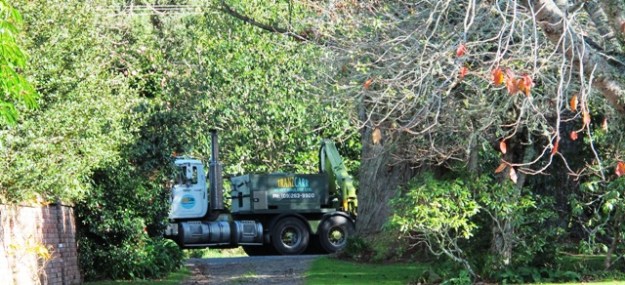
Heavy transport passing our entrance
Because we live in the country, free farming newspapers appear in our letterbox. They can be surprisingly interesting, even to a non farmer like myself. An article in the latest Farmers Weekly (Sept 10) caught my attention. The chief executive of the NZ Petroleum Exploration and Production Association was reported.
“Chief executive David Robinson says ‘passionate’ climate change campaigners had set out to create a bleak picture of the industry….
There had been exploration in NZ for more than 100 years and industry had been working ‘extremely well’ in and around farming country in Taranaki for several generations.
Good relationships had been formed, characterised not only by compensation for farm access and improved entranceways.”
Really?
I am sure the industry is pleased with how well things are going around the farming country in Taranaki. That is because locals are, in the main, astonishingly polite and stoic. But I wonder if those industry people have even bothered to ask local residents how well it is working for them? In fact, I doubt that they could even find one local resident who would say that their life has been enhanced by the developments but they could find many whose lives have been adversely affected.
What really beggars belief is the rewriting of history. The bully-boy tactics employed by some of the petrochemical men is still very recent. I wish David Robinson had been a fly on the wall when a sick, elderly man in his seventies from down the road sat at our dining room table and explained why he had signed a consent for Fletcher Challenge (a planned development in the heart of Tikorangi that we actually managed to stop). You see, he’d been told that if he didn’t sign, they’d hop over the fence to his neighbour’s property and he didn’t trust his neighbour. He thought he’d have more control if it was on his own place. And pitching neighbour against neighbour was common practice, compounded by confidentiality agreements.
I sat in public meetings and heard the same petrochem men tell bare-faced lies.
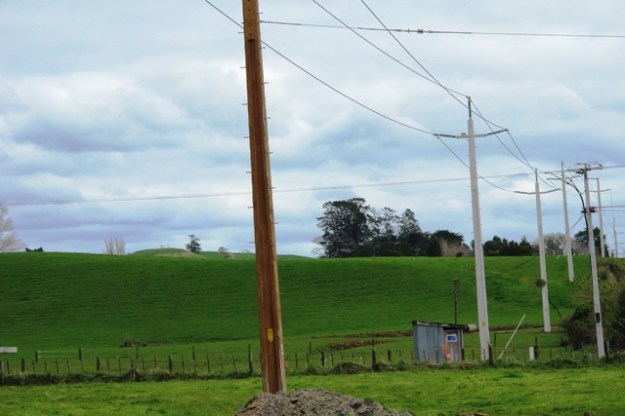
New power pylons marching over the landscape, solely to service the petrochem industry
I wish David Robinson had been present when another neighbour wistfully said to me earlier this year that she just wished the company would come and sit in her lounge and see what they now look at out their window. See, they built their dream home on family land with soaring views across farmland to the sea. Now they are the closest house to a major industrial development which is undergoing construction 24/7 and that is what they see and hear from their lounge.
Because we protested so publicly about the earlier Fletcher Challenge proposals, the accompanying seismic survey saw the helicopters on a flight path directly above our house. The choppers started as early as 5.30am in the morning, even on Good Friday, and continued all day. It was highly illegal flying over our house with loads suspended below and we believe it was also deliberate intimidation by subcontractors. There was nothing we could do. We don’t forget.
Around that time, another neighbour from up the road who had a lot of well sites on his farm rang me and said he couldn’t speak out publicly because he was in so deep with the companies but I should stick to my guns. I still recall his telling comment: “If I knew then what I know now, I would never have let them in at the beginning”.
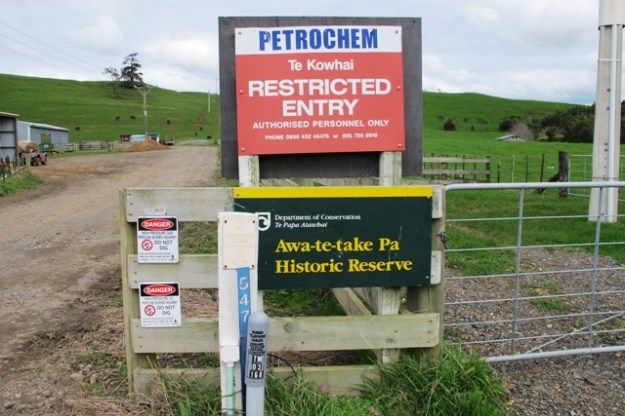
The site of the Otaraua protest
When Otaraua hapu staged a protest over many weeks on Ngatimaru Road a couple of years ago, the company involved simply did not have a clue how deeply insulting it was to turn up with a slab of beer for them. Otaraua had declared their occupation site drug and alcohol free and I recall a gentle kuia saying to me: “What next, beads and blankets?” Because of course the unspoken implication in the beer was that they were Maori so they would be partying and boozing.
It is not a proud history of cooperation at all. At least that bully-boy stuff is not as common these days. I think we have three, maybe four companies operating around our area. We are in Todd territory ourselves, and for that we are grateful. There are conversations around the area as to which company is better to deal with and there appears to be some consensus that we are lucky to be in Todderangi. They don’t bully, they are courteous and communicative. But that communication is simply telling us what they are going to do – the next intrusions on our formerly quiet country area. The impact remains very high.
Our quiet country roads here are now like main highways with large amounts of traffic and constant heavy trucks. Every one passes along one of our road boundaries and about 50% of them pass along two. And lucky us, the roads are being upgraded so the traffic can travel even faster. We have adjacent properties, separated by the main access route – there are many times now when crossing that road is downright dangerous.

Cos every farmer yearns for an “improved entranceway” like this bisecting the farm?
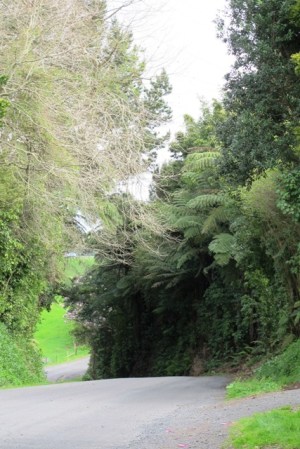
The “improved entranceway” opens from this small country road
The photo above is of the neighbour’s “improved entranceway”. It meets a small country road. Because every farmer covets an “improved entranceway” like this, don’t they, Mr Robinson? Except it is not the entranceway to the farm, it is a security controlled access to a major well site development and it actually bisects the farm.
Compensation for farm access is mentioned as a benefit. I don’t know what the current going rate is for compo but it certainly used to be pathetically low. It is hard to find out the figures because usual practice is for the companies to lock the landowner into a confidentiality agreement.
I do know that the most recent going rate for a seismic survey shot hole was $12 (2012 prices). For that, the company’s contractors get to bring a drilling rig onto your property and from then until the explosive charge is detonated, which may be a couple of weeks later, the affected paddocks can’t be grazed. This causes problems for farmers’ grazing cycles. Then there are the helicopters working on the survey, any hour of the day, any day of the week. For $12 a shot hole? Ridiculous. Seismic surveys are one of the most intrusive aspects for the largest number of people.
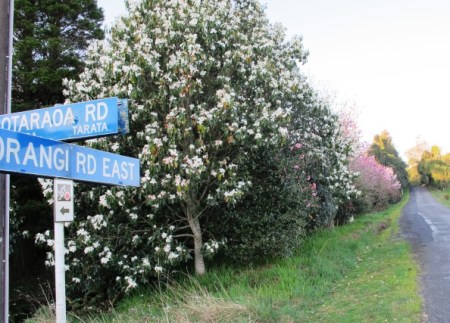
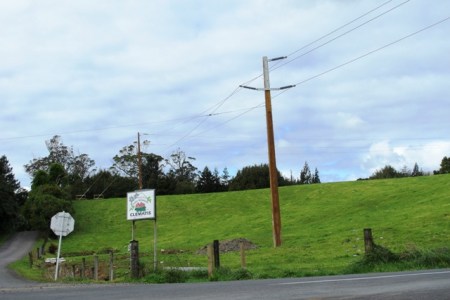
To the left is one of our road boundaries. Below right is the neighbour across the road. Until earlier this year, it was well treed, including mature kahikatea and tawa. That was all cleared to make way for huge power pylons to bring a secure power supply to the petrochem developments. We are lucky. We can’t see this from our property but others are not so fortunate. Their rural outlooks now feature pylons marching across the landscape. And guess what, the stringing of the wires was done by helicopter. It felt like Apocalypse Now living here on those days.
So please don’t tell us that everything is hunky dory here and always has been because it isn’t. There is just nothing we can do about it. Mr Robinson might do better to come and talk to locals here, rather than only talking to companies and to the overly sympathetic councils in Taranaki. I very much doubt that the elected councillors understand at all what the impact is like for locals. They are just thrilled to accept financial gifts for civic projects which are some distance away in New Plymouth. And councils have abdicated any planning role. Basically what they do is approve applications from the companies.
All that is without even touching on the environmental impact of oil and gas extraction and the controversial practice of fracking.
In the meantime, I offer drive-by tours of the petrochemical developments in my local area to anyone that is interested. You can see very clearly what the negative effect is for locals. And frankly, nobody seems to care much at all about that and Mr Robinson reinterprets history to give a rosy glow to petrochemical development in Taranaki.
For an earlier post on this same topic, check “Tikorangi – the new Texas?”
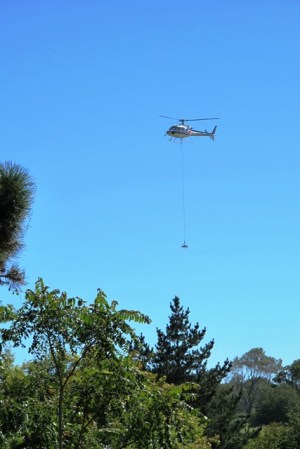
Helicopters are part of it all
-39.042098
174.300314

 This is a handy reference book for diagnosing many common problems in the garden, predominantly of the pest or disease variety. It is reasonably comprehensive though not encyclopaedic. Each ailment is given a brief description, usually with a clear illustration, and then advice for dealing with it or avoiding the problem happening again. I like the fact the illustrations are paintings, not photographs because it gives a much clearer picture. I also like the fact that not every recommended treatment involves buying a Yates product. So when spinach bolts to seed prematurely, the advice is that this can be caused by long days, summer temperatures, dry conditions and overcrowding. Sow summer spinach (well, ‘Summer Supreme’ actually – presumably one of Yates’ own). There is a fair amount of handy general information which is not commercially driven, though the organic section is pretty perfunctory. That said, we are talking an interventionist approach to gardening and where products are recommended, they are branded Yates products – it is their book after all. We double checked the ingredients of branded sprays and the in-house expert here gave the advice a general thumbs up for accuracy. I am a bit suspect about spraying cheap annuals like pansies and hollyhocks. I am more of the view that you rip out diseased plants and try a different strategy with replacements but if you are an older style gardener who reaches for the sprayer at the drop of a hat, at least you will have a diagnosis and know which spray to use.
 Tikorangi The Jury Garden