Tag Archives: Abbie Jury

In the garden this fortnight: June 21, 2012

A fortnightly series first published in the Weekend Gardener and reproduced here with their permission.

Before - too much mondo grass, not to mention superfluous hostas and Ligularia reniformis needing attention

Before – too much mondo grass, not to mention superfluous hostas and Ligularia reniformis needing attention

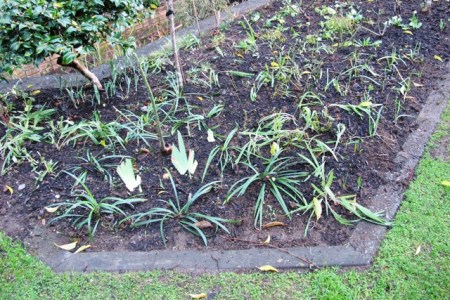
There are times, I admit, when the advice I give as a garden writer is from the do-as-I-say school. Digging and dividing perennials is an example – a recommended activity but not as urgent as other tasks here so rarely gets done. I am reformed, inspired by the dramatic response of plants which I lifted, divided and replanted into well dug soils last year. They romped away. I am working my way through the garden borders, lifting pretty much every perennial (but leaving Helleborus orientalis – the most common hellebore. It doesn’t appreciate being disturbed). As some have been left for well over a decade, it is a major task and takes some physical effort. It also gives the opportunity to clean up the perennial plantings to achieve a more cohesive look. Years of plugging gaps had meant that some were pretty hodge-podge in the selection of plants.

I have carted away two barrowloads of green mondo grass from just one smallish border – too much mondo. A drift of yellow polyanthus will give winter colour, interplanted with bluebells for early spring contrast. The variegated Soloman Seal (Polygonatum multiflorum var.) will give spring and summer detail, all held together by the evergreen tractor seat ligularia (L. reniformis) and the green mondo grass (Ophiopogon japonicus) – but in moderation. All of this is in the lee of a large mandarin tree, which gives wonderful orange winter colour with its abundant fruit. The fun part of gardening is deciding on different combinations for different areas but after the hard work, patience is needed before it all starts growing again.

And after - it needs to grow but it is very tidy

And after – it needs to grow but it is very tidy

TOP TASKS
1) Limit the mondo grass – both the black and green forms. It seems to have quietly spread into too many areas where it is not needed at all.
2) Get a layer of compost mulch onto the borders where I have been working. The compost will feed the plants while stopping dirt splash in rain. It is a fiddly job because it needs to be placed around in each plant by hand.
3) With only two months until spring here, the pressure is on to get winter projects done. This includes my reconstruction of the rose garden. It will make a major mess so once started, it is a case of needing to persevere until it is done. I have not been game to start yet but will run out of time unless I get moving.

The garden identity crisis

Finding the shapes within the plants, in this case a maple

Finding the shapes within the plants, in this case a maple

“People don’t know what to do with the garden when they get to year fifteen,” commented the retired gardener who was visiting us last week. “You need to do quite big things.” I grabbed a pen and paper to record his words because he is so right. We know exactly what to do with young gardens in this country, but too few know what to do as they mature and change.

The general age of crisis was set at fifteen years but that is a reflection of the rapid growth rates we have. It could be twice that in colder climates. The point is that at some stage, you wake up to the realisation that your garden is not how it used to be. The trees that you planted too closely in order to get a quick effect have now grown too large for their allotted space. Similarly, shrubs have outgrown their area and you are either madly hacking them back every year or you have stopped walking round the house on the path and have been forced sideways to avoid the dripping foliage. Your hedges seem to have grown wider than you intended and nearby plants appear to be suffering. The bulbs aren’t flowering as well as they used to. In fact a fair number seem to have disappeared altogether, as have the choicest perennials. It is the thugs that are left and even they are struggling in some areas which are now heavily shaded. The clumping perennials have become enmeshed together with bald areas showing and weeds popping up throughout which you can’t spray or pull out because they are so intertwined. The garden looks tired, lacking the freshness you remember from earlier days.

You are not alone. It is a natural part of the ageing process of the garden. In this country, most people leave the problem behind by selling up and moving on and the new owner is likely to cut it down and start again. The problem comes if you don’t want to move. That is when you need to do some quite big things.

Most people try and regain the earlier freshness and juvenility in the garden because they can’t see beyond that option. It used to be so pretty, you know. So poor plants are either slaughtered and removed, to be replaced by younger, smaller models. Or they are brutally cut off in their prime and reduced to ground level in order to “come again”. I have seen it done repeatedly.

The alternative is to learn a whole new set of skills. These are not skills that you often see demonstrated in this country because we still lack a heritage of long term gardens. First off, do not make the mistake of thinking that your garden is mature at 15 years. It isn’t. It is really just a gangly adolescent relying on your guidance to take it through to adulthood. On more than one occasion, we have had garden owners gushing that it is just wonderful having mature trees when there is not one single specimen that is older than 20 years. Fast growth we may have, but maturity in trees takes somewhat longer than that.

Leaving tree stumps to rot out in their own time is not without risk though many of us do it.

Leaving tree stumps to rot out in their own time is not without risk though many of us do it.

But it is a common fault to overplant gardens, both large and small, in the early days. At some point, you need to reassess and work out which are the key long term plants worth saving and which are expendable. You may need advice. The ones that are staying are the foundations to take the garden through to maturity. Be ruthless about the expendable plants in between. If you just cut woody plants off at ground level and leave them to rot out over time, you run the risk of opening up the whole area to armillaria (honey fungus) which starts in decaying wood but can then romp through killing healthy plants as well. Best practice is to get rid of the stump and many of the roots, especially willows, but that does not come without money or effort. Convenience and economy means that we often just take our chances.

An example of lifting and limbing over many years.

An example of lifting and limbing over many years.

Then lift and limb and let light back in. Plants need light to grow, even in shade gardens or woodland. Make tree loppers and a pruning saw your friend. But you don’t have to have the light beaming straight down from above. If you lift the lower branches and thin the plants, you allow light in sideways. It also creates views through and brings welcome changes of light and shade.

Now is the time to develop skills in shaping plants. This is not beating them into submission. It is negotiating to make the most of the plant’s best features by highlighting its good form and shape. By now you are working in an environment which has height as well as width and depth. It is a lot more fun than weeding – and on the bright side, weeds are fewer in shaded gardens.

It is just a different way of gardening and these are but the first steps. If you are floundering a little, take heart. It takes time to learn new skills (and some never do). But if you have a garden which is now in that mid adolescent phase, take a hard look because you will need to do something quite major with it sooner or later.

First published in the Waikato Times and reproduced here with their permission.

Plant Collector : Luculia gratissima “Early Dawn”

Luculia gratissima 'Early Dawn'

Luculia gratissima ‘Early Dawn’

To be honest, this is not my favourite luculia but it is the one that you are most likely to find offered for sale and it stays somewhat smaller than the other types we grow.

Do not let the fact that this winter flowering shrub hails from the Himalayas lull you into thinking it is hardy. It does not like frost at all and much more than a few degrees will cause short term damage to the foliage and possibly take out the winter blooms for the year. A heavy frost may kill it. However, you can learn a lesson from the fact that it is a forest tree in the Himalayas. If you have areas of the garden with good overhead cover from larger, evergreen trees, you may succeed with this plant, even in frosty inland areas. And it looks a great deal more attractive, in my opinion, when grown as a woodland plant.

The common practice in this country is to plant Early Dawn in full sun in the open and to keep it hard pruned and therefore more compact. It then covers itself in its rather harsh candy pink flowers (which are at least sweetly scented), shouting “Look at me! Look at me!” Its foliage develops a red tinge in cold temperatures and if an untimely frost catches it, you then have this rather unsightly, little shrub with shrivelled leaves. The plant we have in our woodland, however, is tall (2.5m), willowy, graceful and the sugar pink flower heads contrast well with all the greenery. It is a very different picture to the one we have in the open. Get it into woodland, is my advice, into ground rich in litter and humus. Then it may cheer up a bleak winter’s day.

First published in the Waikato Times and reproduced here with their permission.

For my preferred luculias, check out the white Fragrant Pearl and the pretty almond pink Fragrant Cloud (scroll down to the photo).

The sweet smell of daphne in winter

Daphne odora - happy around the back by the rubbish tin.

Daphne odora – happy around the back by the rubbish tin.

We have never forgotten the nursery colleagues who told us that their range included lemon trees and daphnes “because you can sell a lemon tree to pretty much every household and everybody has to replace their daphne every five years or so”. I had never thought about it before, but they were right. Most New Zealand gardens have at least one of each and daphnes do not rank up there as long lived plants. But we wouldn’t be without them in the winter garden.

While there are upwards of 60 different species in the wild, in terms of garden plants in this country, generally you have a choice of odora, odora or odora with occasional breaks for D. bholua and if you are really lucky, you might spot the little ground hugging D. cneorum (with its silent c), the dainty D. x burkwoodii, or the remarkable blue D. genkwa. You may buy your odora by many other names, but if it has typical daphne foliage and flowers, it is just an odora selection. The flowers are generally small and a mix of lilac pink and white with a range of subtle variations. Some are darker, pinker or even pure white. I bought one that was reputedly apricot but that was wishful thinking with the description.

The good and the bad of the Himalayan Daphne bholua

The good and the bad of the Himalayan Daphne bholua

We have a bit of a love-hate relationship with the Himalayan Daphne bholua. In our opinion it has the best and strongest fragrance of all and it has a long flowering season. Its upright habit of growth means it fits into borders and beside paths well. That is the good side. On the down side it suckers (spreads underground), seeds much too freely and is dispersed by birds so has weed potential. It also becomes very scruffy with time. It is semi deciduous which means it is neither one thing nor the other – it drops some leaves and those that hang on often look messy. The form is ugly and it can get quite large after a few years if you don’t stay on top of the pruning. So it is not a plant of great beauty at all, but its scent is superb. Hide it at the back of the border in behind more attractive plants so that it can wow you with its fragrance.

The blue flowered Daphne genkwa from China is remarkable. For most of the year it is just an anonymous willowy shrub. It is fully deciduous, so drops all its leaves in autumn. Then in late August, all those whippy growths burst into lilac blue flowers down their length. It is a wondrous sight. Some claim a light perfume, but I think that is imagination. It is just one of the loveliest shrubs you will ever see in flower. Alas, it is difficult to propagate (it is generally done from root cuttings) and can be difficult to get established so it is not common. However, it is still produced commercially and a good garden centre may be able to order it in for you. Plant it where it has good light, good drainage and plenty of space so it won’t need trimming. I killed a well established plant by cutting it back and I wasn’t that brutal. I loved it so much I bought three replacements and these will be planted with plenty of space so they should never need pruning.

Deciduous, lacking scent and blue lilac but it is probably the most spectacular - Daphne genkwa

Deciduous, lacking scent and blue lilac but it is probably the most spectacular – Daphne genkwa

Growing tips: daphnes are not suitable plants to grow in containers. Mostly they look unhealthy and straggly because it is hard to get the potting mix right. It is much easier to keep them lush and healthy planted in the garden, even more so if you pick a position out of full sun. The odoras and bholua are often a good choice for the more shaded house borders. While they need good light levels, they are quite happy with little or no direct sun.

Daphnes prefer rich loamy conditions, neither acid nor alkaline. They won’t love you if you put them in waterlogged conditions either so look for spots with good drainage which never get bone dry either. Keep them mulched with compost or leaf litter.

While Daphne bholua will accept hard pruning, most other types won’t. You are better to take a bit more care and think more about pinching out new growth to encourage bushiness and shaping with secateurs, rather than hacking bark hard all over.

Because they are winter flowering, finding locations near to where you walk in winter means you will get more benefit. This is one of the few plants with such strong scent that you will pause and look for the source so plant it where that can happen. Only D. genkwa is spectacular in flower, so they are wasted in more removed locations. Round the back of house near the rubbish bin is a handy location for us though we have quite a few other plants all over the place.

First published in the Waikato Times and reprinted here with their permission.

Grow it yourself: European radishes

I still associate radishes with encouraging young children to garden. The little red globes of the European radish grow so rapidly that you can be eating them in just over three weeks which gives a wonderfully quick result, even if the flavour may not be to littlies’ taste. If you haven’t had a look at radishes in recent years, you may be surprised by the range now available. There are long thin ones, large and small globed ones and colours range through reds, pinks, whites and bicolours to pure gold (Radish Zlata from Poland) and the Black Spanish Radishes which are black skinned with white flesh. And that is without even considering the oriental radish varieties.

The common garden radish has a bit of a split personality. It is almost exclusively served as a salad vegetable in this country though there is no reason why you cannot cook with it, in a similar manner to other root vegetables, albeit being of rather small stature. However it is a brassica which explains why it is better as a cool season crop. In mild areas, radishes can be grown right through winter. Yet it is a root crop, unlike most brassicas, so it does not want soils rich in nitrogen which encourage too much leafy top growth at the expense of the roots.

Sow seed directly into finely tilled soil and cover lightly to a depth of a centimetre. They will need to be thinned out after germination to allow room for the roots to develop. Pick them young. They soon get woody and too peppery so are best pulled, washed and stored in the fridge if you have too many. And you can always try Hugh Fearnley Whittingstall’s unlikely fresh radish dish – serve with softened but not melted butter and lashings of salt. No Heart Foundation tick for that one.

First published in the Waikato Times and reprinted here with their permission.