Tag Archives: Abbie Jury

In the garden this week: February 4, 2010

· The coming of February heralds the time to be thinking about the winter vegetable garden. As you clear summer harvests, you can start planting winter crops such as winter spinach, brassicas, peas and Florence fennel or celery. Get in quickly if you want to sow carrots, leeks or parsnips. They need a longer growing season. It is the very last call for Brussels sprouts and they must be from plants now, not seed.

· Keep up with plantings of green leafy vegetables which are a quicker maturing crop and can keep you supplied in bulk filler daily veg – lettuce, spinach, silver beet and Asian greens of the bok choi, pak choy, mizuna types.

· If you want to add animal manures to your garden, in their raw state they are best either put through the compost heap first or dug straight into the garden and left to mature and to start decomposing for some weeks before you attempt planting. However chicken manure is too strong to add directly to the garden – dilute it through the compost heap or let it age for a period of time (exposed to the air but not to rain). If you buy product like Grunt or sheep pellets rather than gathering your own au naturel, it will already have gone through some of the composting process and should come with its own instructions.

· Seaweed is excellent for the garden and can be dug in or laid on top, whichever you prefer. It does not need to be washed in fresh water first.

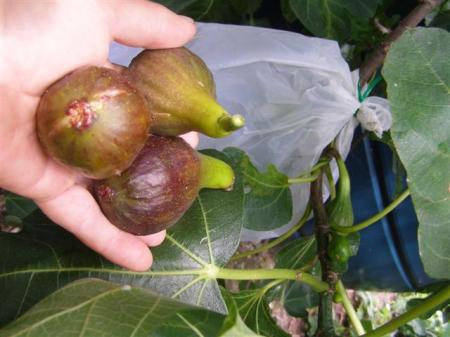
It takes a bit of effort to outwit the birds but the resulting fig harvest makes it worthwhile

It takes a bit of effort to outwit the birds but the resulting fig harvest makes it worthwhile

· We have been enjoying an excellent fresh fig crop this year – the common brown turkey figs which can grow perfectly well here. However, it does take some active management because the birds also love them and don’t worry about waiting for them to ripen. Because our tree is too large to cover, Mark has been bagging the ripening fruit with opaque plastic bags with the bottom cut of, secured with a freezer twist. As long as the birds can’t see the fruit, they won’t eat it and the bottomless bag means the fruit doesn’t rot. Alternatively you could espalier a fig against the side of a building or wall so that the whole plant can be bird netted.

· You can prune plum trees as soon as they have finished fruiting. Summer pruning can help reduce diseases getting in to cut surfaces. The aim is to have a good, open framework to the tree to allow for light and air movement. Take out wayward branches that cross others or branches that rub their neighbour.

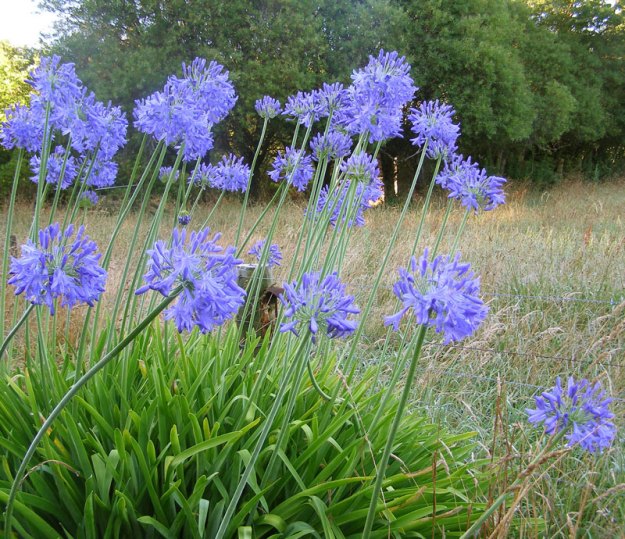
Agapanthus -the blue (and white) stars of our summer roadsides

Our summer roadsides would be the poorer without agapanthus

Our summer roadsides would be the poorer without agapanthus

We have a bit of a love-hate relationship with agapanthus here in Taranaki and in warmer areas of this country. But as you drive around the countryside at this time of the year, most would agree that our roadsides would be the poorer if they were gone. They resemble giant blue harebells growing, well, growing pretty well everywhere if we are honest.

Agapanthus all come from South Africa and from relatively limited areas of that country. Don’t be misled by the common international name, the Lily of the Nile. They are neither a member of the lily family, nor do they grow anywhere near the Nile. Nor does Agapanthus orientalis come from the Orient. That descriptor merely means eastern, so the natural habitat of A. orientalis (probably more correctly known as A. praecox ssp orientalis) should be on the eastern side of South Africa, assuming the original plant collections and recording was done accurately.

The name comes from Greek. Agape is love and anthos is flower but whether this means the flower of love or lovely flower is unclear.

So are they a weed? These matters are rarely as black and white as they appear. On the debit side:
• Most agapanthus set seed freely and the seed germinates readily.
• Agapanthus grow well in a wide range of situations including inhospitable clay banks and shaded areas. They form a dense cover which prevents other plants from germinating – particularly desirable native regeneration. They have the potential to colonise bush reserves, national parks and native bush.
• The common agapanthus are resistant to the world’s handiest weedkiller, glyphosate (formerly known by its original brand name: Round Up). While you can take them out with stronger brush killer sprays, most of these require you to hold a spray licence.
• Digging out well established clumps takes quite some physical strength and determination because the plants cling on for grim death and the clumps can be formidable. Because they have roots which are rhizomes, if you don’t get the whole plant out, what is left behind in the soil will re-grow.
• There is no way this plant would ever be permitted into the country now. Mind you, the same thing could be said about kiwifruit.

There is a credit side and a degree of resigned acceptance by the authorities in this country which sees agapanthus treated as a surveillance pest plant rather than the hard line decision to ban it outright.
• While it seeds freely, the seeds are not dispersed by birds at all so in most cases, the seedlings pop up close to the parent plants. The big problem comes with plants beside waterways because the water can do a very efficient job of spreading them much further.
• They are a significant plant for cut flower producers and there are dwarf and sterile forms available for home gardeners which pose no threat at all. There is a large international market and agapanthus occupy an established niche in our nursery industry. Many of the named hybrids have parentage which includes one or more of the species other than praecox and this reduces the weed problems.
• They make a significant contribution to our summer landscape as a flowering plant and will tolerate harsh, roadside conditions so are favoured for amenity plantings.
• They are evergreen, tidy and suitable for using to stabilise slip-prone areas.

Basically Biosecurity and most northern regional councils would love to ban it outright but pragmatism triumphs so the aggie lives on to flower another day. Auckland has banned the larger growing forms of A.praecox (the common form), still allowing the production and sale of dwarf forms as a compromise position. The sensible position for the home gardener who lives adjacent to native forest or to waterways, would be to remove them entirely. As a back-up position, being industrious and thorough about dead heading would reduce the problem. For the rest of us, it probably doesn’t matter and they make a huge contribution to our summer gardens and landscape.
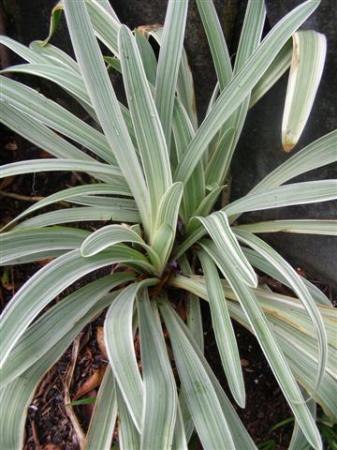
Agapanthus Tinkerbell - no weed potential here

Agapanthus Tinkerbell - no weed potential here

By no means are all agapanthus thugs. Little Tinkerbell is common in gardens though probably more noted for its very clean white and sage green variegated foliage than its flowers. It is distinctly shy on flowering, as a rule. It also has a significantly large root system for a plant without a great deal on top but it is a useful addition in the garden border. Other named hybrids are often more amenable than thuggish and have their place in the garden setting.

This is a plant family which is a great deal more highly prized overseas than here. In harsher climates, stronger growing plants are valued for their ability to survive the conditions and most of Europe and the US have much harder conditions than we have. Toughies that stay in leaf as well as put on a lovely summer flowering display are harder to come by, especially in blue. Because they don’t tolerate extremely cold conditions, additional measures are often required to get the common agapanthus through winter.

But in this country, you can’t even give away common agapanthus. Which is why we were genuinely shocked by a section in “A Green Granny’s Garden”, by Fionna Hill. I reviewed this before Christmas and I have to admit I did not read it cover to cover or that review might have been a little tougher had I come across the following paragraph referencing her attendance at a Hollard Gardens’ workshop here in Taranaki:
“Workshop participants have been invited to bring seed and other plant material to share. We pulled lots of agapanthus plants from Maggie’s New Plymouth garden that day and (we thought) cheekily we’d take the opportunity to leave a wheelbarrowful. We give the barrow to some helpful children to wheel back to the meeting shed, while we speed off down the road. I think it might not have been welcome, at that time, believing them to be a pest.” (sic). The page of self justification that follows does not mitigate the action for anybody except the author, who concludes: “I shouldn’t feel so guilty about that wheelbarrowful that Maggie and I have left as a contribution – at UK rates, the barrowful was worth about 300 pounds.” I don’t think so, dear. What you did was to furtively leave your friend’s weeds for Hollards’ staff to dispose of. You should be feeling guilty and embarrassed.

In the Garden this week: January 28, 2011

• A point of clarification from last week: if you want to try water retention crystals (Saturaid, Crystal Rain or similar) on a dry lawn, you must rake them in, not just leave them scattered on top. Otherwise you will just hoover them all up with the lawnmower.

• If you read the article on the food pages of our local paper last Tuesday about pine nuts, you may be interested to know that they are easy enough to grow here. Pinus pinea, the Italian stone pine, is the most common variety though there are other species suitable for seed (pine nut) production. However, and it is a big however, as soon as it comes to harvesting the seeds and peeling off the outer coating of each seed, you will realise why they are relatively expensive in the supermarket. You are more likely to decide that they are actually extremely cheap to buy instead.

• If you needed an extra reason to get motivated to plant a winter vegetable garden, the Australian floods may be it. Vegetables are tipped for hefty price rises this year – it is all a matter of supply and demand. So start digging. If you are working on grassed areas skim off the top layer of turf and stack it to one side to rot down. Or, if you are not determined to be organic, spray with glyphosate (formerly known as Round Up) which will also kill off most of the perennial weeds (but not clover). Current evidence is that glyphosate is safe to use when applied according to directions. It has been around for many years now so there has been time to discover lingering ill effects or contraindications.

Last weekend's rain means it is safe to return to planting out herbaceous material

Last weekend's rain means it is safe to return to planting out herbaceous material

• With the heavy rain last weekend and more forecast, we have resumed planting but only of herbaceous material, not woody trees and shrubs which will get stressed when we next dry out again. Herbaceous material is quicker to establish itself and to get its roots out and it responds much faster to watering if necessary. I have been digging, dividing and replanting an enormous clump of Ligularia reniformis (the tractor seat one) – but cautiously. It is within reach of a hose just in case.

• If your potatoes are showing signs of blight (dark brown wet patches on the leaves), you have to be in really early with a fungicide spray to stop it. If the foliage is already collapsing, it is too late. Dig the potatoes immediately and you may save some of the crop. Delay and the blight will also infect the potato tubers. You have to remove all the diseased foliage and tubers to try and stop the fungus from remaining. Either burn the affected plants, put them out in the rubbish or hot compost them. Don’t just throw them in a heap or cold compost them. It is this blight (Phytophthora infestans) that caused the Irish potato famines.

• On the grounds that a few phone calls asking the same question may indicate a landslide of curiosity out amongst the readership, I found the rolling compost maker shown in Outdoor Classroom last week at Mitre 10 Mega in New Plymouth. This is not to say that other outlets do not also have it in stock – I did not look further.

Plant Collector – auratum lilies

Auratum lily Flossie - one of Felix Jury's hybrids

Auratum lily Flossie - one of Felix Jury's hybrids

I don’t cut flowers to bring indoors very often. When every window of the house looks out to a garden, it doesn’t seem necessary. But as soon as the auratum lilies start to open, I reach for the kitchen scissors and head out. They are just the perfect cut flower – one stem can have up to ten flowers (sometimes even more) and put in a tall, slender vase they not only look superb, they can spread their delicious scent through an entire room.

Auratums are known as the golden-rayed lily of Japan – how lovely does that sound? The flowers are the largest of the lily family, often more than 20cm across, and they are a mainstay of our January garden. Felix Jury adored them (probably for all the same reasons that we do) and dabbled with breeding them, naming several selections. This one is the very large flowered Flossie. The upshot is that we have a lot of auratums in the garden and generally they are quite happy with benign neglect, growing in both full sun and semi shade. They prefer soils with good drainage and plenty of humus but not too rich.

The bulbs are large – fist-sized even – and we tried to get around all the plants last winter to dig and divide them. They haven’t had any attention for many, many years but when the clumps get too congested, the tops tend to fall over if they are not staked. The freshly divided patches are mostly standing up like little soldiers without any assistance. Some of the taller ones can get over 2m high and they need some support though often I will intertwine them through neighbouring plants.

You can sometimes find lily bulbs for sale in garden centres in winter. Make sure you avoid any dry, shrivelled specimens – they do not like to be dried out completely even when dormant. You may be lucky and find some auratums but they are not widely offered on the NZ market despite their spectacular summer display.

In the Garden: January 21, 2011

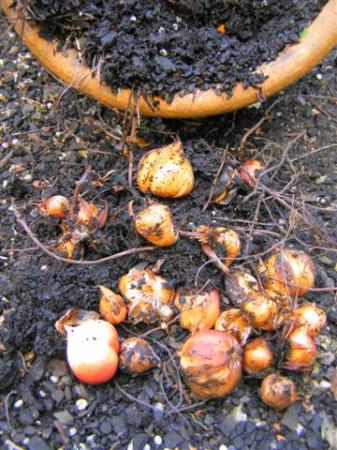
Dry bulbs can still be planted

Dry bulbs can still be planted

• Saturaid or Crystal Rain can look like a good idea at this time of the year. These products generally resemble rock salt crystals when dry but absorb large quantities of water, expanding and changing to chopped jelly in appearance. Use them for hanging baskets, potted annuals or short term potted vegetables. Don’t make the mistake of using them in the garden. While they look appealing at this dry time of the year, with our high rainfall, for ten months of the year they will hold water and ensure that our free draining soils become water logged. Once you have them in the soil, they will stay for years. Longer term container plants don’t want to be kept waterlogged in winter either. So restrict their use.

• However, I am told that these water retention crystals can be very good on lawns which dry out badly over summer and turn brown. I have yet to try this myself but I will in a couple of small problem areas. Carol at my local garden centre says that scattered lightly on the lawn, they have proven very effective and there is good logic to that but be sparing in the quantity used.

• Summer prune cherry trees.

• We have pretty much stopped planting any ornamentals here now until we get significant amounts of rain. If you insist on continuing to plant, you must water well before, during and after the planting process and continuing to water over the next weeks. With water restrictions being imposed in much of our area, it is better to delay all but vegetable planting.

• You can plant dry bulbs and leave them for nature to take its course though garden centres will not generally get any of the new season’s bulbs in stock until the start of February.

• If you grow your own vegetables from seed, you should be getting onto sowing winter vegetables – brassicas, parsnip, carrots, winter spinach and lettuce, leeks and celery. If you are going to buy plants, you have plenty of time. However, starting from seed will save money and give you extra to share.

• This does not apply to Brussel sprouts which must be planted immediately, using young plants, if you are to get a crop through. They have a longer growing season and need to be big, strong plants by winter. This is assuming you eat these gourmet baby cabbages, as we do.

• The food pages of our local paper had a piece tea this week. You may be interested to know that you can grow the tea camellia easily here, as long as you do not get very heavy frosts. What is more, it is sometimes available to buy. Look for Camellia sinensis. Mark brewed the best tea from ours when he bruised the leaves and left them to ferment slightly for 24 hours – apparently closer to Oolong tea. Our home grown product has not replaced our favoured Earl Grey but it is not a bad substitute for those in search of self sufficiency or those who love the freshest of green tea.