Tag Archives: Abbie Jury

The constructions at Paloma

First printed in the Weekend Gardener issue 322 and reproduced here with their permission.

Clive Higgie and his slightly surprising small companion, the irrepressible Pablo.

Clive Higgie and his slightly surprising small companion, the irrepressible Pablo.

Over the years, Clive and Nicki Higgie have amassed one of this country’s foremost collections of plants and turned them into a remarkable garden at Fordell, near Wanganui. With his farming background, Clive is both practical and innovative and enjoys turning his hand to both construction and sculptural installations for the garden. He is not afraid to mix and match different styles and the results can be both surprising and original.

Some of Clive’s work is edgy, even flamboyant, and pushes boundaries in unexpected ways. A plain board fence at the entrance has been transformed into a statement by using witty wall writing – it is rather too whimsical and well executed to be described as graffiti.
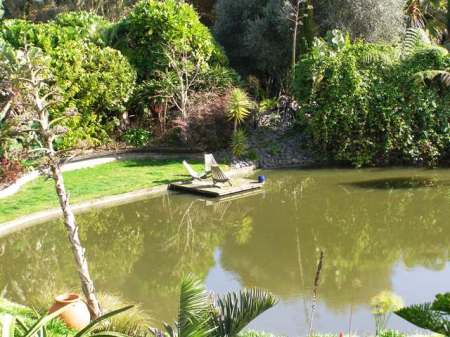
The seating deck built out over the large pond area is also a little edgy. There is something a little insecure about sitting in such an exposed position even if the water is shallow. Clive says he made a few design mistakes on this small platform, particularly making it so low that leaves accumulate below the deck. Clive also constructs the seats. He calls them his Barebum Chairs, which I originally misread as Ba-ree/-bum.
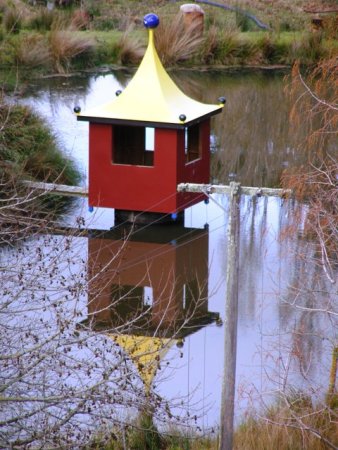
The boathouse is a work in progress. Showing typical ingenuity, Clive has used a concrete water tank as foundations for the structure. The roof is made from fibreglass matting coated with acrylic while the balls are ceramic.

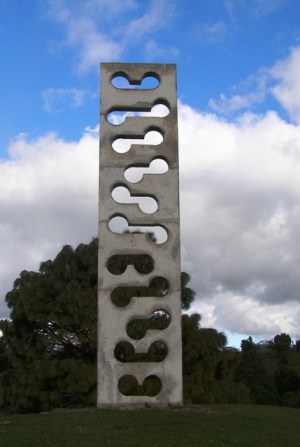
The Iona Cross is distinctly monumental construction made by Clive, standing nearly two and a half metres tall. It is concrete and was poured flat before being moved to its location. By contrast, the Polynesian influenced vertical panel was boxed up and poured in its final location. These are just two of a series of installations surrounding his earth labyrinth which reference the ancestry of Clive and Nicki’s first grandchild.
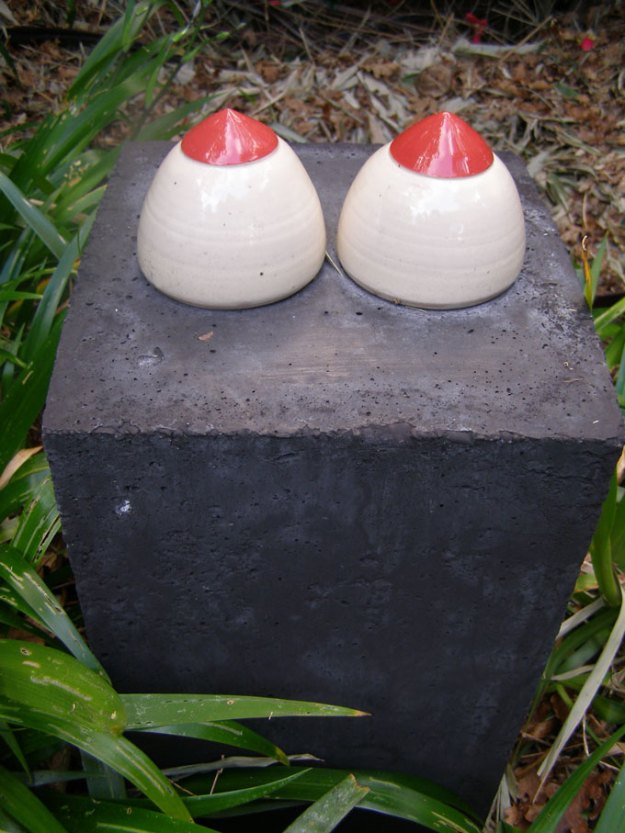
Paloma Six

Clive is pleased with his recent constructions of simple concrete plinths. “I add a bit of oxide to colour the concrete and to stop it being that glaring white of fresh concrete. I really like the plinths. Sometimes a small vase or sculpture can get lost in a garden setting but the plinths make them stand out.”
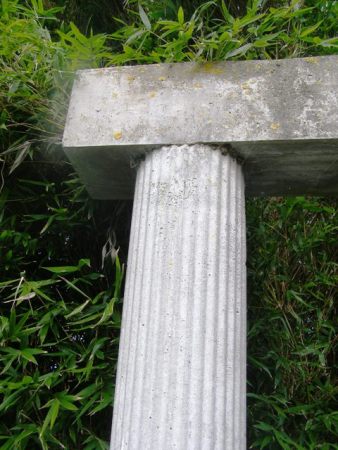
The ribbed pillars have a clear debt to ancient times but have been created using labour saving modern techniques. The mould was simply a product called baby iron (small profile corrugated iron) bent in a circle and filled with concrete. These have reinforcing rods down the centre and are boxed up and poured in their final location.

Paloma orange

Elsewhere in the garden, Clive has made extensive use of pillars constructed from terracotta field tiles. He first saw the technique used at Tupare in New Plymouth. He explains: “The pipes are irregular so I mortared them together before filling them with concrete. The mortar joins give structural strength. They didn’t do that at Tupare and many of their pipes had cracked and split.”
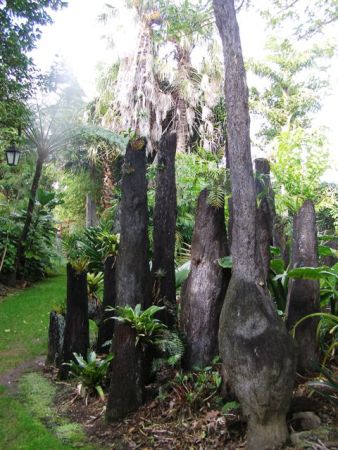
Not all construction is in concrete. Clive used ponga longs of irregular shapes and sizes to build a simple stumpery installation. The pongas vary from waist height to around 3 metres.
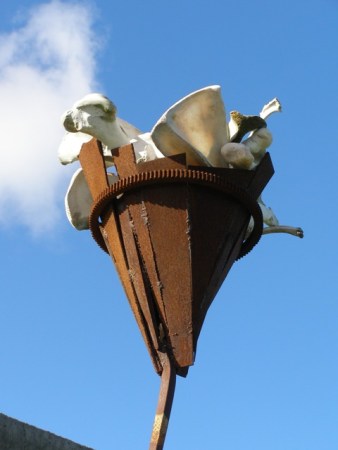
In his new Garden of Death, his friend, sculptor Steuart Welch, made the hanging crucibles which he calls Dracula pots. Clive has filled them with bleached animal skulls to complement the theme of the garden which is based around the social history of poisonous plants.
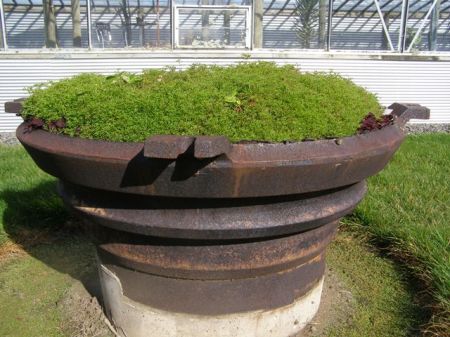
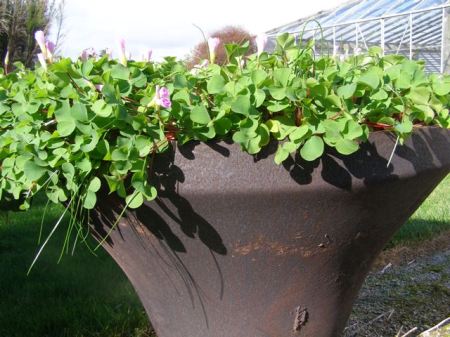
The attractive large planters came from a quarry stone crusher and, originally, the smooth sided bowl fitted inside the ribbed one, breaking large stones down to form road gravel. Being magnesium steel, they were of no scrap value but now contain large plantings of ornamental oxalis.
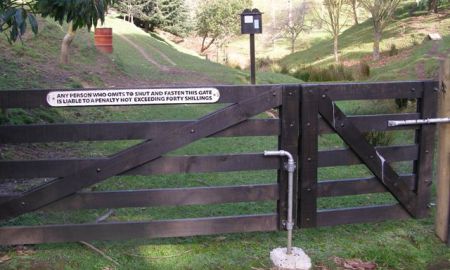
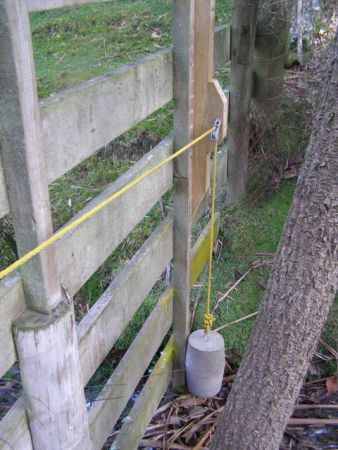
Clive is pleased with his simple solution for the side gate leading from the lower garden to the Matchless Arboretum. Because sheep graze beneath the trees, it is important that the gate be kept closed. A simple system of a counterweight pulls it shut behind visitors.

Paloma Gardens are open to the public all year round. For further information, check out their website: http://www.paloma.co.nz, email clive.nicki@paloma.co.nz or phone 06 342 7857 For my earlier story on Paloma, check Breaking the Mould of the Modern New Zealand Garden – the Dreams at Paloma.

Ideas to Import

Simple ideas from English gardens. First printed in the Weekend Gardener, issue 321 August 25 to September 7 and reprinted here with their permission.

Lutyens steps at Hestercomb

Lutyens steps at Hestercomb

Lutyens steps at Great Dixter

Lutyens steps at Great Dixter

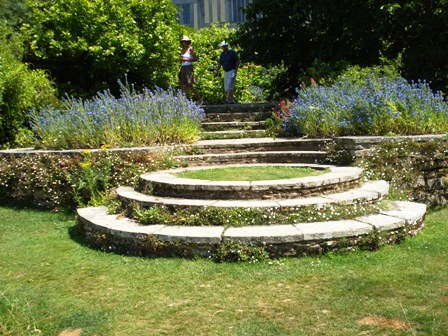
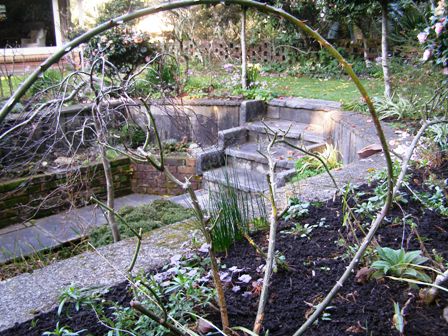
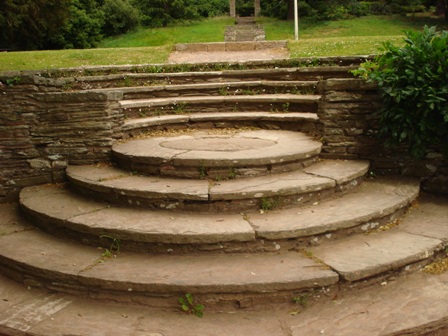
Nobody does statement garden steps quite like the great English architect Edwin Lutyens did. Outward facing semi circles lead you into the steps from both sides with the transition of a full circle in the centre. These examples are from Hestercomb and Great Dixter.

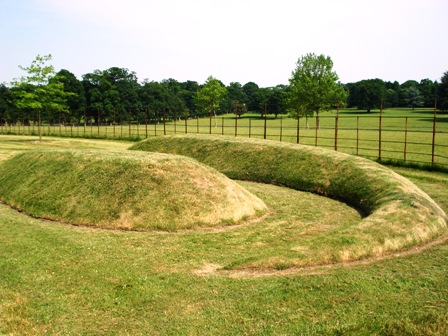
Discreet and informal seating for up to seven people in the outer reaches of the garden at Helmingham Hall. The tree trunk sections are set at the same height and backed by an informal brush barrier which frames the seating area. The view from the seating area is across a recent freeform earth feature towards the Tudor deer park.

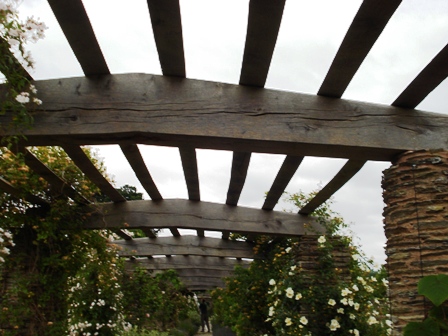
The simple device of subtly shaping the cross beams of this pergola at Hestercomb gives a lighter, more graceful effect as well as guiding the eye down the long view.

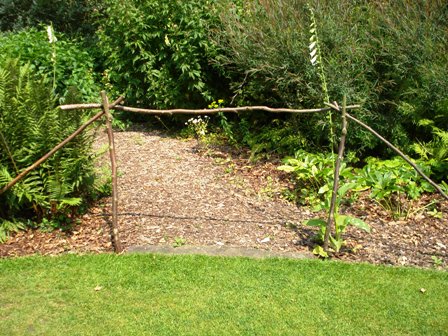
It is clear that this path is closed in Beth Chatto’s garden and the use of fresh saplings (probably hazel) forms a discreet visual barrier. Traditionally, English gardeners have used stakes and supports in their natural form, harvested from their own property, rather than the common use of imported bamboo, tantalised timber or metal stakes used in New Zealand.

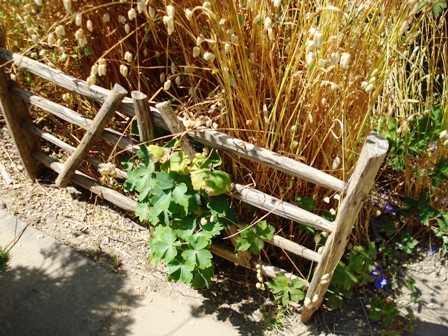
A rustic, low wooden fence built like a gate is an attractive, permanent means of holding back the floppy growth from falling over the narrow paths at Great Dixter.

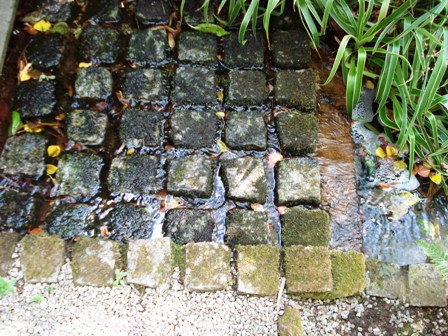
Using small, square cobbles makes the most of what is otherwise a rather insignificant small stream at Lamorran Garden in Cornwall.

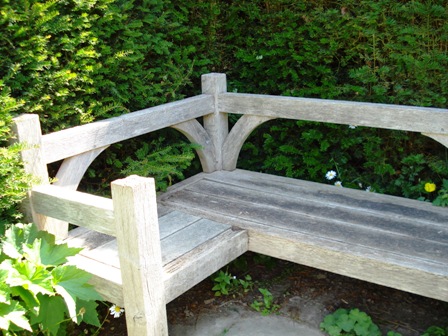
Adding a return to this seat at Great Dixter makes it a generous and attractive feature rather than just another wooden garden seat. It does not, however, increase the seating capacity.

A short lesson in hooping, no less

Hooping the long whips on the apple trees

Hooping the long whips on the apple trees

Many woody plants concentrate their hormones at the tips of branches. If you bend the branch closer to the horizontal, then the hormones which lead to flowering are more evenly dispersed along the length which encourages the growth buds lower down to flower and grow.

Our Friend of the Garden, Colin, braved the snow and frost this week to come and stay and he has pruned the apple trees. He has hooped over some of the long whips to encourage the plant to push out growth buds along the length, which should result in the production of stronger fruiting spurs to replace old, spent spurs.

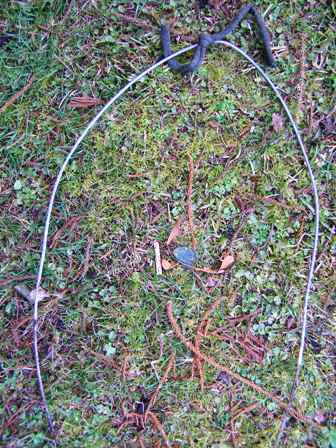
Hooping roses which put out long growths increases the flowering markedly. It is a technique I first saw done at Ayrlies Garden (back in the days when Neil Ross was head gardener there). It takes up a lot of space but is worth the effort. I tie the long whips down to wire hoops in the garden. Many of the David Austin roses put out long whips which are ideal for hooping.

Hooping the roses to maximise flowering this season

Hooping the roses to maximise flowering this season


Using a simple wire hoop to tie down the long rose whips

Using a simple wire hoop to tie down the long rose whips

It is of course the same principle as using espalier techniques to increase cropping. Espalier is not just a space saving exercise in keeping plants as close to flat as possible. It can also maximise fruit yields in a restricted space. You need to make sure that ties are flexible so they don’t cut in and damage the branches – stockinette or similar. The apple hoops were secured with a tapener or tying machine which staples a small piece of flexible plastic tape in place.

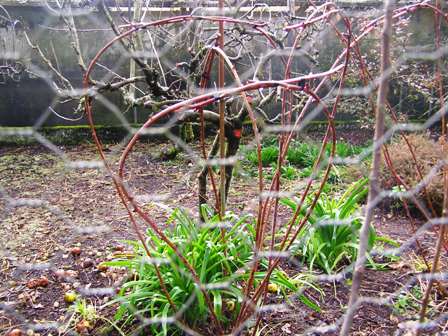
Postscript: A man on a mission, Colin is now hooping the raspberries. This is a particularly strong growing variety and this hooping is in part to keep the growth under control and to prevent them making an escape out the top of the raspberry cage. It should also make picking easier.

Any woody plants which make long, whippy growths can be hooped to maximise flowering and fruiting. Colin, a retired horticulturist of vast experience, assures me that when it comes to fruiting plants, the redistribution of the plant’s hormones achieved through hooping encourages leaf buds to form flower buds as well which increases potential fruit yield.

A man on a mission, Colin is now hooping the raspberries

A man on a mission, Colin is now hooping the raspberries

Prole drift in New Zealand gardening

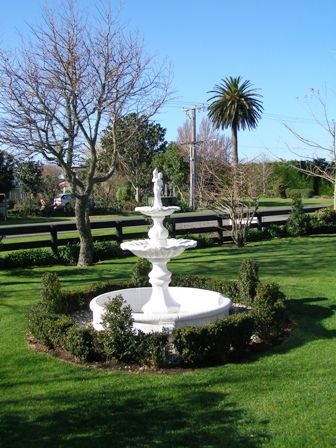
The rococo styled fountain has drifted down the road from us

The rococo styled fountain has drifted down the road from us

Prole drift. I had never heard of it until last week but I was greatly amused by it. The usual example of prole drift is the devaluing of status suffered by the Burberry plaid when it was embraced with gusto by the chavs of the UK (referred to, apparently, as a downmarket demographic). The SUV is undergoing a similar slide in status. The classic Range Rover slipped a little when Japanese manufacturers started making more reasonably priced models. But those new generation sports utility vehicles still came with a reasonably hefty price tag and appealed to the wealthy middle classes who wanted to look as if they were forever whipping up to the ski fields, whether or not it was true. “The four wheel drive is so handy – eliminates the need for chains, don’t you know.” In those early days, such vehicles were often referred to as urban tractors or Remuera shopping baskets. These days they are just as likely to be Manukau or Pakuranga Tractors. There is a certain inevitability that the status symbols of the privileged will be coveted just as much by those a little lower, or indeed much lower, on the socio economic ladder.

But as I pondered prole drift, it occurred to me that it is a remarkably good description of much of New Zealand gardening. In an earlier column, I asked whether there was such a thing as the New Zealand garden. I came to the conclusion that there are certainly some defining characteristics. At that time, I wrote:

It must be something in our egalitarian heritage which has many New Zealanders taking the ideas of the large, historic gardens – especially in Britain though sometimes from wider Europe – and attempting to re-create something similar here. We seem to be oblivious to the fact that the vast majority of the great gardens of Europe and Britain were established and maintained by the wealthy and the powerful who could afford to pay gardeners to actually do the work. So we go for high maintenance gardening styles (clipped hedges, a touch of topiary, sweeping lawns, mixed borders, buxus enclosures around statuary) – all the trappings of the gentry and the nobility which our forbears were so keen to leave behind.

Prole drift! That is what it is: prole drift. We are still at the stage of wanting the status and class (prounounced something akin to claarss) and thinking that if we embrace the status symbols of those further up the social scale, somehow the mystique of privilege will envelop us as well. It is not our egalitarian heritage after all. It is covetous envy and has resulted in scores of mini-Sissinghursts and even mini-Villandrys with barely a smidgeon of originality. Buxus hedges in abundance, tightly clipped, filled with either neat and decorative vegetables (which makes it a potager), citrus trees (which makes it Italianate), colour toned perennials or annuals in formal style (French parterres) or a froth of artfully casual blooms lifted by the mandatory white cosmos or foxgloves (which passes for English cottage style but tightly corseted by encircling low hedges) , with accents of clipped topiary balls or pyramids, even the occasional knot garden, all ornamented with obelisks, Lutyens styled garden seats, pergolas, formal avenues, laburnum arches, and… marble garden features. Diana, perhaps, something armless or a small fountain.

The funny thing is that so far so good – this heavily derivative style of prole drift gardening has indeed been accorded status and recognition in this country and, scarily, is often equated with style, superior taste and class. It remains to be seen what happens as it continues its drift sideways and downwards.

The evolution of a New Zealand style of gardening better suited to our conditions (geographic, climatic, botanic, cultural and financial) will continue. Genuinely original gardens shine and in time, we may see a decline in popularity of the current prole drift styles.

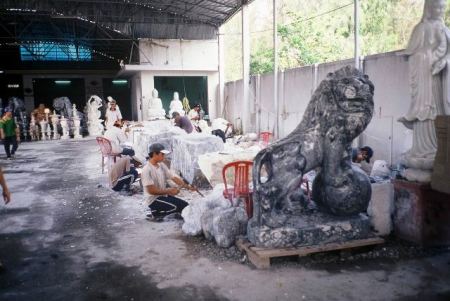
Random piece of information: just beyond Hoi An in Vietnam, on the road to Danang are the Marble Mountains. These are mined and the local craftsman can create whatever you desire and to whatever scale you wish. What is more, they will then pack it and ship it to your home. On the day we visited, the striking memory was of the carved American eagle, but the factory was full of repro classical statuary. You too can order your greatest desire – and at third world prices. They were doing a roaring trade in the classical figures. I am afraid I still subscribe to the view that if you can’t have an original (and the British museums got first dibs on a large quantity of them), then you are better off to have nothing.

Repro classical statuary to your heart's desire from the Marble Mountains near Hoi An in Vietnam

Repro classical statuary to your heart's desire from the Marble Mountains near Hoi An in Vietnam

A final few words about the rococo fountain: it belongs to Pat. I do not for one minute think that Pat believed that this recent installation in her front garden would elevate her social status. It is equally unlikely that she has looked into the rococo forbears of her fountain. No, she bought it because
a) she really liked it
b) it was cheap
and c) she has a very obliging husband who was willing to install it for her. I just think that the fountain may have drifted as far as it can – it may have reached its ultimate destination.

Plants that Delight

This article was first published in the Weekend Gardener Magazine, issue 316, June 2 – 15, 2011

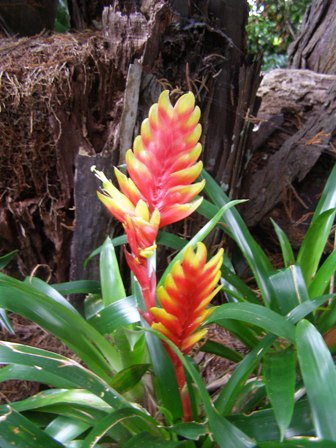
Bromeliads - a vriesea

Bromeliads - a vriesea

Bromeliads
Generally speaking, I am not a fan of prickly, spiky plants (I have always felt that yuccas in particular were aptly named) but I am willing to make an exception for the bromeliad family even though it means donning protective gear when it comes to working amongst them. We use them extensively in dry woodland conditions and for much of the year they just sit around being extremely undemanding, bar the occasional clean up to remove accumulated debris.

It is when they flower, that bromeliads look exotic. The range of blooms is extraordinary and there is nothing quite like them. Some of them have strange, flattish flowers which might be cast out of thick wax, dyed in parrot colours. What is more, the flowers last for ages. I haven’t timed them but we are into months, rather than weeks. This one is a vriesea of some sort but we have never become experts on the genus, despite growing a range of different ones. Our cool, frost free, high shade conditions keep them looking particularly lush. With some of our plantings dating back to the early 1950s, we would rate them as one of the lower maintenance garden plants.

Bromeliads are readily available and many are easy to multiply for the home gardener. If you want to learn more about bromeliads, check out “Bromeliads for the Contemporary Garden” by Weekend Gardener writer, Andrew Steens.

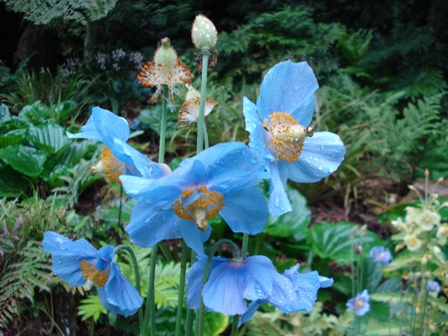
Meconopsis

Meconopsis

Meconopsis
The simplest poppy form – a mere four petals surrounding a ring of golden stamens – is always charming, no matter the colour. When it comes in pure blue, it enters a league of its own.

Coming from the Himalayas, these are plants which are happier in much drier, colder conditions. We have to work at keeping them going here, where we have high rainfall, high humidity and generally mild conditions. They certainly don’t seed down and naturalise for us as they will in parts of the South Island but when they come into flower each spring, it is worth every bit of effort.

We don’t generally let them flower in the first year because if they put their effort into setting seed, the young plants tend to die. If we delay the flowering, we have more chance of some at least becoming perennial, albeit still comparatively short lived. Fresh seed is easy enough to raise but best done in seed trays and not merely broadcast to the ground with a wish and a prayer.

Meconopsis are available in New Zealand both as seed and as plants. If you have a choice, Meconopsis x sheldonii shows a little more vigour than either grandis or betonicifolia. All come in blue, though there are also white, pale yellow and red meconopsis which are nice to add in to a garden but no replacement for the beautiful and eye-catching blue.

Magnolia Felix Jury

Magnolia Felix Jury

Deciduous magnolias
How could I be a Jury and not put deciduous magnolias in my top favourites? These trees are surely one of the most spectacular on the planet when in full flower, though it has to be said that the bigger the flower, the better in terms of impressive display.

Magnolia trees just get better with size and age which seems entirely appropriate for a genus which is ancient – so old that it does not even have proper petals. What we usually call petals are in fact tepals. They evolved before bees so originally adapted to be pollinated by beetles – hence the fact they have pollen but no nectar.

To get maximum flowering, select a variety which sets flower buds down the stem rather than just on the tips. Some varieties like the purple Lanarth can take your breath away but only for about 10 days. Others, like Iolanthe or Felix Jury, flower over many weeks, extending the display. Indeed, spring flowering on Iolanthe extends over at least eight weeks from first to last bloom and there is the bonus of random flowers over summer.

Daphne genkwa

Daphne genkwa

Daphne genkwa
A daphne with no scent? Yes, but it is so spectacular in flower that the absence of fragrance does not seem to matter. It is also deciduous, which we do not expect from a daphne and it flowers before it comes into leaf so all that is visible is a mass of graceful whips smothered in lavender blue flowers.
I think you can never have too much blue in a garden. It is a colour that complements all others and while I will admit that genkwa is not a pure toned blue, it is still blue enough for me.

D. genkwa is not easy to propagate and is generally increased from root cuttings. Neither is it easy to get established. In fact it is definitely on the touchy side. This plant was a particularly fine specimen but outgrew its allotted space so I pruned it after flowering, as you do. It promptly died, to my great disappointment. I am trying again, but this time as specimen shrubs with plenty of space to grow so they will not need to be pruned. Daphne genkwa is available in New Zealand but is not standard garden centre fare so you may need to find an obliging operator to order it in for you. It is a Chinese shrub and, being deciduous, it is generally rated as hardy.

Narcissus cyclamineus

Narcissus cyclamineus

Dwarf narcissi
In a large garden with some enormous trees, we love the tiny treasures that give detail to the bigger picture. We also have more success with the baby narcissus than with their larger cousins. They don’t seem to be quite so vulnerable to the dreaded narcissi fly, possibly because many of them flower earlier in the season.

These little cyclamineus seedlings always make us smile. With the reflexed skirt of petals, they are rather reminiscent of floppy eared dogs with the heads out the car window and ears streaming behind in the wind.

We grow a whole range of different dwarf varieties – species, named hybrids and unnamed seedlings, tucked into positions around the garden. The first to bloom are the Narcissus bulbocodium citrinus or hooped petticoat types which can show colour as early as late April while others continue the display through to late September. The best known dwarf variety is probably Tete-a- Tete, but there are innumerable others which are offered for sale from time to time.

Cyclamen hederafolium

Cyclamen hederafolium

Cyclamen species
These little treasures mostly hail from southern Europe and northern Africa but some varieties are particularly suited to New Zealand gardens.

The most widely available variety is Cyclamen hederafolium (formerly known as neapolitanum) which puts its first flowers up in our garden in January and flowers through until May or even June. After that, the marbled, heart-shaped leaves are attractive in themselves. C. hederafolium comes in shades of pink and pure white. Following on from them, we have a lot of success with C. coum in winter and C. repandum in spring.

Cyclamen are particularly successful planted in drifts on woodland margins in dappled light but they are pretty adaptable in a range of conditions as long as they have good drainage. They are easy enough to raise from fresh seed if you know of anybody with plants and they grow to form tubers which are like round, flattish discs.

Rhododendron Yvonne Scott

Rhododendron Yvonne Scott

Rhododendrons
Unfortunately, the glory days of rhododendrons have been and gone in this country, but we would not be without them in our garden. Our particular favourites are the nuttalliitypes with their large, waxy trumpet flowers, most of which are scented. Combine that with big, heavily textured leaves (the technical term is bullate foliage) and the most beautiful cinnamon brown bark which peels off in long tendrils leaving a shiny trunk behind.

Add in the fact that these plants show generally healthy characteristics in warmer climates. They can get a touch of thrip but nowhere near as much as colder climate plants and they are not susceptible to the brown crisping round the edges of the leaves which disfigures so many varieties.

If I could only grow one rhododendron, R. sino nuttallii would be my first choice. Sino just means it comes from China (there is another Himalayan form). Fortunately we can grow many so we have a fair range of the nuttalliis and their hybrids, including the lovely and distinctive Yvonne Scott. Huge lime green buds open to lime flowers which fade out to white within two days, but keep the green flare in the throat. Mi Amor is probably the most widely available nuttallii hybrid on the market. While we might not rate it as the best, nuttalliis are not readily available so you might have to grab whatever you can find.