Tag Archives: Abbie Jury

In the Garden: August 20, 2010

  • The season of panic for gardeners is nigh. The slow moving cold days of winter are over and the rush of spring means the pressure is on to get everything done. Priority number one has to be pruning grapevines if you have them – their sap is on the move already. If you are not sure what you are doing, our Outdoor Classrooms on the topic (both winter and summer pruning) show how – click on the Outdoor Classroom topic to the right or type into the search box immediately below the photo of yours truly on the top right.
  • Kiwifruit are pruned in a similar manner to raspberries – take out old fruiting canes and weak growths, leaving the best of last season’s new growth to set fruit for next season. It is usual to tie kiwifruit along horizontal supports to increase crop yield and to keep them under control.. We saw them trained to cover pergolas in northern Italy where they were regarded as rather more exotic than here. They were very effective and we are thinking of trying it.
  • Keep sowing peas fortnightly and sow onions from seed.
  • Get a mulch onto the asparagus patch if you are lucky enough to have one. It is the optimum time for feeding this crop as it breaks dormancy and comes into growth.
  • It is the last call for using hormone sprays on the lawn, if you feel you must. After this next week or so, put the spray right away to back of the cupboard until all deciduous plants in your own and your neighbours’ gardens have put on their fresh foliage later in spring. You can cause terrible leaf damage which can last until leaf drop next winter, or even kill the plant in bad cases, with even the slightest whiff of spray drift at the wrong time.
  • It is the time for digging and dividing spring and summer perennials which will be coming into growth.
  • Do not delay on sowing new lawns or patching balding old ones. The lawn we showed in the last Outdoor Classroom is now a pleasing swathe of green though still very fresh.
  • Apparently the use of Cold Water Surf as a moss killer is widely known, judging by the calls I received after last week’s Countdown to Festival. And it is quick – I tried it on a mossy path and within three days it had turned brown. Don’t be too generous lest you be like the person who told me she laid it on so thick that her lawn foamed when it rained. Another caller told me it does not have to be CWS – any washing powder will do so I have bought the cheapest I can find to experiment. Be a little cautious though – it will either be the alkaloids or the phosphates or something caustic that causes the moss to die. In moderation, septic tanks show these are not a problem but you probably don’t want to carpet your environment in them. Vinegar also works.

Planting an easy-care hanging basket of succulents: step-by-step with Abbie Jury and Chris Sorensen

If you are an admirer of other people’s hanging baskets but lack the resolve to feed weekly and water up to three times a day in the height of summer, you may enjoy constructing one from easy-care succulents.

photo-1-copyphoto1a-copy

1) You can use solid plastic hanging baskets or you can chose to use wire baskets with a coconut fibre lining which allow you to plant all around the basket surface. You can even tie two hanging baskets together to create a round ball. It doesn’t matter whether your pieces of succulent plants have roots or not but if they are just cuttings, it can help to cut them a day or two early and let them dry

2) Cut slits or holes at random intervals all over the basket lining. Turn the basket upside down for planting.

step3-copystep3a-horizontal-copy

3) Poke the stems of the succulents through the holes. If you have rosettes without stems, bend flexible wire to make hoops around 8cm long and use these to skewer the rosettes into place. Smaller rosettes are not as heavy so are less likely to fall out.

4) Supporting the plants with your hand, turn the basket up the right way and gently hold it in a suitable sized bucket. Fill the basket with a free draining potting mix containing slow release fertiliser. Succulents can survive in poor, dry conditions but they will grow better with food and water. However be mean, rather than generous if you are adding the fertiliser yourself.

5) Plant the top of the basket with some trailing types of succulents so they can hang over the side. You may wish to include one or two flowering plants such as impatiens to add seasonal colour.

6) This basket was planted about three months ago and already looks well furnished and healthy.

Finally, as a modern postscript from 2017 (because I see people are still looking at this post), I give you the succulent display to celebrate the 10th anniversary of the new glasshouse at RHS Wisley Gardens in the UK. Not exactly a hanging basket but showing a similar basic technique.

Plant Collector: Magnolia Lanarth

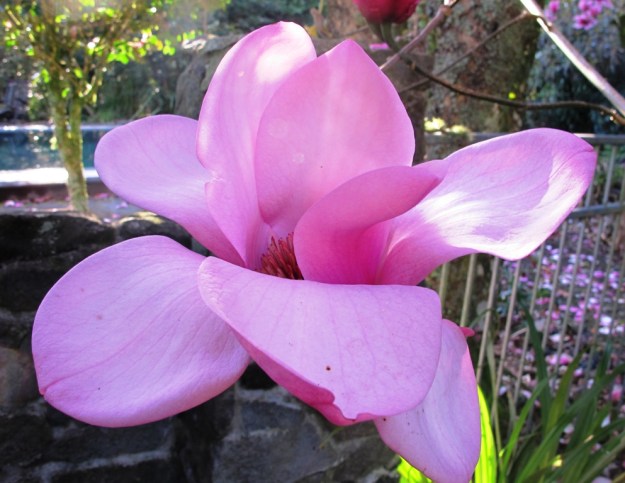
Magnificent in its purple splendour - Magnolia Lanarth

Magnificent in its purple splendour - Magnolia Lanarth

It is magnolia time and Lanarth is always one of the early bloomers and still sets the standard for pure stained glass purple colouring. We have yet to see a modern hybrid match the colour, flower form and size of Lanarth. So it is a bit of a shame that it is hard to propagate, so rarely offered and not that easy to establish so there can be a fall-out rate amongst those that are produced. On top of that, it takes a few years to flower (sometimes a decade or so), it makes a fairly large tree and the flowering can be short-lived. Get a storm at the wrong time and the season is pretty much over not long after it began. But in full bloom, it is a magnificent sight and that is why it is a collector’s plant.

Its full name resembles a stud animal – Magnolia campbellii var. mollicamata Lanarth – but it is usually just referred to as Lanarth, sometimes with the mollicamata in front to impress. Lanarth refers to where the seed was raised which was a garden in Cornwall. Intrepid plant collector George Forrest collected the seed in North West Yunnan in China back in 1924 where it was growing at a fair altitude of over 3000 metres. Only three seeds were grown and Lanarth was selected as the best of them. The usual pink and white campbellii magnolias come from the more westerly areas of China, Tibet and Burma whereas the mollicamata variants come from the more easterly side of that magnolia habitat.

In the Garden: August 13, 2010

Prunus Pink Clouds - bringing in the tuis

Prunus Pink Clouds - bringing in the tuis

• Spring has certainly made her presence felt this week and our tui have returned to the flowering cherries, including one distinctive golden brown tui in its third season here. It is the campanulata or Taiwanese cherries in flower at this time which attract the native nectar feeders. Try and buy sterile, named forms if you are planting them because some can seed too freely.

• With the warmer weather, there will be an explosion of germinating weed seeds so be vigilant and try and eradicate this crop before they get established and seed further. Spreading a thick enough layer of mulch will suppress weeds as well as retain moisture levels for when drier weather sets in but lay your mulch after you have done a weeding round, not on top of existing weeds.

• Slugs and snails are also getting more active. If you are looking for alternatives to poisonous baits, you can try baker’s bran in reasonably thick circles or mounds (irresistible to the slimy critters who then get picked off by the birds). Alternatively, ring plants in sand, grit or masses of crushed egg shell – it is not bullet proof but it helps discourage them. Or make traps from the time-honoured hollowed out orange skin or half empty cans of beer – but you do have to go round and squash them after you have encouraged them to congregate. Getting out with a torch at night, especially after rain, can show up quite a number of them too.

• Spare a thought for permanent container plants. They need their potting mix replaced every two years and they need feeding at least once a year in spring. You may need to hose all the old mix off the roots and trim the roots to fit back into the same pot. It is less stressful to the plant to do it now rather than when it starts to look very sad in summer.

• I read a hint in a gardening magazine to trample down green crops before you dig them in to the vegetable garden. The crushing process hastens the breakdown. It seems to make good sense. Get onto digging in any green crops without delay.

• If you still plan to plant fruit trees this season, get right onto it now. The sooner they go in, the better chance they have of getting established. The same applies to all trees and shrubs for the ornamental garden.

• And a bouquet this week to Todd Energy who have started the process to put in screening plantings to block their Mangahewa-C well site from public view. Living as we do in green countryside peppered with ugly, albeit small, industrial sites, we applaud this new move and hope that other energy companies will follow the lead. These sites can be rendered almost invisible to ground level view by simple plantings but it has taken a long time before one company has decided that this is an appropriate priority. By planting the right species, they can contribute to the environment as well.

Beware the bangalow (Arcontophoenix cunninghamiana)

A very handsome palm in the landscape, but scary weed potential

A very handsome palm in the landscape, but scary weed potential

The newest weed in the garden here is a palm. Not the native nikau palm, although that too seeds down freely and we regularly cull self sown seedlings. By definition, we don’t regard natives seeding down as weeds. No, the offending palm is the incredibly popular and very attractive bangalow palm. We have had it in the garden here for decades but it is only recently that it has started to set viable seed. It is a bit too efficient in the seeding stakes and, being attractive to birds, it has been dispersed throughout our entire property at a scary speed.

When alarm bells were first sounded in the Auckland area about bangalow palms, the howls of outrage and denial from within the nursery industry were instant and loud. We watched with a desultory interest and felt that it might not have been our industry’s finest moment. We need to take some responsibility for what we produce and we certainly have enough noxious weeds in this country without knowingly adding more. So we should look at the facts and the information, rather than immediately assuming that out of control bureaucrats are trying to control our livelihoods. The howls of alarm were such that the proposals to ban its sale were put on the back burner and its status is part of a five year review so nothing will happen quickly.

The so-called Chinese Windmill Palm (Trachycarpus fortunei) is also under threat of reclassification as noxious weed. While it has not proved a problem here in our garden, Mark has seen it seeding down and giving rise to a thicket of babies in the Nelson area. I have just found a photograph in the Encyclopedia of Cultivated Palms showing it naturalised in Switzerland. Plants with a climatic range from Switzerland to Nelson and Northland have scary potential. Trachycarpus fortunei is enormously popular throughout the world because it is generally hardy but with that tropical and exotic look so frequently sought by gardeners irrespective of nationality. The big advantage of trachycarpus is that you need both male and female plants to set seed so if female plants were culled, it would not be a problem. Our specimens in the garden here are male so no seed is formed. And Mark’s guess is that the seed is not spread by birds because it only seems to fall to the base of the tree and sprout there, which makes it much easier to contain. The seedlings can be mown off, grubbed out or sprayed. If it was spread by birds, we would hear a great deal more about it appearing all over the place in parks and reserves.

Side by side germinating self-sown bangalows

Side by side germinating self-sown bangalows

But it is the bangalow that worries us more and that is because of our personal experience. There would hardly be a square metre of our garden (which stretches across several acres) where we have not found a bangalow germinating and in those early stages, they closely resemble young nikau palms. Left to its own devices, this Aussie import will threaten our native nikau swamping out the habitat and growing at a hugely faster rate. The proper name is Archontophoenix cunninghamiana and it grows naturally in the coastal forests of southern Queensland down into New South Wales. It is a most elegant palm, tall and graceful and growing sufficiently quickly to give a fast result. It can reach 20 metres when mature, but like many palms, it takes up little space and casts little shade. It is easy to grow but it is also tougher than many palms and will tolerate cooler temperatures – light frosts, even – and damper conditions. It is that easy-going nature which has made it so popular and useful as a garden and landscape plant in relatively mild areas of this country. Alas, if it had only been dioecious, it could have had its wayward reproductive habits curtailed – dioecious meaning that you have both male and female and one of each is required for reproduction.

The bangalow seed is freely dispersed by that great seed dispersal machine that we have in our kereru or native wood pigeon. Presumably the seed casings taste delicious and the resulting guano gives the falling seed a good start after aerial distribution. And it sets a simply astounding amount of viable seed. When our specimen finally set seed for the first time, Mark just left it, noting how very decorative were the lavender flowers and bright orange-red seed hanging in voluptuous bunches. Within months, we were picking out the rash of self sown seedlings everywhere. We left one in the coldest, wettest spot in our garden just to see how it would grow. This is an area where Mark plants his treasures which need a winter chill – the deepest red hellebores, the Chatham Island forget-me-nots, trilliums and Himalayan blue poppies. Nowithstanding the fact that it comes from sub-tropical Australia, the bangalow is very happy there too, thank you. It is a worry.

It is still perfectly legal to buy and sell bangalows or Archontophoenix cunninghamiana in this country. If the prices I have seen on the net are a fair guide, you will pay around $150 for a reasonable sized one, up to an eye-watering $1700 for one already six to eight metres tall. For that sort of money, if you are starting out, our recommendation is to look at alternative varieties which don’t show the potential to be a noxious weed. It really does matter. Besides, as Mark will testify with the advantage of new information, it is an awful lot easier to plant something that will not require you getting out the extension ladder to take off the flowers and fruit when it is mature. Our recommendation, based on personal experience, is the Queen Palm, Syagrus romanzoffiana.

While on the subject of palms, which are a fantastic family of plants, we would like to pay tribute to the work done over many years by Colin Verlaan at The Palm Farm. Some readers may not realise this nursery is local but Colin has done more than anybody to make a huge range of palms available in this country at more affordable prices. Most of the palms you buy could be traced back to The Palm Farm as the main supplier. Colin has announced he is retiring and we think it might be for real this time (I am sure he has tried to retire before). While he may not agree with our opinion of the bangalow and the trachycarpus, we would certainly find common ground in admiring many of the magnificent and interesting palms he has made available. Mark has been gently building a collection of palms from him over recent years, concentrating on varieties which we think should be hardy in our conditions. He hopes to get his new Palm Walk planted sooner rather than later and is pleased he started work on it while he could still source a fantastic range locally.