- Quinton Reeves from Wintringham in New Plymouth describes his lawn as currently looking like army jungle camouflage if viewed from above. This is because he took advice from an expert and used Cold Water Surf sprinkled in powder form to kill out the unwanted mosses. It has apparently worked a treat and he is now waiting for the grasses to come away with renewed vigour. We have never heard of this simple remedy before but plan to experiment with moss in other areas. The trick, Quinton says, is to apply it after a rainy period (no problem there) and the lawn has had a day to dry out and it must be Cold Water Surf which is alleged to have an ingredient which is missing from other brands. So now you know.
- Also in town, La Rosaleda’s Coleen Peri was shocked to find her renga renga lilies (arthropodium) sporting their own form of acne (orange blotches due to rust), giving lie to the belief that these tough plants are maintenance free and indestructible, bar heavy frosts. Coleen treated the rust but also chopped the plants back hard and disposed of the affected foliage. This may stop the cycle of rust continuing and the plants will have recovered with fresh foliage by festival time. Coleen’s little fellow, Will, discovered to his cost that hurtling down a garden path between rose bushes on his scooter was fraught with danger when he canned out and landed in a rose, embedding a thorn in his cheek. The rose bush fared worse, being snapped off entirely, but Will has made a good recovery.
- Jan and Graeme Worthington of Gordon Dale Gardens are fresh back from their tour of Britain and Ireland. They were enormously impressed by Beth Chatto’s garden near Colchester (her garden is a magnificent example of how to manage large scale herbaceous plantings over time and her dry garden is magic) but equally impressed by the sight of Mrs Chatto herself, now at a very advanced age, climbing up a red brick wall to water some plants. They will hardly be emulating her dry garden at Toko, but Jan says her first task on return is to prune her 200 roses and to try and salvage the sweet pea babies which have been swamped by weeds in their absence.
- In Manaia, Jenny Oakley has taken advantage of the presence of a couple of strong and willing young men to spread the contents of four large compost bins across her vegetable and perennial beds. In the process they also uncovered two pairs of secateurs and one Niwashi hand hoe, despite Jenny’s best efforts to keep garden tools to hand and to mark them with ribbon and insulation tape. Any synthetic, fluorescent type of colour is going to stand out best in an outdoor setting because these are not the colours of nature. Jenny, by the way, votes her Niwashi as her most favourite garden tool.
- In Kakaramea at Te Rata, Jacq Dwyer is delighting in the fragrance of her Daphne bholua. This is the upright Himalayan daphne. It can get a bit scruffy with age and does have a few bad personal habits but we are in complete agreement with Jacq that its perfume is the best and the strongest of any of the daphnes. While on scented plants, Jacq says she has just bought a wintersweet (Chimonanthus praecox) and is looking for the best position in the garden where its scent can be enjoyed. As she has already moved her davidia (ghost tree) twice in search of its permanent home, the chimonanthus may be in for a period of slight instability in its life. There are gardeners who only buy plants for specific garden positions or gaps and there are gardeners, like Jacq, who buy plants because they love them and who then set about finding the right spot.
- At Paradiso Vegetable Garden, Denise Wood is delighting in the simple sight of her lemon tree underplanted with white primulas and looking very fetching. Her broad beans have been a success at previous festivals so she is pleased to see them growing well and already a metre tall. The sweet peas are also coming along well. By the time she has done her round freshening up the paintwork this month, she feels that she will have done most of her preparations.
Tag Archives: Abbie Jury
Tikorangi notes: August 6, 2010
Our plant sale starts today. It is of limited duration (from today until Monday 9 August and then again the following Friday and Saturday) but there are good bargains as we try and clear space in the nursery.
Latest posts:
1) August 6, 2010: Illicium simonsii is flowering now with dainty little blooms which resemble unlikely water lilies cast from wax.
2) August 6, 2010: Hints on garden tasks for this week – don’t beat the gun on planting out summer vegetables, a recommendation for white sapotes and what you should not be doing with your wheelie bin.
3) August 6, 2010: Into the fraught territory of lawn renovation – our latest Outdoor Classroom.
 Tikorangi Notes
As the galanthus start to pass over, the dwarf narcissi are opening, along with the early magnolias. The cyclamineus types are a favourite here – resembling a floppy eared dog with its head out the car window, perhaps? Twilight, shown here, is one of Felix Jury’s most successful cyclamineus hybrids – not so reflexed in the petals but a pleasing form and colour and it increases at a most satisfying rate. More magnolias open each day but we are still a couple of weeks off having the display entering its most spectacular phase. The fragrance of the earliest flowering michelias (all white at this stage) is already noticeable, hanging in the air. The worst of winter is over and temperatures are on the rise.
In the Garden: Friday August 6, 2010
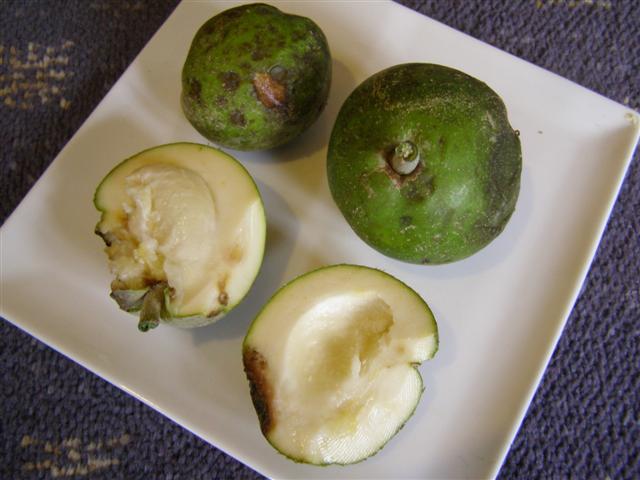
We are harvesting our white sapotes now
- If you can grow orange trees or avocados, you may like to try the white sapote or casimiroa edulis – an exotic taste of Mexico whose fruit ripens at this time of the year. I would describe it as a cross between vanilla icecream and creamy custard in flavour and texture. It will tolerate light frosts only but you can get a good crop in our coastal areas and it is an attractive plant, tropical in appearance.
- In case you are wondering after looking at our Outdoor Classroom this week, Mark sowed a rye and fescue grass seed mix for our lawn. He also added microlina – a fine native grass which he tries to encourage, for which he harvests his own seed. There are experts in grass seed mixes around if you wish to seek out good advice. Turf rye appears to be a good option for shady lawns but sandy lawns (which turn brown in summer) remain problematic if you don’t want to use kikuya.
- Esteemed colleague Glyn Church advised last year that all winter pruning should be finished by the time birds start nesting. Some readers may need to start panicking – it is clear that the birds are gathering nesting materials here and our first clutch of ducklings is imminent. Give grape vines and kiwifruit priority if you have them. Their sap starts to run early.
- If the tastes of Italy are what you covet, you can get Franchi seeds mailorder from Italian Seeds Pronto – the catalogue is available at http://www.italianseedspronto.co.nz or you can buy seeds off the shelf at Vetro or Fresha. These are large packets of seed with plenty to share and a range of Italianate goodies which go beyond the common tomato, capsicum and lettuce varieties.
- Keen veg gardeners will be champing at the bit to prepare the ground for planting out (dig in green crops and start cultivating the ground) and sowing seed in trays or pots to keep under cover in order to get an early start in a few weeks time. You don’t gain anything by trying to get summer seed sown or plants out before the soils have had a chance to start warming up and the risk of frost is past. If you really want to try and push the pace, get a cloche or build a cold frame from old windows. However, carrots, onions, parsnip, beetroot, peas and brassicas don’t mind the cold if you want to be out sowing and planting. Get early crop potatoes in now – by the time they come through in three weeks time, you can mound them over to protect them from late frosts.
- We gave the All Round Bad Idea of the Week Award to the recommendation in a national gardening publication that your wheelie bin makes a great container for growing potatoes (just drill holes in the bottom first, we are advised). Not only do few of us actually own our wheelie bin, as a container for growing potatoes it is miles too deep, will take far too much dirt or potting mix and that doesn’t address how one is supposed to get the harvest out from the bottom later in the season. If you can’t grow them in the ground, try stacks of tyres though why anybody would prefer to fiddle with potatoes in containers eludes us.
Tikorangi notes: July 30, 2010
Latest posts:
1) July 30, 2010: Agapetes serpens – aptly described by somebody else as a vegetable octopus, we love the fact it feeds our native birds despite its origin in the Himalayas.
2) July 30, 2010: All Gardeners Dream – Abbie’s newspaper column.
3) July 30, 2010: In the garden this week – tasks and hints from pruning to making little slug bait stations to lichen.
4) July 30, 2010: Around the province, gardeners are counting down to our annual garden festival at the end of October – the latest update.
5) July 27, 2010: Camellia Diary 4. The sad story about camellia petal blight in NZ.

Towering 20 metres up in the air - our queen palms
Tikorangi Notes:
We enjoy our queen palms (Syagrus romanzoffiana), now of rather towering stature at about 20 metres high and half a century old. But their falling fronds can be a bit of a menace and there is certainly no way of getting up to groom those hanging about waiting to fall. You would not want to be underneath one because they weigh a surprising amount at the base and crash down with considerable force – taking out a large wodge of a camellia below recently. Mark has been moved to comment that there are rather a lot of vegetable time bombs planted very close to houses and apartments in Auckland, often by landscapers who all too frequently lack the
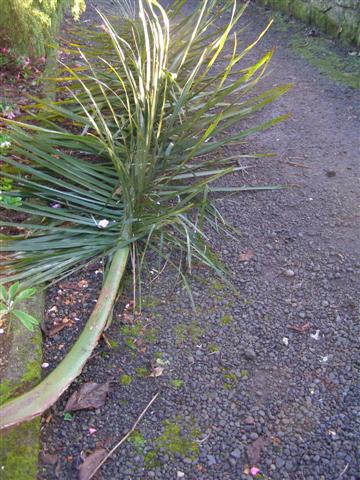
Falling from 20 metres, the fronds can be somewhat alarming.
plant experience to know what their selections are capable of when mature. Palms, you see, take up little space, are easy-care and wonderfully evocative of the warmer temperatures of the tropics so have been all the rage in urban gardens for some time now. As they keep reaching for the sky and growing in stature, the potential for falling fronds to cause damage increases – you certainly wouldn’t want your house spouting to be caught by a falling frond, let alone your car. But the average life expectancy of a garden plant in this country is, I have been told, a mere 10 years (before being chopped out and replaced by the latest fashion) so the chances of many palms reaching sufficient maturity to cause problems are not great.
Plant collector: Agapetes serpens
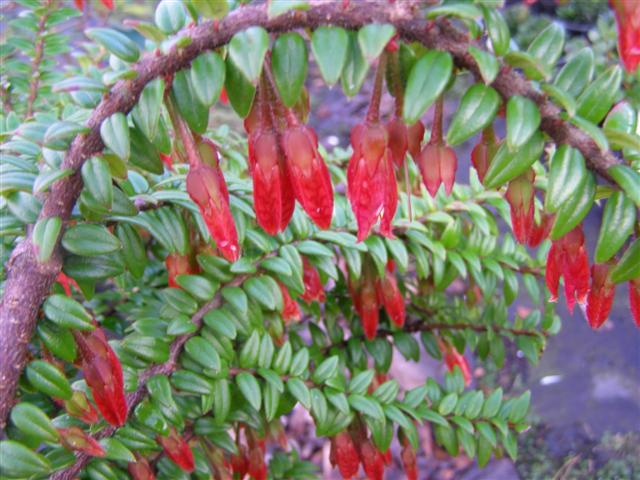
Agapetes serpens - attracts nectar feeding birds in winter
Agapetes serpens is a surprisingly hardy woodland plant from the Himalayan region and there we have been for years thinking it was a somewhat tender plant from India! Right general geographic area at least (she says in self defence). It is an evergreen shrub but with arching growth – aptly described by another as being like a vegetable octopus. What is really lovely through winter and spring is the prolonged flowering season when the branches are festooned with tiny hanging red bells with cute little chevron markings which Mark always thinks resemble Chinese lanterns and these must contain nectar because the wax-eyes come in to feed regularly. Mark was delighted to see even a bellbird come in to feed on one of our plants.
In the wild, A.serpens is often epiphytic which means it grows perched in the embrace of a larger tree. Consequently, in a more suburban environment, it is equally suited to growing in a container or a hanging basket. As the plant matures, its roots develop into big nubbly, woody protruberances pushing themselves above the soil, which we assume is for water storage. We grow serpens both in the shade where its foliage stays predominantly green and in full sun where it tends to be red-toned. I am still a little hesitant about declaring it as totally hardy so in colder, inland areas it would probably be wise to treat it as a woodland plant which needs some overhead cover rather than using it out in the open.
Agapetes are related botanically to the vacciniums (which includes proper cranberries) and all are members of the wider ericaceae family which takes in the heaths and heathers as well.
 Tikorangi The Jury Garden