Tag Archives: Abbie Jury

All Gardeners Dream

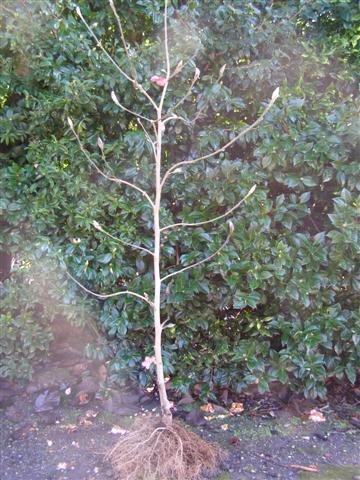
Buying bare sticks with a dream but at least this Magnolia Iolanthe has the promise of flower buds

A letter to the editor last week talked about the Pukeiti dream as if Pukeiti had the monopoly on dreams. I would suggest that pretty well every gardener I know works on dreams. It is what keeps us going. Call it vision, if you prefer, or hope or trust – but every time somebody buys a bare stick in mid winter, they are dreaming of what it should look like in spring when it comes into leaf.

Often folk will plant a long term tree with a dream. No matter that they know they will not live long enough to see the tree reach maturity. When one heads out with the spade and the plant, the dream is of how it may look in the future, always with the hope that subsequent generations will appreciate it. If it wasn’t for the dream, why would anyone plant rimu, kauri, totara, davidia involucrata, monkey puzzle trees (Araucaria araucana) and any number of other high quality, slow growing trees? Maybe to plant one is a dream for the future, to plant many is an inspired vision.

I briefly toyed with a theory that ornamental gardens (those planted merely to delight the eyes and nose and not to feed the stomach) are based on dreams whereas the current rage of the productive garden (fruit and veg) is based on pragmatism and quick results. But Mark disabused me of that idea immediately. No, he replied. Of course all those fruit trees and edible crops are based on dreams. Romantic dreams, fantasies even, of The Good Life, of eating wholesome food that not only tastes yum but is free of dodgy chemicals, of children who frolic out joyously to pick the silver beet for dinner and then consume it with gusto. The mere term home orchard conjures up picture book images of apple trees laden with ripe red fruit awaiting harvest. Hark, is that a swing I see hanging from the branch of the old apple tree? (But not from our dwarf apples, unless it is for dolls). The common mental image used to have grass beneath the trees in the old orchard (entered by a lichen encrusted wooden gate) but that betrays my age. These days it is more likely to be comfrey carpeting the ground below. Or maybe borage to attract the bees. It really does not matter that we all know there is a big gap between reality and the dream. There is much that can go wrong. The barefoot children can be stung by the bees on the borage. The trees need pruning and, upon occasion, spraying if there is to be much of a harvest. None of it is as easy as it looks. It takes time and practice to learn. Some veg crops will fail altogether. Some will hardly be worth the effort while some will yield an embarrassingly large harvest, much of which goes to waste. It will rain and the ground will get soggy and boggy (garden dreams are usually sunny). It is the nature of gardening that it is unpredictable and greatly dependent on factors beyond our control – particularly the weather.

Ornamental gardening is even more based on dreams because it is purely aesthetic and there is not much of the quick random reinforcement of harvests, however meagre. Those who rip into gardening and view it like interior decoration will overplant badly to get a quick effect and then tend to lose heart when it all becomes an overgrown jungle too quickly. Creating a lovely garden and creating a lovely house interior are opposite ends of the spectrum. Interior design is about creating the perfect picture (hopefully combined with good function) from the start. It is a fixed picture, already finished in its perfection and it sets the standard to maintain (though in all honesty it is mostly downhill from then on as day to day living scratches the paintwork, marks the carpet and personal clutter builds up).

Gardening, on the other hand, is about putting the building blocks in place and allowing time for plants to grow with the hope that the mental picture will be achieved over time. It is a much less exact and precise activity, fraught with outside interference. A garden is never finished. It is in a constant state of change and prone to unpredictability. That is why we dream, why we build mental pictures of our goals.

We may put in a row of little plants at 60cm spacing and trust that in time the plants will close up together, grow uniformly and make a smart hedge. Or we may build a seat beneath an overhead frame and trust that the bare sticks we plant will come into leaf and flower to create a shady bower for summer. We may (and more should) plant an arboretum across many acres with fine specimens of trees for centuries to come. Or we may develop a large garden which we hope will create a magical place full of scent, colour, form and botanical interest as well. Or we may just plant an orange tree and hope optimistically that in the future there are so many oranges to harvest that it feels fine to squeeze the juice from half a dozen just to get a glass of fresh OJ a day.

They are all dreams. No, the whole issue about dreams here is about who pays for them. Once the public purse is expected to foot the bill, it becomes a whole new ball game. Some might think that only the very naïve or optimistic could believe that the Pukeiti dream of the founders is in safe hands in the public sector. What will be safer in the public sector are the expansionist dreams of the latter day guardians of Pukeiti and that doesn’t have a whole lot to do with the hallowed founders. But even they may have been surprised to read last week that Pukeiti is apparently some sort of de facto war memorial. Hmmm….

Camellia Diary 4, July 27, 2010

Click to see all Camellia diary entries

Click on the Camellia diary logo above to see all diary entries

The ugly devastation of camellia petal blight

I suspect there has been a bit of a conspiracy of silence about the devastating impact of camellia petal blight in this country. Between camellia enthusiasts, growers and retailers, nobody has really wanted to own up publicly to the fact that it must irrevocably change the types of camellias we plant and they way we use them. The sad thing is that when it was first discovered in Wellington over a decade ago, it was only in two or three locations and if there had been a will, it could probably have been eradicated.

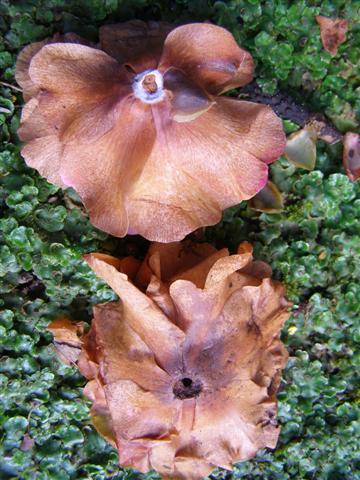
Camellia petal blight at the top, showing the distinctive white ring, merely botrytis on the lower flower

Camellias used to be the second biggest plant seller in this country (roses were number one) and it was the wide use of them in relatively large numbers which aided the spread of petal blight. It is a fungal spore which can travel, apparently, up to 5km on the winds as well as being transferred by infected blooms and soils. The overseas advice to rake up and burn all infected blooms to reduce the spread was simply impractical in a country where they are heavily used in informal hedges and windbreaks. Camellias are seen as utility garden plants in New Zealand and not as show blooms so people were never going to get out with the leaf rake to clear up every single affected bloom.

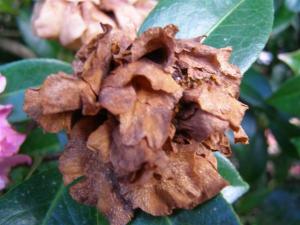
Botrytis shows up as a darker brown on the bush and has been with us for a long time but nowhere near as devastating as the more recently arrived petal blight.

Botrytis shows up as a darker brown on the bush and has been with us for a long time but nowhere near as devastating as the more recently arrived petal blight.

So petal blight has turned the annual flowering into something of a disappointment, particularly on the japonicas where mass display is a thing of the past. We have always had botrytis here, which can turn blooms to sludge on the bush but the combination of botrytis and petal blight has dramatically reduced the display. Botrytis shows up as darker brown markings whereas petal blight is a paler discolouration. When you turn the blooms over and flick off the calyx (the little hat that holds the petals together on the back), petal blight is revealed as a powdery white ring. Botrytis does not show that white ring. As the affected blooms reach the ground, they give rise to the mushrooms which form at the base of affected plants – these release the spore and the petal blight continues its self contained cycle. Alas the self grooming characteristic (where camellias drop spoiled blooms) so determinedly sought by Les Jury in his days of breeding, no longer apply. Blight means the blooms hang on way past spoiling.

Mark put camellia breeding on the backburner and is only now returning to it as the picture becomes clearer on the directions to pursue. They are still a wonderful and versatile plant but we need to explore different ways to use them in the garden.

Winter pruning apple trees: step-by-step guide Abbie Jury and Colin Spicer

Apple trees benefit from a little attention in winter and in summer – easy care summer strategies for apples.

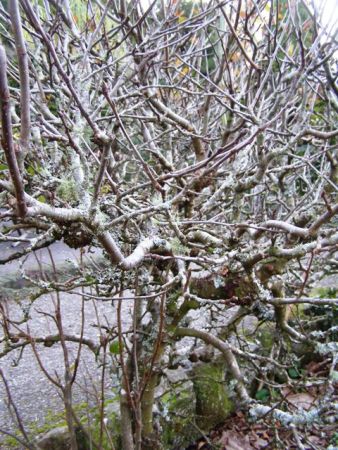
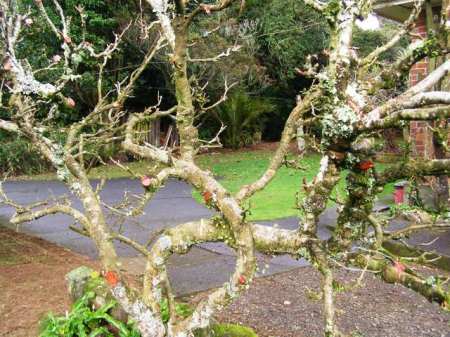
1) This dwarf apple tree has not has not had any attention other than a light haircut in winter and again in summer for many years. It is congested and overgrown and while it still fruits, the quality of the crop will improve in better conditions.

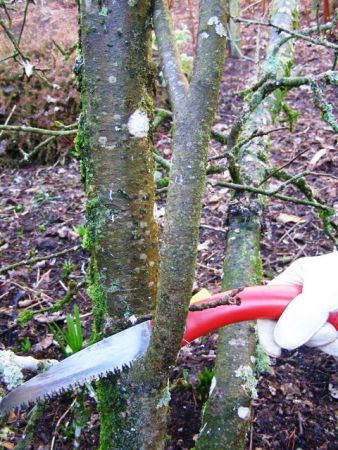
2) Select the branches which will give the tree its framework. Keep the main leader in the centre of the plant and choose branches which are well spaced to allow for air movement and maximum light. Remove all surplus growth not needed for this framework, including branches which cross each other. We are pruning for a tree which is more or less an espalier shape – two dimensional with height and width but little depth because it grows in a narrow border beside our driveway.

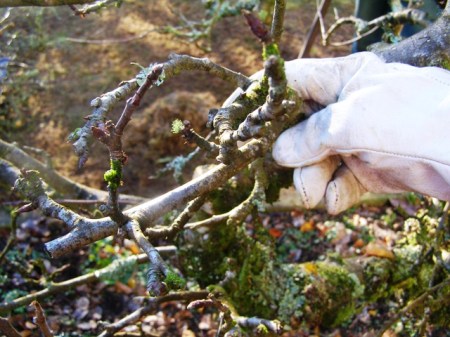
3) Now that the basic shape of the tree has been restored, thin out the clusters of fruiting spurs. Apples will continue to set fruit on old spurs for several years, but best results will be on growths from one to three years old. Where a spur is cut off, the plant will usually push out a fresh growth in spring.

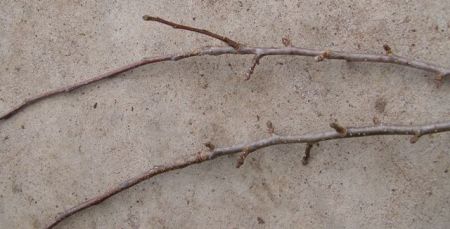
4) This shoot shows two years of growth. The lower half was new growth made in spring two years ago and the upper half is growth from last spring. You can see the fruiting spurs forming on the 2008 growth. These will flower and set fruit this year. If you make the mistake of always pruning by trimming off the long whippy new growths, you are cutting off all the fresh fruiting spurs. Try to get a mix of fresh spurs and already established spurs so that you are encouraging gradual replacement.

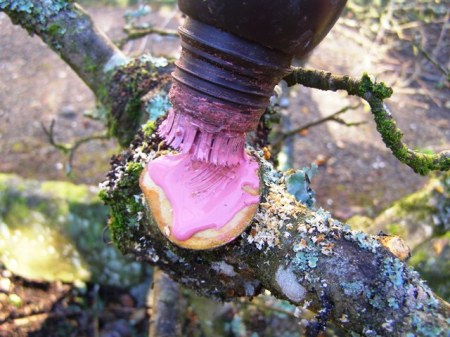
5) Sealing the cuts is optional but strongly recommended by our visiting pruning expert. He applies Bacseal which is an antibacterial sealant. Avoid getting this on your hands and always wait until you have finished all the pruning to avoid brushing wet surfaces with your skin or clothing.

6) A spray of lime sulphur will clean up the heavy lichen infestation. Follow up with a copper spray at winter strength in three weeks time to get the tree into a much healthier state. Follow the instructions on the containers for dilution rates for both sprays.

Tikorangi notes: Friday 16 July

Latest posts
1) Early, frilly and fragrant – one of the first rhododendrons for this season is R. cubittii.
2) Exotic trees versus native plants – Abbie’s column (spare me from politically correct ignorance).
3) Cranberry update
4) In the garden – tasks for this week.

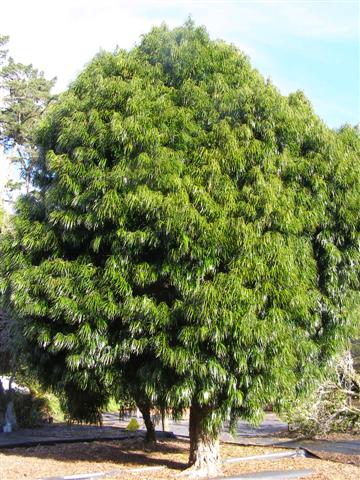
Our magnificent Podocarpus henkelii will see the nursery capillary beds surrounding it both come and go in its lifetime

Tikorangi update:
I was listening to a radio interview last weekend with Peter Arthur, a keen dendrologist and NZ’s foremost retailer of garden and plant books. In a country where it is currently quite difficult to sell any plant which is not a vegetable or a fruit tree, he was asked to predict what the next big gardening craze will be. He didn’t hesitate: trees. A return to trees.

I thought of Peter’s comment as I looked at a beautiful specimen of Podocarpus henkelii. When Mark established the nursery here, he worked around existing trees on site so we have tended to have obstacles – a citrus tree amongst the vireya rhododendrons with the overhead shade cloth cut around to fit, an eriobotrya in the hosta block – and this magnificent African podocarpus set amongst the capillary beds. Now the day has come, as we wind up the nursery, that the capillary beds will go and the P. henkelii will be accorded the status it deserves as part of a planned new garden. It will have to share the limelight with the planned Palm Walk but it has at least four decades on the palms and will no doubt retain its status as the senior plant in this new area for our lifetime. I hope Peter Arthur is right and we will see a wider appreciation of the magnificence of trees. A utility apple tree is not, I think, a match for our P. Henkelii.

Flowering this week: Rhododendron cubittii

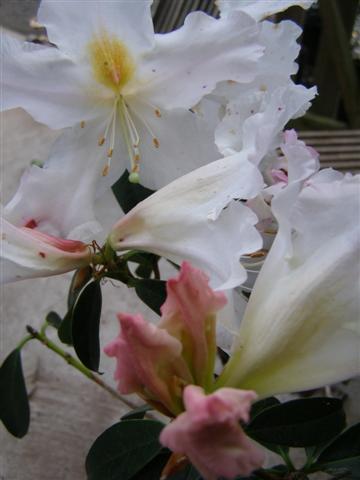
Early, frilly and fragrant - Rhododendron cubittii

Early, frilly and fragrant - Rhododendron cubittii

The early rhododendrons are just starting to flower and amongst them is the gorgeous R.cubittii. We tend to take our ability to grow these delights for granted but there are many rhododendron enthusiasts in the world who would sell their soul to be able to have these strongly scented and somewhat exotic types in their gardens. Cubittii hails from Burma, first collected around 1875 – long before that country became renamed Myanmar and shut its borders. Rhododendron buds at the point of opening are a lovely feature in themselves and cubittii has buds in dusky pink which open to big, frilly flowers, mostly white with a yellow throat and pink flush on the backs of the petals. The scent is sufficiently strong to hang in the air around it.

Cubittii is one of the better options for warmer areas because it is largely resistant to the dreaded thrips which turn leaves silver. Grown in full sun, it makes a compact shrub of about 1.5m x 1.5m (the sun encourages bushier, lower growth whereas shrubs tend to stretch and reach for the light in shadier conditions). I have always advised people in cold, frost-prone areas to shy away from this variety but I am told on excellent authority that it does well in Palmerston North in sheltered positions. If it grows well there, it can be grown pretty much anywhere in Taranaki, bar sub alpine areas or the coldest inland valleys. Just plant it in the lea of some trees to protect the early blooms from frosts.