Tag Archives: Abbie Jury

Flowering this week: Moraea polystachya

Moraea polystachya - blue lilac flowers all autumn into winter

Some bulbs are a fleeting seasonal delight but you can’t say that about Moraea polystachya which has been a sight to behold for many weeks in our rockery and which will continue to flower for some time to come. The wiry stems are about 50cm high and while individual flowers don’t last long, fresh buds keep opening because it flowers down the stem, a bit like a bearded iris. The colour is an intense blue lilac with yellow markings. When the foliage follows, it is narrow and unobtrusive so these are not plants which take up much room.

Moraeas grow from corms, like gladiolus, and most of the family hail, yet again, from South Africa. It is the spring flowering M.villosa which has given the common name of peacock iris to the whole family (its flattish blooms have markings like the eye of a peacock feather). Polystachya looks more akin to a dainty iris. It is not tricky to grow and seeds down easily in well drained conditions without becoming weedy. If you can find somebody with one, it sets seed freely and is easy to raise. I have never timed its flowering season from go to whoa but it is more likely into the months rather than days or weeks.

In the Garden this week: May 14, 2010

Gather up the pumpkins and their relations before the bad weather hits

• No doubt the weather statistics will confirm in due course, but this autumn seems to be notable for the extended spell of calm, sunny, dry weather. It will run out soon and we will be complaining about damp, bleak and cold days so make the most of the mild conditions while they last.
• If you wish to use sprays on your lawn to kill out flat weeds and invasive competitors, it is much safer to surrounding plants to apply in autumn. Most lawn sprays are hormone based and designed to leave the grasses while targeting unwanted plants. Hormone sprays are particularly damaging to vulnerable plants which can be affected by even the slightest of spray drift. Always use on a dead calm day. Deciduous plants coming into growth in spring can get hit very hard by a mere whiff (magnolias and kiwifruit in particular) so applying these sprays in autumn can be an extra safeguard and still effective.
• While on lawns, if you wish to fertilise yours, watch the weather forecast and always apply just as the rain is about to start to avoid burning the grass. Don’t be heavy handed – keep to the recommended application rate. If you use a mulcher mower, you don’t need to feed the lawn to keep it lush and green because you are constantly returning the goodness in the clippings.
• If you have any nut trees and have yet to gather the autumn harvest, the rats will likely be beating you to them. It doesn’t pay to delay picking them up. As a general rule, nuts need to be dried in a warm, airy position for a few weeks before being stored or used. The personal nut favourite here is the enormous walnut we grow (nice and easy to shell) but it is not a heavy cropper.

Each walnut is large but the entire crop this year was not a great deal more than this

• Lift the last of the season’s potato crops to avoid damage from insect pests and blight. Gather up your pumpkins before the weather turns cold and wet. Likewise, keep your compost covered to keep it warm and dry. We use heavy black plastic for this.
• Sow down bare areas of the veg garden in a green crop. Lupins are a good winter option and have the added bonus of fixing nitrogen in the soils.
• If you haven’t renovated your strawberries, get onto it straight away because these are spring croppers and they need to get re-established while conditions are still mild. You can split the clumps if they are a clumping type or replanting the runners and discarding the old crown is the usual method. Replant them in well dug, friable, rich conditions in full sun.
• The early spring bulbs are all coming through the ground. Watch where you put your feet and be cautious with weed spraying and push-hoeing.

Tried and True – vireya rhododendrons

• Extended flowering, sometimes more than once a year.
• Once established, generally only need dead heading and an occasional prune.
• Available from garden centres in a range of colours.
• Easy to propagate at home from cutting.

The smaller leafed, smaller flowered vireya hybrids are often tougher and better performing as garden plants.

This small flowered yellow vireya has been a picture in full flower in recent weeks. Vireyas can be touchy as garden plants but get them well established in a frost free area with good drainage and they are most rewarding. Unfortunately people are often drawn to the exceptionally showy, fragrant varieties and bypass these less spectacular types. The big scented trumpet types with heavy felted foliage can be very touchy indeed and you often don’t get the flower power display of the smaller leafed, smaller flowered ones. This particular one is a sister seedling to one we have sold in the past under the name of Mellow Yellow but there is a whole range of different vireyas available with the same characteristics – in different colours too. They are hardier and tougher by nature and certainly justify a place in the garden. Flowering times are unpredictable with vireyas but many will repeat flower later in the year or gently open flower buds over an extended period of many months.

Camellia Diary – the second entry. May 13, 2010

Click to see all Camellia diary entries

Click on the Camellia diary logo above to see all diary entries

Camellia sasanqua Elfin Rose - a personal favourite

Camellia sasanqua Elfin Rose - a personal favourite

Now that we are well and truly into autumn, it is the sasanquas which are the dominant flowering shrub in the garden. What they sometimes lack in flower substance and form, they more than make up in mass display. And in a country where camellias are used extensively as garden plants and shelter, we have been hit hard by the advent of the dreaded camellia petal blight from mid season onwards. The sasanquas flower early enough to miss the onset of that scourge.

Crimson King - a graceful plant with a light canopy

My personal picks are Elfin Rose and Crimson King which just keep on flowering but there are a host of others which are very charming in their own right – Bettie Patricia, Gay Border, Mine No Yuki, Yoimachi (a sasanqua hybrid), Bonanza and Silver Dollar to name but a few.

Many of our plants are decades old, three to four metres high and just as wide. Of all the different groups of camellias, sasanquas particularly lend themselves to clipping and shaping, turning into either layered forms or light canopies often growing from multiple trunks. There is a grace to be found in their natural growth habit and form which is not always present in the more sturdy japonicas.

In the species, we couldn’t help but notice that brevistyla was brief indeed in flower. While individual blooms continue to open, the mass flowering can only have lasted ten days. The closely related microphylla, however, has continued to put on a really good show for nigh on a month now. I was writing a piece on the earliest flowering camellias for a national gardening magazine and friend and president of the NZ Camellia Society, Tony Barnes, mentioned C.granthamiana as one of the earliest to open.

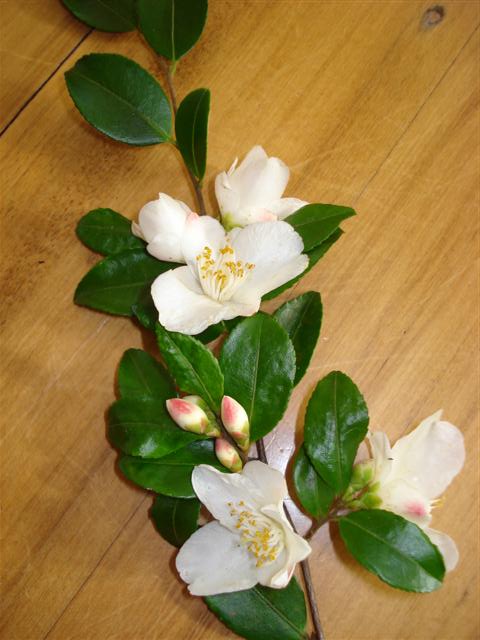
We are pretty sure it is C. gauchowensis

We have it somewhere in the garden but we appear to have mislaid it – which is to say that Mark can’t remember where he planted it and neither of us have come across it yet. We have what we think is C.gauchowensis in flower. It is another pristine white single bloom as many of the species are , on a narrow, columnar bush. Unfortunately it does get easily weather-marked. Few of the species are inherently spectacular when compared to the modern cultivars on offer but they have a quiet charm which we enjoy.

The Tui NZ Fruit Garden – dear oh dear.

The latest update on this article is The Sequel, a second coming for Tui NZ Fruit Garden

Sally Cameron is attempting to punch well above her weight in her book The NZ Fruit Garden. Her main experience seems to be in food writing and cooking and she runs a catering company in Auckland. Her gardening credentials are very limited and it shows in this Penguin publication sponsored by the Tui garden products company.

There is nothing wrong with using a researcher to pull together a comprehensive book as long as the editor/publisher ring-fences her with an expert panel to review the information. There is no evidence that this was done. Alas, being a keen home gardener on the North Shore is not sufficient. There are too many errors and in places the information is simply not adequate. Even worse, there are sufficient instances of unacknowledged quotes to make me breathe the dreaded word: plagiarism.

All those multitudes of fruit trees and plants sold in the past two years need attention. Clearly the time is right for a manual. And a manual is what this book is. To be fair, it is a well-presented book designed to be used often – good-quality paper, opens flat and even has a thoughtful heavy-duty plastic cover. The majority of the book is an alphabetical listing of 58 fruits and nuts, each giving some information on the origin, recommended varieties and the where, when and how of growing them. In addition to that, the first 50 or so pages give a great deal of generic information on propagation, planting and care. At the end of the book, there is a section on pests and diseases and a monthly diary for maintenance and harvest tasks. From almonds and apples to walnuts, most of the crops you will ever want to try growing are included – along with quite a few that you cannot grow, though you are not likely to learn that from this book. Tui’s sponsorship is generally unobtrusive. Superficially, the book looks really helpful and the design is good. Sadly, looks can deceive.

I went to double-check some of the information on apricots, particularly the claim that ‘‘many people think they are subtropical’’. In New Zealand, we all know the best apricots come from Central Otago and nobody ever claims that area to be subtropical. According to Cameron, apricot trees are considered subtropical, which means they can tolerate temperatures from 0 degrees Celsius to over 35 degrees Celsius and still remain healthy. Puhlease. That is not a definition of a subtropical plant. Elsewhere in the book, she recommends them as a suitable crop for Northland. But worse was when I found the Wikipedia entry and thought it seemed familiar. It was. I had just read it in the book.

Cameron: There is an old adage that an apricot tree will not grow far from the mother tree.
Wikipedia: There is an old adage that an apricot tree will not grow far from the mother tree.
Cameron: Although often regarded as a subtropical fruit, the apricot is native to a continental climate region with cold winters.
Wikipedia: Although often thought of as a ‘‘subtropical’’ fruit, this is actually false – the apricot is native to a continental climate region with cold winters

The guava entry is a worry. Actually, it’s even more than a worry when I compared it to easily tracked online sources, to which it owes a rather large debt. Cameron: The guava succumbs to frost in any area – it is a tropical fruit after all. Even if summers are too cool, the tree will die back.

There’s a slight problem here. She is writing about the large growing tropical guava, Psidium guajava, which you may have tried eating in Asia (I found it disappointing). But what we can and do grow here – and which has similar hardiness to a lemon – is the strawberry guava, Psidium littorale. The recommended varieties and some of the photos in the Cameron book are of P. littorale, but they are included under the tropical guajava and there is no indication that Cameron knows the difference. In our 30 years of experience with growing littorale, it does not suffer from any of the hideous pests and diseases she lists at length. Added to that is the propagation information, which is bizarre. Why even mention air-layering when it is not recommended and is so rarely done in this country as to be virtually unknown? The reason: because it appears to be cut and pasted from an easily traced Californian website that was all about guajava. Had Cameron known her material, she would have explained that littorale is commonly raised from seed in this country.

Cranberries: what is grown widely and successfully in New Zealand and indeed is now branded the New Zealand cranberry is, in fact, Myrtus ugni. Most New Zealanders wouldn’t even know that it is not the true cranberry and that the fruit used for Ocean Spray cranberry juice and dried or frozen cranberries is, in fact, a vaccinium.We have never heard of proper cranberries being grown in this country, though presumably you could grow them in Southland, because they need cold temperatures and may be happy in the southern peat bogs. Presumably the author didn’t know about cranberries, because the book doesn’t even mention Myrtus ugni, which you can buy from pretty well every garden centre here, but instead is all about vacciniums. That is the problem with using overseas references without local knowledge. Even then the information given is contradictory. In one sentence, vaccinium is recommended for growing around ponds and other soggy areas. In another, it is recommended that you plant it in the coldest, wettest spot in your garden, but adds that the ground should never be waterlogged. Has the author never heard of the cranberry bogs in North America and seen the deliberate flooding of them? And honestly, what rush of creative frivolity led to the recommendation that they are suitable for growing in hanging baskets?

Gooseberries: according to this book, gooseberries need 800 to 1500 hours of chilling in order to fruit well. Really? What constitutes chilling? Is it temperatures below 5 degrees Celsius – 3 degrees, maybe – or below freezing? Nowhere is that information given, which means that it is very hard to start counting your hours of chill. And the huge range is questionable. Does the author mean that gooseberries require a minimum of 800 hours of winter chill below a certain temperature, but if your hours are much more than 1500 (which presumably takes you to alpine areas in this country), the growing season may be too short?

What the New Zealand reader really needs to know is that because gooseberries need a cold winter to fruit well, you are probably wasting your time unless you live in the centre of the North Island or from Christchurch southward. Measuring winter temperatures in hours of chilling is an American custom not usually seen in this country.

Avocados: the advice is that avocados do best inland away from ocean winds. This could be interpreted as suggesting that they will grow more successfully in Inglewood than Waitara, but we can tell you that in this part of the country, you can only grow avocados successfully in mild coastal areas. In fact, even in warmer areas of New Zealand, you can get frosts if you’re more than 5 kilometres inland. So in this country, avocados have to be grown in coastal areas. Again, I tracked the source of Cameron’s information to a Californian website.

The entry on lychees is lifted pretty much word for word from a copyrighted website belonging to the California Rare Fruit Growers (I started with Wikipedia and found it one click through.)

Under quinces, one of the photographs labelled quince blossom is in fact chaenomeles blossom. And while one of the photos of the fruit is indeed a quince, the other one is chaenomeles. And the photo by the quince header is, we suspect a crabapple. It is certainly not a quince. One is left with the uncomfortable suspicion that nobody involved with this book realised that quinces (cydonia) are an entirely different plant to japonica apples (chaenomeles).

I could keep going, listing the glaring deficiencies in this book. It is riddled with them. You can spend $45 on it if you wish and I am sure it will receive glowing reviews in other media because, superficially, it looks good. It is a book that was probably rushed out to meet a market demand and escaped anything but the most perfunctory of editing. It lacks rigour in every aspect. Near enough is close enough and it all looks just lovely, darling.

I don’t wish to be accused of going on a witch-hunt, but I turned back to Cameron’s earlier volume, The NZ Vegetable Garden, also published by Penguin and sponsored by Tui. I actually gave it a good review in this publication. I randomly inspected the garlic entry and went to check a rather odd piece of information. It took me all of two minutes to find a copyrighted website, http://www.garliccentral.com/varieties.html, which contributed at least some of the exact wording for page 116 in that book.

It should be an embarrassment to a credible publishing house like Penguin, but presumably nobody bothered to check for relevance, accuracy, or plagiarism. Looks are all in this current world of publishing and cut and paste has a lot to answer for.

POSTSCRIPT: My, but Penguin acted quickly to recall the book from sale. Given an advance copy of this column, they issued a recall within 24 hours.