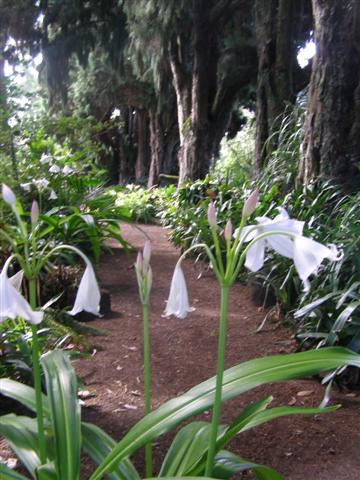
A great grandfather's legacy - the canopy of rimu trees planted in 1880 as a shelter belt.
New Zealand is a windy country. It seems self evident but it wasn’t until I started travelling overseas that I realised that the wind we have learned to live with here is not the experience of many. But you just have to look at a map and see our long thin islands surrounded by vast bodies of ocean and it is hardly a surprise that we have on shore winds, off shore winds, winds from the south, the north, the east and the west. It is the norm and consequently shelter belts in rural areas are also part of our landscape. Australians have commented to me about the predominance of clipped hedging in our garden landscape too and a lot of that has to do with minimising wind.
Many readers will be aware that hedges and plants are better at dissipating the blast of wind than a solid barrier. Walls and fences can funnel the wind up and over, protecting only the area in the immediate lea of the barrier because the air then flows down again. Even then, you are only protecting for the height of the wall so any time a plant gets its head above, it catches the full blast.
But it is not hedging for urban gardens that I have been thinking about, rather the benefits of a bit of creative thinking and plantsmanship when it comes to utility shelter belts. Here we benefit greatly from the vision of Mark’s great grandfather when he settled here 130 years ago. Presumably Tikorangi had already been cleared of most of its native tawa forest cover because the first thing Thomas Jury did was to get in and plant some shelter from the prevailing winds. Those trees give us our stately garden avenues today and we have learned much from looking at them. The more spectacular is the rimu avenue, often likened by visitors to the effect of a vaulted cathedral ceiling. Now those trees give us an environment which is one of the most special areas of our garden – and as it has taken well over a century to reach this stature, it is not easily replicated.
Our other avenue comprises mere pine trees, but pines of huge grandaddy stature – towering over 40 metres high and a mixed blessing. At ground level they give us wonderful gnarled old trunks, again in rows because of course they started life as a shelter belt. Above is a little more problematic with falling pine cones and a few swinging branches but nobody has been injured so far. Both avenues continue to perform their initial function – they break the wind and shelter the garden.
How many of today’s shelter belts will still be around in another century? And how many are planted in trees with the potential to add significant impact to the landscape? Leightons Green, phebalium, nasty yellow conifers or pittosporumns … I don’t think so.

After 130 years, our Pinus muricata are somewhat more compact than the P. radiata windbreak trees of the same vintage.
It is of course Arbor Day tomorrow and that is a good time to make some shelter belt resolutions. These wind breaks do not have to be 100% cheap, utility and uniform. Dropping it to 90% cheap, utility and uniform is fine and there is the opportunity to use these shorter term plants of little or no aesthetic value to act as nurse trees for the long term landscape trees. For who will plant the rimu, totara, araucaria (Norfolk Island pines, monkey puzzle and the like, along with our own kauri), picea, abies, tawa, beech, oaks and other splendid trees with the potential for stature and longevity? As the size of town sections grows ever smaller, the need to continue planting potentially large trees in positions where they have the opportunity to reach maturity becomes correspondingly more important. Owners of lifestyle blocks have a chance to make a significant long term contribution and leave a worthwhile legacy if they just plant some decent trees. It is all very well thinking farmers should do it. Some do, but you can’t just plant trees in paddocks which are grazed. Trees have to be fenced off and that is very expensive and fiddly on a large scale. By their very nature, shelter belts are double fenced and planting is the easy part.
When it came to our own roadside shelter belts some fifteen years ago, Mark went for the mixed and layered approach. Quick, cheap cover came from expendable alders. Long term landscape trees are mostly kauri, rimu and totara, planted perhaps for our grandchildren and great grandchildren. Then, because we don’t have to buy the plants, seasonal impact has been added with magnolias – both showy deciduous types and larger growing evergreen michelias. The final layer is the roadside camellias – larger growing varieties surplus to garden requirements. They are a bit of a seasonal statement, some of our shelter belts, but also practical and planted with an eye to the long term future.
Many years ago, I wrote a column advocating that every person should plant at least one good, long term, landscape tree in a position where it has the chance to reach maturity. I recall two responses. The first was: “What, only one?” Fortunately a few will plant many but that only compensates for some of those people who will never, ever plant a decent tree in their entire lifetime. The second person castigated me for being too honest about how large a large tree will eventually grow. “We will never sell any if people know how big they can get,” she said.
In my books, landscape trees are large, handsome and long lived. These are not to be confused with pretty but low-grade, short term, quick impact trees favoured in most home gardens – the Albizia julibrissin, flowering cherries, robinias and their ilk. As a general rule, fruit trees will never make a landscape tree either. By definition, any plant with the telltale words compact or dwarf in the description will lack stature.
Our country is still somewhat raw and utility in our approach to trees. To many farmers, they are a waste of valuable grazing space and they get in the way of machinery in this heady world of high production but green desert farming. To many town dwellers, they block views and are messy. In a country with a tendency to cold houses, the shadow they cast is another black mark. Any tree of stature is measured in terms of timber potential, not landscape value. Compare that to the pride taken in the UK with their champion trees – those specimens judged to be the largest of their type in the country and awarded accordingly and in Europe where trees of ancient pedigree are venerated. I have seen the plane tree, now some 2500 years and definitely ailing, beneath which Hippocrates apparently sat to write the Hippocratic Oath. We have a long way to go yet here. Arbor Day would be a good place to start.
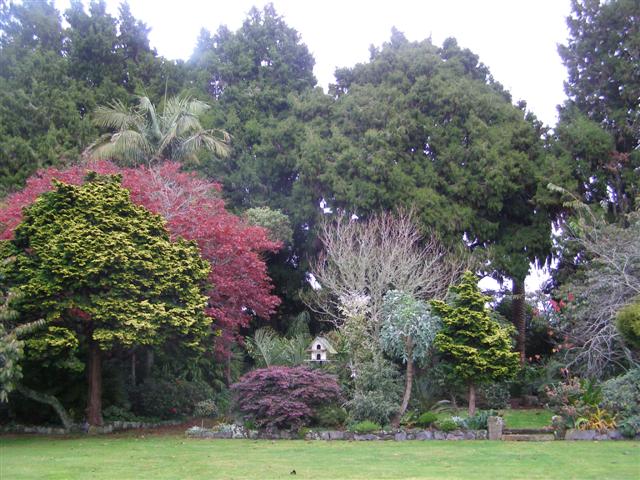
Rimu trees from 1880 in the background, mixed plantings from 1950 to now in the middle ground

 Tikorangi The Jury Garden