Tag Archives: Abbie Jury

Groomin’ grasses

The Court Garden in winter

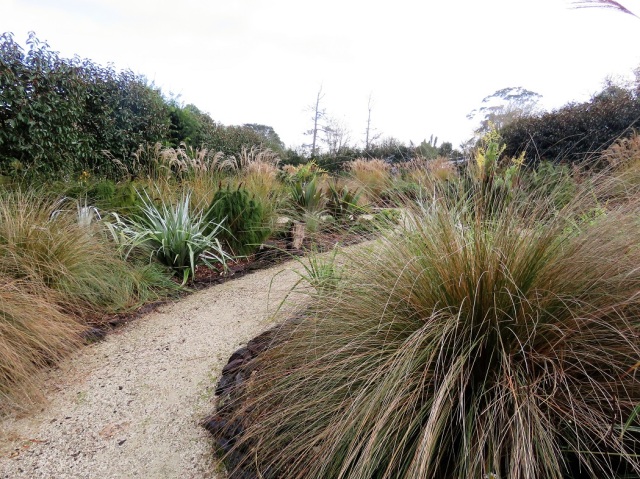
I do not subscribe to the notion of no maintenance gardening. There is low maintenance gardening, lower, lowish, high and very high maintenance gardening. The grasses are generally on the lower side of the spectrum.  
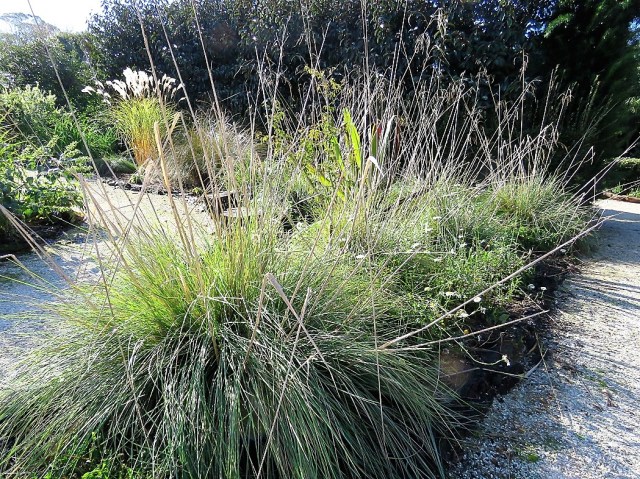
Before on the Stipa gigantea

I certainly don’t groom ornamental grasses in wilder, more naturalistic settings but the Court Garden requires some quite precise maintenance to keep its looks, although it is not usually onerous. This train of thought came about because I have been grooming the Stipa gigantea and that has been more major than I anticipated. At least I have worked out that every established clump is putting up maybe 40 flower spikes which is a lot, really. But there are 24 large plants of it in that garden (yes, I counted!) and every one takes up to an hour for a thorough dead heading and grooming out the dead leaves with a few also needing to be reduced in size. It is not such low maintenance and it is entirely optional but the plants do look tidier for it.
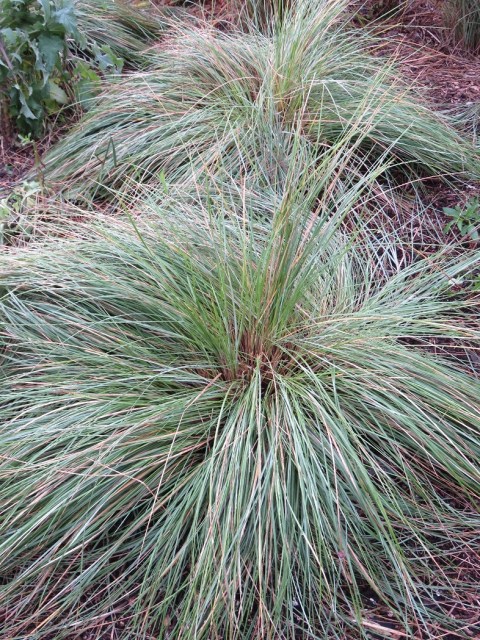
and after on the Stipa gigantea. There is at least half a barrow load per plant removed.

The lowest maintenance option are the deciduous grasses that just get cut down to the ground. That is Miscanthus sinensis ‘Morning Light’. We also cut down Calamagrostis ‘Karl Foerster’ and ‘Overdam’ which are not deciduous but look pretty scruffy and of no merit by late autumn. We have plenty of other evergreen plant material in that garden that gives winter interest and, when cut down, the calamagrostis return with pristine fresh foliage in spring.

Cut to the ground. Maybe don’t try this with clumps that have yet to establish well because you may run the risk of them rotting out over winter but ours are now solid plants.

If you have a very sharp spade and sufficient strength, it is possible to reduce the size of the clumps when they are cut down without having to lift the plants and disturb the roots. I have our Zach with a sharp spade to do this very job, as he has done on the calamagrostis last week and will do on and miscanthus that are looking too large when we cut those down soon.
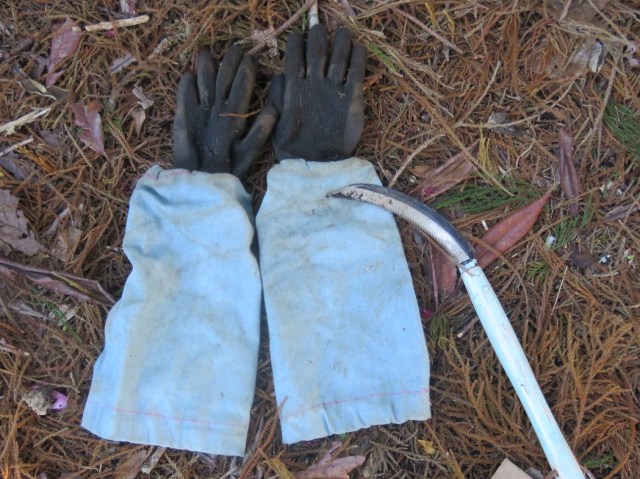
A simple tool, cheap enough and sometimes sold here as a flax cutter. Along with my homemade arm protectors and garden gloves.

For cutting down grasses or perennials, buy yourself one of these very handy little tools with serrated teeth and a curved blade. I think I bought my latest one described as a ‘flax cutter’.
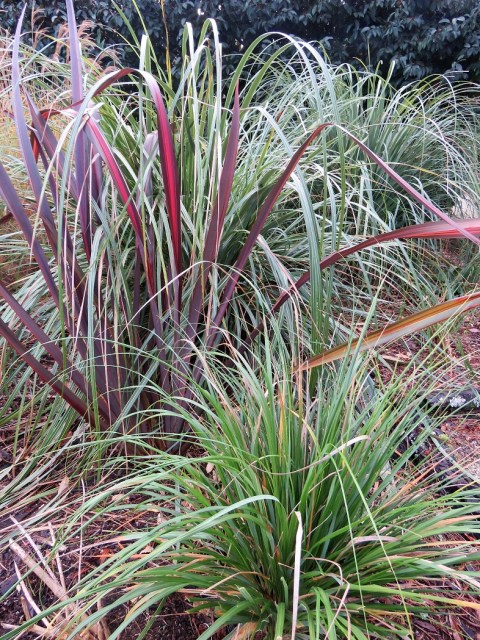
Chionochloa flavicans at the front with an unnamed red phormium or flax and the rather large Austroderia fulvida or proper toetoe behind.

Our native Chionochloa flavicans (dwarf toe toe) has a reputation for ‘whiffing off’, as Mark is wont to say. In other words, it grows beautifully for a few years and then starts dying out. I feel that the proper toetoe we grow – Austroderia fulvida – is showing signs of the same trait and I put it down to a build-up of detritus and dead foliage in the middle of the plants. In the wild, it will be part of the natural cycle; in the garden, we don’t want to cope with half dead plants needing replacement. My theory is that if I keep the plants cleaned out, they won’t suffer that fate. Ask me in five years’ time if I am right on that. I cleaned the plants up in summer, after flowering. The chionochloa were fine to do and did look better for it. The mature toetoe were not much fun to groom because, like a number of our native grasses, they are a form of cutty grass and cut they do. I always wear gloves and I also covered my arms but my ears, my ears! Those very long leaves can cut ears readily. At least it is only a once-a-year job.

The adjustable metal leaf rake, long handled hand rake and flax cutter

The Stipa gigantea does not cut flesh and is probably fine to be left without intensive grooming. I have never done it this thoroughly before so maybe it is overkill or maybe just something to do every few years. You can take the Monty Don of BBC ‘Gardener’s World’ approach and just use your hands as a comb to pull out the dead leaves. He doesn’t even wear gloves that I have seen so I guess they don’t have cutty grasses. I have used the metal leaf rake before and that does a pretty good job when you have room to move around the plants. This time I got in for a thorough clean using our useful little hand rake that you won’t be able to buy at the garden centre. Mark tells me it once  belonged to his father but that he replaced the broken handle with a beautifully whittled, sanded and oiled handle that is longer than the original. Not only is this a useful implement for getting in to plants, it is also very nice to handle.

Chionochloa rubra
Anemanthele lessoniana

A few of the grasses don’t need much attention at all – notably our native Chionochloa rubra (red tussock) and Anemanthele lessoniana (gossamer grass). They may need digging and dividing every few years to reduce their size in a garden situation, but they don’t need routine maintenance, bar weeding out the many self-sown seedlings of anemanthele. It is the only prolific seeder we are using in the Court Garden. The miscanthus throws a few seedlings; the stipa is sterile; the others I have yet to find seedlings of (a thick mulch discourages seed germination) but the anemanthele… It is just as well it is both native and has merit because it certainly seeds down.
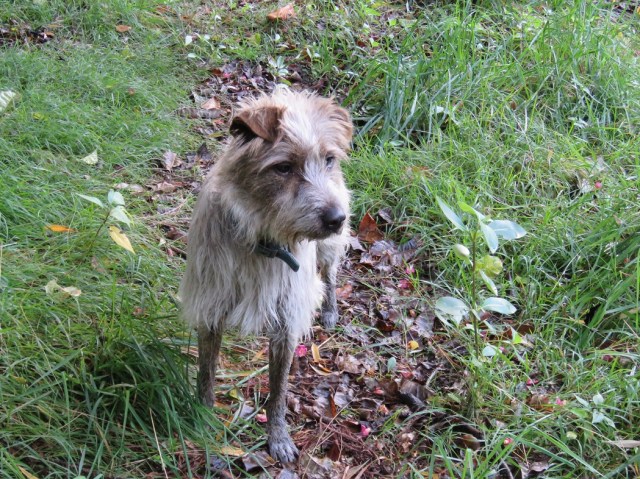
Ralph

Finally, may I introduce Ralph? Ralph came to us from the city pound. He is a little larger than our usual grade of dog but he has settled in here instantly with no doubt that this is his home. Life is terribly exciting for Ralph with so many interesting smells. He is constantly on the move outside and most of my photos end up being a passing blur. But he makes us laugh and it seems that everybody loves a scruffy dog. Come the evening, tired Ralph decides he is now a lap dog and that can be a bit challenging with one his size.  Engaging but challenging.
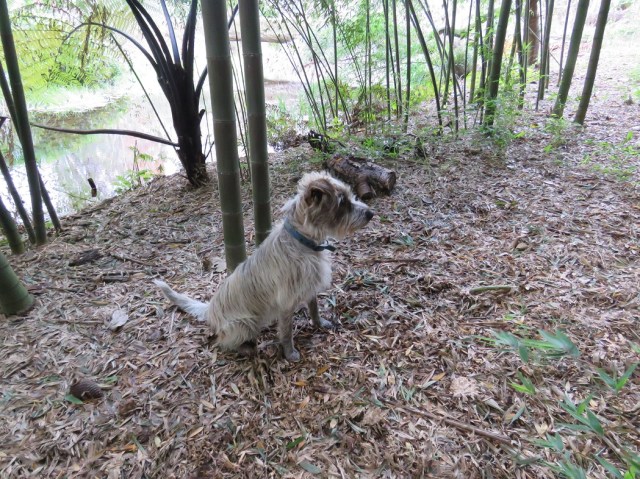
Ralph, briefly sitting down to order, in the Wild North Garden – or dog heaven as he prefers to call it

Falling trees

First published in the May issue of Woman magazine. This is what one might call a retrospective view of the impact of Cyclone Dovi back in February and what it might indicate for the future with climate change.

“Imagine if trees gave off wifi signals, we would be planting so many trees, we would probably save the planet, too. Too bad they only produce the oxygen we breathe.”

social media meme

I did not have ‘hit by cyclone’ on my personal bingo card of climate change risk. Rising sea levels, flooding, mini tornado (we get a few of those in our area), slips, droughts – I had mentally considered all those scenarios.

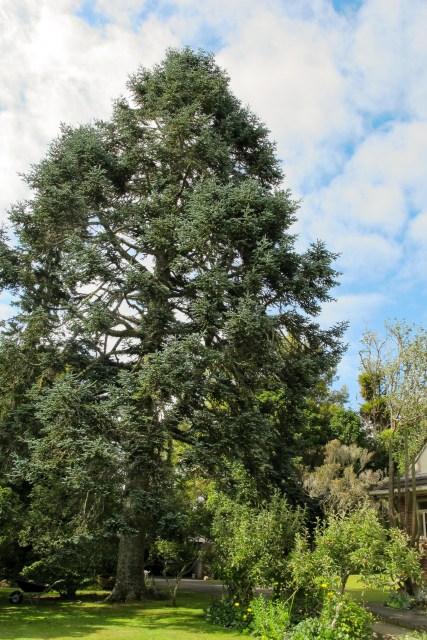
We dropped the large abies two years ago as a precautionary move lest it fall on the house and when Dovi hit, we were very glad of that.

Indeed, we made the decision two years ago to drop the one big tree that could fall on our house and pretty much demolish it. It was a handsome Abies procera glauca, also known as the blue Noble Fir, planted by my late father-in-law about 70 years ago. We were sad to see it go but it seemed a wise precaution at the time.

It seemed an even wiser decision when we took a direct hit from Cyclone Dovi in mid February. As massive trees crashed down around us, we could at least take comfort from the thought the abies was not going to fall on us as we sheltered indoors.

When Cyclone Bola hit parts of Taranaki and then the East Coast in 1988, it largely bypassed our little corner of the countryside. The winds were strong but nothing too far out of the ordinary.  New Zealand is a windy country and we are used to that, but there hadn’t been any cyclones in our area in the intervening 34 years which is why I hadn’t put it on my mental bingo card.

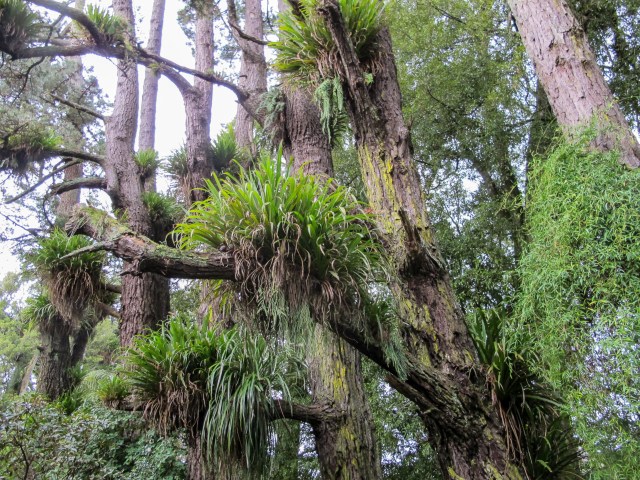
At 150 years old, our massive old Pinus radiata trees are weighed down with epiphytes and nearing the end of their life.

I garden on a fairly expansive scale, with my husband, Mark. It is a property that has been handed down the generations of his family since 1870 and we know who planted which trees and when. Some of the trees are now 150 years old, planted by Thomas Jury, and we know the old pine trees are pretty much at the end of their life. They are not helped by the fact Thomas’s son, Bertrum Jury, topped them at about 10 metres high in the early years of last century. It didn’t stop the pines from growing and the biggest are now up to 45 metres but with a weak point where Bertrum cut them. We have had some snap off at that point and others that uproot entirely and fall.

Why, you may wonder, do we not bite the bullet and get all the pines felled? It is just too big a job. We can’t get heavy machinery into that part of the property and it would probably have to be done by a massive logging helicopter. We are not in that financial league and, where those trees are, when they fall, it is only our property that gets damaged so they are not a risk to others.

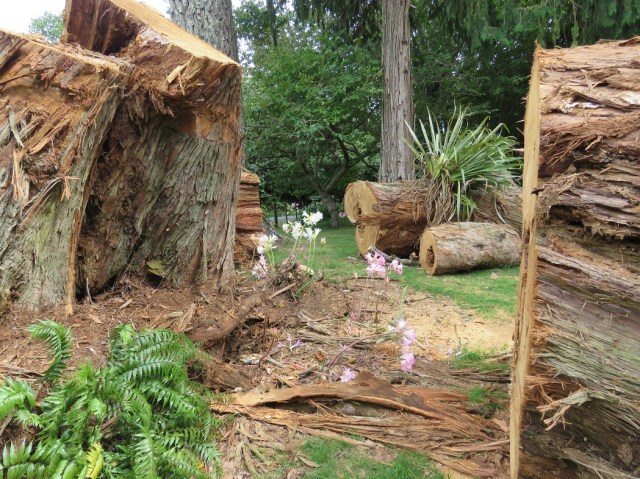
The belladonna lilies flowered on, unperturbed by the fallen gum tree. I measured the diameter of the tree and the main section was two metres across. We cut the root ball and base free from the trunk and used heavy machinery to push the base back upright to create a more attractive gardening environment.

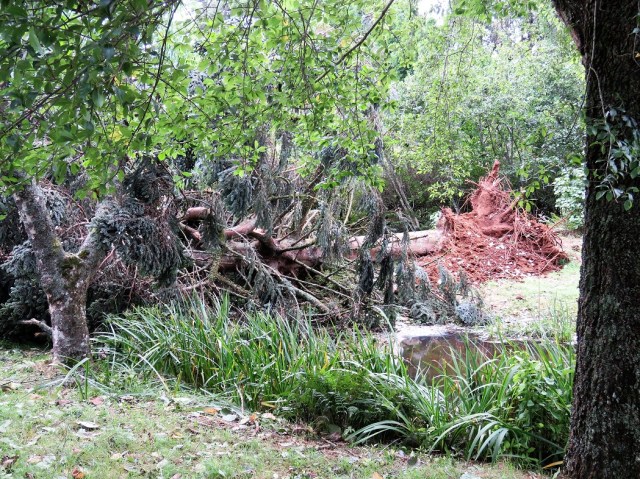
Besides, we can cope when big trees fall one at a time. We are used to that and can go in and do an efficient and speedy clean-up. Losing several at once, as we did with Cyclone Dovi, was rather different. It wasn’t just the damage from falling pine trees; we also lost a giant gum (eucalyptus) at our road entrance that was also 150 years old and Mark literally had tears in his eyes when he found another abies – a baby at just 70 years but one of our most handsome trees – uprooted in the park and lying over our high bridge. Those were just the largest trees. There were smaller trees and branches down everywhere.

The sheer scale of damage from fallen trees after Cyclone Dovi left us paralysed by shock for two days.

Mark and I went into shock for the first two days, paralysed by the scale of the clean-up task that lay ahead. Fortunately, most of it was garden damage, not structural damage, and we have good people around us. It did not look so overwhelming when we eventually got power and running water restored and the most urgent areas were being cleared. A fair number of homes in our local town of Waitara will be heated by firewood and pine cones after I offered both free, on a local Facebook page.

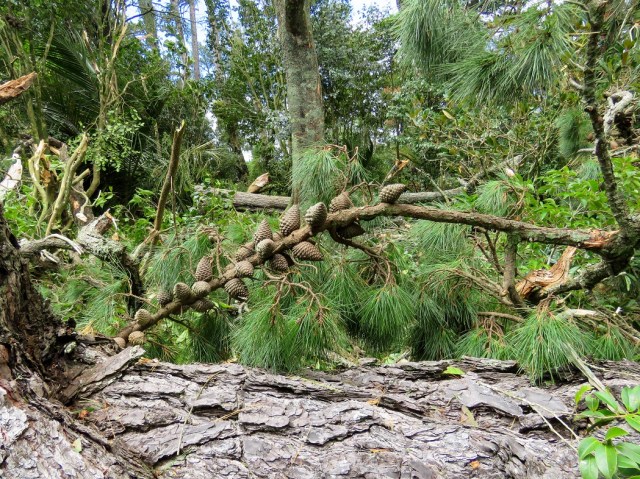
We cut back the fallen pine on the left to clear the path and it will eventually collapse to the ground but it perches somewhat like a giant lizard in the midst of woodland garden.

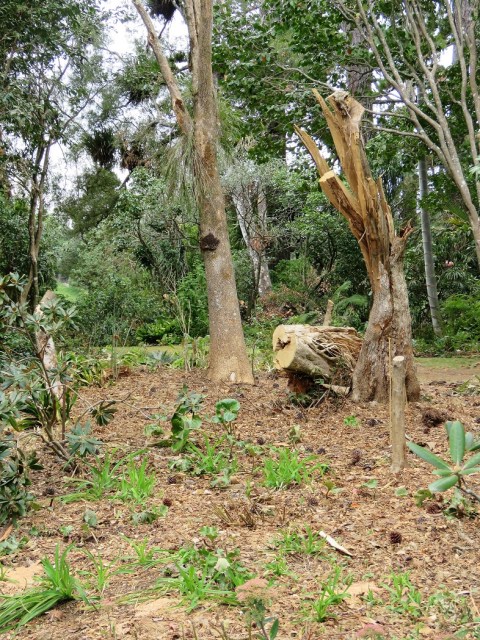
When big trees fall, our approach is now tried and true. Attempting to remove the fallen tree in its entirety would cause huge amounts of additional damage to the area and add considerable expense. We go in and remove all the debris, the foliage and side branches on the tree. We will cut through the trunk where it is blocking paths or access but we leave the main length lying where it fell.

I use ‘we’ in the royal sense. I do not chainsaw and I would not like to mislead with a mental image of me in work boots and ear muffs wielding a noisy chainsaw. My strengths lie more in the lighter aspects of cleaning up and reinstating gardens around the remaining trunks.

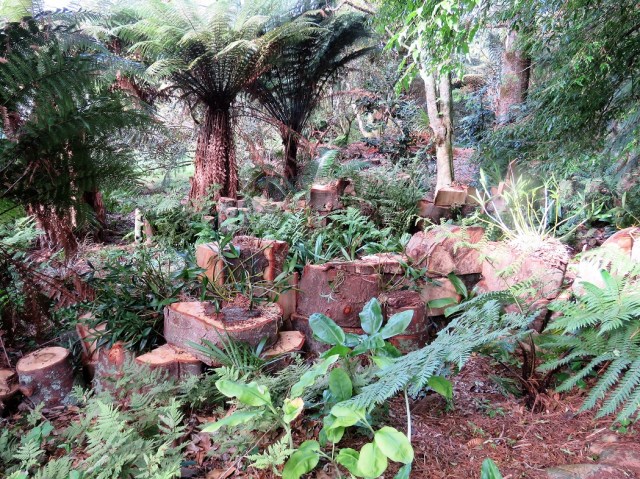
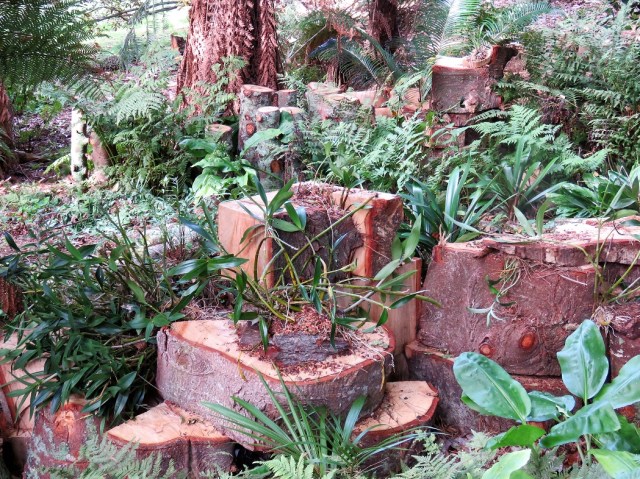
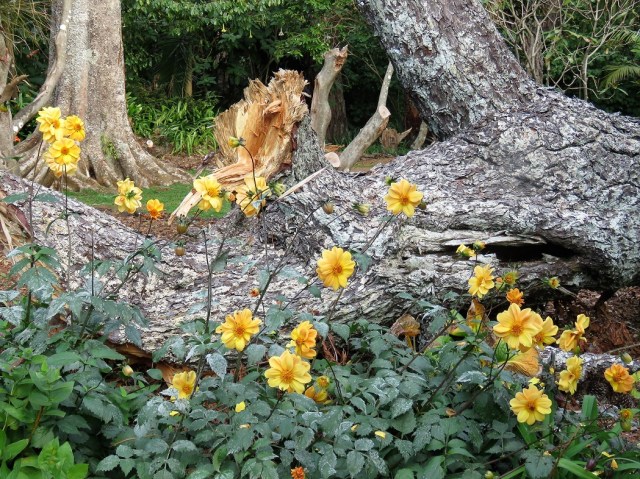
These two pine trees fell eight or nine years ago and we left the main lengths where they lay, gardening around them and allowing epiphytes to establish as they gently decay.

Within a year, we can have those fallen trunks nestled into the garden with plants thriving on and around them and they can gently decay over the years. Instant, unplanned stumperies, one could say, or a pragmatic gardening solution.

The conundrum is that we know one of the ways to mitigate climate change is to plant many trees. Big trees. Long-lived trees. A dwarf apple or maple is not going to contribute to saving the world. But with climate change, we know also that we will get more extreme weather events and that can bring those big trees down.

Power companies and linesmen are not tree-lovers.  I can understand why when I saw trees on three roads around us bring down lines in the cyclone. I was relieved that none of them were our trees. It is a fine line to tread. We monitor our trees that could endanger power lines or buildings and have already dropped some that we deemed too risky.

The answers seem to be: plant trees, lots of trees if you have space, not just for future generations and to help the planet but also for the pleasure of watching them grow. But choose the spots carefully so that they have a chance of reaching maturity without threatening power lines or buildings and without casting unwanted shade on either your own house or the neighbours.

Circles of pine trunk now define the edges of a pathway

Don’t believe the heights given on commercial plant labels – these are often conjured out of thin air to make the tree seem less threatening to the customer or, at best, are what might be expected in the short to mid-term. If space is limited, consider narrow, columnar trees that give height and grace without spreading or casting much shade. Trees which stay lower often spread widely instead, taking up much more space without giving stature in a garden. 

Think long term. Some trees can live hundreds of years. While a tree can achieve some size in 20 years, they are not mature – not by a long shot. From about 40 years on, you can start to claim you have mature trees. Trees are generally low maintenance, but that does not mean no maintenance.

We will be keeping a closer eye on our higher risk trees after Cyclone Dovi.

When survival of a species rests on a single plant

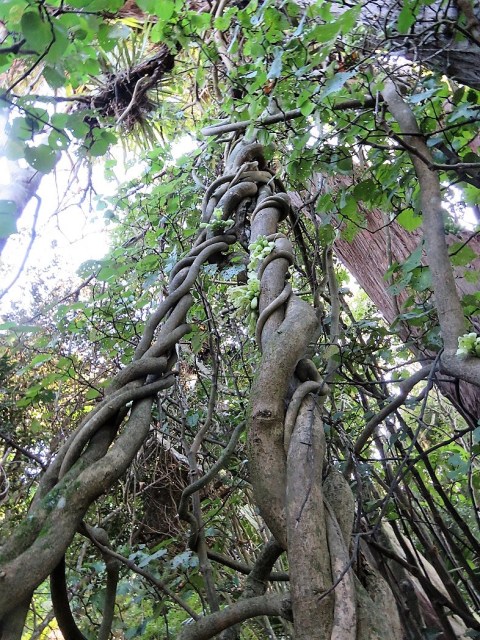
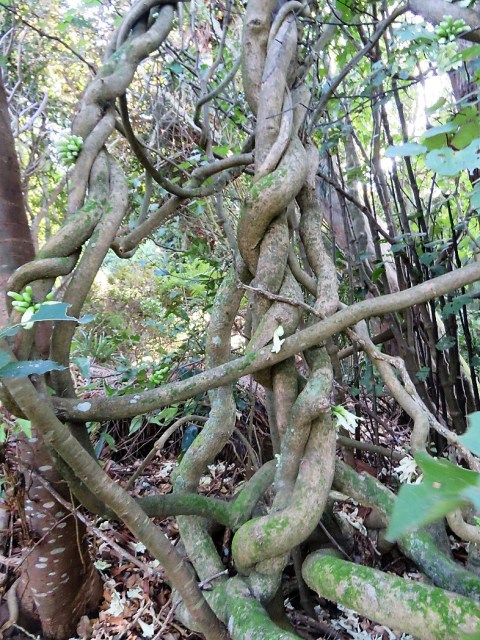
Our native Tecomanthe speciosa is quite the clmbing vine over time

Plant collectors and the nursery trade don’t always have the proudest record when it comes to preserving desirable plant species in the wild. It was the habit of stripping material for commercial gain that saw flora as well as fauna being protected by CITES*.  But there are exceptions and our native climber, Tecomanthe speciosa, is one example.

It was down to just the one, single, solitary specimen ever found and I think it is still down to just the one plant in the wild. Arguably it is the nursery trade and the popularising of it as a garden plant that saved it from extinction.

The same situation applies to Pennantia baylisiana, found at the same time on the same island. We have that growing in our garden too. One of the species of our native kakabeak, Clianthus puniceus, has never been reduced to just one plant but it is critically endangered with just one small location in the wild on Moturemu Island in the Kaipara Harbour. Circulating these plants in the garden trade doesn’t alter the situation of them being endangered in the wild due to loss of habitat, but it does stop them being wiped out entirely.

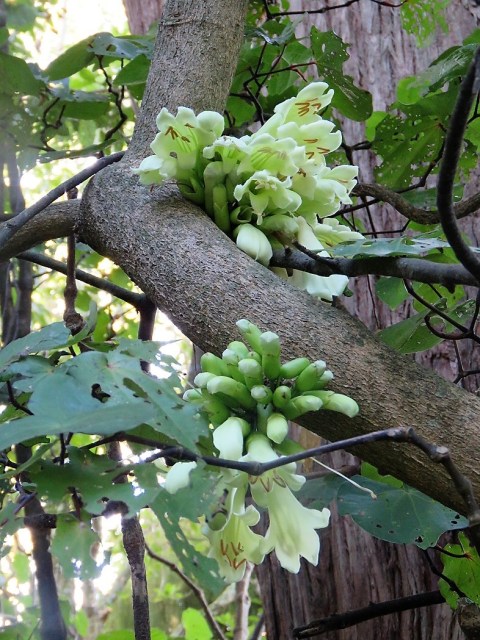
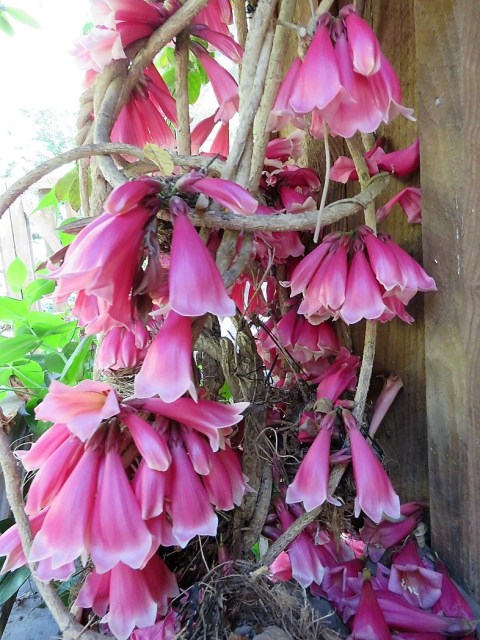
Tecomanthe speciosa setting flowers down its woody stems in very late autumn. The foliage in the photo is unrelated.

The  tecomanthe was found on Manawatāwhi (formerly referred to as the Great Island in the Three Kings group to the north west off the top tip of New Zealand. It was found in 1946 and it is thought that the introduction of goats to the island had led to the extinction of all but the remaining plant. I understand the goats were introduced to provide food for shipwrecked sailors. With the eradication of goats, vegetation on that island has regenerated to the point where that last plant has become heavily shaded and  it has hardly flowered since that year of discovery.

The tecomanthe is climbing vine, subtropical and therefore frost tender but well adapted to coastal conditions. Its foliage is relatively large, lush and shiny and I can’t get a photo because it is all right up on top, maybe 10 metres above. Fortunately, it doesn’t only flower right at the top but can put clusters of blooms out on its bare lower lengths of vine.  

I didn’t know until I looked it up that T. speciosa is best grown from fresh seed and can flower within a couple of years whereas it takes much longer for a cutting-grown plant to start flowering. I am guessing most plants sold in the trade are cutting grown.

The potential is there for this vine to become a gnarly old plant – as ours has – with very thick trunks which may smother and even fell the host tree it clambers up for support but that will take many decades. I have seen tecomanthes trained along front verandahs but they do need training and pruning. Left to their own devices, they may rip the guttering off the house if you turn your back on them but at least you can get most of the flowering at eye-level with a bit of effort. It is probably safer to train a plant along a fence or a wall but whatever location is chosen, it needs a strong support.

Our Tecomanthe venusta needs to be grown under cover but it also flowers on bare wood, although in summer, not autumn. It doesn’t always flower quite as prolifically as this but it is showy.

We grow two other tecomanthe species but both are more tender than T. speciosa because they come from New Guinea. Tecomanthe venusta (syn dendrophylla) needs to be under the cover of a verandah this far south but can be grown outdoors in Northland. The dainty one we have as T. montana (which may or may not be the correct botanical name) is arguably the prettiest of the three. We did have T. hillii which is native to Queensland but it succumbed to neglect.

I think Tecomanthe montana is the prettiest flower. It blooms in spring.

None of the tecomanthe species are common in New Zealand but only one of them is extra special for the patriotic gardener. Fancy being a direct descendant of the one sole, surviving plant. They don’t come more endangered than that.

*CITES stands for Convention on International Trade in Endangered Species of Wild Fauna and Flora

Fallen blooms on Tecomanthe speciosa

The Barricades

The remaining stump doesn’t look very large in the photo but the poor abies was between 60 and 70 years old.

I think we all breathed a sigh of relief when the last of the Cyclone Dovi major damage was cleared and repaired. The abies that fell over the high bridge in the park has been cleared; Lloyd has reinstated the stopbank which had been ripped apart by the tree roots and the he has repaired the bridge.  

The bridge was beneath the tree

The challenge with the abies was what to do with it. Mark had no interest in the timber for firewood. We have plenty already and abies is a lighter wood that does burns quickly so was not desirable. Had it been somewhere with vehicle access, we would have given it away but it was too much of a challenge to try and get it back up the hill when the only access was by our baby tractor or Lloyd’s quad bike and trailer.

Installations, maybe.

The job of cutting it up fell to Zach. Given it had fallen right across the stream, we are lucky that we have had a dry late summer and autumn with low water flow because he spent a few days working around the water with gumboots that are no longer waterproof. He burned the foliage on site as he went. The wood was cut to manageable lengths. A few were used nearby as ‘installations’, we might say. Most of it, he carted halfway back up the hill to build what we have come to call The Barricades.

The Barricades

For readers not into musicals, this is a reference to ‘Les Miserables’. Of course it is. Zach is a fan of musicals and we have been been a Les Mis household ever since our second daughter played Little Cosette in the stage show at the tender age of 10.

That is a Bardo Rose dendrobium freshly planted in the wood

Meet our barricades. Essentially, they are a way of dealing with surplus wood while giving some structure and height in a casual woodland area. Over the years, they will rot down but, in the meantime, they give all sorts of cavities in which to grow plants as well as being not so much a trendy hotel for insects, as an entire insect resort. Or condominium. Zach started with planting a few orchids in it and we will continue to add more plants as suitable candidates become available.

Early March after the initial clean up in the Avenue Gardens

Meanwhile, the rate of recovery in the Avenue Gardens has been rewarding. When Dovi hit, this area was completely covered by fallen pine and the lower canopy of jacaranda, camellia and cordyline. After it had been cleared, it was a bare wasteland with everything tramped into the ground by heavy boots dragging out the debris. We covered it in the woodchip mulch – of which we had small mountains heaped around the area and this was how it looked on March 5.

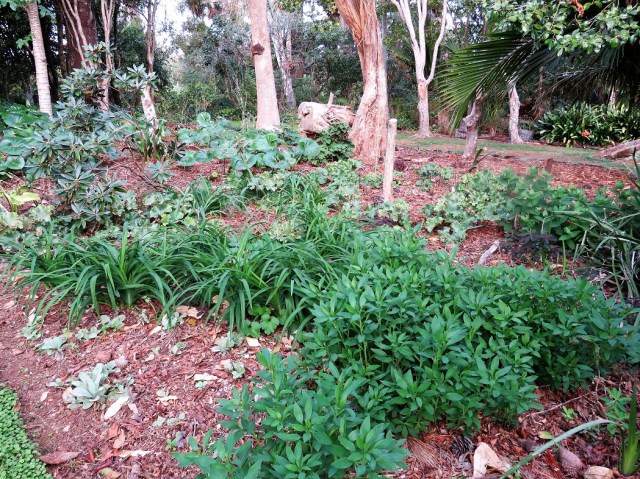
Early May. The poor jacaranda is unlikely to rally again but the rest is recovering.

Two months on, in autumn, it has already recovered to this point. We are still missing the middle canopy layer, but it looks as if the perennial groundcover will return afresh.

Further along the damage zone, the plants are already softening the length of trunk we decided to leave where it fell. In a few years’ time, Cyclone Dovi will just be a memory.

I wrote about Mark’s hippeastrum hybrids back in 2019. Another one has opened and is positively glowing in the Rimu Avenue. Everyone that has bloomed so far is red. It would have been nice to have had more variety, given that one parent is H. papilio. But what is more interesting is their random blooming. H. aulicum flowers like clockwork for us in September, H. papilio in October. These hybrids are popping up the odd flower any time of the year. It will take a few more years to see if they settle down to a predictable seasonal pattern but, in the meantime, it is quite delightful to come across unexpected, over the top blooms glowing in the woodland gardens.

After more than two years – a trip away

The foreshore in Ulladulla

Our trip to Australia has been, done and gone. In pre-Covid times, a trip across the ditch was not a major one. For us it is just two flights with a total of about 4 hours in the air. Four hours can get you a long way in Europe but for New Zealanders, it gets us to our closest neighbour. We fly longer and further than anybody else to get to most places so it is not long haul until it is a 12 hour flight and that only gets us into Asia or Los Angeles.

But times have changed with Covid and this trip to Australia to reunite with our children felt like a major event. It was between two and three years since we had seen them in person and that was our focus. We met up in Ulladulla first, a beach town three hours’ drive south of Sydney. What a pretty coastline that is, full of attractive bays, golden sand and an unthreatening ocean – though it was too autumnal for any of us but the five year old grandson to go swimming.

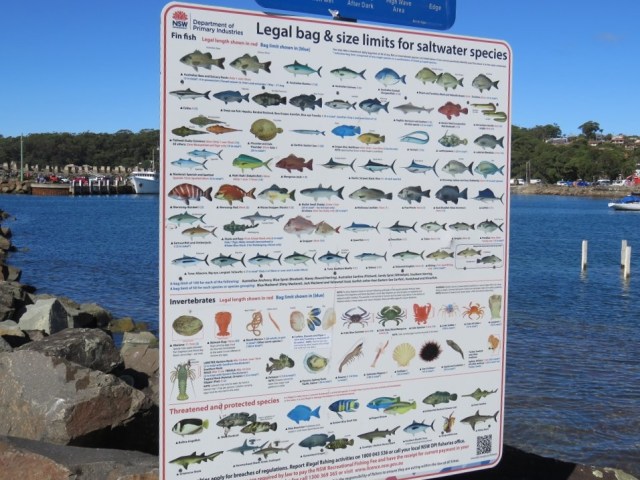
Look at that range of fish species! The quality of fresh fish on the eastern coast of Australia is exceptionally good, even down to beachside fish and chips.

Where we live in Taranaki, our beaches and coastline are grand and wild west coastline with unpredictable seas, big surf and vast expanses of dramatic black sand. That Australian coastline seemed benign and user-friendly in comparison. Ulladulla had a vibe that was vaguely reminiscent of Cornwall fishing villages to us.

We stopped on a walk to see what this man was doing beside a fish-cleaning station on the breakwater
He was attracting the ginormous stingrays in closer. It looks like a shadow in the water, a rocky area maybe, but I can assure you it was one of three excessively large stingrays attracted in close to shore by an easy feed.

The sight of the most enormous stingrays we have ever seen was a reminder that it is not as benign as it appears. I was not at all sure I would want to swim amongst monsters like that. The Australian Museum site tells me that ‘The Smooth Stingray is the largest of all Australian stingrays (Family Dasyatidae). It grows to 4.3 m in length, 2 m disc width and a weight of 350 kg.’ I have no idea if we were looking at smooth stingrays but it does confirm that my memory is not playing tricks on the astonishing size of the ones we saw.

Cordyline fruticosa – easy to propagate, easy to grow and right at home in areas with hot summers and mild winters

While the temperatures felt very similar to those we had been experiencing at home, the common garden plants told us that the climate is warmer than ours. We have seen Cordyline fruticosa (formerly C. terminalis) growing wild on the roadsides of Bali but unless you have a very favoured spot in NZ, preferably in the more sub-tropical north, it is a house plant here. It was in every second garden in that area of coastal New South Wales. What it lacks in subtlety, it makes up for with its exotic tropical vibe.

Those are NZ cordylines but I have never seen them looking that good in NZ

Australia has its own native cordylines but gardeners there embrace all manner of different species and cultivars and, galling though it is to admit it, our native NZ cordylines look better as garden plants there than here. That is because our plants get attacked by a native caterpillar – Epiphryne verriculata – which gives our plants a perpetually motheaten, chewed appearance.

Tibouchina – another indicator of a warmer climate than home

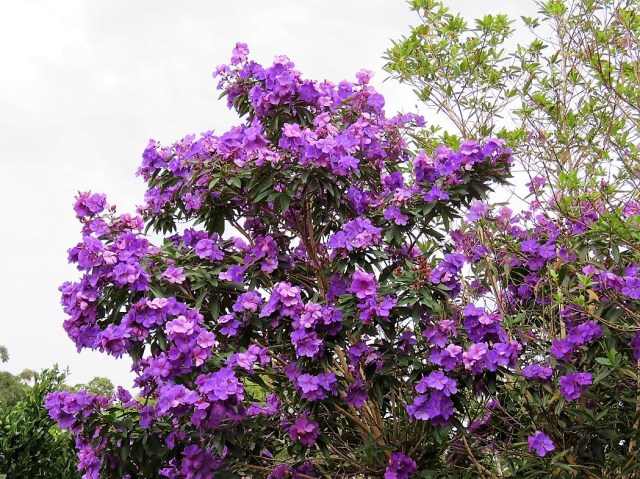
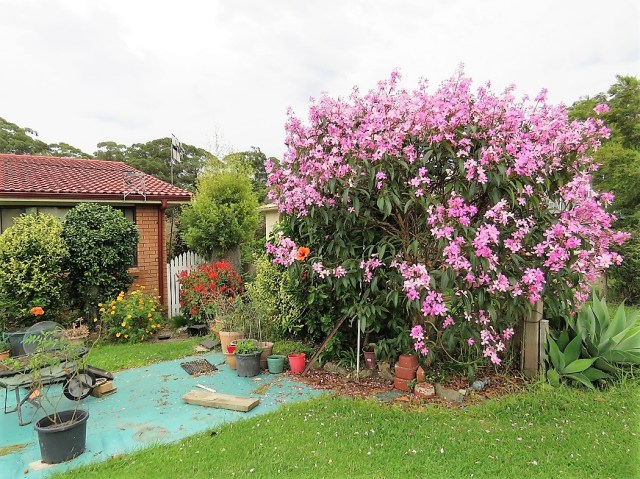
The splendid tibouchinas in full bloom also featured strongly. Commonly known as lasiandra in Australia, these are tropical plants originating from Central America – mostly Mexico, Brazil and the Caribbean. Again, these are conditions that can only be replicated in the warmest areas of northern NZ so we don’t see them like this in Taranaki. Some may think they are garish but there aren’t too many plants that are a blaze of glory in mid to late autumn.

There did seem to be a choice limited to either purple or candy pink in the tibouchina range

While this pink one was highly visible from the road, I stopped to ask the garden owner if I could photograph it because I thought it may worry her to see a random stranger photographing the front of her place. I did take more arty photos of close-ups of the flowers, but I quite like it in the context of the whole front garden, which had its own flavour. The owner was so thrilled by my request, she took me round the back to show me the purple one above.

Australians love their sasanqua camellias and they were looking very pretty everywhere but I came home with not a single photo featuring them, so you will just have to take my word for it.

Another cordyline derived from NZ species but with the clean foliage they keep in Australia as compared to here. And lo, there is a sasanqua camellia – albeit a pretty ordinary variety.

After Ulladulla, we relocated a little further south to Bateman’s Bay. This was entering bushfire territory from the summer of 2019-2020, now referred to as the Black Summer. That was haunting but the story of 37 000 hand-knitted wattle flowers commemorating the event will have to wait for my next post.