Christmas is different in this land of ours at the further reaches of the southern hemisphere. With the summer solstice just a few days ago, our days are at their longest and all schools and many businesses have closed for the long summer break. The festivities many love over Christmas and New Year are intertwined with the feeling that now is the time to relax and recover, to enjoy the warmth of summer.
May you find peace and happiness in whatever way you choose to mark this time of the year wherever you are. Mark and I will likely be in the garden.
Seasons greetings and may you go well and stay safe.
Abbie
That is Kevin and Sharon, They are a family joke shared by our second daughter many years ago. Kevin has to wear a Santa hat on account of a slight accident with his antlers.
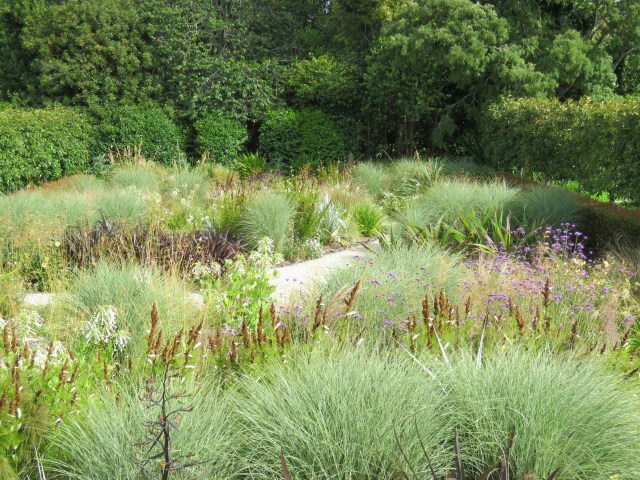
I was up the top of our tall platform ladder to get these photos – a view of the Court Garden which we do not usually see because it has been designed and planted to be immersive at ground level, with no long vistas.
I see it is exactly 364 days ago that I published a piece on deciding to establish a tussock walkway. It is entirely coincidence that I return to it today.
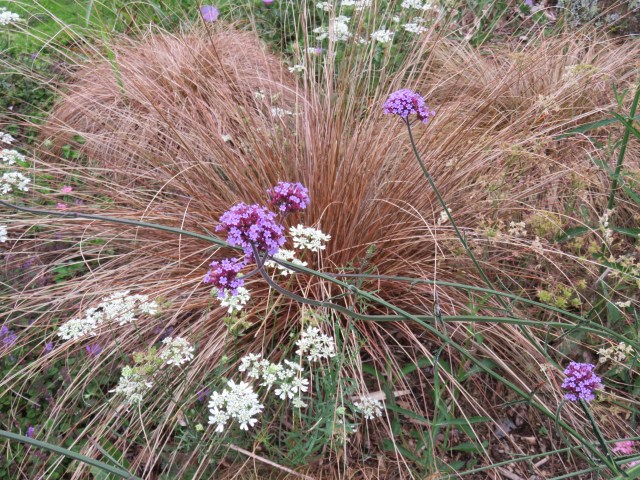
From a different part of the garden, that is Carex buchananii at the front with the orlaya and verbena and Carex comans behind.
I have no idea if other countries talk about tussock or tussockland. Overseas readers may like to enlighten me. Maybe it is our term and other countries have prairies, steppes and grasslands? Our tussock areas are our native grasslands and I am not even sure that many New Zealanders realise that our native grasses are not only largely unique to us but also varied and interesting with many good garden candidates. Contrary to what some think, a tussock is not a specific grass, it is a term for the growth habit of a number of grasses that include our chionochloa, poa, festuca and – sometimes – carex.
Not exactly well furnished yet but on the way
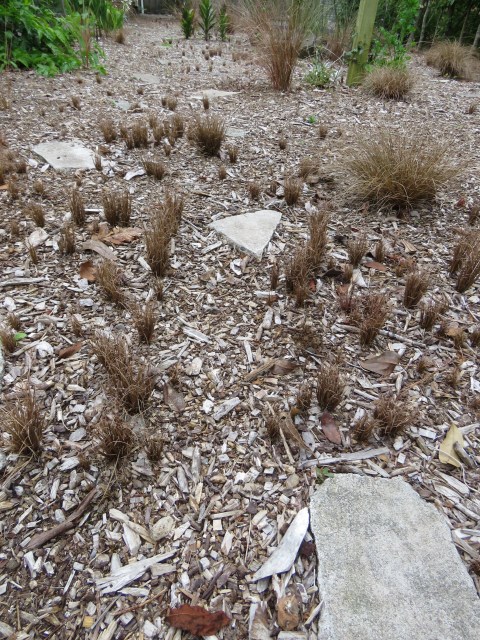
I opted for carex in this area, specifically Carex buchananii and Carex comans ‘Bronze” because I had them to hand. I will admit that they got off to a slow start because I shifted them, divided and replanted in high summer. While well watered-in, they had to endure a long, dry summer and autumn and not all of them lasted the distance. But it will not matter. They are seeding down with great gusto, on a scale I had not expected. Not only do I anticipate it being a fully clothed tussock area by this time next year, I think I will have to thin them. Most of these look to be the more upright C.buchananii at this stage but I am hoping for some of the fountaining C.comans as well.
That is a whole lot of self-seeding happening in a short space of time
The purity of vision with which I started – that of a rippling grassland of bronze tussock with no defined paths – has been watered down a little. When we broke up the two concrete paths that defined the site of the old propagation house that formerly filled most of this space, I made the call to get Lloyd to lay some crazy paved stepping stones through it and that may be a good call in terms of keeping some clear pathways, given the dense seeding of the plants.
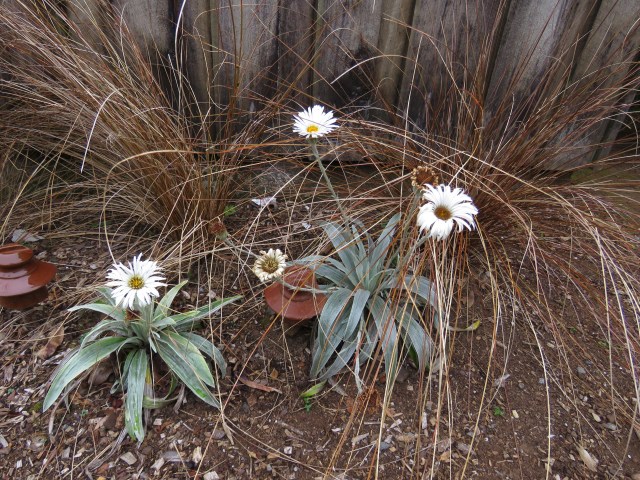
Adding native celmisia to the Carex buchananii
Next Mark asked me, “What are you going to do to add some seasonal interest and colour?” And those words are the death knell of pure visions. I added some celmisias – our native mountain daisy – and I really like the look of those with the carex. There were some legacy plants that survived the removal of the propagation house and I feel Cordyline stricta can stay, even though it is Australian. Another tropical-looking cordyline has popped up and it may or may not be C.petiolaris. A bit of seed is blowing in and I will have to manage Verbena bonariensis and the white nicotiana because, while a few plants are charming enough, we don’t want them everywhere and they seem to want to be everywhere. And I admit I planted a swag of dwarf narcissi. For spring interest, you understand.
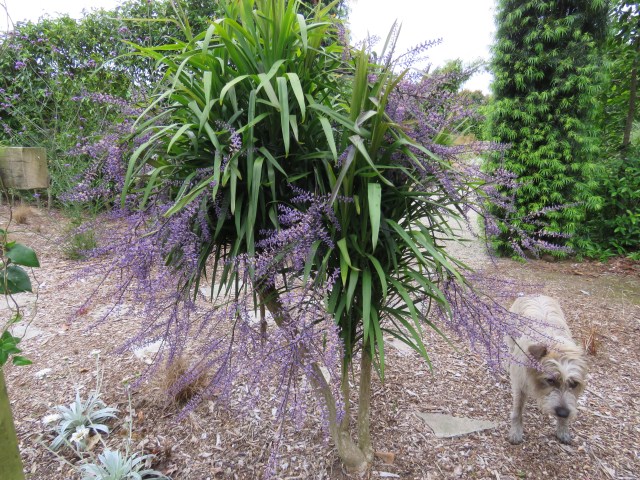
An Australian interoper – the blue flowered Cordyline stricta (not Ralph)
Zach refers to this area as ‘the prairie’, albeit a very small prairie. I shall keep referring to it as the tussock walkway because the grasses at least will remain the dominant plant and they are native tussocks.
Gardening a cyclic affair. I see I write about foxgloves every few years at this time of the season and here we are. It is this time of the year, I get around the garden to pull out the nasty pink ones.
There are about 20 different species of foxglove and we have tried a few of the different ones, particularly in honey and soft yellow shades but really, it is only the common Digitalis purpurea which lasts the distance. The other species are much pickier and won’t naturalise for us.
It is the shade of pink, I think, that bothers me so much I won’t even tolerate them in wilder areas of the garden
What is it I dislike so much about the pink form? It really is the colour and the status of the plant as a countryside weed, though I think I would be less worried about the weed aspect if it was a prettier colour. I do, after all, grow wild fennel in the summer gardens. That murky, hard pink is just not a colour I like. I like it even less in a garden situation because I feel it lacks any refinement or charm.
Whites and pastels gently seeding in the gravel heap. They were a little more impressive earlier in the season before the rains came in the last week.
The whites and pastels are no less thug-like in their growth habits but I like the height and the flower form and I am fine with letting them seed around in a gentle sort of way. We have a patch of self-sown seedlings growing in a small gravel heap – the contents of the capillary beds back in the days when we had a nursery on site. It is quite handy having a stash of fine gravel to use in some situations and it is not doing any harm where we stockpiled it. The foxgloves are happy to grow in straight gravel.
Red ribs to the left are meant to mean pink flowers but no, this is not always the case. Green ribs to the right, however, usually indicate white flowers
I can categorically state that this plant has white flowers with a few red freckles inside, despite those clear red ribs on the foliage
It is because I keep track of that patch, that I have worked out that the advice to cull any seedlings that have red ribs to the leaves if you want to get rid of the pink ones and keep the whites and pales is not in fact accurate. It may be true that all dark pink ones have red ribbing on the foliage but it is not true the other way round – so, too, can some of the whites and pales. For a brief while, I thought that only the white foxgloves with freckles or spots inside the thimble flowers had red ribs but no, so too do some of the all whites with no freckles.
All white forms in the Iolanthe garden where their thuggish and wild ways are fine
The white foxgloves are simply a variant of the same species, Digitalis purpurea, but the dominant gene is clearly pink so if you are not vigilant on weeding out the stronger pink forms, you will end up with a dwindling number of white seedlings. You have to pull the plants out and remove them from the site as soon as the colour is obvious. If you leave them to flower, the bees which constantly work these blooms will transfer the pollen from one to another so the genes in the seed will not stay the more desirable white.
The common pink to the right is not acceptable to me; the second from the left opens white but matures to the same pink tones I dislike so must also be removed in its prime
I also pull out plants which are clearly pastel forms of the same pink parent rather than the peachy hues of some I have and I pull those plants that think they can outwit me by opening white and then changing colour to pink as the flowers mature. Were I truly dedicated to the genus, I might start selecting for different habits – more compact or with larger sized thimbles for example – but I don’t love them enough for that. I am fine with keeping to pure whites in the Iolanthe garden and pastel peach in the Court Garden.
If I lived in a drier climate, I might expend the same random energy on lupins – another plant that hovers on the margins between being a delightful garden plant, wildflower or even noxious weed. But lupins don’t like our high rainfall, high humidity conditions so I must make do with foxgloves.
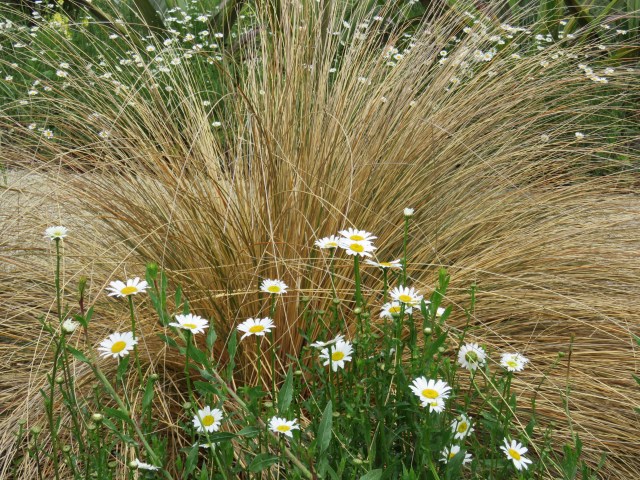
Our native red tussock (Chionochloa rubra) with the Eurepean ox-eye daisy (Leucanthemum vulgare)
We visit Australia fairly frequently on account of all three of our children living there these days and their native birds never fail to astonish me. Big, brash, vibrant, colourful and varied, they have an astonishing range of exotic birds. Aotearoa New Zealand also has a huge range of native birds but ours are far more restrained. Our iconic kiwi is, after all, all brown, lives on the ground and only comes out at night so is rarely seen in the wild. Most of our birds are in muted colours and need the light or a closer view to catch the iridescence in the feathers or the charming fluffy chests. But our birds sing sweetly whereas those brash Aussie birds squawk raucously.
Our tui at the top – and I admit it can look plain black with just a white fluffy pompom at its throat without the light coming at the right angle; just one flock of Australia’s showy parrots below
So too, are our native plants of a more restrained persuasion in the showy, flowering stakes. Many of our natives have very small flowers while those of a bolder persuasion can have very short flowering seasons. A kowhai (Sophora commonly tetraptera) is spectacular but only for a week or 10 days if we are lucky. Similarly, our iconic pohutukawa (Metrosideros excelsa) is but brief in its Christmas raiment. We have very few native bulbs and we lack the range of flowering native perennials that many countries have.
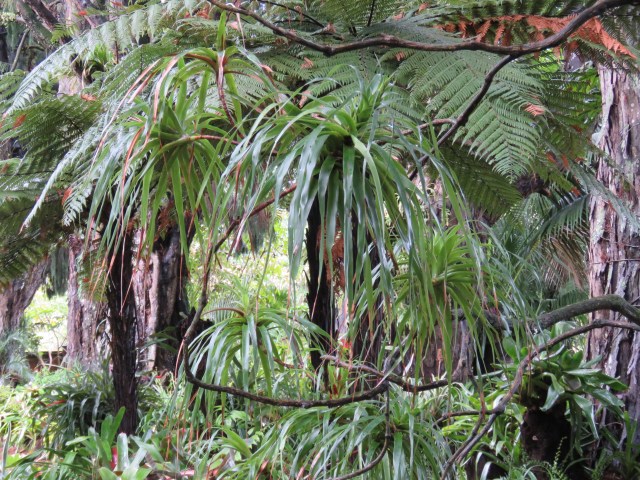
Not a native forest at all but our Rimu Walk which we often describe as sub-tropical woodland and where exotic bromeliads are a dominant planting. But the big trees are rimu (Dacrydium cupressinum) and you can see both tree ferns and Dracophyllum latifolium – all native and it is our indigenous vegetation which forms the backbone and much of the canopy for the exotic imports below.
Our native forests are commonly referred to as ‘bush’ in this country but really, it is better to think of those remnants of original vegetation as neither bush nor forest but more as cool-climate jungle. At least it is jungle without snakes or other threatening wild life. The risks in our native bush are more to do with getting lost, falling over concealed cliffs or making very slow progress through dense growth in areas where deer, possums, pigs and goats (all introduced animals) have been kept under control.
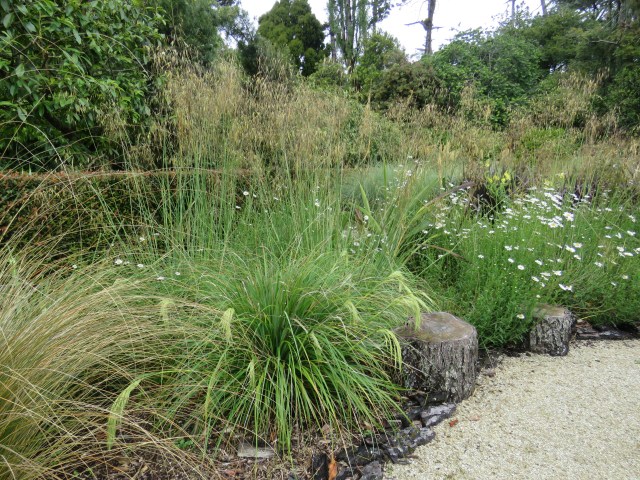
Our native Chionochloa flavicans (sometimes referred to as ‘miniature toetoe’) in the foreground backed by Stipa gigantea and more ox-eye daisies because they are most rewarding in the flowering stakes if cut back regularly.
What we DO have in this country is a large range of very distinctive and unique plants – trees, shrubs and grasses – which are remarkable in their foliage, form and structure in the garden. Many are highly prized overseas – including our tree ferns, flaxes, grasses, cordylines and hebes.
I like foxgloves which have a wide natural spread in Europe, North Africa and western Asia but I don’t like them in the common deep pink shades. What I like even more is how our Chionochloa rubra combines with seasonal flowers. As the season progresses, the giant inula, single dahlias and helianthus will take over from the foxgloves and verbascums.
We have always opted for a mid-line in gardening terms – using native plants but in conjunction with exotics. A few purists may go native only with the pinnacle of moral rectitude being eco-sourced plants from the local environment, while at the other end of the scale are those who eschew natives as ‘boring’.
The showy Verbascum creticum – from Crete – with phormiums which are commonly referred to ‘coloured flaxes’ here
I was looking at the combinations of flowers and foliage that pleased me in the Court Garden and it is that mix of native and exotic. Of the structural plants I chose, nine are native and seven are exotic but all the pretty filler flowers that lift the scene are exotic. That was not by deliberate design although I did lean towards native grasses where I had a choice. I think it shows how effective some of our native plants are as bold, structural statements and how we make up for what we lack in showy flowers with some top-notch grasses.
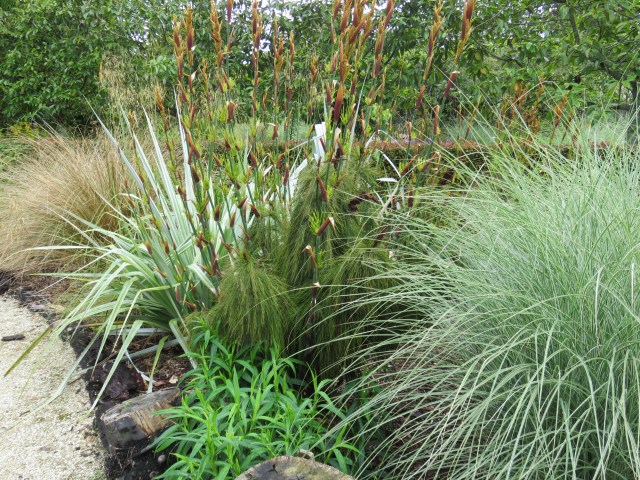
Left to right, we have my favourite Chionochloa rubra, Astelia chathamica (both natives), Elegia Capenis from South Africa and Miscanthus ‘Morning Light from eastern Asia.
There is plenty of material to work with. Gardens do not generally replicate the natural environment but I find incorporating a range of our native plants satisfying in a faintly patriotic way. It is of course the access to a wider range of our unique native flora that makes NZ gardens different to those around the world. And when all is said and done, flowers are seasonal and ephemeral whereas form, substance and structure is with us all year round. Because our native plants are evergreen, they are ideal for filling that role.
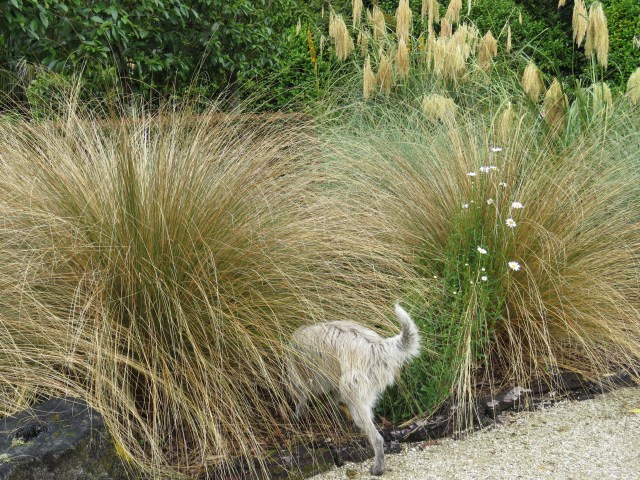
My constant companion is Ralph, who is sniffing out rabbit trails here, so I end up with rather a lot of photos of his rear end disappearing under foliage. In this photo is Chionochloa rubra with our toetoe (Austroderia fulvida) behind. These native grasses make splendid garden plants where there is sufficient space.
First published in the September 2022 issue of Woman magazine
“… an ecologically dead status symbol.” Douglas W. Tallamy
Let’s talk about lawns.
I remember doing a profile on a gardening couple who took great pride in their lawn. “Visitors say they just want to take their shoes off and luxuriate in the grass,” declared the lawn man of the pair. I had taken my gardening and life partner, Mark, along for moral support and as soon as we were safely in the car and departing, he expostulated, “People want to let their bare skin touch that?”
We both knew what sort of chemical arsenal was used to achieve a lawn that looked like green velvet and we would not be wanting our skin touching it. It is a value that originates from American suburbia – all those perfect street frontages – and I am not sure that is of merit.
There is the perfect lawn and then there is mown grass. It is many years since Mark declared that he would not routinely spray the lawn to try and keep it to the chosen grass varieties that give a handsome sward. As long as it was small-leafed, green and able to be mown, that was fine. I notice that it is me, not him, who goes around on my hands and knees rooting out the flat weeds but the excessive daisies, dandelions and docks worry me more than him.
I would make an exception if we had small children in our lives. I might then agitate for spraying Onehunga weed, or prickle weed as it is often called. It makes going barefooted unpleasant. If you are going to resort to spraying it, you need to understand that it germinates in winter, grows madly all spring and, when the prickles appear in summer, it has already set its seed and the plant will die so there is no point at all in spraying at that time. You need to spray in spring when it is in full growth to break the seeding cycle and you will need to do it for several years as dormant seeds will keep germinating.
If you are not keen on spraying, you can let the grass grow long in the spring flush which will force the Onehunga weed to grow taller to reach the light. Then set the mower level lower than usual and you will be cutting off most of the Onehunga weed before it has a chance to flower and seed.
Our front lawn, seen here in autumn, is a fairly major feature and I wasn’t sure about letting it grow wild.
What about not mowing at all? It is a controversial position to take in an urban setting. We recently let our front lawn grow over summer and there is no doubt it is alive with bees and butterflies when in flower. The Californian quail love it too with its abundance of seed. Our main interlopers are clover, lotus major and self-heal (Prunella vulgaris) which means it flowers pink, white, yellow and blue. Mark refers to it as a low meadow.
Mowing the perimeter of the lawn and paths gave instant form to what would otherwise look unkempt. It would look better had we raked the paths or collected the clippings as well. The mulcher mower was not equal to the sheer volume of grass to be cut down on this occasion.
Because our front lawn is quite a major statement, it worried me when it looked …. well… rank and unloved in the early stages. I had a stroke of genius, drawing on what I had seen overseas, and asked for a double width to be mown around the perimeter and our most used paths across the lawn to be mown, again a generous two mower widths wide. It made all the difference visually and transformed it from unmown lawn to managed meadow. We kept it that way until the flowering was finished and then cut it all down again.
Our ‘low meadow’ in full flower
On the topic of mowing, get yourself a mulcher mower that chomps up the clippings to a fine tilth that is absorbed back into the grass. It means you don’t ever need to feed your lawn with nitrogen fertiliser again and it makes mowing faster without faffing around with lawn clippings which are the bane of landfill. The only reason lawns need fertilising is because constant mowing and collecting the clippings strips out any goodness and doesn’t allow for a natural cycle of replenishment. We haven’t fed our lawns for years, maybe even decades, but they remain green, well-covered and healthy simply because we use a mulcher mower.
If you choose to spray your lawn, then at least educate yourself as to what the active ingredients are and choose accordingly. There are more environmentally friendly options coming available but lawn sprays in the past – some of which will still be in garden sheds around the country and some may still be available – were a toxic brew.
Contrary to widespread opinion in NZ, this is not a wildflower meadow. It is a pretty sowing of annuals in a casual style and is not an easy-care alternative to lawn.
Proper meadows and wildflowers are a whole different topic. When wildflowers are mentioned, most people think of wildflower seed mixes – the ones that are soldier poppies, cornflowers, cosmos, daisies white and daisies yellow and a whole lot more. Pretty though they can be at their peak, they are neither meadow nor wildflower, or certainly not our wildflowers. Essentially it is gardening with annuals and such plantings are generally short-lived and need quite a bit of work to stop them deteriorating to a flattened, weedy mess. There are alternative approaches but they are not an easy answer and take a much higher level of gardening skill than a simple lawn requires.
What does a lawn achieve? If you are the sort of family who gets out for wholesome games in the garden, be it backyard cricket, rugby, badminton or even croquet, then yes, the lawn provides a suitable recreational space. Most of us persist with lawns long past the time when we have children frolicking outdoors, assuming they ever did.
Mondo grass creates a green breathing space that is every bit as effective as mown grass.
I came to the conclusion that there are two reasons for lawns. The first is practical; they are lower maintenance than most styles of garden. The second reason is aesthetic; an expanse of mown grass gives a breathing space in a garden and can frame the more detailed, decorative areas. The mistake is to think that you can only get that breathing space with a lawn. There are other ways and it doesn’t have to be the courtyard approach of paving or decking. I remember Gil Hanly’s garden in Auckland where she created a simple breathing space with green mondo grass beneath palm trees. It would have been lower maintenance than mown grass and, in a highly detailed garden with lots of colour, it gave that space to draw breath and relax.
In the end, lawns are on a spectrum. At the extreme end are the lawn fanatics who will de-thatch, aerate (because they have killed off the earthworms), core, oversow, irrigate, use sprays frequently, fertilise extensively and mow every day or every second day to maintain a perfect velvet monoculture comparable to a bowling green. I see this as an environmental travesty and a political statement from people who are proudly declaring total control and supremacy over nature by every means in their chemical and mechanical arsenals.
At the other end of the scale are those who either dispense with lawns entirely or simply give up mowing. There is a lot of room to move in between those two extremes where most of us can find a level which sits better with us in environmental, aesthetic and practical terms.
There is a different charm to a casual seating arrangement in long grass rather than on mown lawn although my practical side says this probably works better in a drier climate.
We just need to stop thinking of one end as admirable and aspirational and the other end as disgraceful and lazy. Nature would prefer it if more of us were inclined to land on the laissez faire end of the spectrum.
“Over three-quarters of all garden chemicals sold in Britain are for the improvement of our lawns.” The Curious Gardener’s Almanac by Niall Edworthy (2006)
Once was mown lawn at RHS Rosemoor. English friends tell me that the sight of mown grass in public parks and gardens is increasingly rare