
November 2017
When I first started writing about our new sunny borders last year, a reader commented that she would be interested to see how we managed year-round interest in them. Because, in colder climates, and particularly the UK where we drew inspiration for this project, gardens are not expected to perform all twelve months of the year and most of the herbaceous material is fully deciduous. Most gardeners in cold climates put their gardens to bed for the coldest months and retire indoors to their very warm homes, or at least to the shelter of the garden shed if they are determined. Expansive herbaceous plantings leave huge gaps in winter and nobody expects them to bloom all year round.

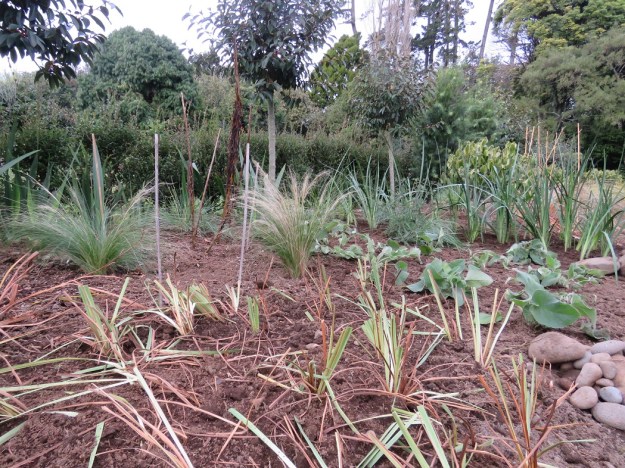
Early December 2017, still very new
It is different here. So much of the plant material we use is evergreen and we expect to be wowed by something every week of the year. I tried to make sure that I photographed this new area each month to track the performance and today I went through and organised the photos by date so I could see the sequence. February is missing! What happened in February? I am hoping I just miss-filed February’s photos because I am sure there was plenty going on in the gardens, it being full summer.
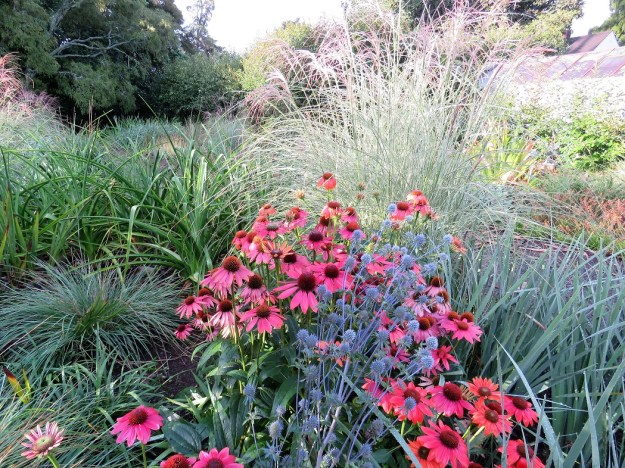
March 2018
It is also interesting to track the growth as the borders filled out. Planting was mostly done in late winter and spring last year – so July to November. I had to stop over summer because the hose doesn’t reach that far so I could only plant after rain. From memory, we had a particularly wet spring followed by an unusually hot, dry summer extending well into autumn.
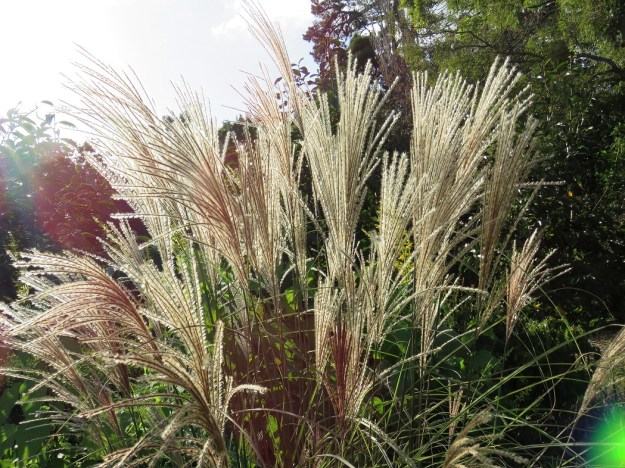
April 2018
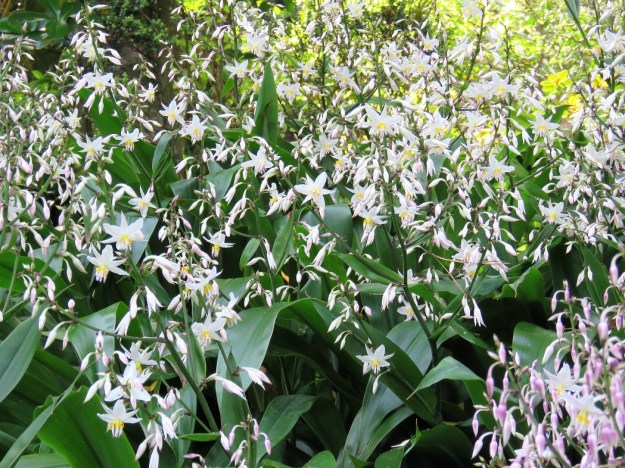
Rather than list what is in bloom each month – plant lists can get very dull – I would comment that even I am surprised at how much bulb material I have added to get that seasonal spread and I shouldn’t be surprised because it is me who has planted every single one of them. Ixia, babiana, sparaxia, narcissi, snowdrops, crocosmia, moraea, albuca, Aurelian lilies, ipheion and more have all found their home here but in clumps, not drifts or dots. Even the somewhat coarse blue Dutch iris and a pure yellow gladiolus that looked crass in the more refined rockery look right at home in this bigger and bolder planting.
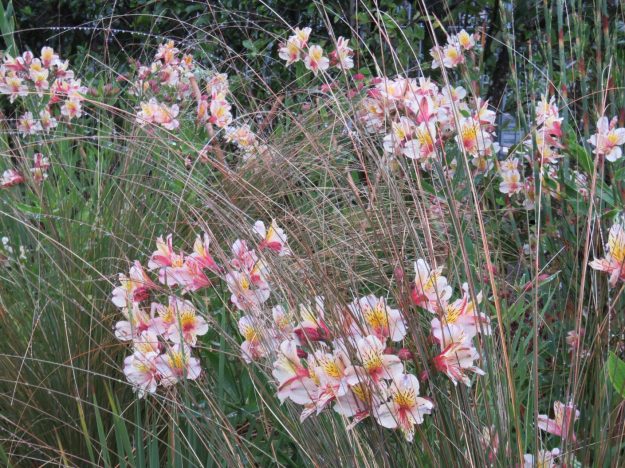
The stand-out plants for length of blooming season are the echinaceas (from December to May) and the kniphofias (from October to April). Verbena bonariensis, alstromeria and hemerocallis also give extended blooming to justify their places.
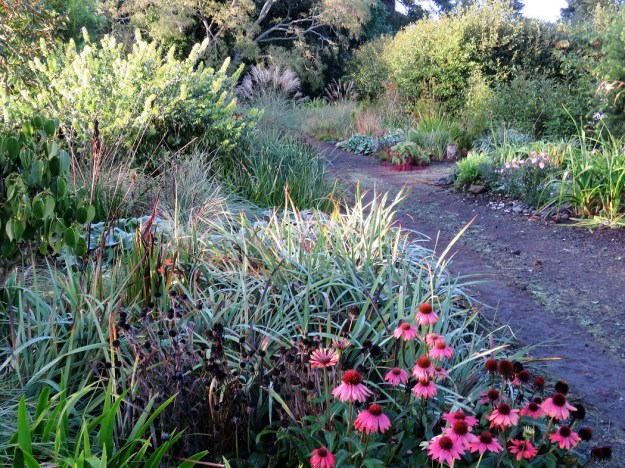
May 2018
So what happens in the quietest months of the year? In the late autumn of May, the grass plumes are beautiful. The echinacea, salvias and plectranthus are the major providers of colour. Finally I have a place for those giant, thuggish salvias that can reach well over two metres tall and they certainly come into their own in April and May.
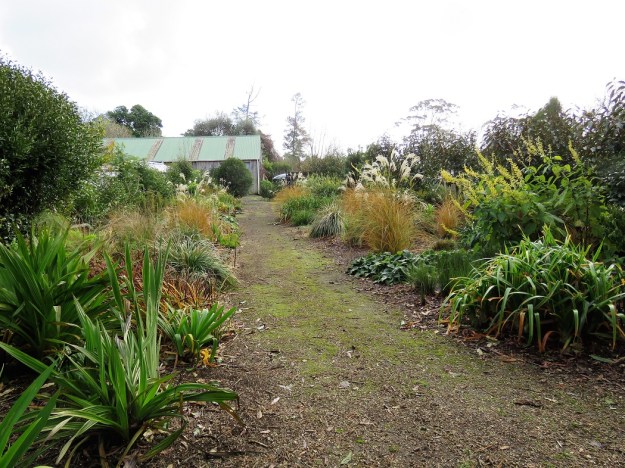
June 2018
June is the quietest month and the grass plumes of the miscanthus are particularly beautiful with the lower light angles. But already the new season is starting. We have a backbone of pretty Camellia yuhsienensis with its michelia-like blooms and it starts flowering in June.
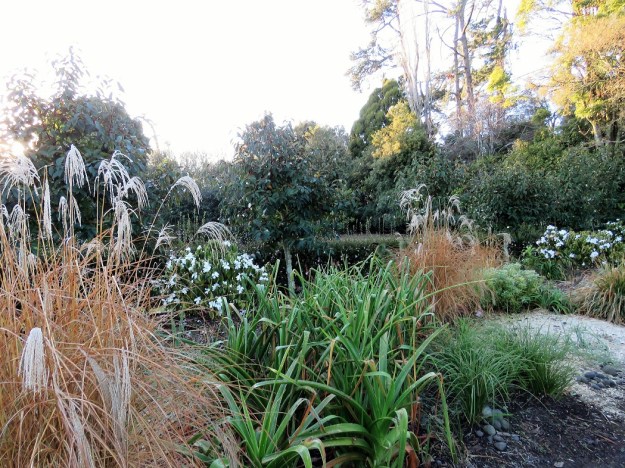
July 2018
July is our bleakest, coldest month but already there are the camellias in full bloom (we have five of them scattered along one side) and the extensive avenues and surrounding hedges of michelias (particularly ‘Fairy Magnolia White’) are coming into flower. This is also the month when our most successful snowdrop – Galanthus S Arnott – flowers. I planted just a few in one patch but I now think I might bulk up one section with it because it would give a winter white garden with no other flower colours in evidence.
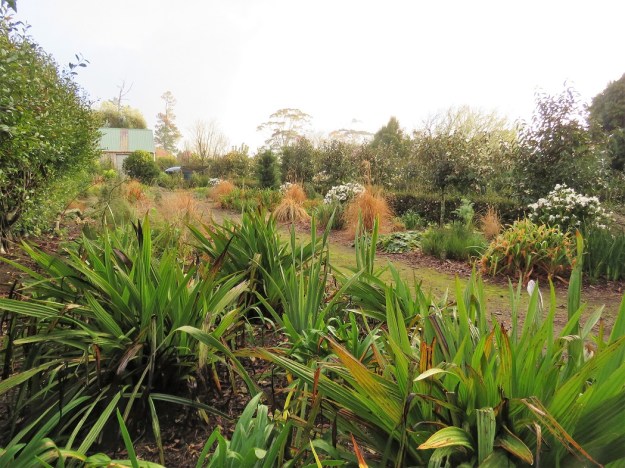
August 2018
By August, we are warming up. The early narcissi are in flower; my trial patches of ‘Peeping Tom’ made me smile each time I saw them. Many plants are already springing into growth and by September, we are in full swing again.
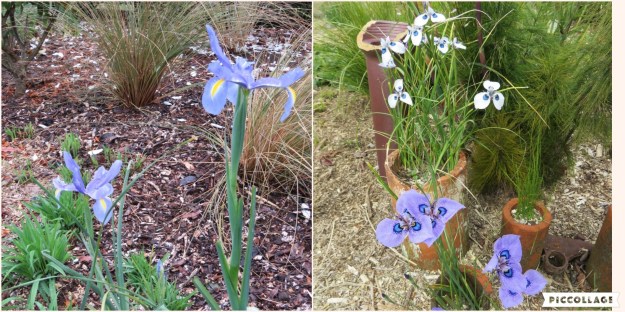
Dutch iris and moraeas in September
The garden is still in its early stages, just a year down the track. We have yet to do the paths which I want covered in soft honey coloured hoggin, which I discovered is crushed limestone. Mark still wants to move the propagation houses often seen to the side of the photos and that may take another year or three. But the garden borders, they are getting to where I want them. I am at the tweaking stage now, the foundations are all in place.
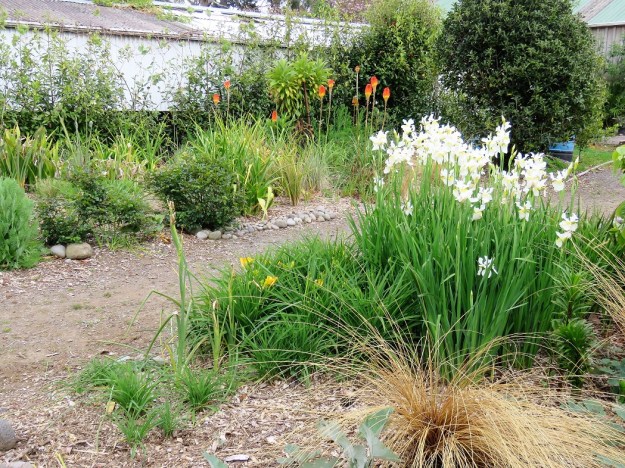
October 2018 The propagation sheds to the left are planned for removal
None of this would be possible had I kept to a very restricted plant palette. It is the range of material we can grow that makes these borders work all year round. What knits it together visually are the repeated large blocks of key plants like the Iris sibirica, yellow Phlomis russelliana, Dietes grandiflora and Albuca nelsonii and the rhythm of a limited range of large grasses threaded throughout. Within this solid framework, other plants are in defined clumps, not scattered cottage-garden style.
There is no hard landscaping and next to no ornamentation in these borders and I have no plans to add any. The plants can carry the day here. Every day.

November 2018

And just a year ago – November 2017

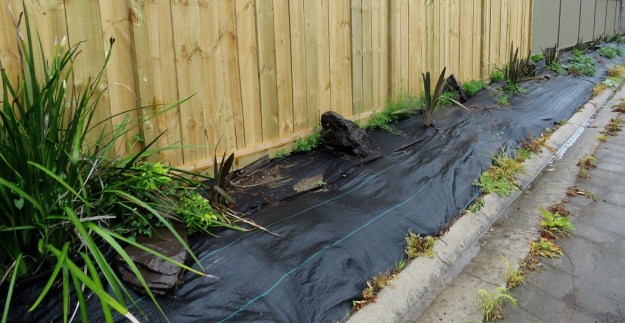 Starting with the public frontage (or maybe sideage), we have the sight of weed mat. I am sure I have railed against weed mat in domestic situations before. It is a commercial product for a commercial application – plant nurseries – and it has zero aesthetic appeal. All that can be said for it is that it is marginally better than the earlier habit of laying heavy duty black plastic which soured the soil over time. Weed mat is permeable so it allows moisture through. The soil beneath will compact over time, but it won’t become dead soil, bereft of all microbial and insect activity. It possibly has some application to use as a weed barrier that is then covered (entirely, please, entirely so that none is in view) with some pebble or lime chip but that means it can only be used on a flat surface. What could they have done? It was a rough slope so unsuitable for grass. I would be wanting to stain the fence dark and maybe plant the area solidly in something like mondo grass, perhaps with some marguerite daisies to bring pleasure to passers-by.
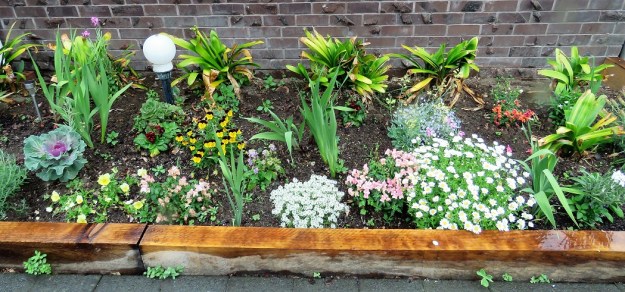 It was the borders inside that made me smile. They were recently planted and into heavy soil. One of this and one of that, randomly distributed. A lavender, a gerbera, a bromeliad, a patio rose, a cineraria, a kale, a paper daisy, a polyanthus and much, much more. In singles, bar the five clivias. I immediately conjured up the mental vision of this couple heading to the garden centre, determined to plant up the beds. They must have wheeled at least two trolleys around, loading up with one of everything which had flowers on it on the day. There were a lot of plants and I don’t imagine it was cheap at all. A garden centre owner’s delight. This is, by the way, a rental property and let me at least give credit that the enthusiastic landlords were attempting to make the outdoors attractive.
 If I still had a paid gig writing for the print media, I would be heading out with my camera to find some of the best examples of low maintenance, outdoor planting and design for non-gardeners that I could find. But I don’t, so that idea was short-lived.
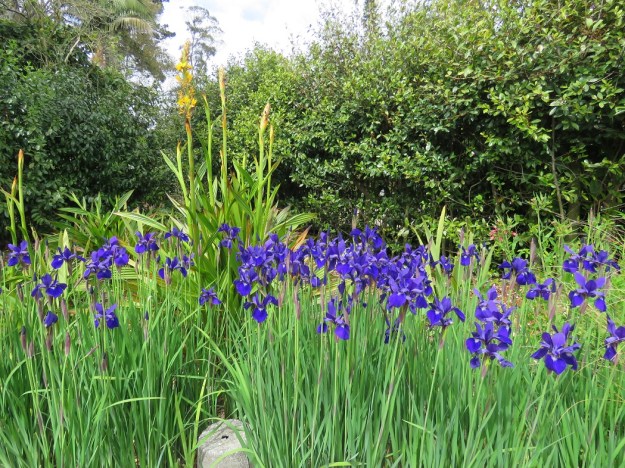
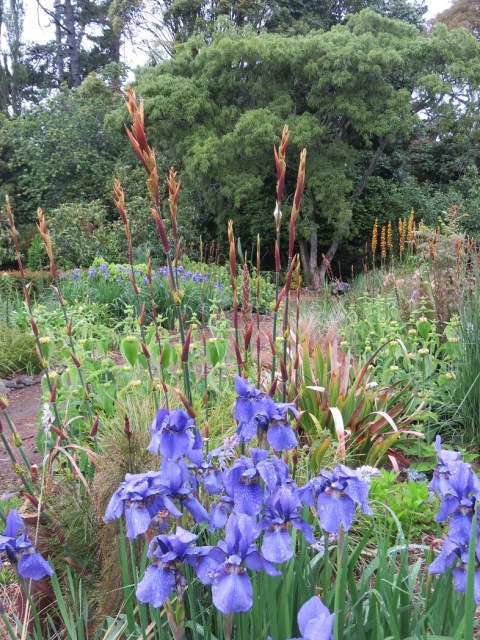
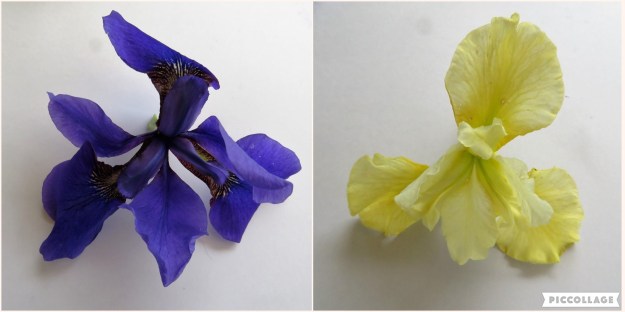
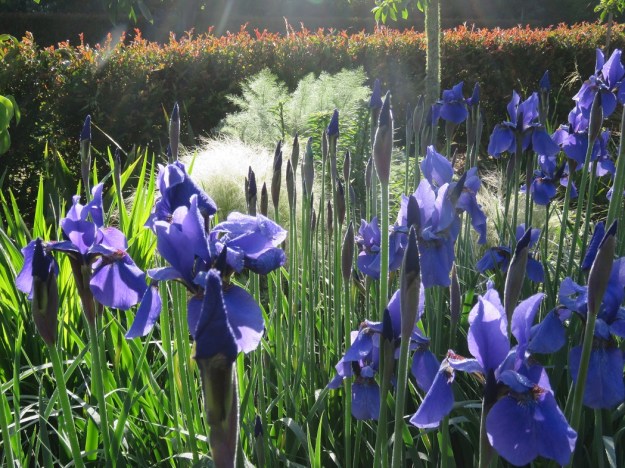
 “I think I prefer the sibiricans now to the bearded irises. Much easier care.” So spake a friend who will, for unrelated reasons, always be known as Cemetery Sue here, as we stood looking at my swathes of Iris sibirica in the new borders. In the second year since planting, their display has been fantastic.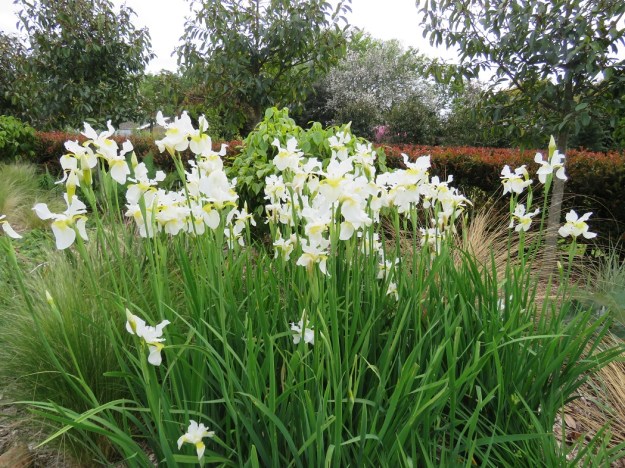




 Tikorangi The Jury Garden