Tag Archives: Abbie Jury

Monty Don’s British Gardens. Part 2 – from a New Zealand perspective.

“What do you think the ingredients of a typical English or British garden are?”

“That is an interesting one. I would say hedges, borders, grass, (something inaudible to a NZ ear) and enough manicuring in some parts that it looks cared for. I think it is that mix of formality, the manicured elements and the wilder, more romantic parts that make the British garden especially British.”

Monty Don in conversation with Chris Crowder, head gardener at Levens Hall in episode two of the TV series ‘British Gardens’.

“Yesss!” I said out loud and went back and replayed it. Not just British gardens – that is a pretty accurate description of how we personally garden in Aotearoa NZ. I would qualify that we don’t do topiary here so much as some heavy clipping but it serves the same end of giving definition and form in the garden. And I would add a high level of plant interest which is another feature of British gardens (and very much so in our own garden). It is perhaps an understandable omission on Chris Crowder’s part, given that he manages a garden that dates back to 1690 (!) and is famed for its topiary.

In brief, Monty Don’s summary of the essence of British gardening seemed to come down to a few key points.

Gregarth Hall, the home and garden of Arabella Lennox-Boyd, was not featured in the TV series. To us, it is a fine example of the quintessential British garden of the late twentieth century built around some splendid architecture from earlier generations.
Gresgarth incorporated topiary.

Firstly that British gardening is deeply rooted in eighteenth century landscape design (think Capability Brown and his peers designing grand landscapes for the rich and powerful) and that, to this day, a high value is placed on that long history. Many British gardens have wonderful, historic architecture features – be they massive walls from old walled gardens, ruins, follies, pretty manor houses or even castles.

Those early funders also supported plant hunters combing the world for new plants which were welcomed with delight back in their homeland in a rarified pursuit of competition and one-upmanship. To this day, British gardening is a celebration of the ability to grow a huge range of different plants collected from around the globe and plant range is a defining feature. I remember quipping after my first trip to Italy – a magnolia conference tour – that they basically gardened with the same ten plants but that is not true of British gardens, or indeed New Zealand ones.

British botanists kept up the tradition of plant collecting. The Tetracentron sinensis in our park dates back to Frank Kingdon-Ward who financed some of his expeditions by subscription. Felix Jury paid in advance to receive seed back in the 1950s. We could have done without the rhus but the tetracentron is a fine tree.

Secondly, climate. In global terms, Britain generally enjoys a moderately temperate climate and there is no doubt that it is easier to garden in a climate without extremes. I don’t think their climate is quite as good as some of the people in the programme asserted but I would say that, as a New Zealander.

Thirdly, Monty Don talked about his homeland as a place where people ‘learn the language from an early age’. I think it is a bit more complex than that. What I see is a place where gardening has been both professionalised and institutionalised over a long period of time, which has given leadership and placed a value on it which is often lacking in other countries. Gardening, not just the broader notion of horticulture, is a respected profession. There is an established career path and high-quality training. Added to that, there is considerable support from institutions like Kew, The Royal Horticulture Society with their major gardens and in the media. BBC Gardeners’ World has been running since 1968 on primetime television, for goodness sake, and still has a loyal following. There is quite the collection of other TV garden programmes, both good and execrable, and garden celebrities who are actually celebrated, as opposed to just being recognisable. The vast majority of domestic gardening is done by amateurs but there is institutional knowledge to underpin much of that, and a strongly educative side.

In this country we haven’t had a proper TV garden programme for over two decades. That is despite census data regularly showing that gardening is one of the most popular leisure pursuits. I have long figured that nobody in the TV programme commissioning area has understood this simple fact, nor have they seen past the dated formula of instant garden makeovers.

Britain is a densely populated country with much more restricted personal space. This means that large numbers of people want to get out and about in their leisure time. With gardening so embedded in the national psyche, that often includes garden visiting and the level of visitor numbers supports both public and private gardens.

Hatfield House – again not in the Monty Don series – but an example of the style emulated by some aspirational NZ gardeners.

In Aotearoa NZ, we have taken on some of the same gardening values, although our colonial interpretation of British garden design is more Arts and Crafts (garden rooms) than 17th century pastoral landscape. With our benign climate, we certainly place a high value on growing a wide range of plants and having an attractive home garden – albeit quite a few want it to be both attractive and low maintenance. With a small population and overall low density of housing, the majority of people have private outdoor space. So yes, we do garden a lot. But overall, we lack that professional and institutional backbone of British gardening.

Great Dixter, the garden of the late Christopher Lloyd, is given credit for its significant contribution to gardening directions in recent decades in Britain.
Similarly, Beth Chatto is accorded a major place in the history of British gardening. She was pioneering sustainability long before we were even aware of climate change.

It was interesting to hear discussion on the impacts of climate change threaded throughout all the episodes. Many gardeners and Don himself referenced it as they discussed the gardens and future considerations. All I can say is that I am not seeing that sort of discussion in this country where the prevailing views seem to be either a loud ‘harrumph’ of denial or, at best, issues of climate change are pushed out to the margins as not being a relevant issue at a personal or local level. We have not normalised it as a factor in planning for the immediate – or even distant – future. We may be in for a shock as we continue to treat extreme weather events as one-offs rather than part of a larger pattern which is set to get considerably more extreme in a shorter space of time than originally thought.

Allotments – this one in suburban London. It is not from the TV programme but Mark and I often wandered allotments on our travels. These have a long history and are basically areas divided into small plots which are leased to individuals at a low annual rent, predominantly – but not exclusively – to grow food on a non-commercial basis. Their continued popularity is testament to the drive to grow gardens even in densely populated areas where people do not have personal space around their home.

Facebook showed me a post by Gardens Illustrated on one of our most favourite gardens, Wildside and I read the comments. Lovely series but it would be nice to see some ‘normal’ gardens”. Reader, what is a ‘normal garden’? The series gave considerable attention to both the wonderful British phenomenon of allotments as well as community gardens, alongside a potted history of the evolution of gardening down the past 450 years, touching on the most innovative recent developments.

I suspect a ‘normal garden’ equals ‘a garden like mine’ to that Facebook commenter.

“Rewilding” will have to wait. I will return to Knepp Castle and Waltham Place and the questions they raise in the future.

Harbingers of autumn


It may still feel like high summer where we are, but the flowers do not lie. We are on the cusp of autumn.

Colchicum autumnale

Summer here in North Taranaki has not followed its usual pattern. While we are always slower to warm up in November and December than the east coast, it didn’t really feel like summer until mid January. I don’t swim in cold water and I wasn’t tempted into the pool until well into January. Since then, we have been in and out of the water every day in an unseasonably warm and dry spell. A couple of degrees of extra heat on an ongoing basis makes quite a difference when you spend most of your days outdoors in the garden.

A stray belladonna in the raspberry cage was the first autumn bulb I noticed this season

And dry. I know when we talk about dryness, others may scoff. We all adapt to our own, local conditions and we expect rain on a regular basis all through the year. Mark, a keen weather watcher who could have happily pursued a career on meteorology, tells me we only had 40ml in January and that fell basically on one day, late in the month. We don’t ever water the garden (except for some of the vegetables) and we have no irrigation system; it isn’t necessary in our climate and nor does it seem like good practice but we are seeing some floppy looking plants and some early dropping of leaves.

Even the first nerines are opening

When the autumn bulbs started flowering in what still feels like high summer, I assumed they were being triggered by day length, as vireya rhododendrons are. They are certainly not being triggered by change in temperature, either day or night. Mark pointed out that it may well be that one day of rain in January that triggered them into growth and that makes sense because many bulbs are identified as summer rainfall bulbs.

Lilium formasanaum is a bit controversial in this country. It is on the Pest Plants Accord so illegal to propagate or sell. We keep it because it is showy and not a problem in our garden but also, it is not in a situation where it can escape from the garden to become a problem elsewhere.

Zach and I are waiting for rain so we can move plants again. We have plans we want to get underway. At least we know that here, with a temperate, maritime climate, the rains will come. While our high summer may be of short duration, so too is the depth of winter which we measure in weeks, not months. We have exceptionally long autumn and spring seasons and that does make for a good gardening climate.

A self-seeded Moraea polystachya on the side of the drive. Of all the autumn bulbs, this moraea probably has the longest flowering season.

The autumn bulbs are one of our seasonal highlights.

The Worsleya procera is opening! This bulb is one we take some pride in because it is rare in cultivation, even rarer to see it flowering in a garden situation and it is very choice. It is generally grown as a pot plant in carefully controlled conditions. The lilac colour deepens and spreads as the flower opens.

Finding form

I meant to continue with Monty Don’s British Gardens series this week but I haven’t spent the time watching a second time to clarify my thoughts so that must wait. Instead, I channelled my former garden writer persona to capture a before and after as I pruned a camellia.

I was flattered when a gardening friend and camellia aficionado complimented us on our camellia pruning last year. I think his comment was along the lines of how much he notices and admires it every time he comes into the garden. It is not that we prune all our camellias by any manner of means and we do clip, shape, restrict or clean up in many different styles, depending on the role each plant plays in the garden. One size does not fit all.

The before photo…

Camellia minutiflora is a dainty little species with the prettiest of tiny flowers and naturally arching growth which we like enough to have maybe half a dozen specimens through the garden. Normally, we try and prune in early to mid-spring but, as I cleaned up the border in which this one sits this week, I could not ignore that it needed some work done on it, albeit in the height of summer. In so doing, I cut a lot of flower buds off but it has so many that it doesn’t matter and the form is more important, really.

I started by taking off all the growths that were shooting straight up because we want to accentuate the arching growth. Second was pruning back the branches that were arching out too far; third was lifting and thinning from the bottom up. Finally, I thinned out what remained, tracing branches back to the trunk and checking how much bulk we would lose if I took off the whole branch. Always, I try to cut flush to the junction point and to make sure that the outermost cuts are, to all intents and purposes, invisible so no stumpy bits half way down the branches.

It used to take me ages to prune a plant like this but I am getting faster with practice and this was an hour from start to finish, using secateurs and a pruning saw. The pile in the wheelbarrow is well over half the plant in volume. Ralph supervised, as he does, but did not offer advice.

And voilà. The finished product. It is all about freezing this plant in size, finding its form and making it a shapely statement, rather than an unruly blob.

It is growing at an angle and we don’t mind that. It is perhaps a form of bonsai on steroids and in the garden rather than a pot. We want the plant to feature on its own, not to meld with its surroundings.

Camellia minutiflora – dainty, floriferous and characterful, in an understated sort of way

Monty Don on British Gardens

When we saw advance publicity on Monty Don’s new ‘British Gardens’ TV series, we wondered how long we would have to wait to see it here. We are old, you see, so it took our younger gardener Zach to alert us to the fact that it is readily available online. We watched it on You Tube (just go to their home page and type in Monty Don) but it is probably available on other streaming services too. It is worth watching.

We visited Upton Grey Manor in 2009. Featured in episode 4, it has been meticulously restored by the owner to its original Gertude Jekyll plan and is now kept frozen tin time.

Love him or not, Monty Don knows his stuff and this is not just a happy jaunt around various gardens – sixty of them, I believe, in an attempt to define what characterises British gardens. That comes to about twelve gardens per hour of TV time so some are once over lightly but Monty’s thoughtful commentary and analysis is what knits it all together. I imagine there is fierce debate over his selection of gardens in UK gardening communities but all I want to say on that is that out of sixty gardens, there were only two that made us raise our eyebrows and wonder at their inclusion.

We have a great deal of respect for the English gardening tradition. The standards set there are high, due in no small part to the fact that gardening and working with plants is a respected profession with high skill levels. I did a cursory trawl through the memory banks and photo files and was a bit surprised to find that on our trips, we have seen more than seventy gardens in Britain, both great and small, so we are not inexperienced. We had been to quite a number that Monty Don included in his five part series which added to our viewing interest.

Scampston Hall (episode 2) gets extensive coverage. The Oudolf planting of perennials was the best of it to our eyes when we visited in 2014.
Still at Scampston. *Conceptual gardens* are not my cup of tea but we all like different things and there are a few examples of the genre covered in the series.

He started in the north, in Scotland and Northumberland which is an area that is unfamiliar to us. The only times I have been to Scotland were before I started gardening. But the gardens in the far north with low winter light levels and exposed to North Sea storms are very different to our gardening experience. Starting a garden there might be akin to starting a garden on Chatham Island – not for the faint-hearted.

Tom Stuart Smith’s planting at Trentham Gardens which are not included in the series, although Tom Stuart Smith is.

Episode two was somewhat poignant for us. In the north of England with a foray over to Northern Ireland, it was more familiar territory. We had another trip planned in 2020 which had to be cancelled due to Covid and that included some of the gardens in this episode – Lowther Castle, Levens Hall, Nigel Dunnett’s private garden and Chatsworth.  I wish we had managed to get to see them in person but there comes a point in life when realism means accepting things that will not happen after all. Other highlights of this episode include a local competitive gooseberry show – British eccentricity at its very best – and landscape architect Tom Stuart-Smith talking with Monty Don at Chatsworth. When I had Chatsworth on our list of places to visit, it was primarily to see the area designed and executed by Dan Pearson. I didn’t even know that there were major new borders that are the work of Tom Stuart Smith so that would have been a bonus.

Bressingham in episode 3 is credited with pioneering island beds. Also, maybe, the origin of what we refer to as ‘kiwi hosepipe style’ here, in a case of what might be renaming by cultural appropriation.
Bressingham had the best Alchemilla mollis I have seen. It never looks quite like that here.

Episode three covers the area from Wales to Norfolk, four is in London and the Home Counties and five is in south. There were quite a few gardens we had been to and we were waiting with anticipation for Monty Don’s visit to Wildside, one of our most favourite gardens of all. The interview between Don and Keith Wiley was fine, as were Don’s interpretative comments. The timing of the visit was not. Wildside is predominantly perennials full of flowers, colour and interesting plant combinations but on screen it just looked, well, green.  Mark’s comment was “Could they have picked a time to visit when there was less colour in the garden?”

Wildside without the flowers is not quite the same.

There is enough meat in this series to make us want to view it a second time. I think I am coming to a slightly different conclusion as to what sets British gardening apart but that will have to wait until after the second viewing. Also thoughts on what the Brits are calling ‘rewilding’, what makes a garden film or photograph well as opposed to being in the garden in person and how much they are talking about the impact of climate change which many people are resolutely ignoring in this country.

I am still wondering about the gooseberry show where the top award went to the heaviest gooseberry. What I want to know is how they guarded against cheating. Is it possible to increase the weight of one’s show gooseberry by nefarious means, maybe injecting the fruit with additional water just before tabling it at the show? This may remain one of life’s little mysteries.

Invisible gardening

I made that term up. It is when I spend a fair amount of time working through an area, removing a large amount of plant material and at the end of it, most people wouldn’t even see the difference because it all looks pretty much the same. Just a bit tidier.

This times ten is a lot of waste to remove from an area that is not large

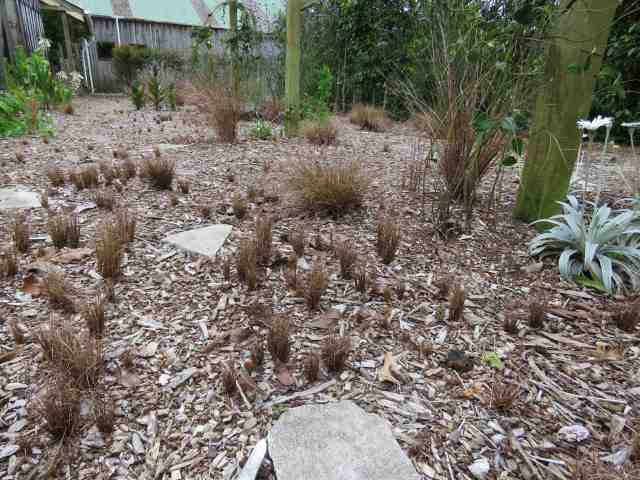
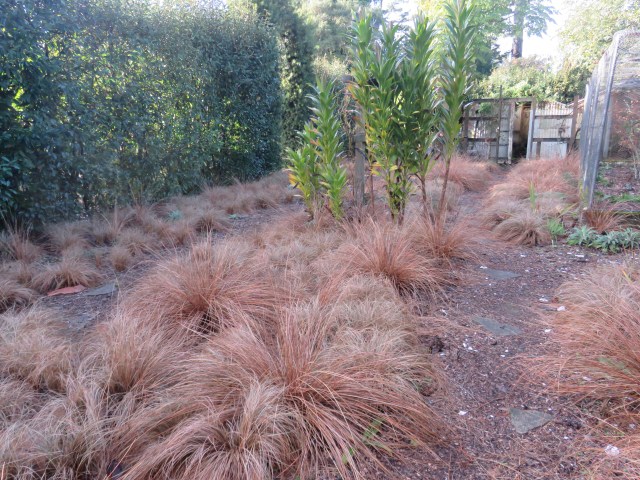
In the past week, I have spent five days meticulously going through the area we refer to as ‘the grasslands’. It is a very simple planting, mostly our native Carex buchananii and Carex comans ‘Bronze’. In the process, I have removed about ten overloaded wheelbarrows full of vegetation but honestly, nobody else is likely to notice the difference. That is fine. In fact, I regard it as something of a triumph because I know it is a lot better.

The ‘before’ scene
And the ‘after’ scene looks very similar

Most of the grasses we grow are evergreen and it seems that taking the time to work them over once a year, removing spent foliage, dead patches and debris buildup in the crown of the plant keeps them looking healthy and attractive as garden plants. That is the big difference between how they grow in the wild and keeping them in the garden – the human hand making an intervention now and then. While they will seed down and establish as a colony in the wild where some dead plants and strugglers are just part of the natural cycle, a garden situation only looks natural. My intervention makes sure that each plant is standing in its own space with limited competition, either from its seedlings or indeed weeds. I also comb out the foliage on each plant to remove the buildup and to keep the festooning form rather than it becoming a tangle.

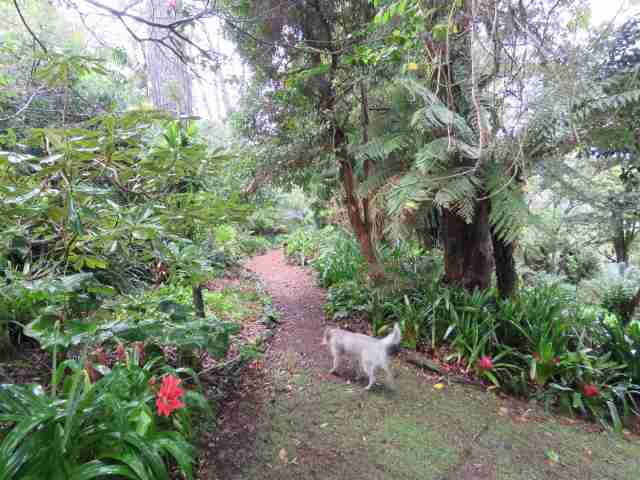
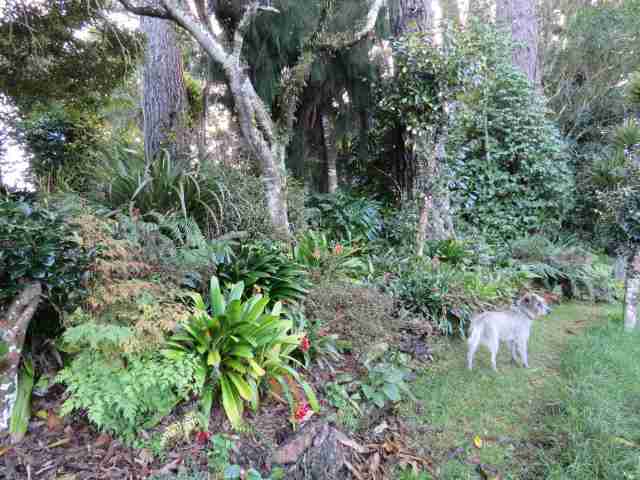
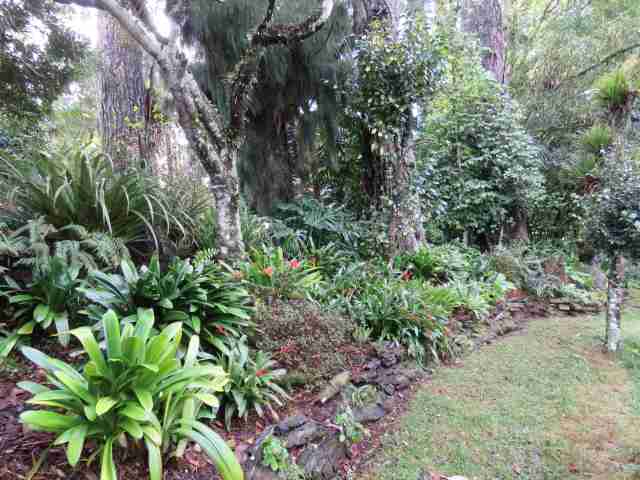
The Rimu Walk is maintained with one major, annual blitz and just the occasional tidy-up of fallen debris inbetween

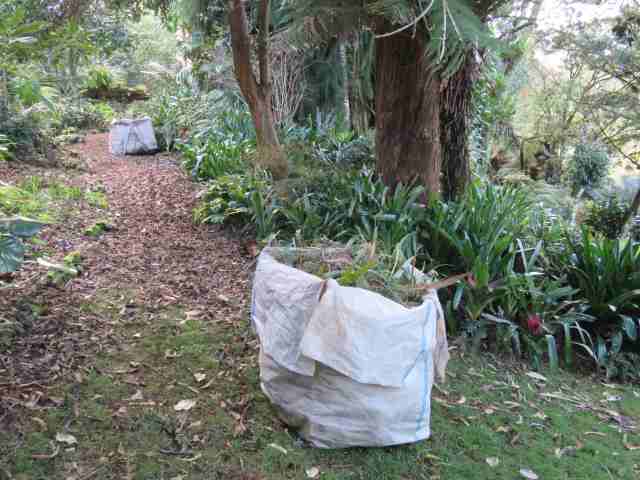
We have a few other areas that also thrive and look good all year round with just one concentrated, annual blitz on maintenance. The Rimu Walk is notable. Every year, I spend a couple of weeks working my way over every plant from one end to the other and the garden waste is shipped out by the wool bale load to compost in a patch of bush elsewhere on the property. I work on rotating two wool bales and, at a rough guess, we probably move out over fifteen bales full. That is to say, I fill them and Lloyd or Zach remove them for me. At the end of it, there are no gaps in the garden, no bare areas and no indication of the time and care that has been spent but it just looks tidy, cared-for, healthy and loved. My efforts are largely invisible and I like it that way.

The spectacular Scadoxus multiflorus ssp katherinae is also managed with one major clean-up a year and very little inbetween

I refer to areas like these as ‘low maintenance’. With one thorough, detailed effort a year, there is little that needs to be done between those big clean-outs. We did one weeding round on the grasslands area in spring but nothing else. The scadoxus area will remain largely untouched until late winter again. Beneath the rimus, we will pick up fallen branches and sticks brought down by the wind and pull out the odd weed that has sneaked in but that is about it. They feel as though they are low maintenance, but if you averaged out the hours spent on that annual blitz, they are possibly not that low.   It is just different maintenance, albeit that it only works in areas that are largely weed-free to start with, filled with plants that do not require ongoing staking, deadheading, cutting back, dividing, restricting or training and where a thick layer of natural mulch has built up over the years. Nor do they have edgings that need to be maintained, grass that needs to be cut or paths that need to be swept.

It is perhaps easier to see in close-up. Before…
… and after

Garden maintenance can be a bore as well as a chore. There are areas I don’t enjoy working in. But it is oddly satisfying to focus entirely on just one block, working over it in minute detail and wrapping up after a few days, a week or even more and having the area look its well-furnished best at the end of it all, despite the removal of prodigious amounts of green waste. Even better is knowing that it will remain looking fine for the better part of the next year.

Maybe it is more discreet gardening than invisible. it is also a sign of somebody who has the time and inclination to spend on such fine tuning. I am aware that for many people, garden maintenance sits somewhere closer to crisis management and that is a very different scenario.