
Tag Archives: Abbie Jury

Shady broms

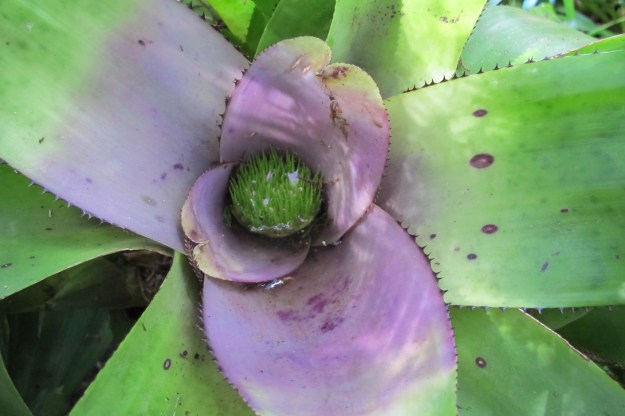
Neoregelia

Bilbergia

We are not big on low maintenance gardening here, though I know that many others are. It has always seemed like an oxymoron to me. But as I looked at the bromeliads flowering beneath our stand of rimu trees, it occurred to me that here was a genuinely low maintenance area of the garden. As long as you don’t mind the prickly nature of many of the bromeliads, they are extremely undemanding plants.

About twice a year, I don gloves and home-made lower arm puttees (to stop my skin being shredded) to go through removing fallen debris and dead leaves or dying rosettes from the plants. That is about all the maintenance they need which is pretty astonishing for such an exotic planting.

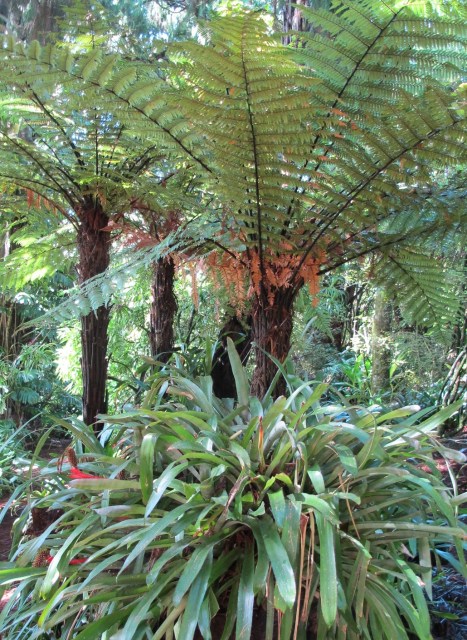
We are not quite frost-free so we grow most of our bromeliads in the high shade cast by huge trees. Some varieties, particularly the ones with red foliage, lose the colour intensity in shaded conditions. Some just turn green, in fact, but at least they never get frosted. Because we are detailed, mix and match gardeners, we don’t only plant bromeliads. They combine very well with ferns, dendrobium orchids, clivias, begonias, hippeastrums and a host of other choice, shade-loving plants.
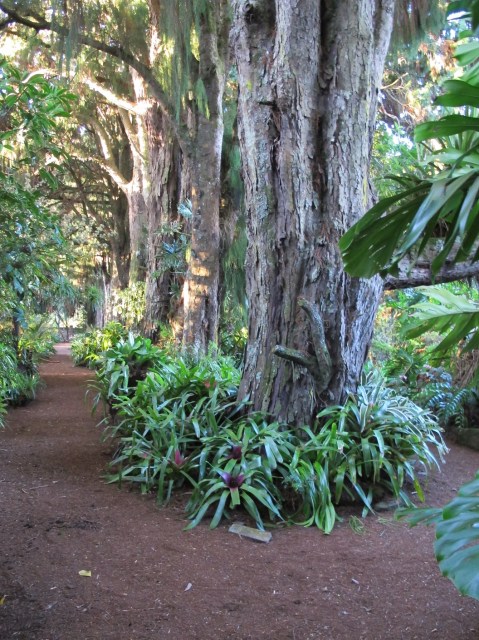

Aechmea

Mark’s father planted the first stretch of this sub-tropical woodland area back in the 1950s, when the use of bromeliads as shade plants would not have been common. He was working with very few different types but over the years, as a wider range has become available, we have added variety. Most of what we grow are epiphytic so they don’t have much at all in the way of root systems and they gather all the sustenance they need from the air and rain. The majority of them increase steadily by putting up two new rosettes at a time to replace the main one which, having bloomed, will slowly die. In the right conditions, these are truly self-sustaining plants to grow.
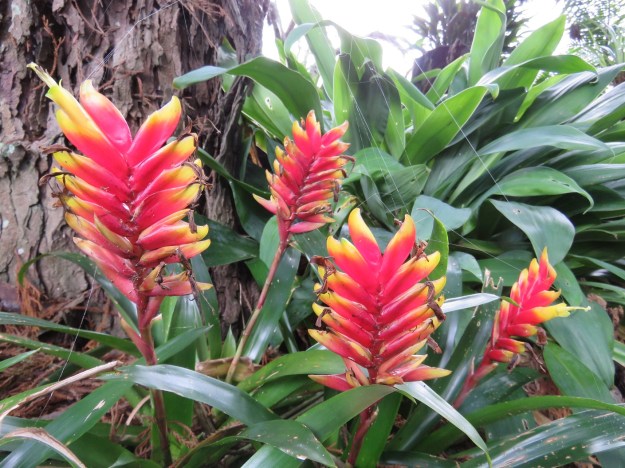
Vriesea

I have to make an admission. Neither Mark nor I have any botanical expertise in bromeliads – though we can claim to have gardening experience with them. Neither of us have ever felt drawn to unravel more of their botany. It is a big and complicated family – close to 3500 different species and goodness only knows how many hybrids from crossing the species. The best known member of the family is the pineapple while at the other end of the spectrum, tillandsias (commonly called Spanish moss) are also bromeliads which seems pretty surprising. In the middle are the ones most of know and grow – the alcantareas, bilbergias, neoregelias, vrieseas and the like. A lot of what we have in the garden will be named hybrids though the names have long gone.

If you are more dedicated to the botany of this family than we are, track down the books written by Andrew Steens which are even more useful in that all his experience is based in this country, not overseas.

Aechmea

A fair number of bromeliads come into flower in winter and their exotica is unmatched by any other plants at this somewhat gloomy time of year. Not only can the colour be startling, so too is the huge range of flower form and texture. Some, like vriesea, can resemble flat two dimensional wax creations and these blooms can last months. Others, like the bilbergias, are more abundant but over much more quickly.

If you are willing to tolerate the prickly foliage, the only other downside to my mind is that many hold water in their centres and that can breed mosquitoes in summer.

That opinion was not shared by a cantankerous garden visitor. Notwithstanding that she had managed to get into the garden without paying, she stood in the middle of the Rimu Avenue, looked around and rudely declared, “I hate bromeliads. They look so fake and artificial.” I just left her to it.
First published in the June issue of New Zealand Gardener and reproduced here with their permission. 

Just a recipe – delicious cheese puffs reputed to be of Brazilian origin

On Radio Live yesterday morning, Tony Murrell and I were having a free range conversation about flowers, foliage, seed heads and ongoing harvesting in what is now early winter when Tony asked me for this recipe for cheese puffs. I had whipped up a batch for an impromptu lunch when he called in on Thursday.
The Brazilian Cheese Puffs
Preheat the oven to 160 or 170,
Put into the bowl of the food processor:
2 eggs
generous 2 cups of tapioca flour
1/2 cup olive oil
1 cup milk
pinch of salt
generous amount of cheese (any cheese or mixture of cheeses) – one cup grated or half a cup packed.
Whizz it up. Pour the batter into muffin pans (makes 12) and bake until they have puffed up and sound hollow. The finished result should be crisp on the outside with a slightly chewy, almost hollow centre.
Notes:
I adapted the recipe from one on the internet but I did not record the source so I can’t credit it.
Nor can I vouch for its authenticity in terms of being Brazilian but they are delicious.
I suspect the critical ingredient is the tapioca flour which neither of my usual supermarkets stock but I find it either at the delicatessen or Asian supermarkets. As far as I know, tapioca flour is gluten free, being cassava-based. In texture and consistency resembles finely milled rice flour or what we know as cornflour.
If you have never worked out the differences between tapioca, sago and semolina and their close relatives of couscous and corn grits, I once unravelled the various base ingredients here.

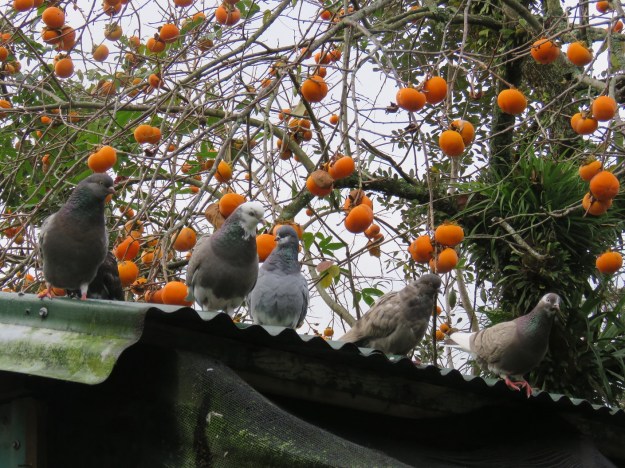
Mark’s tumbler pigeons and the persimmon tree – entirely unrelated but they fit the colour scheme.

Panic in the myrtles

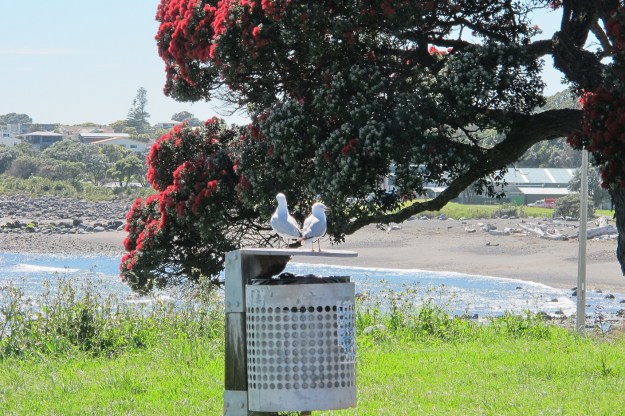
It seems highly unlikely that we will see the end of our coastal pohutukawa to myrtle rust

Myrtle rust – words to strike terror to the heart? We are erring more on the side of a watchful eye at this stage. There is no doubt it is a worry but we have yet to see that it will be a catastrophe that will change our landscape forever, as predicted by some.

The catastrophic predictions are not been helped by the media referring to it as “deadly myrtle rust” and from there, hypothesizing that we could see the manuka honey industry under threat, the loss of our defining landscape pohutukawa trees and, horrors, the ubiquitous home fruit tree, our beloved feijoa. The deadly bit has yet to be proven. But the tone is one of unrelenting high drama. Indeed, the old warhorse, New Zealand First leader Winston Peters wants heads to roll. He has called for the resignation of the Minister of Primary Industries for failing to stop the arrival and spread of myrtle rust.

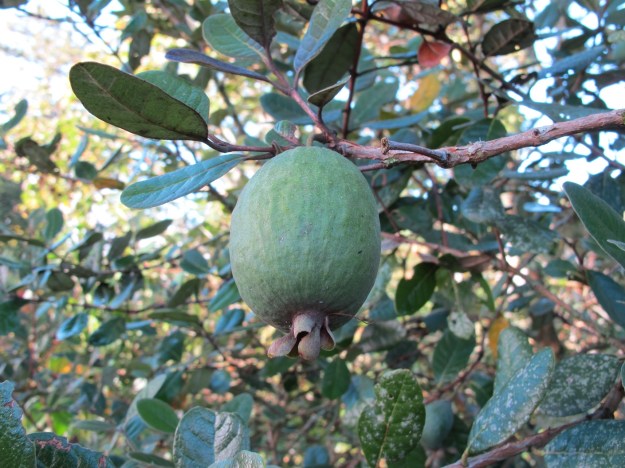
A future without feijoas seems far-fetched 

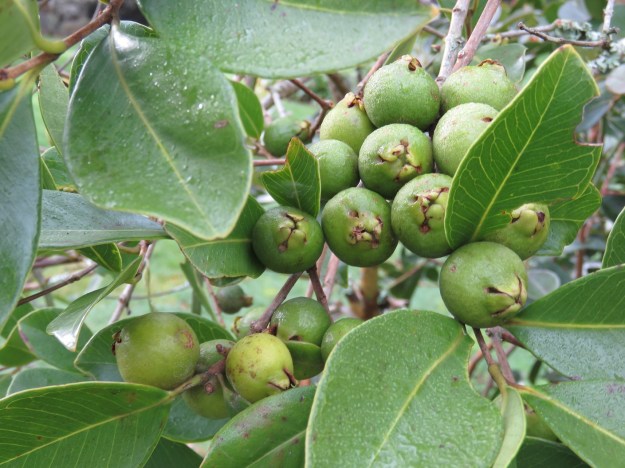
The hardy Chilean guava, Psidium littorale, is another myrtle 

A single isolated outbreak in Keri Keri (which is heading up to the most northerly part of New Zealand, for overseas readers) could possibly have been contained. As soon as it was found in nurseries and a garden centre in Taranaki, it raised every red flag for the Ministry for Primary Industries (MPI) and indeed for us. That brings the rust to within 5km of our place. I am sure the first thing MPI did was to find out whether there was any link between the Keri Keri and Taranaki outbreaks. Had any plant material been shared or anybody visited? It appears not.

The discovery of rust at another three locations in Taranaki, including private gardens, changes the picture entirely. There is a lot to find out yet, but odds are that it is widespread and established here already so the possibility of eradication has passed.

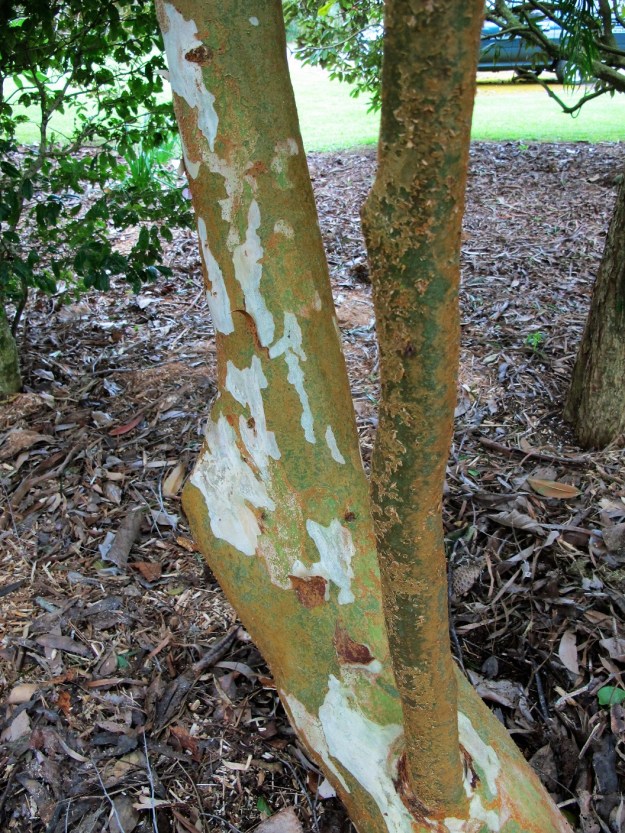
Myrtus luma, often grown for its attractive bark, is another member of the large myrtacae family

The fact that the locations include four nurseries and a garden centre has given rise to some downright stupid comments that I have read. It is not the nursery industry spreading the disease. The rust affects juvenile plants with fresh foliage and that is what nursery plants are. It is also a great deal easier for a vigilant nurseryperson to spot the tell-tale signs on plants in tidy rows.

There are equally stupid comments about our border control and not just from the aforementioned political opportunist. Myrtle rust is carried by light-as-air fungal spores. As soon as it got to the eastern seaboard of Australia, New Caledonia and Raoul Island, it was only a matter of time before it reached here. It could presumably be transferred on a traveller’s clothes as well as being blown across. It started in Central and South America but it is also in the Caribbean, Florida and Hawaii so it is not some deadly new phenomenon – just new to this country.

It is early days, but we think it is likely that it is something we will have to learn to live with.

The ever-handy Wikipedia tells me there are nearly 6000 different species spread across over 130 different genera in the myrtacae botanical family. It is really unfortunate that it includes our beloved pōhutukawa and rata and the economically important crop of mānuka along with feijoas and guavas. But all is not lost. The rust does not affect all myrtle family members equally. Nobody has had time to research which of our myrtle members could be badly affected.

There are many variables at stake – whether there are different strains of the rust known as Austropuccinia psidii, which of our core plants it will affect badly enough to impact their growth, flowering and seed set, how it will behave in the range of our climatic conditions here and more.

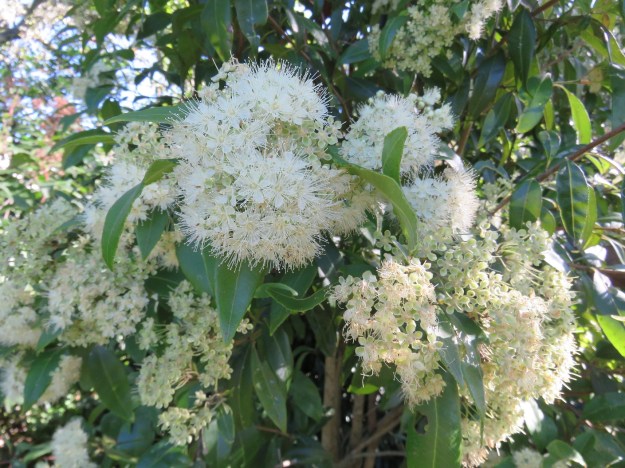
Backhousia citriodora – the fragrant lemon myrtle

What is known from the Australian experience (and they have a seven year jump-start on us with this unwanted organism) is that it does not appear to have a major impact on mature trees. We are not likely to see the wholesale death of established trees before our very eyes. The impact is on young plants (but only of some myrtle species, as already stated, not all of them) so the long term effect may be the failure of plantings in the wild to regenerate.  If this is the case, then there is hope that over time more resistant specimens can be selected for propagation because there will be variation in how individual plants respond, even within the same species.

The Ministry of Primary Industries is posting information almost daily on myrtle rust and the Department of Conservation is also keeping their website current on this issue. If you want to know more, there is information from Australia. I just scanned the NSW biosecurity site which also points out that “myrtle rust spores require darkness, moisture and temperatures of 15–25°C to germinate. The first symptoms become visible within 3−5 days of initial infection. The new pustules can mature to release spores in 10–12 days. Spores can remain viable for up to three months.” I am no scientist but if that applies in NZ, I would have thought that was a fairly short life expectancy for the spore, especially when combined with a relatively high germination temperature. I note that no country has ever managed to eradicate it.

Of course we could have done without myrtle rust in New Zealand. But maybe it is time to take the finger off the panic button and  stop mourning the impending mass death of huge pōhutukawa trees and the end of feijoas in this country. It is way too early to catastrophise and point fingers of blame.

*Having just listened to yet another anxious news story about it all, I wonder whether MPI should take responsibility for the tone. In trying to impress upon us all how important it is to identify possible myrtle rust so they can track its spread, have they fed the paranoia and angst? Maybe their comms people could tone it down a little? 

We think it likely that history will prove that these Waitara riverside pohutukawa are at far greater risk from the chainsaws of the Taranaki Regional Council than myrtle rust (a reference to earlier stories). 


Reinterpreting inspiration. The new garden progresses.

The resident cat at Bury Court in 2014. We plan to visit this garden again next month.

I have been planting what I loosely refer to as “my grass garden”. I wrote about this back in February and progress is being made. I have been asked whether this garden has been planned on paper and for a while I felt somewhat shamefaced to admit that it has not. Now I just think experience and instinct will serve me better than a paper plan. Trained garden designers learn to plan on paper and good ones know how to relate open space and proportions to paper measurements. Amateurs do graph paper gardens and then, when religiously followed outside even though proportions don’t translate well, these remain forever looking like graph paper gardens. I have seen this mistake made in other people’s gardens.

This is part of a much larger area that we are gently bringing in to an entirely new garden and Mark did draw up the entire space to get the proportions right for the separate sections. He also staked out the area with bamboo sticks to define the spaces visually before any earth-moving and planting started. The first plants to go in were the structural ones which will give a formal backbone – Fairy Magnolia White in two rows to be pleached in due course, underplanted with Camellia Fairy Blush to be clipped tightly as a hedge. String lines were used to make sure that this formal green structure was straight.

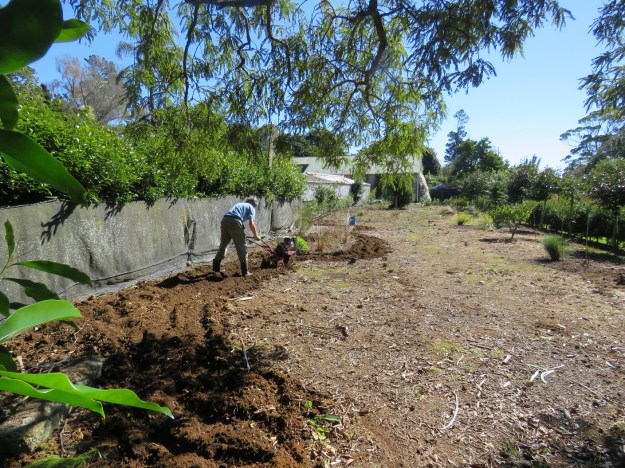
Work starts. A man with a rotary hoe can be a wonderful thing.

My patch is like passage-way to the side of all this, albeit a passage-way in full sun that is about 10 metres wide by 30 metres long; at around 300sqm it is larger than some urban dwellers get in life.  The idea of a “grass garden” has somewhat morphed into “grasses and other plants with long, narrow foliage and spear-shaped foliage”. The plant palette is broadening substantially as I go but still restrained overall, by our standards. “You are not copying the Bury Court garden, are you?” asked friend and colleague, designer Tony Murrell. Well, no.
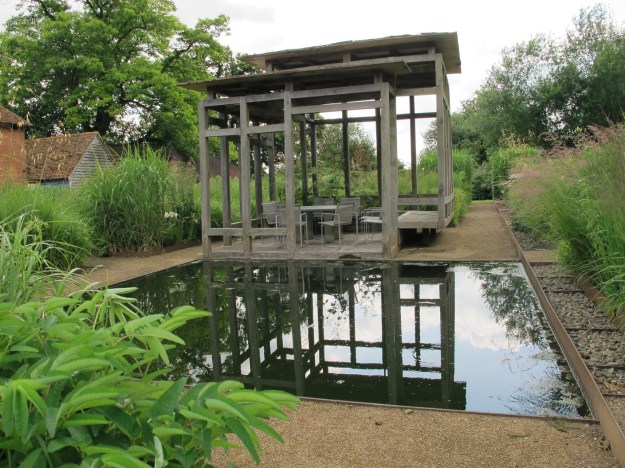
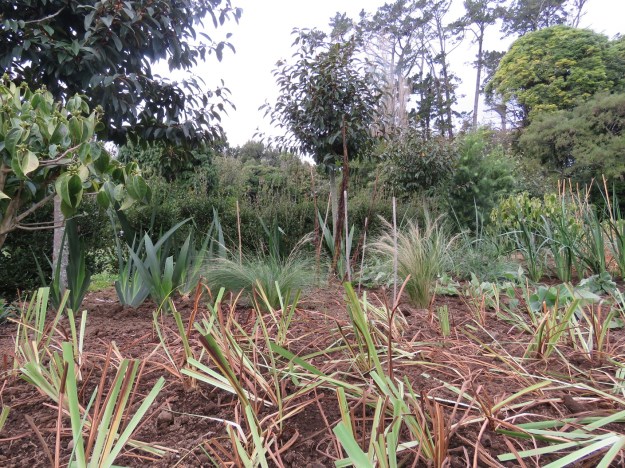

The grass garden at Bury Court

The hallmark of Bury Court was the sharp edged, geometric design filled with billowing grasses – a signature style of English designer Christopher Bradley-Hole. No hard-edged design in mine. We want even the path to meander informally without sharp definition.

From memory, Bury Court’s garden is fully deciduous in that English and Northern European style. We just don’t do fully deciduous gardens in New Zealand. Our climate is milder but also our native flora is almost 100% evergreen so we think in terms of foliage and flowers all year round. My ratio is probably closer to 60% evergreen and 40% deciduous.

Not exactly Bury Court but planting has started

Bury Court’s garden was, I am guessing, big budget. What we lack in budget, we have, I hope, made up for in sustained thought and discussion over a fairly long period of time, along with the trialling and analysis of most of the plant material. At the back of my mind, I keep repeating some of the points made by Tim Richardson in the book I reviewed recently. “Immersive, not pictorial”, I say to myself. These are not twin herbaceous borders. They are an antipodean interpretation of the New Perennials movement and I chant like a mantra the words ‘rhythm’, ‘drifts’, ‘billowing’, ‘repeats and echoes’. It is a whole new approach to composing with plants for me.

Because we are not buying in the plants but relocating them from other areas in the garden and from small accumulations in the nursery, it is more work digging and dividing than simply knocking out of pots. But I am also starting with larger plants and with the luxury of plenty of plant material. I repeat again, a lot of thought has gone into the plants to be used – a few years of thought and observation.

We have never seen gardening as instant gratification and there is much work to be done in this new area before we are ready to share it in a few – or maybe several – years’ time.

Radio Live has now set up a separate site with Tony Murrell’s Home and Garden Show audio and photos so it is a whole lot easier to find than before. Last Sunday, Tony and I were talking about hybrids and species. Coming up this Sunday, we are discussing cottage gardening. I tell you, I leap down the stairs as my alarm rings 6.23am, make myself a cup of tea and am sitting wide awake and firing on all cylinders for when the phone rings at about 6.32. These are relatively extended discussions we have and it takes quite a bit of combined concentration, especially at that hour of the morning. For me it is a new skill to be focusing my mental energy on a radio discussion rather than on writing – often the ideas are similar but the process and skills in communicating them are very different. It is probably why I have not been writing as much recently.

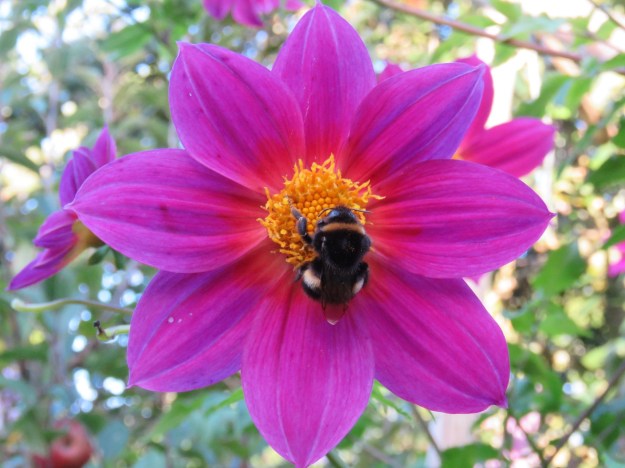
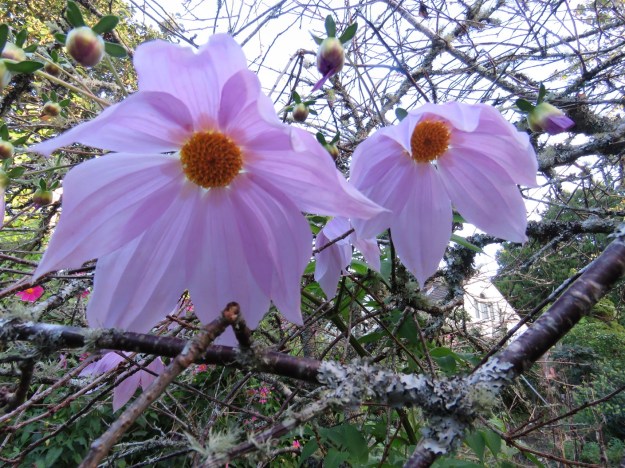
Finally and entirely unrelated, I give you flowers for no reason except to share the pleasure. It is tree dahlia season again.

Pink and white detail – species cyclamen.

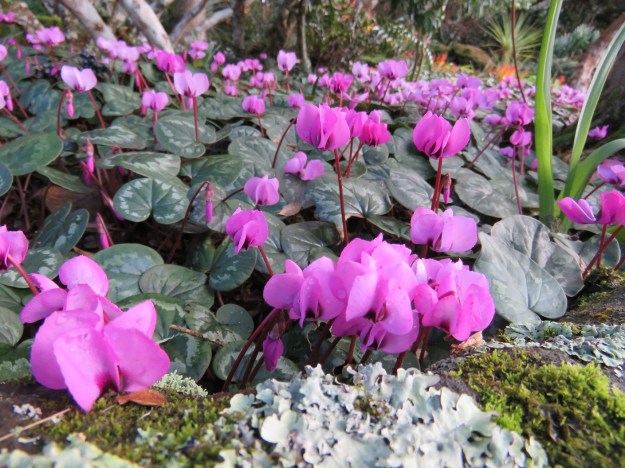
It takes a fair number of cyclamen to create a carpet but it can be done over time

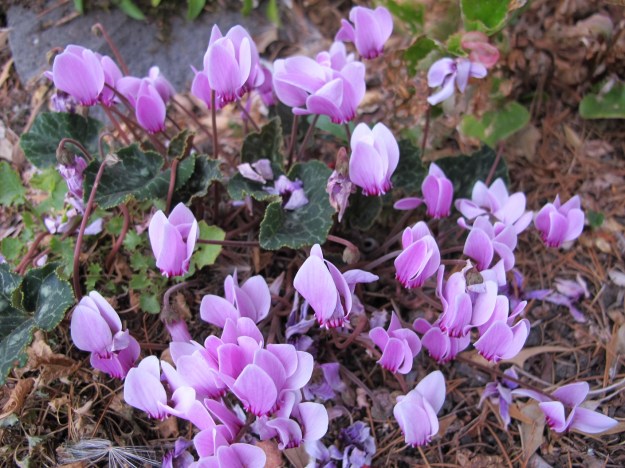
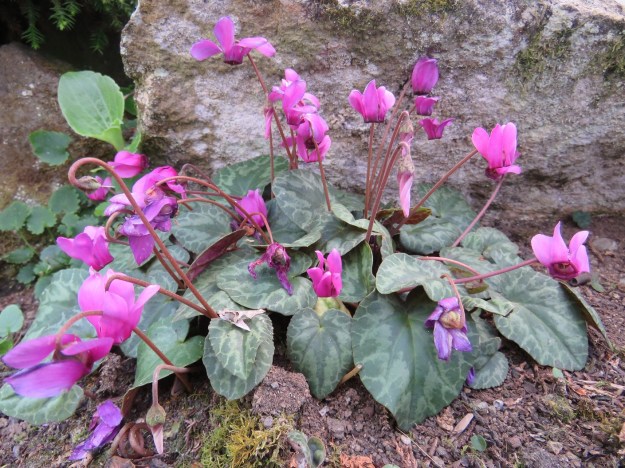
Even though we garden on a large scale across 10 acres, the little pictures are as much a delight as the big ones. For many months of the year, the species cyclamen give us charming detail. Over the years, Mark and his father before him gathered up all the different species they could find. When it comes to showy and proven garden performance, we now rely on four different ones which take us through most of the year – C. hederifolium flowers from January to late autumn, C. coum which takes us through winter, C. repandum for spring and C. purpurascens which flowers on and off all year round. C. graecum also flowers well but does not increase readily.

Cyclamen coum

There is a world of difference between the dainty species and the big hybrids which are sold primarily as house plants. Those are mostly bred from C. persicum, which we also grow but in itself it is not a stand-out performer in our conditions. I am not a fan of the hybrids, even less so when they are used as garden plants. To my eyes, they lack the charm and refinement of the species. They have been bred for a different purpose and have flowers which are much larger, often in different hues and sometimes selected for novelty value in flower form. But that is all a matter of taste.

Cyclamen graecum

A key to understanding cyclamen is knowing where they come from. This explains why C. libanoticum failed to establish as a garden plant here. It is native to the mountains of Lebanon – hardly conditions we can replicate. As it has the most beautiful flowers of any cyclamen I have seen, I was disappointed – though Mark tells me he still has it growing in his nova house (best described as his private but chaotic treasure house of obscure and curious plant material which may or may not transition to the garden, eventually).

Naturalising hederafolium by scattering seed

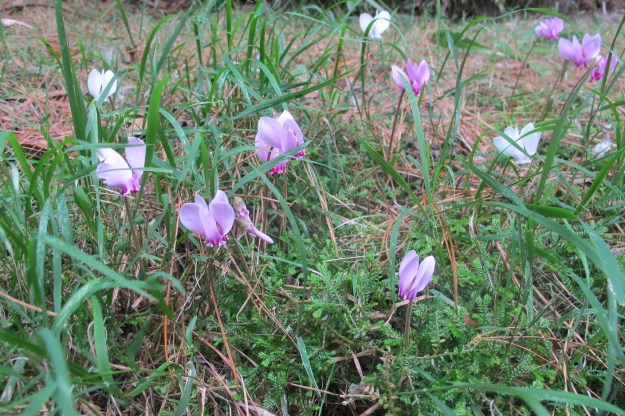
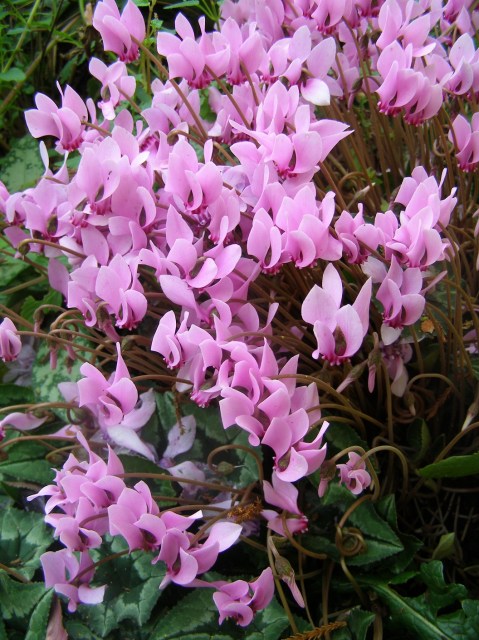
C. hederifolium (formerly known as neapolitanum) has been the easiest to naturalise for us – to the extent that we can even claim that we have carpets of it. It has a wide distribution from southern France through the Mediterranean to western Turkey, growing in range of conditions from rock and scrub cover to woodlands. We find it is happy in both full or partial sun on the edges of woodland areas but it needs good light levels so is not so satisfactory in shade. Some years ago, Mark scattered seed across grassy banks in our park and now we have it naturalised in meadow conditions. C. hederifolium sets lots of seed which is easy to germinate as long as it is sown fresh and not stored. The seed pods form on the end of corkscrew spiral stems. If you know somebody growing it, you may be able to request some seed.

Cyclamen purpurascens

If only C. purpurascens would set seed as freely, we could use it much more extensively. It is one of the more hardy, European species, occurring naturally as far north as Poland. It is also a terrific performer, evergreen and flowering much of the year. But it sets very little seed and that seed does not germinate readily so it is not an easy plant to increase and naturalise, despite its unfussy ways once it is growing.

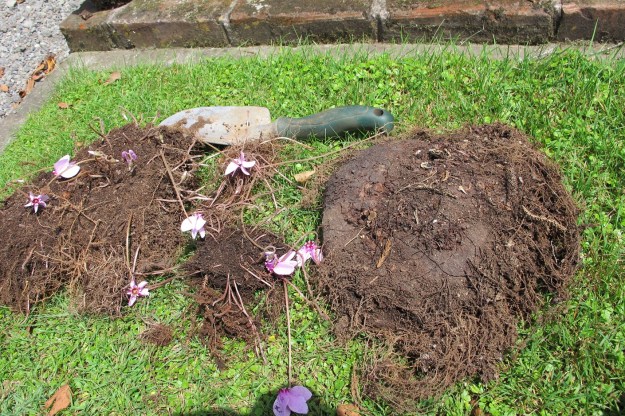
Cyclamen hederifolium tubers with trowel to give scale

Cyclamen grow from flat, disc-like tubers. While hederifolium tubers can get very large – I have measured up to 15cm across on old specimens – our more delicate coum and repandum stay small. I can’t recall ever seeing a repandum tuber much larger than my little finger nail and they are mostly smaller than that. While they still set good-sized blooms, it does mean that you need a fair number of them to have much impact. Siting is also critical. They are not a suitable option where ground is being cultivated. No matter how careful you are, the tiny corms look too much like soil when they are dormant and are therefore easy to discard or dig in too deep. Nor do they like companions which can overshadow and overpower them. Our main patches are on woodland margins, particularly as ground cover beneath tall, limbed-up evergreen azaleas. We leave them undisturbed and they reward us with low carpets of bloom, sometimes combined with snowdrops (galanthus) or the little, dwarf narcissi.  Excellent drainage is also vital. All tubers will rot out in wet or heavy soils.

Hederifolium again

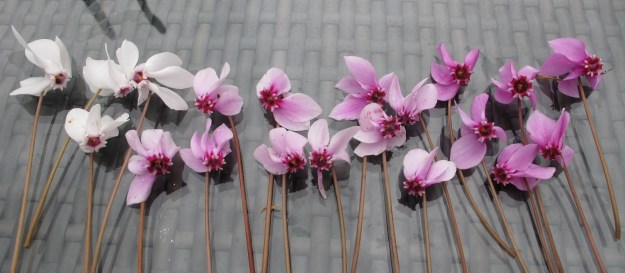
Generally, cyclamen show the typically heart-shaped leaves, usually marbled white or silver and a distinctive flower with upswept petals. They come in white and all shades of pink from palest through to deep cerise. Almost all of them are fully deciduous and like to sit on or in line with the ground surface, rather than being buried.


Shades of Cyclamen hederifolium

As to whether  the family name is pronounced “sike-lamen” or “sick-lamen”, we go with the former though Wikipedia tells me that is the American pronunciation whereas the latter is the British version. Take your pick.

First published in the May issue of New Zealand Gardener and reprinted here with their permission.