
“The arums make the white of Persicaria polymorpha a very definite cream and highlight the problem I had with Sissinghurst of putting too many whites together in one space. White flowers always have something else in them, be it blue, pink, mauve or even brown, and these off-whites soon look grubby when they are shown up by the purity of something like Zantedeschia aethiopica. A cream rose such as Rosa ‘Nevada’ needs to be with the right partners, and, since it fades to pink, it is a shame for this ageing process to feel muddied by wrongly placed companions.”
Natural Selection, A Year in the Garden by Dan Pearson (2017)
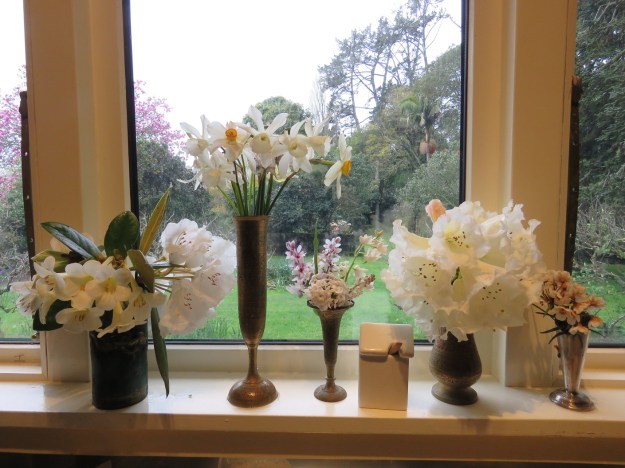
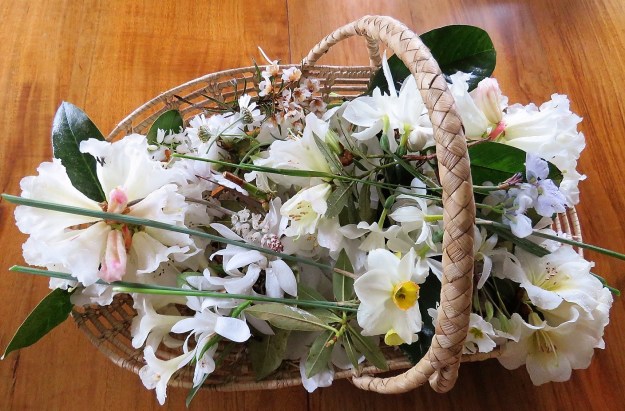 I have been drafting a piece about contemporary white gardens for a publication, so my mind has been on white blooms. Yesterday, in the post-election hiatus and the gloom of a wet, grey day, I headed round the garden with my vintage flower basket to pick a selection of white and largely white flowers.
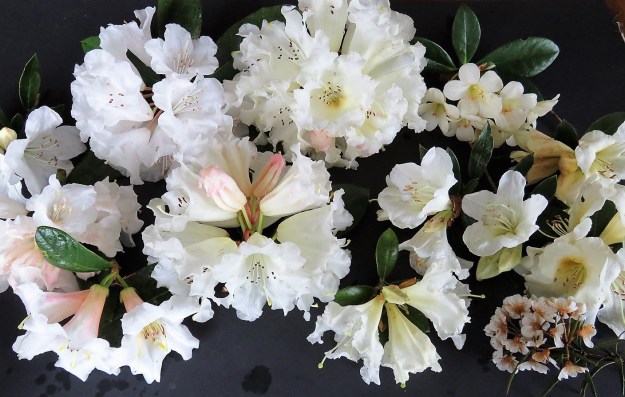 Ringing in my ears were Dan Pearson’s words above, even though I had read them so really they should have been flashing in front of my eyes – visible rather than audible, so to speak. I had not really got my head around the different shades of white before. Neither, I am sure, had the many women whom we used to describe as being of the Remuera genre back in the 1990s, but who would be known as “ladies who lunch” these days. These were the ones who were hellbent on putting in a white garden, à la Sissinghurst. They were numerous and, in our peak retail days, we met a fair number of them. I recall some for whom white flushed pink was out of the question. Candidates for their white garden had to be pure in hue. White and nothing else. I wish I had the Pearson quote back then. There are many, many plants that open from a pink bud to a white bloom.
Never did I hear any of these women getting their heads around the different shades of white. Nor indeed the role of cream and where creamy white becomes more cream than white. Let alone where cream crosses over to palest yellow. It is spring here, so we have a number of rhododendrons in flower. Of the maybe ten different white rhododendrons I picked, only one was what I would call pure white.
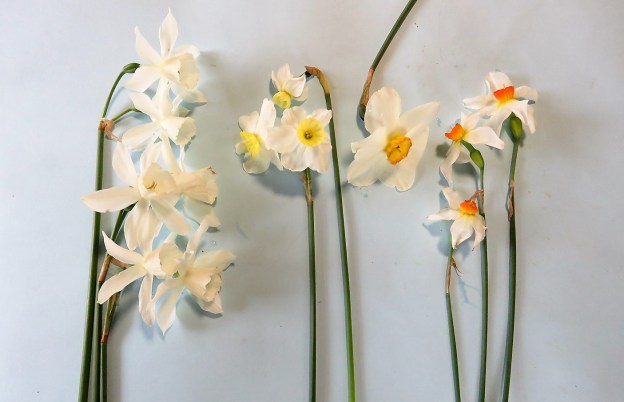 Is Narcissus ‘Thalia’ (on the left) acceptable in a white garden, though it is cream, not white? If ‘Thalia’ is acceptable, how about the narcissus with the pale lemon corona and white petals? And if that lemon corona is still okay, does this go across to ‘Beryl’ and other poeticus hybrids with white petals and small coronas which are somewhat stronger coloured and into the yellows and oranges? Where is the cut-off point? I tell you, this white garden business is fraught with problems and judgement calls.
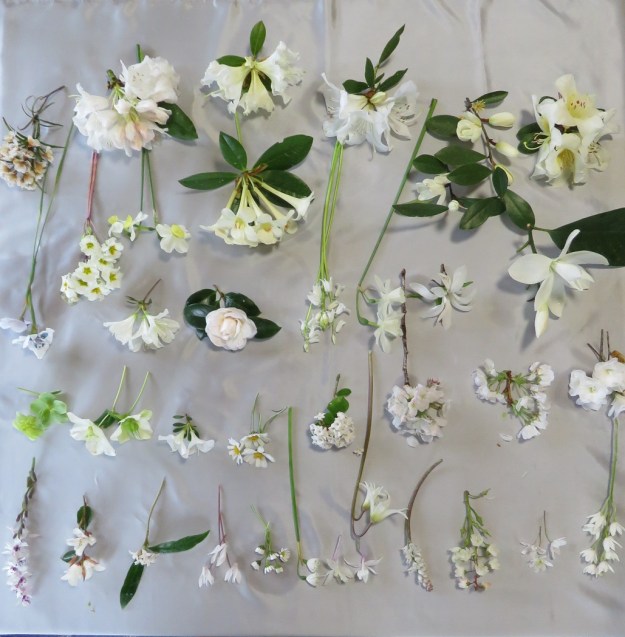 Are green flowers permissible? If so, why not the white Moraea villosa with blue peacock eye markings or Lachenalia contaminata or Onixotis triquetra which are white with maroon markings? If the latter two are not acceptable, does that rule out the white rhododendron with maroon spotting. Is it not sufficiently pure? Is it okay for a white rhododendron to open from a soft pink bud? No? How about a soft lemon bud or one with a green cast?
I laid all the whites out to peruse and Mark walked into the room. All he wanted to do was to add yellow to lift the scene. I have never wanted a colour themed, pure white garden. It is just not our style and it is hard to stop it being a little flat, a little lacking in energy or pzazz. But if you want one, maybe start considering the importance of different shades and textures of white.
White is not always whiter than white and not all whites are the same. Detail matters and never more so than when you are taking on somebody else’s idea in your garden. Without that attention to detail, you will only ever have an inferior interpretation of the original but without the originality.
Postscript: Should I mention to overseas readers that the white arum lily, Zantedeschia aethiopica, can be found listed on every weed reference site in New Zealand, though I am not sure how widely it has been banned outright at this point? It is generally seen as a sign of poor land management to be growing it. Pure white it may be, valued it is not. It joins the giant gunneras and even the erigeron daisy as a botanical crime here.
 Why so grey, New Zealand? Each time we fly somewhere, Mark looks out the plane window and winces as he sees the sea of grey roofs. It is quite a while since we had to re-roof a house, but I assume roofing is available in other colours? It is not compulsory to roof in grey, is it?




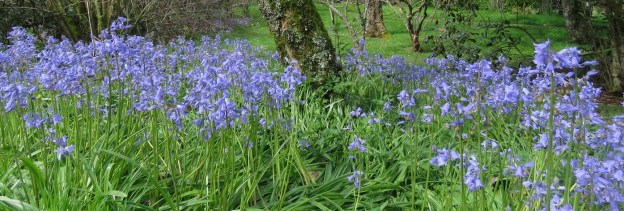
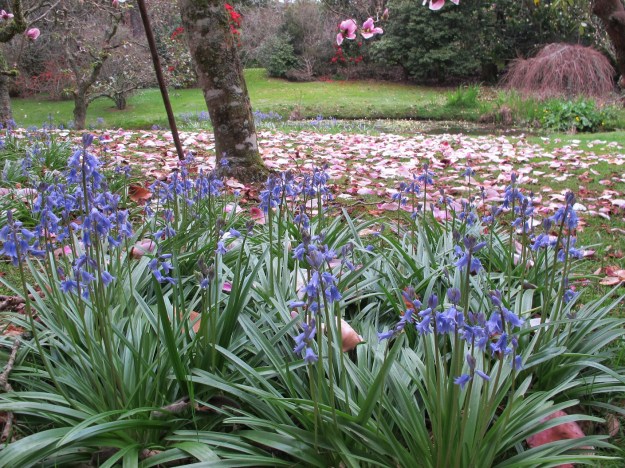 There is something wildly romantic about a proper bluebell wood. I have never forgotten being entranced by the haze of blue through woodlands near Castle Douglas in Scotland and that was more than two decades ago. Those particular bluebells and woodland trees are native to the area but this does not stop many of us trying to replicate the effect at home.
 It took UK writer Ken Thompson to demystify bluebell differences for me. The English Hyacinthoides non-scripta has sweetly scented, deep blue flowers on a droopy spike which means most hang to one side. Individual flowers are narrow tubes with reflexed tips. The Spanish H. hispanica is much stronger growing with an upright spike and flowers radiating all round. There is a greater range of colour from pale to dark blues and lilacs along with the pinks and whites. Individual flowers are bell-shaped and while the tips of the blooms flare out, they don’t reflex. They have little scent.
 A word about white or pink bluebells. While the English bluebell can occasionally throw a white mutant, given the rarity of H. non-scripta in this country, it seems likely that all colour variants we have are either Spanish or hybrids. The whites and pinks are charming mixed with the predominant blues, making a pretty scene. Isolate them out by colour on their own, and they become a novelty plant. Bluebells, by definition, should be mostly blue. A display of only pink bells would look awfully contrived for this simple flower while a mass of white bells might as well be onion weed, really. That is my opinion.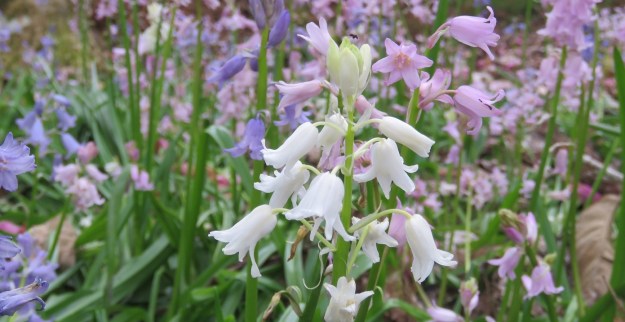

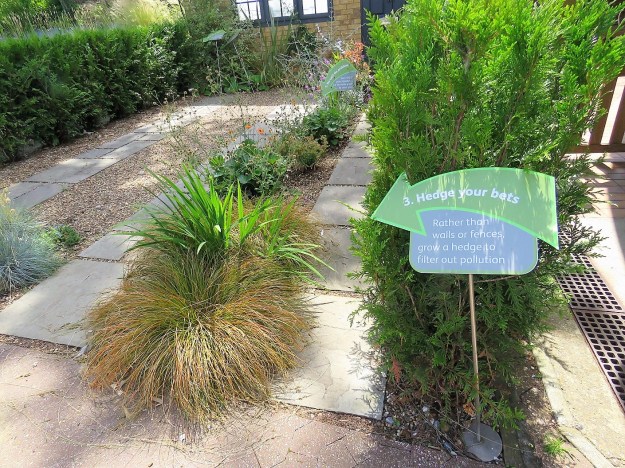
 The environmental benefits of growing plants are perhaps a harder concept to sell to people who don’t see anything wrong with living in concrete jungles. But we ignore the evidence of declining insect populations and the loss of biodiversity at our peril. Our planet is hitting crisis point, fuelled by human ignorance.
 It is not that the RHS are the only body leading public education in this area, but they are an influential one and all power to that.
