
“Believe me, my young friend, there is nothing – absolutely nothing – half so much worth doing as simply messing about in boats.”
Kenneth Grahame, The Wind in the Willows
I misremembered. I felt sure there was a Wind in the Willows quote about messing about in the muddy waters of a stream but I was wrong. Of course they were messing about in a boat, not mud. When I went searching, there were many other charming quotes from the same book which are gently affirming in a world seemingly gone mad, but I found another escape this week.
 I have been weeding the stream. Yes, hand weeding the stream. I see it is five years since I last got down and dirty in the water, although Mark and Lloyd do a certain amount of ongoing maintenance with the long handled rake. I find it easier to climb right in and scoop by hand or sometimes with a rake. It is very muddy and Mark laughs when I stagger back up from the park but I am way too vain (or self conscious, maybe) to immortalise this by taking a selfie of Muddy Me.
There are both eels and fish in the stream – small fish, mostly mud fish – and I find it deeply unnerving when something smooth and slippery brushes past my bare legs. I wouldn’t be quite so anxious were it not for Mark’s recent encounter with an eel. He was reaching into the water to pull out some blockage when an eel mistook his hand for something else and latched on. There was blood, quite a lot of blood and all of it was Mark’s. Eels are renowned for their backward facing teeth so it is not easy to dislodge them, though I think both the eel and Mark got such a fright that everything went flying. I console myself with the thought that eels are not known for aggressive attacks and it would be bad luck for one to follow up with me so soon after. Just in case, I wear both shoes and gloves as a precaution. I am hoping one will not attack my knees, calves or thighs. Still, as I reviewed one cleaned area of the stream a few hours later, I was disquieted to see an eel gently swimming along the somewhat bare expanse. But it was a small one and I will not be intimidated.

Clockwise from top left: crocosmia, oxygen weed, wretched Cape Pond Weed, blanket weed and tradescantia
But the weeds! We get up close and personal with the weeds that are carried down to us from properties further upstream but the major flood in 2015 has caused us a few more problems than before. Crocosmia, often referred to as montbretia but technically crocosmia x crocosmiiflora, have pretty summer flowers but the huge flood carried the corms far and wide and we are now working on restricting its spread. There is simply too much of it for us to be able to eradicate it and we would get reinfested during the next flood event.
Eradication, however, is the aim with the dreaded Wandering Jew (Tradescantia fluminensis). Mark has spent two decades battling this on our properties but still we get new outbreaks washed down to us. The problem is that every piece that is broken off is capable of growing and it is truly rampant once established. Both the tradescantia and the crocosmia grow alongside the water, rather than in it.
The goal is also to eradicate the oxygen weed and the Cape Pond Weed (Aponogetum distachyum). Mark has succeeded once in eradicating oxygen weed so he was most disappointed when he saw a larger form of it getting established on our place. His theory is that it comes from people emptying their little aquariums into fresh water ways, presumably because they do not wish to euthanise their goldfish and can’t find anyone to give them too. Don’t. Please don’t ever do this. Not only do we not need or want free range goldfish in our waterways, the oxygen weed becomes a choking blanket in slow moving fresh water. We have spent countless hours pulling it out but unless we get every bit, it will grow again. Ditto the Cape Pond Weed, about which I have written several times in the past.
What I call the blanket weed – a mass of very fine filaments – is here to stay but we try to keep it from getting too solid and impeding the flow of water. It is at least easy to rake out. Besides, the aquatic life needs some cover.
We are not perfect. Although we try and dead head our waterside irises and primulas, some of those may have washed downstream. I did at least go to a lot of effort to get rid of the noxious flag iris beside and in the water when we realised what an environmental hazard it is in this country.
In the meantime, there are worse ways to spend a pleasant, mild day than poddling about in the water. Our adult son is returning home from overseas next week and plans to stay for a few weeks. He spent many childhood hours playing with his mates in the ponds and the stream – boogie boarding up and down and playing bike jumping games into the water. I am wondering at what stage I might suggest to him that it would be a huge help to his Aged Parents if he could turn his attention to scooping or raking the weeds from the deepest sections of the ponds which are beyond my reach. We shall see.
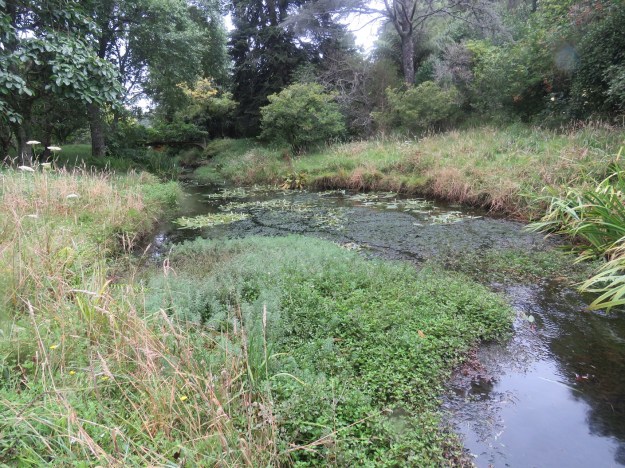
We have lowered the water level to enable major weed removal over the next week or two
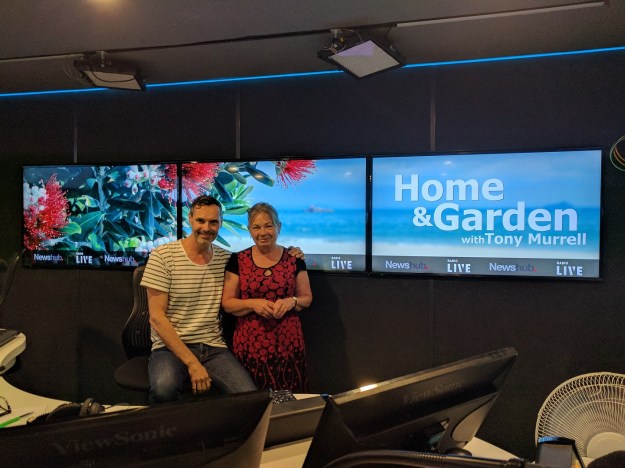 A quick trip to Auckland at the weekend saw me rushing hither and yon but also enabled a face to face conversation with Tony Murrell in the studio at Radio Live. Usually we do these by phone. It is at the unseemly hour of 6.30am each Sunday morning so I had to rise even earlier to get to the studio. These conversations are remarkably complex for the early hour but both Tony and I are enjoying them enormously. Last Sunday it was partly about taking inspiration from other people’s gardens and not falling into the trap of thinking that recreating these ideas at home means using their blueprint, often from another climate, another country and another time. The link is
 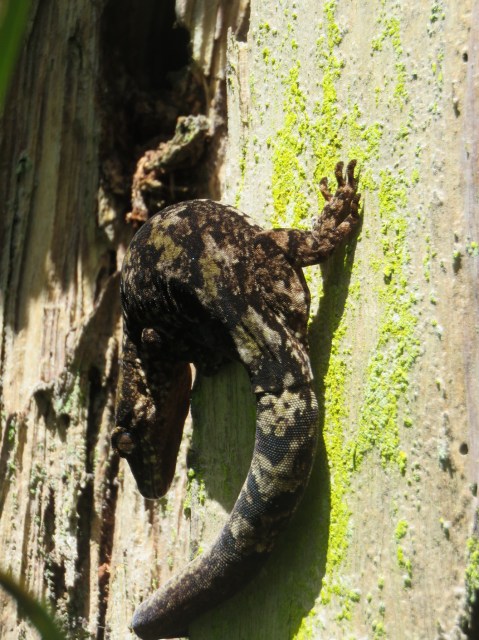 We did not see
  The UK gardening tour I mentioned last week has done been and gorn. It rained, steadily, when they arrived which was disappointing but we moved them all indoors for tea and cakes and the rain stopped a few minutes into the walk around the garden. While hosting these tours takes a bit of work and a surprisingly large amount of mental energy, the visitors often repay the efforts in more than money. Being able to share the garden with appreciative visitors who have a fairly high degree of knowledge themselves – albeit with an entirely different range of plants – is what it is all about really. We don’t garden on this scale just for ourselves and it can be extremely affirming to share it with a group like this one. I have to report that the lilies in the garden did not flower as hoped but we have enough lilies planted “out the back” as we say for me to pick an impressive display for vases indoors and they did not go unnoticed.
 Also putting on the very best display we have ever seen here is
 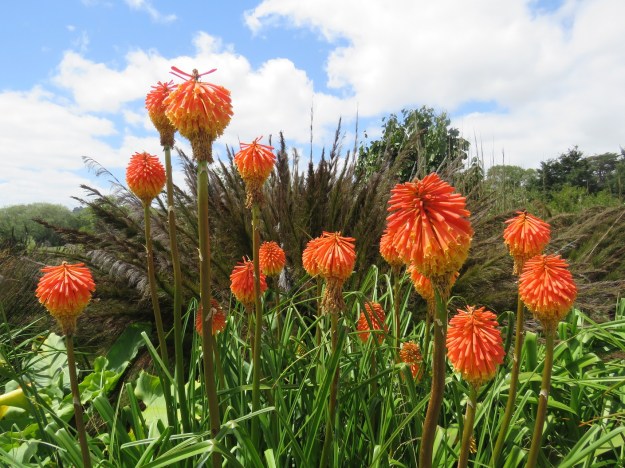 Finally, a few snapshots of summer flowers I liked this weekend. I called in to Joy Plants to check out their perennials and the kniphofia in the gardens were looking marvellous.

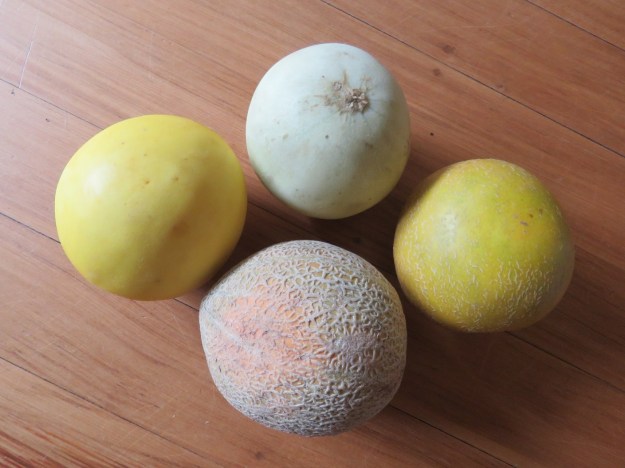
 The Otara Markets in South Auckland are held each Saturday morning. Because I come from rural New Zealand, I find the mix of cultures, different styles and colour fascinating. We don’t see much of this in Taranaki and New Plymouth. We also pay a great deal more for our fruit and vegetables and have a way more limited range from which to choose.
 Selling quick maturing Asian greens from the carpark.
  Preaching with a loud sound system but no visible congregation or audience.
 A spot of faith healing being carried out beside the carpark.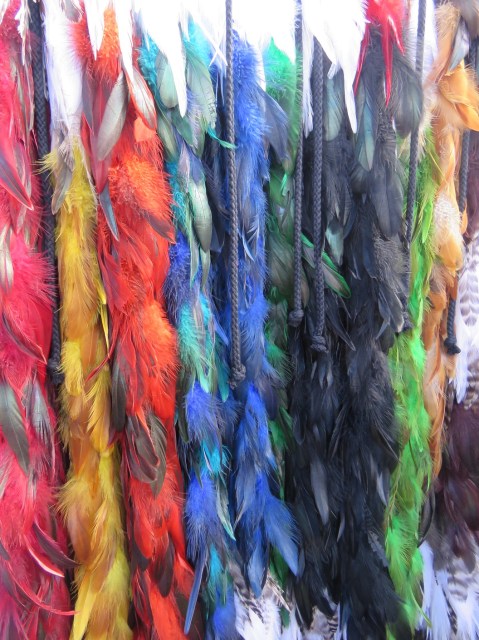
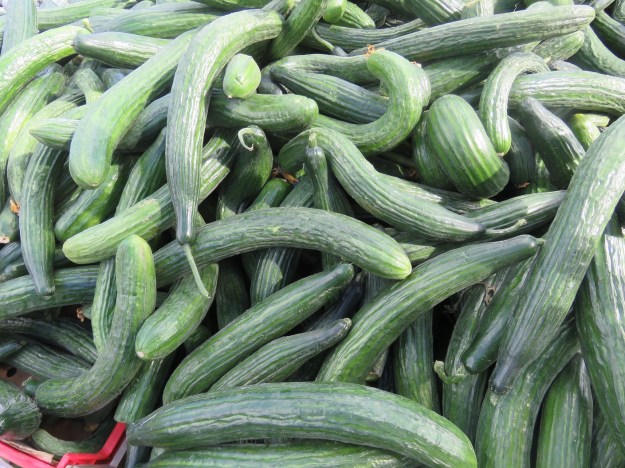
 There is something so visually appealing about piles of fresh garden vegetables being sold on market stalls.

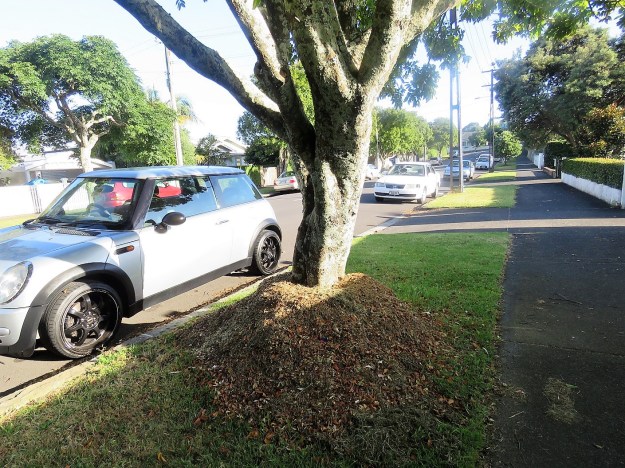 Well lookee here. When I was submitting three new articles a week to the Waikato Times – that was in the days before syndicated features and the resulting copy that became the newspaper equivalent of elevator muzak – I used to be on constant alert for subject matter. Old habits die hard and I reached for my camera to bring you this example of what not to do, photographed on a street in Auckland’s upmarket Mount Eden.
 That is how the snake entered our family. Theo admired it. He was still too little to pronounce his s’ss (or should that be esses, or maybe ‘isses?) and he always referred to it as “my ‘nake”. He had a great deal of fun with it for several years. Yes, you can harass New Zealand cats with fake snakes and even adults instinctively flinch when a snake’s head looms close. When he grew out of it, we relocated it to the Pinus ‘Beuvronensis’. I think it may be time to move it to the back shed and produce it with a flourish should our son, now in his late twenties, ever have offspring.
 Tikorangi The Jury Garden