
“Against the uniform sheet of snow and the greyish winter sky the Italian villa loomed up rather grimly; even in summer it kept its distance, and the boldest coleus bed had never ventured nearer than thirty feet from its awful front.”
Edith Wharton The Age of Innocence (1920)

Coleus, I regret to inform you, appear to be staging a comeback if what I saw in Auckland at the weekend is any guide
I have done two trips to Italy. The first was a major garden tour in the north, in most elevated international company so it was the full immersion experience where we got to meet head gardeners and, in some cases, garden owners. Why, we even had a reception with the Principe and Principessa Borromeo on Isola Bella. For those not in the know, the Borromeo family have an aristocratic pedigree, wealth, power and influence even today which is beyond the average New Zealander’s comprehension.
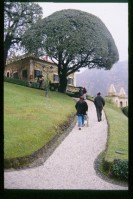
Villa del Balbianello on Lake Como
Yes, there tends to be a very restrained plant palette and the same plants are seen in most gardens. I remember writing at one point about the ten plants that show up in every garden. Many of the historic gardens are clipped and groomed to within an inch of their lives and plant health isn’t always great.
Talking to the head gardeners and garden managers, the restricted plant palette is largely climatic. It is not an easy gardening climate, being cold and dry in the north in winter and hot and dry in summer. Further south, it tends to be just dry and dusty. If they could, they would grow a much wider range and that is evident in some fine gardens like Isola Madre and Villa Taranto.
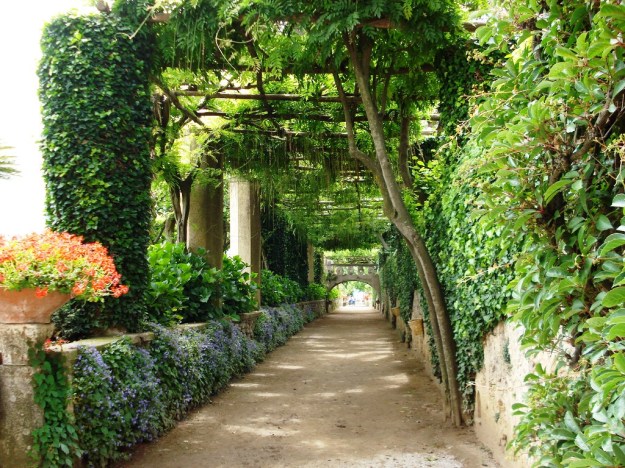
Villa Cimbrone in Ravello on the Amalfi Coast
So it is a mystery to me as to why New Zealanders, in their quest for “Italian styled” gardens would want to take that restricted plant palette as a mandatory, defining characteristic. This is a country where we can grow almost anything.

The grand historic reality

The modern domestic reinterpretation on the other side of the world
And can you achieve a domestic version of the grand, historic Italian gardens In New Zealand without the pivotal grand villa and the grace and proportions of a major estate let alone without the historic stonework? I mean, Villa Serbelloni on Lake Como has a genuine Ancient Roman fort in remarkably good condition at the top of the garden. Difficult to top that as a garden feature. And the grand gardens often have landscape vistas of astonishing beauty.
I don’t know anything about contemporary Italian garden design but neither, I suspect, do most New Zealanders. I can say that my limited experience of current domestic gardening in Italy showed a certain leaning towards what they saw as the “romantic English style” – less formal, more frothy and trying the broaden the plant palette.
Not only do New Zealanders on the quest for an Italian-style garden go for a limited range of plants, with the historically questionable exclusion of colour and bloom, they take a simplistic interpretation of hard-edged formal design without acknowledging that this is the garden design of the super powerful and super wealthy Italians in centuries past.
I could suggest that the Italianate gardening that I have seen in this country is to Italian gardening as a dinette is to a dining room, a kitchenette to a kitchen or as marblette is to marble.
All this is because I visited a garden during the Heroic Garden Festival that billed itself as “transport yourself to Italy…”. I don’t think so. It was a beautifully presented, immaculate garden, very hard edged and clipped with “a controlled palette of plants”. The fact that it is not to my personal taste is completely irrelevant. I can respect the determination and focus that goes into creating and maintaining that sort of garden and it was done to a high standard. I am sure the owners are very proud of it.
But Italian, it is not. I think what we bill as Italianate in this country is more Miami hotel-style reinterpretation of Italy. The Italian inspiration is distant at best.

The real deal in Italy
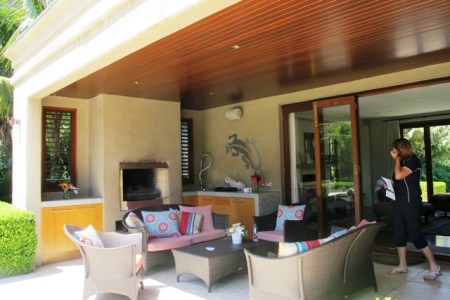
More Miami than Italy in Auckland




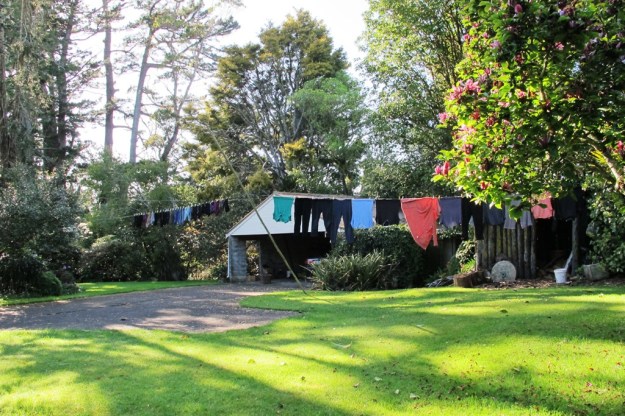 1) This is my own washing line, dating back, I assume, to when the house was built in 1950. I like the giant bamboo prop we use to hold it up. I think it is what Kevin McLeod of Grand Designs would call “honest” or maybe “unpretentious”. Old fashioned, certainly, it offers excellent drying but you do need space and you have to walk up and down it rather than standing in one spot to peg and unpeg.
 2) The rotary clothesline, often referred to as the Hill’s Hoist, is an Australasian phenomenon which features heavily in suburban backyards of both Australia and New Zealand. There is no doubt it is practical but it also lacks any aesthetic at all. Is there a sadder sight than a barren backyard with nowt but a weed infested area of broken concrete and a Hill’s Hoist washing line?
 3) Presumably in an attempt to hide the heavy visual presence of the Hill’s Hoist, there seems to be strong interest in wall-mounted lines which can often folded down discreetly when not in use. I would guess this one was advertised as having 20 metres of line space (10 wires by 2 metres each) but it isn’t really 20 metres of usable space and it won’t hold large sheets without folding them in on themselves. It lacks the air circulation of the first two options so will not offer such efficient drying but the wide eaves give some protection from rain.
 4) For property-proud people, the service areas needed for a household may be screened. Here the washing lines join the Sky dish, heat pump units, and probably the wheelie bins and recycling bins. The trade off is the reduction in sunshine hours on the shaded side of the house as well as reducing the air movement which dries washing more quickly. I have seen this done in a small garden but the screening was much closer to the washing line which created more shade and reduced air movement even further. Keep some distance if you can.
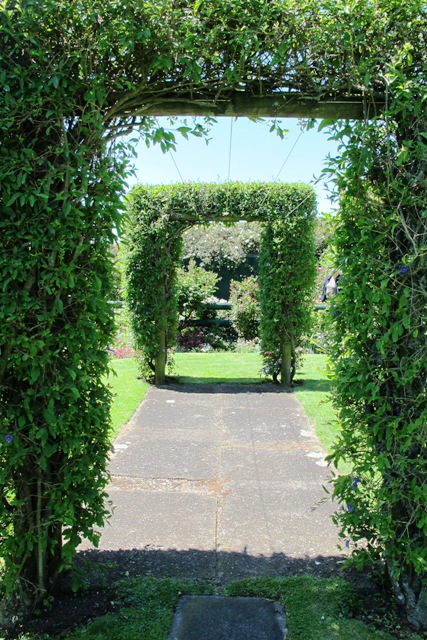 5) As a D.I.Y. compromise, I photographed this fixed line which is free standing in full sun but softened by the frames at either end which are wreathed in a flowering climber – one of the solanum family but I am not sure which one. Paving beneath gives reflected heat and keeps fallen items cleaner. This is the best example I found for a town section where the owner wanted a more discreet but still efficient washing line. It also took the award for the prettiest clothes line I found.
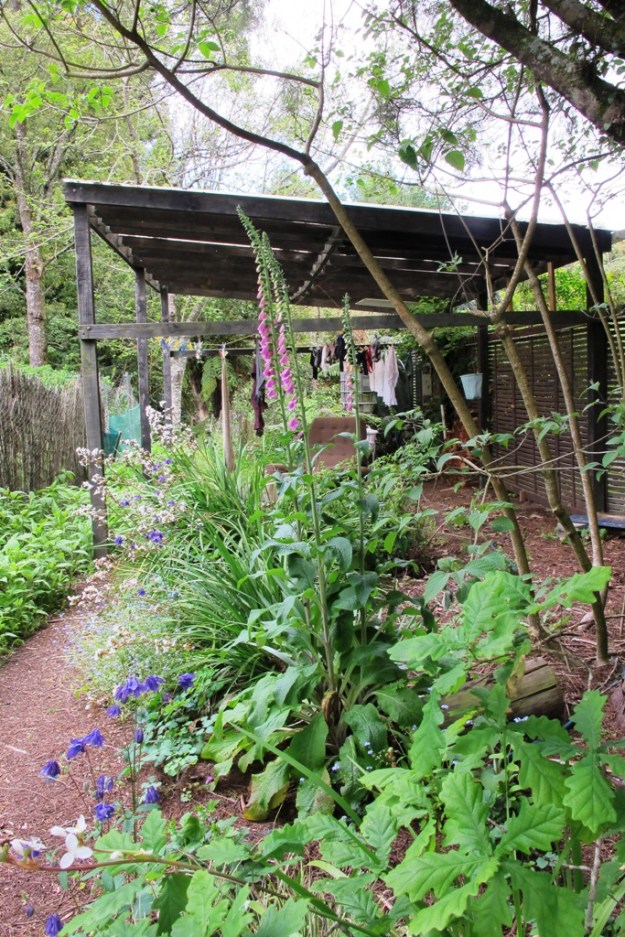 6) I spotted this line on a large country property where winters can be a little cold and bleak. It is under cover but the roof is high. It incorporates screening from view without sacrificing air movement. It is on a property with accommodation units and the owner told me there was sufficient line space to hang all the washing from the four units. She loved her washing line and, where space allows, it struck me as remarkably practical.
  Tikorangi The Jury Garden