Tag Archives: camellia petal blight

Early flowering camellias

First published in the Weekend Gardener and reproduced here with their permission.
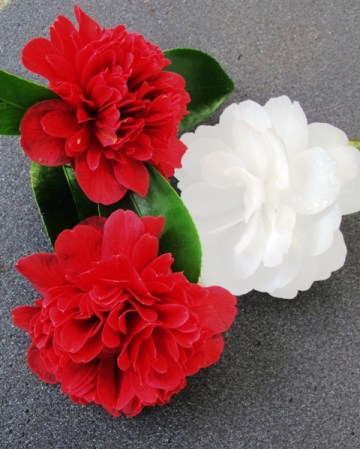
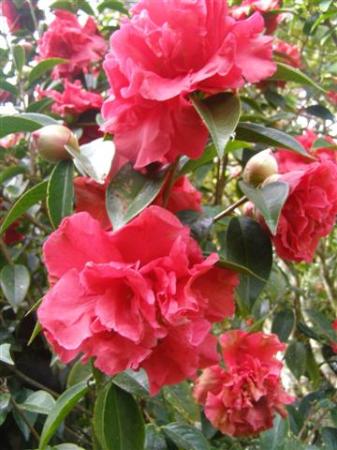
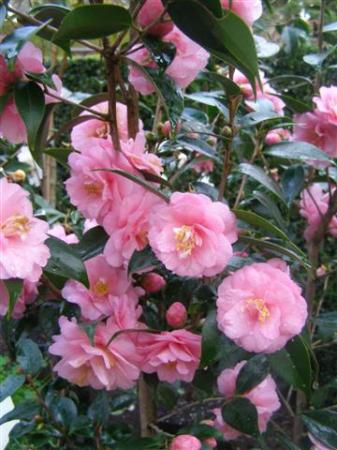
White ‘Early Pearly’ is one of the most beautiful of the sasanquas, while red ‘Takanini’ is a japonica which flowers from early to late in the season.

White ‘Early Pearly’ is one of the most beautiful of the sasanquas, while red ‘Takanini’ is a japonica which flowers from early to late in the season.

There is always something magical about the first flowers and camellias are no exception. They seem fresh and new, heralding the progression of seasons. While the main camellia season is from late winter to mid spring, the earlier varieties bring colour to the late autumn and early winter garden. Early flowers also escape the curse of camellia petal blight which affects mid and later season varieties.

Early camellias fall into three groups: the sasanquas, early flowering species and a few japonica types and hybrid camellias which have an exceptionally long flowering season, continuing from early to late.

We particularly enjoy the charming sasanqua ‘Crimson King’, seen here as a mature shrub with a graceful, arching form.

We particularly enjoy the charming sasanqua ‘Crimson King’, seen here as a mature shrub with a graceful, arching form.


Camellia sasanqua ‘Bonanza’ is a bright spot of colour on a grey day

Camellia sasanqua ‘Bonanza’ is a bright spot of colour on a grey day

The sasanqua camellias originate in Japan and are renowned for being sun tolerant, having smaller leaves and being suitable for clipping to hedges. While some are slow to get going as garden plants, over time they can make graceful, airy, large shrubs. They mass flower and most are scented, in a mossy, slightly sweet sort of way. Their blooms are softer and lack the defined form and substance of most later flowering camellia types. This is an advantage when the flowers fall and break up quickly, rather than leaving a sludge of brown at the base of the plant. While white sasanquas have been particularly popular for some years, they also come in a whole range of pinks to red tones and bi-colours. We prefer the coloured ones for a splash of winter cheer in the garden when there is not a lot else in flower.
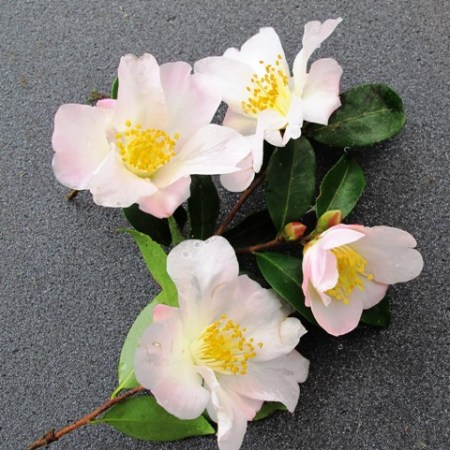
‘Fairy Blush’ is a scented hybrid with a very long flowering season.

‘Fairy Blush’ is a scented hybrid with a very long flowering season.

There are a range of early flowering species but these are unlikely to be found for sale these days. The most useful of them for us, are dainty little C. brevistyla and C. microphylla which offer potential as replacements for buxus hedging and are a great deal prettier than box when in flower.

There are some japonica and hybrid camellias which have remarkably long flowering seasons. In the reds, ‘Takanini’ flowers early, middle and late and should be readily available. Later season blooms develop an unusual purple hue. ‘Roma Red’ is a new release and not as widely available, with its formal flowers in mid red. ‘Mimosa Jury’ is a perfect formal in pretty pink and shows good weather hardiness. ‘Fairy Blush’ is a scented, small flowered pale pink and white miniature bloom with an exceptionally long season. These varieties open their first flowers with the sasanquas but continue long after they have finished and will still have flowers when the late season varieties are on show.

For perfection in a bloom, it is hard to go past the formal shape of Camellia ‘Mimosa Jury’ which has the added benefit of showing good weather tolerance without marking badly.

For perfection in a bloom, it is hard to go past the formal shape of Camellia ‘Mimosa Jury’ which has the added benefit of showing good weather tolerance without marking badly.

GROWING CAMELLIAS IN CONTAINERS
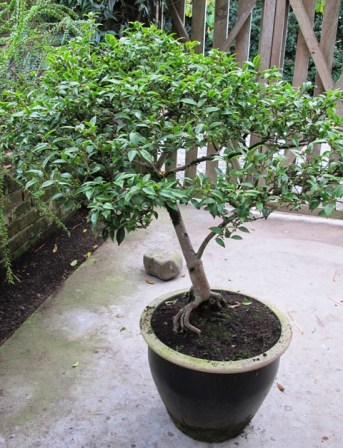
Camellia ‘Itty Bit’ is a dwarf variety that has been kept in a pot here for 20 years

Camellia ‘Itty Bit’ is a dwarf variety that has been kept in a pot here for 20 years

All camellias can be grown for a year or two in a pot but you are fighting nature if you want to keep a larger growing variety long term. Plants need repotting every two years to keep them healthy and lush. Unless you are root pruning and shaping the plant regularly, larger growing varieties will soon get too big to handle.

Do not make the mistake of thinking that small flowers mean the plant is small growing and vice versa. You are better to start with varieties with words like “compact”, “dense growth”, “dwarf”, or “slow growing” in their description. Where heights are given, pick those of 100cm or under (and remember that heights are almost always understated on plant labels).

We have had Camellia minutiflora in a succession of containers for about twelve years. We have a miniature “Itty Bit” which has been featured in a container for at least twenty years. On the other hand, it is clear that “Spring Festival” is going to be too large after only three years.

Rules of thumb are not to drown a small plant in an over large pot, to ensure that the pot has plenty of drainage holes at the base and to use a good quality potting mix with slow release fertiliser. Feed by top dressing after the first year and repot with fresh mix after two years.

WHITE SASANQUA CAMELLIAS
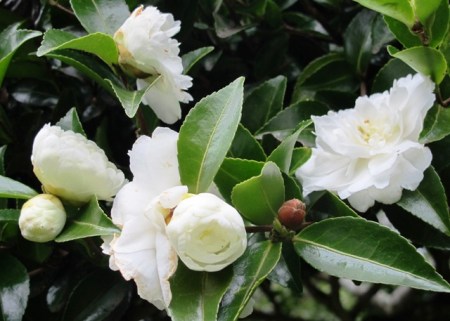
There is a range of sasanqua camellias in white. ‘Silver Dollar’ has a long flowering season and is an excellent option for a more compact hedge.

There is a range of sasanqua camellias in white. ‘Silver Dollar’ has a long flowering season and is an excellent option for a more compact hedge.

While ‘Setsugekka’ is the best known white sasanqua in this country, it is not the only one. For perfection in a sasanqua bloom, it is hard to go past ‘Early Pearly’ with its formality in that shape that resembles a water lily. It is unusual to see a formal flower in sasanquas. ‘Silver Dollar’ is a smaller, bushier growing white with a mass of pompom flowers over a long season. It makes an ideal lower hedge option, able to be clipped to about a metre high. ‘Mine No Yuki’ is a slow growing variety, though will ultimately get large if it is not clipped (ours is at least 3 metres high and spans 4 metres wide, though that is after about 50 years). ‘Weeping Maiden’ grows rapidly to give a quick result with its arching growth and masses of large, single white blooms with golden stamens.

CAMELLIA PETAL BLIGHT
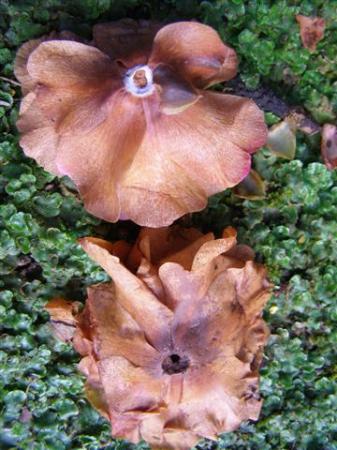
Camellia petal blight shows in the top flower as a distinctive white ring whereas the lower flower has been spoiled by botrytis.

Camellia petal blight shows in the top flower as a distinctive white ring whereas the lower flower has been spoiled by botrytis.

If you have been thinking that your mid season camellia display is not what it used to be, you will be right. Camellia petal blight has taken firm hold and cut the display to a fraction of what it used to be.

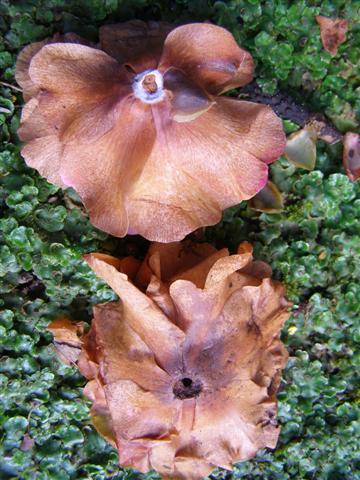
We have always had botrytis in New Zealand. It is the fungus that turns camellia flowers dark brown and mushy, especially in long periods of damp weather. Petal blight is different. It turns the flowers to a paler coloured mush, spreading through each bloom rapidly. A brown mark one day can cover most of the flower the following day. If you turn the affected bloom over and remove the calyx (the small cap holding the petals together at the end of the stem), you will see a white fluffy ring, indicating camellia petal blight. If it is dark and greyish, it is botrytis. Unfortunately, blighted flowers often hang on the bush rather than falling cleanly. Petal blight is a great deal more rampant than botrytis.

There is no cure and it will take many years before we see resistant varieties on the market. It does not usually take hold before late June or July, so the early flowering camellias can get through with their mass display unaffected.
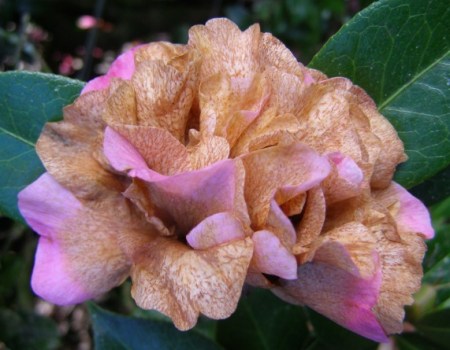
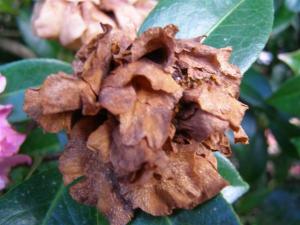
The ugly face of camellia petal blight which affects mid and later season blooms.
The ugly face of camellia petal blight which affects mid and later season blooms.

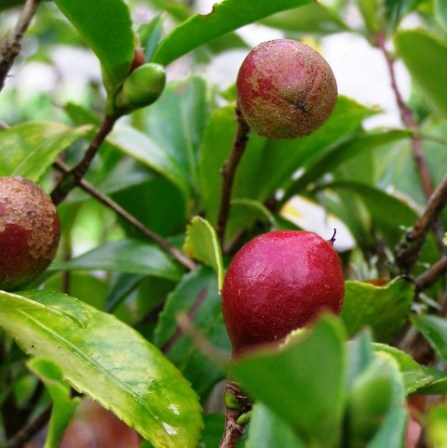
Camellia species can be grown from seed. There will be some seedling variation in the plants but they are usually close enough on appearance for hedging purposes. These are last year’s red seed pods on C. microphylla.

Camellia species can be grown from seed. There will be some seedling variation in the plants but they are usually close enough on appearance for hedging purposes. These are last year’s red seed pods on C. microphylla.

COMPACT CAMELLIA HEDGING
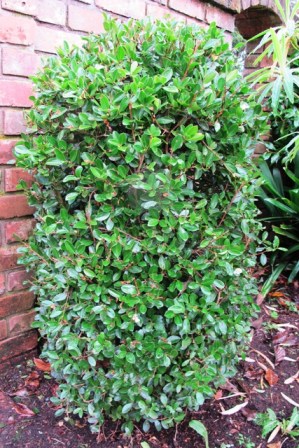
Camellia species brevistyla and microphylla offer an option as buxus hedging replacement and can be grown from seed. This plant is C. brevistyla.

Camellia species brevistyla and microphylla offer an option as buxus hedging replacement and can be grown from seed. This plant is C. brevistyla.

Simply the best camellias we have found as a potential replacement for buxus hedging are C. brevistyla and C. microphylla. These two species are very hard to tell apart and must be closely related. Their leaves are a little larger than buxus but they clip very tidily and are a good dark green. Both species have pure white single flowers very early in the season. C. brevistyla is a little slower growing and smaller but its flowering is over quickly. We have built up C. microphylla as replacement hedging for our own garden.

These species may be hard to source but if you can find a parent plant, they can be raised easily from seed. Both set seed freely. Ask at your botanic gardens. Both species were sold in the past by Camellia Haven in Papakura.

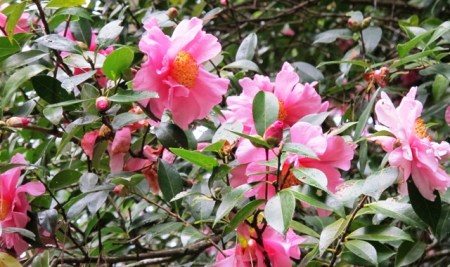
There is nothing special about the individual blooms on Camellia sasanqua ‘Showgirl’, but at the time when it flowers, there is nothing to rival its showiness.
There is nothing special about the individual blooms on Camellia sasanqua ‘Showgirl’, but at the time when it flowers, there is nothing to rival its showiness.

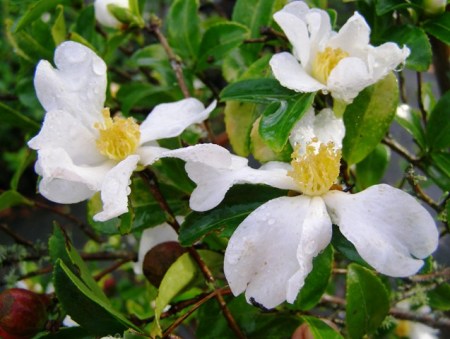
The dainty flowers on both C. microphylla and C. brevistyla are almost identical but last longer on the former, seen here.
The dainty flowers on both C. microphylla and C. brevistyla are almost identical but last longer on the former, seen here.

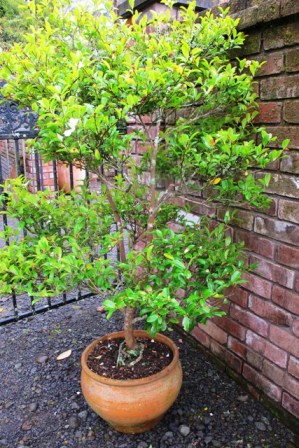
C. microphylla has been kept clipped and shaped in containers for at least 12 years.
C. microphylla has been kept clipped and shaped in containers for at least 12 years.
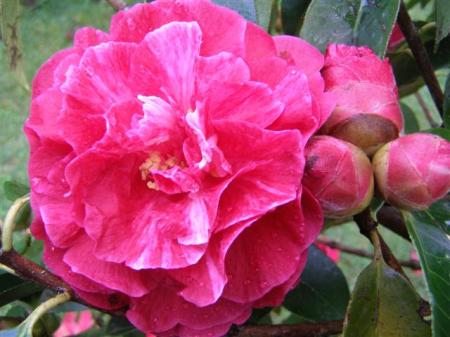
Taking a second look at camellias as garden plants

Make your old camellia bushes work at more than one level as garden plants

Make your old camellia bushes work at more than one level as garden plants

The scourge of camellia petal blight continues unabated. This was one disease we could have done without in this country and the sad thing is that when it was first discovered in Wellington, it was limited to two or three locations. Had all the infected plants been incinerated immediately, this nasty fungal ailment may have been eradicated. So if you have been looking at your camellias, particularly the most common japonica types (which takes in most of the lovely formals and the really showy blooms), and thinking that their display ain’t what it used to be, you are right.

We have always had botrytis in this country which can turn blooms to a dark mush but is generally not devastating. Modern camellias have been bred to be self grooming – in other words they drop spent flowers rather than holding them onto the bush and giving that unattractive look of some of the very old varieties still around.The trouble with camellia petal blight is that it seems to glue the flower to the plant so it defeats the self grooming process.

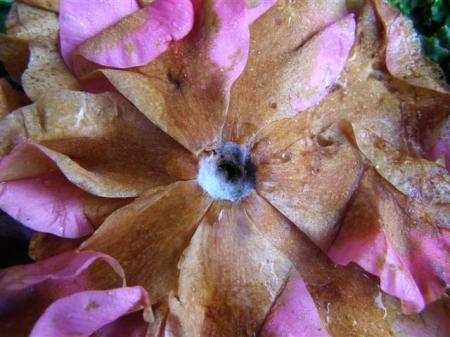
The sad sight of camellia petal blight

The sad sight of camellia petal blight

If you are wondering whether you have camellia petal blight, I would be very surprised to hear that you haven’t. It is unstoppable and untreatable. Well, you can treat your plants but you will just get reinfected. Being a fungus, the blight is spread from spore and I recall reading of it being tracked 5km on the wind. So if anybody has a camellia bush within a 5km radius of you, you are in trouble. If you go out and look at your camellias, you will likely find beautiful blooms with a nasty brown stain starting across some of the petals. Within about 24 hours, that bloom will have turned to a light brown colour. If you pull off the flower, turn it over and pull off the calyx on the back (that is the little green hat that holds all the petals together in the middle), you will find the tell-tale ring of white powdery web. That is camellia petal blight. If it is blacky-grey and the spoiled bloom is a darker brown, it is botrytis.

Camellias used to be second only to roses for the volume sold in this country. The bottom has pretty much fallen out of the market now and the volume sold is a fraction of what it used to be. I married in to a leading camellia family. Les Jury, Mark’s uncle, is still remembered internationally, long after his death nearly 30 years ago, for his huge contribution to camellias including such classics as Jury’s Yellow, Anticipation, Ballet Queen, Elegant Beauty and so many more. In his day, Felix Jury was far better known for his beautiful camellias than his magnolias – Waterlily, Dreamboat, Mimosa Jury, Rose Bouquet, Itty Bit and many others. Mark carried the mantle, encouraged by both his uncle and his father, until the day he heard that petal blight was in this country. He ceased all work on breeding camellias immediately and it is only now, well over a decade later, that he is starting to see directions he can take.

All this is such a shame because the camellia remains an enormously useful plant. It is just that we have traditionally seen it primarily as a plant to grow for its flowers. With the huge hit on its flower power, we are tending to ignore the other possibilities and positive aspects.

  • Camellias are unrivalled as a source of nectar for our tui and bellbirds through the winter. Singles and semi doubles with visible stamens will bring the birds to your garden.
  • Camellias remain fantastic hedging. They will sprout again from bare wood and most will tolerate dreaded salt winds. They only need trimming twice a year for a formal hedge and almost never for an informal look or windbreak. For our money, they remain one of the very best hedging options.
  • Autumn flowering sasanqua camellias do not get hit by petal blight. Not at all, that we have ever seen or heard.
  • Red flowered camellias still get petal blight but it doesn’t show up anywhere near as badly. The showiest displays we have had this winter have mostly been from red flowered varieties.
  • Reticulata camellias are commonly in shades of red and have such big flowers that they have sufficient weight to drop cleanly. They continue to put on a splendid display.
  • The little miniatures and single flowered types have many more buds and flowers and, by their very nature, each bloom only lasts a few days so they are usually over before petal blight gets to be unsightly.
  • Camellias are an unsung hero for topiary and clipping. If you get away from the few with really grungy colour and a tendency to turn murky yellow, most camellias have terrific foliage.

Clipping and shaping has never featured large in this country. While we may say that this is because we prefer a more natural look, gardening by its very character is an exercise in controlling and manipulating nature. It is more likely that we lack the labour force to clip extensively and we lack the cultural context to create entire scenes from clipped plants in the traditions of England, Italy, France, China and Japan. While yew and buxus are common clipping candidates overseas, the ubiquitous camellias grow so very well here that they give us an unexpected option. They are evergreen and not generally fussy. They sprout from bare wood so you can cut them back hard and they are very forgiving if you get the cuts in the wrong place. Clipping encourages bushier growth. Many people have large, mature specimens in their gardens so there is an abundance of raw material out there. The flowers then become a bonus not the prime reason for growing the plant. You will still get lovely flowers, just not as many as you used to and they won’t last as long.

If you have gone off your camellias, try getting out there and clipping before you cut them out. Balls, pillars, obelisks, clouds, free form shapes – there are lots of options if peacocks, animals and other birds do not appeal. A camellia bush can continue to justify its place in the garden if you make it work at levels other than just being a pretty flowering shrub.

Plant Collector – reticulata camellias

Camellia reticulata Purple Gown - a little optimistic on the colour

Camellia reticulata Purple Gown - a little optimistic on the colour

It is a sign of the times that I would even consider classifying reticulata camellias as collector’s plants. They used to be widely available and very reasonably priced – in fact greatly underpriced. The problem is that few of the desirable garden forms grow on their own roots so they have to be grafted and there are many plants which are much easier to graft than camellias. Added to that, many of them have virus (which gives variegated leaves and sometimes variegated flowers) weakening the plant and making it even harder to propagate. In fact, the president of the NZ Camellia Society tells me that he doesn’t know of anybody who is grafting camellias commercially these days. It may be a good reason to learn how to do them yourself at home. If you grow them from seed, the vast majority will be single blooms which are good value for feeding the birds but the desirable garden forms are the doubles like this one, somewhat optimistically named Purple Gown.

The reticulatas (commonly referred to as retics) come from western China. What sets them apart are their enormous blooms, often the size of a bread and butter plate or even larger. The foliage is not as shiny as the more common japonica types and is usually larger and more sparse so they make quite open, airy large shrubs and can even be trained to small tree status. It is the advent of camellia petal blight which has had us looking at our big old retics with new respect. Because the bushes are open and the flowers are so large, they tend to drop cleanly rather than hanging on in an unsightly fashion. And with most being in rich shades of deep pink or red, the stronger, darker coloured blooms don’t show up the browning from petal blight anywhere near as much as pale flowers. For late winter flower power, the reticulatas have left the japonicas for dead this year.

Camellia Diary 5, August 29, 2010

Click to see all Camellia diary entries

Click on the Camellia diary logo above to see all diary entries

Dainty little camellia species minutiflora

Dainty little camellia species minutiflora

The reticulatas, in this case Glowing Embers, are good value in the garden, despite the ravages of petal blight

The reticulatas, in this case Glowing Embers, are good value in the garden, despite the ravages of petal blight

In years gone by (that is, in days pre-dating rampant camellia petal blight), now would be the time when we would be enjoying mass flowering in the japonica camellias. That has gone. But the reticulata camellias have come into their own. Because most are red, petal blight does not show up as badly and with such huge blooms, the spoiled flowers fall cleanly to the ground. And they still mass flower for us, even if we measure their flowering season in weeks, not months. Reticulatas have become hard to source these days. Few grow on their own roots so they have to be grafted and in this day and age, that is a skill which has all but died out. Most buyers can’t tell the difference between a grafted plant and one which can be mass produced with little skill and great ease so they don’t understand why the former plant should be so much more expensive than the latter. It is a good argument for home gardeners learning the more advanced skills needed to produce these plants at home for themselves. Most of the retics in our garden were grafted by Mark’s father Felix, back in the 1950s and 60s – now they are small trees.

Spring Festival - pretty as a picture

Spring Festival - pretty as a picture

The other group of plants which continue to last the distance in the garden are the miniature flowered varieties, both hybrids and species. Any miniature flowered variety worth its salt should have masses of buds and flowers so it doesn’t matter if petal blight attacks after two or three days because there are so many fresh buds opening and individual blooms rarely last longer than a couple of days. Spring Festival is an American hybrid registered 35 years ago but I wish it had been one of ours because it is as pretty as a picture – a particularly pretty shade of pink with an attractive flower form, plenty of flowers, good pillar growth and a pleasing glaucous cast to the leaf colour. Camellias are a bit like roses – far too many are named and registered and don’t stand the test of time but a few last the distance.
It is also clear that in terms of garden appearance, red camellias are a better bet than pale ones when it comes to petal blight. The reds do not look anywhere near as unsightly in the early stages when the blooms are showing speckles of brown.
Camellia minutiflora is just starting to open. It is a gem of a species with very dark foliage and dainty flowers. We have put a hold on most of the plants in the nursery as we ponder its suitability for formal hedging.

Camellia Diary 4, July 27, 2010

Click to see all Camellia diary entries

Click on the Camellia diary logo above to see all diary entries

The ugly devastation of camellia petal blight

I suspect there has been a bit of a conspiracy of silence about the devastating impact of camellia petal blight in this country. Between camellia enthusiasts, growers and retailers, nobody has really wanted to own up publicly to the fact that it must irrevocably change the types of camellias we plant and they way we use them. The sad thing is that when it was first discovered in Wellington over a decade ago, it was only in two or three locations and if there had been a will, it could probably have been eradicated.

Camellia petal blight at the top, showing the distinctive white ring, merely botrytis on the lower flower

Camellias used to be the second biggest plant seller in this country (roses were number one) and it was the wide use of them in relatively large numbers which aided the spread of petal blight. It is a fungal spore which can travel, apparently, up to 5km on the winds as well as being transferred by infected blooms and soils. The overseas advice to rake up and burn all infected blooms to reduce the spread was simply impractical in a country where they are heavily used in informal hedges and windbreaks. Camellias are seen as utility garden plants in New Zealand and not as show blooms so people were never going to get out with the leaf rake to clear up every single affected bloom.

Botrytis shows up as a darker brown on the bush and has been with us for a long time but nowhere near as devastating as the more recently arrived petal blight.

Botrytis shows up as a darker brown on the bush and has been with us for a long time but nowhere near as devastating as the more recently arrived petal blight.

So petal blight has turned the annual flowering into something of a disappointment, particularly on the japonicas where mass display is a thing of the past. We have always had botrytis here, which can turn blooms to sludge on the bush but the combination of botrytis and petal blight has dramatically reduced the display. Botrytis shows up as darker brown markings whereas petal blight is a paler discolouration. When you turn the blooms over and flick off the calyx (the little hat that holds the petals together on the back), petal blight is revealed as a powdery white ring. Botrytis does not show that white ring. As the affected blooms reach the ground, they give rise to the mushrooms which form at the base of affected plants – these release the spore and the petal blight continues its self contained cycle. Alas the self grooming characteristic (where camellias drop spoiled blooms) so determinedly sought by Les Jury in his days of breeding, no longer apply. Blight means the blooms hang on way past spoiling.

Mark put camellia breeding on the backburner and is only now returning to it as the picture becomes clearer on the directions to pursue. They are still a wonderful and versatile plant but we need to explore different ways to use them in the garden.