Tag Archives: Fairy Magnolia Blush

Magnolia Diary 14, February 19, 2010

Click to see all Magnolia diary entries

Click on the Magnolia diary logo above to see all diary entries
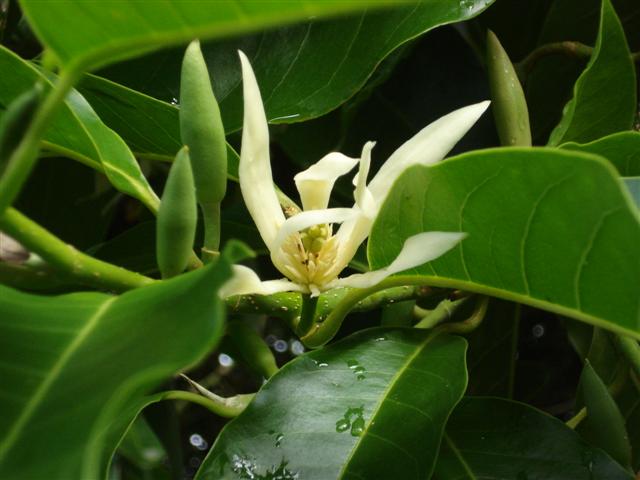
Magnolia alba - hardly spectacular flowers but an intoxicating fragance

In our southern hemisphere summer, Michelia alba is in flower. One could never describe alba as being in full flower – it just gently flowers over a long period without ever putting on a mass display. We planted it near our swimming pool so it could perfume the air in the summer months but as it grows ever larger, we are wondering if we have made a mistake. After about eight years, it is already around eight metres tall and showing no sign of slowing down. It has splendid foliage for those in warm enough climates to grow it and the flowers make up for their rather understated (almost insignificant) appearance with their heady fragrance. We have never seen any evidence that alba is fertile, either as seed parent or pollen donor and lean to the belief that it is likely that there is only one clone in existence and that is sterile. We have champaca (believed to be the seed parent of alba on the premise that alba is most likely a natural hybrid) which has attractive colour in the flowers but the forms we have seen are scruffy as garden plants.

Michelia alba, in the centre rear of the photo, has lush foliage but is growing at an alarming rate in our garden

Michelia alba, in the centre rear of the photo, has lush foliage but is growing at an alarming rate in our garden

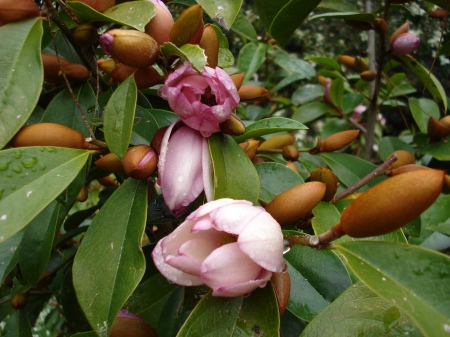
Mark’s Fairy Magnolia Blush (the first of his michelias to be released) is also summer flowering but these are random blooms which lack the colour of the main spring season. We have decided that the move to lump all magnolia relations, including michelia and mangletia, into the magnolia group is not helpful so we are going to remain with the former nomenclature at this stage. Mark is of the view that michelias are a distinct group which warrants being kept separate. As far as he knows, nobody has yet proven that they can successfully cross michelias with magnolias, or indeed mangletias although some have claimed hybrids. We will wait for proof because we doubt that it is possible to achieve crosses between distinctly different groups without scientific intervention.

Many of the deciduous magnolias are summer flowering at this time but we never get particularly excited about these. They are bonus flowers, tucked in amongst the foliage, and they lack the impact of the spring flowering on bare wood though it should be said that Black Tulip has put up some fine dark flowers this year. Iolanthe, Apollo and Serene all have summer flowers – in fact most soulangeana hybrids will do so. With our very strong sunlight (blame the depletion of the ozone layer along with our clear atmosphere) summer flowers tend to burn.
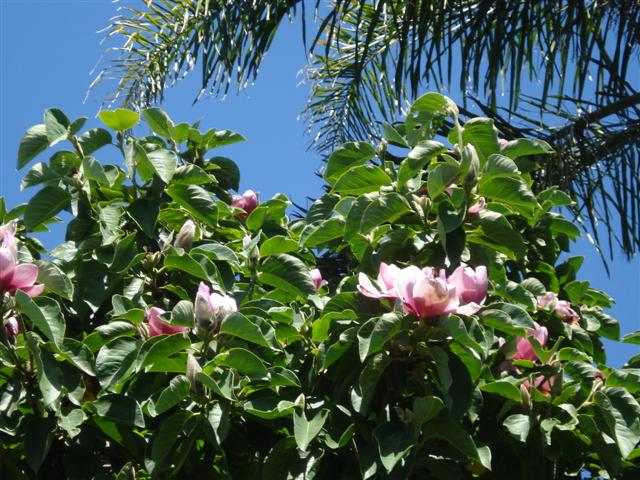
Summer flowers on Iolanthe

Magnolia Serene has stand out dark foliage. Generally speaking, the foliage on deciduous magnolias does not excite much interest and in summer, most of them are just green trees with relatively large leaves. But when we cast our eyes around a number of trees in our garden landscape, Serene stood out as having deeper colour and appearing glossier than the others nearby. We think it has considerable merit as a specimen tree for its summer foliage as well as its form and spring flowering. Some magnolias stand the test of time and this is one of Felix’s where we are surprised that it has not been picked up more widely in the marketplace. With its later flowering (ref Magnolia Diaries 11 and 12 to see the flowers) it should perform well in cooler climates.

Magnolia Diary 12, 15 September 2009

Click to see all Magnolia diary entries

Click on the Magnolia diary logo above to see all diary entries

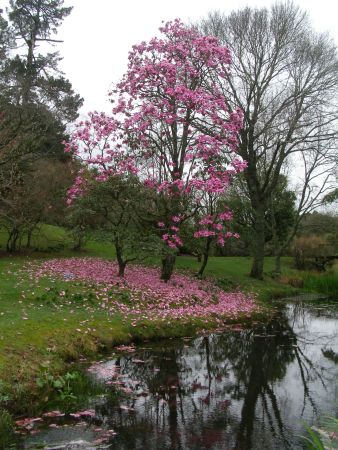
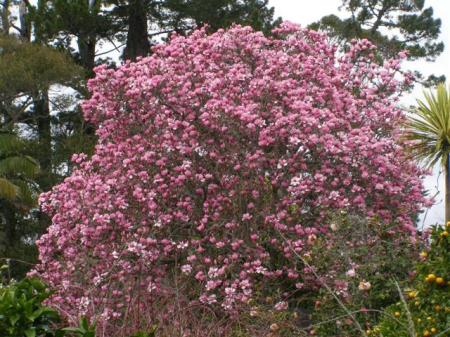
It is Magnolia Serene which is the stand out plant here in full flower this week. Big, beautiful and very pink and signalling the impending close to the deciduous flowering season for this year. This is the original plant, as bred by Felix Jury here (liliiflora x Mark Jury). The original Iolanthe may shade our vegetable garden; the original Serene drops most of its leaves and flowers into our swimming pool. Such is life when you live surrounded by trees.

Impressively pink - the original Serene

Impressively pink - the original Serene

The early yellows are in flower. While still reasonably sought after in this country as novelty plants (New Zealanders take red magnolias completely for granted but yellows are seen as unusual), the problem with most magnolias with acuminata in the breeding is that they flower too late in the season for us and the leaves have already appeared. Elizabeth, Yellow Fever and Sundance will at least flower on bare wood and are attractive enough, but what most people here expect is a butter yellow Iolanthe (ie very large, bright flowers on bare wood) and that is not anywhere to be seen yet. Instead we have pale primrose, small flowers and strappy flower form on plants that tend to rival timber trees in their rates of growth.

Magnolia Yellow Fever planted on our roadside

Magnolia Yellow Fever planted on our roadside

In New Zealand we have a harsh, bright light and the dreaded hole in the ozone layer down near Antarctica is usually getting larger at this time of the year so our sunlight is not well filtered. We are noticing quite bad burning on the late flowers on a number of magnolias. Liliiflora burns, as do liliiflora hybrids (though not Serene at this stage). It may be that extended flowering characteristics are not all they are cracked up to be here – crispy brown blooms are not a good look.

Interlocking circles of pink michelia petals

Interlocking circles of pink michelia petals

Finally, when conditions are right (no wind and light rain), we are always delighted by the sight of rings of pink petals that fall naturally around the base of our row of Fairy Magnolia Blush (Mark’s pink michelia). It is eyes down for a change, to catch this pretty sight.

Magnolia Diary 11, 9 September 2009

Click to see all Magnolia diary entries

Click on the Magnolia diary logo above to see all diary entries

Magnolia Serene, the last of Felix's selections to flower each season

Magnolia Serene, the last of Felix's selections to flower each season

Our magic spring has continued with no wind. A magnolia flowering season with a bad weather factor of only two short lived storms is a good season here. Though I am told that in the south of the province, a series of severe frosts have taken out most of the season’s display. In the deciduous magnolias, Burgundy Star flowers on and is still looking good whereas Felix’s series (Iolanthe et al) are now past their peak. Iolanthe will continue on for weeks yet, but not in her full glory. Serene is still opening. This is one variety that we have been surprised has not had more recognition overseas. Good pink colour, flower form and size, flowers later but still on bare wood and a tidy, well behaved tree. Being liliiflora x Mark Jury, it has reasonable hardiness.

Lollipopped Fairy Magnolia Blush with Magnolia Iolanthe behind

Lollipopped Fairy Magnolia Blush with Magnolia Iolanthe behind

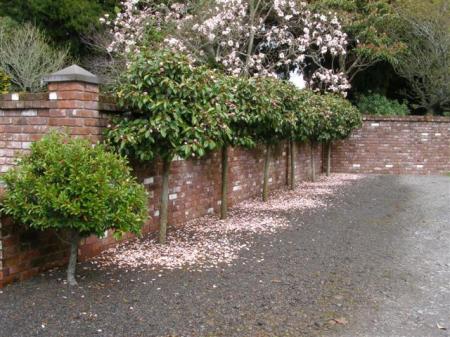
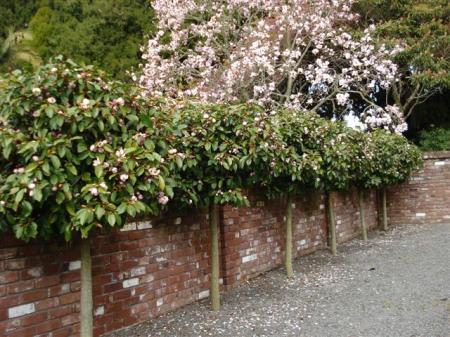
It is full on michelia season. Fairy Magnolia Blush continues in flower and the lollipop row on our frontage is looking good. They were planted in quite harsh conditions (compacted old driveway, in some cases) about five years ago but haven’t minded a bit. I give them a light clip twice a year to retain the shape but otherwise they are left entirely to their own devices.

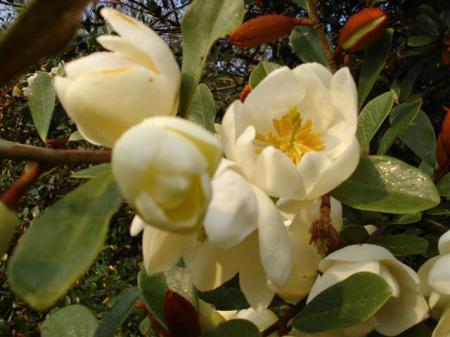
Mark’s Honey Velvet is in full flower. This is a Magnolia dianica (syn: Michelia yunnanensis) selection and every nurseryman, woman and dog has their own selection made now, so easy is it to raise seed. All we can say about Honey Velvet is that it has a honey cream coloured flower (rather than white) of good size, wonderful bud set, longer flowering season than some and good dark foliage. And it does not appear to defoliate in a cold, wet spring as some of the dianicas do. Other than that, we can’t get too excited about what is just a species selection.

Honey Velvet, Mark's dianica selection

Honey Velvet, Mark's dianica selection

We can and do get excited about the michelia breeding programme and the increasing range of deeper flower colour and size we are starting to see as Mark continues down the track of ever more complex downstream crosses. We can see real progress here but that, alas, is all we can say publicly. It was a bit of a red letter day here yesterday as Mark decided that he was happy to give the go ahead on another deciduous magnolia. Mark has only ever named three magnolias in a breeding programme which has built on his father’s work and thus spans close to five decades now with many hundreds of magnolia plants raised. So to make the decision on a fourth one is no light matter. It is still a long haul from here through final trialling and production before it ever gets anywhere near the marketplace but all we will say officially is that this one is not red.

Magnolia Diary number 4, 16 August, 2009

Click to see all Magnolia diary entries

Click on the Magnolia diary logo above to see all diary entries

Magnolia Lanarth - now past its best

Magnolia Lanarth - now past its best

One night of rain and Magnolia Lanarth is in decline for the season. Passing over. We don’t mind that Lanarth looks a picture of perfection for such a short time but we can understand that it is a problem for people who live on small sections and who prefer prolonged flowering.

sprengeri diva - great from a distance

sprengeri diva - great from a distance

Campbellii has peaked too but in front of our campbellii tree, Sweetheart (a Caerhays Belle seedling raised from a Ron Gordon plant and named by Peter Cave) is just opening and is very much pretty in pink. Sargentiana robusta and various stellatas are also opening. Sprengeri diva is in full flower and looks great from afar, but floppy and a tad scruffy when viewed close up. We need more substance in blooms in our conditions with wind and heavy rain.

Michelia doltsopa is flowering around the district. The form in our park was named and released by Peter Cave as Rusty but we have never sold it. Quite simply, we think it is too large. Sure, our plant is only around 10 metres tall – but it is a good 20 metres wide. By my maths, that means that Rusty takes up around 300 square metres of land area. That is a large plant growing from a central trunk and not suckering.

We intercepted the neighbours out sniffing on a morning amble yesterday (and diverted them to coffee). All Mark’s doltsopa hybrids are coming into flower and indeed the fragrance is delicious from the road as well as in our garden. The neighbours were wanting the full on scented experience, having detected it even while driving home.

Fairy Magnolia Blush

Fairy Magnolia Blush

For the domestic garden, Mark’s first michelia hybrid to be released is opening its flowers. Fairy Magnolia Blush is reasonably compact (and clips well) with distinctive pinky purple flowers of reasonably large size. This cultivar is on the NZ market and will become available overseas in the next few years.

The first flowers on Burgundy Star. Doltsopa seedlings behind.

The first flowers on Burgundy Star. Doltsopa seedlings behind.

The row of stock plants of Mark’s Burgundy Star are opening their first flowers though the original plant in our carpark is hardly showing colour. In our opinion, in the proper reds Burgundy Star takes the cake so far.

Royal New Zealand Institute of Horticulture (Inc.)

Mark Jury receives the Plant Raisers Award for 2007

Mark Jury is one of this country’s foremost breeders of ornamental plants, and in recent times he has received international recognition for his achievements.

Mark was born in 1951. He graduated from Massey University in 1974 with a BA in psychology, and could well be the only person with such a qualification in the NZ nursery trade. Early plans for a career in counselling changed, and he took time out to be a rock drummer (he still has his drum kit), to teach himself to draw and paint, and to make a living as a wood turner before deciding to set up a plant nursery on his father’s property at Tikorangi.

The late Felix Jury is one of the most esteemed plant breeders and horticulturists this country has produced. Felix was a farmer who took early retirement to garden and breed plants, and the numerous outstanding hybrids he produced are now internationally acclaimed. The nursery, however, is entirely Mark’s effort, one that he ‘built up from one wheelbarrow’. Contrary to popular belief, Felix never had a nursery.

Despite having no formal training in horticulture, Mark learned enormously by working alongside his father for 17 years. He also benefited greatly from having access to Felix’s plant material, and from being able to tap into the wealth of knowledge and experience that Felix freely shared.

His uncle Les Jury was also an early mentor, particularly in the breeding of camellias.

The nursery, however, has only ever been a means to earn a living for Mark, who claims he is not a dedicated nurseryman. Rather, it is plants and the garden that matter to him, and when breeding plants his quest is invariably to produce better garden subjects.

No new plant is ever released by Mark until he has full confidence in all its attributes. Trialling is an integral part of the breeding process, and new hybrids are grown in the field or the garden, as well as the nursery, to assess their performance over a number of years before they ever get put into production.

Following is a representative selection of hybrids bred by Mark Jury:

Camellias

‘Fairy Blush’ is regarded by Mark as the best of his camellia hybrids currently on the market, followed by ‘Volunteer’. ‘Jury’s Pearl’, however, is the one which brings Mark most pleasure because it achieved what he was looking for; compact growth, abundant flowering over an extended period, healthy foliage, good flower form and an almost luminescent flower colour. He has named a number of others, including ‘Gay Buttons’, ‘Pearly Cascade’, ‘Topiary Pink’, and ‘Apple Blossom Sun’. Two promising new selections yet to be released are a compact and very free flowering red formal double, and a purple pompom flowered miniature.

Rhododendrons

‘Floral Sun’ is Mark’s pride and joy. When he told his wife Abbie that he was crossing Rhododendron sino nuttalli with R. ‘RW Rye’, she recalls quipping that he would probably get offspring which were a mass of tiny white flowers and no scent. Instead he did get the yellow colourings into the nuttalli trumpets, compact growth and nuttalli foliage. He has also named ‘Floral Gift’, ‘Meadow Lemon’ and ‘Platinum Ice’, and has various others under consideration. Mark specifically strives for healthier performance, resistance to thrips and where possible fragrance.

Magnolias

The new ‘Burgundy Star’ could prove to be the best Mark has produced. It ‘loses the purple tones’ of ‘Vulcan’ and ‘Black Tulip’ and is described as carrying a very large Magnolia liliifora type flower on a fastigiate tree. ‘Black Tulip’, however, is the cultivar that has caught the imagination of the market place, while ‘Felix Jury’ is his personal favourite. Mark thinks he may have exhausted what he can do with red flowered magnolias, but he has some pinks and whites under trial. In 2004 the International Magnolia Society conferred upon Mark the prestigious Todd Gresham Magnolia Award.

Vireya rhododendrons

‘Jaffa’ and ‘Sweet Vanilla’ are regarded by Mark as probably the best cultivars he has yet named, although he has produced quite a few others. These include ‘Sherbet Rose’, ‘Peach Puff’, ‘Jellybean’, ‘Mango Sunset’, ‘Pink Jazz’. Sadly some of the others have already been dropped from production. Despite fairly rigorous trialling, when in production some are considered to be too vulnerable to root problems. ‘Festival Ruby’ is scheduled for release later this year for the 20th anniversary of the Taranaki Rhododendron Festival. Part of the vireya rhododendron breeding programme has focussed on trying to get full trusses reminiscent of the hardy rhododendrons, whilst also aiming for compact growth, fragrance and abundant flowering.

Michelias

A range of unreleased new hybrids is currently generating great excitement and anticipation amongst those who have seen them. This series extends the colour range of the flowers, growth habits, foliage and flowering season. Mark is optimistic of a great future for these, seeing them fitting a market niche similar to camellias but without most of the problems such as camellia petal blight and yellowing of foliage. The first two cultivars from this series are scheduled for release next year.

Cordylines

‘Red Fountain’ is a hybrid produced by Felix, while Mark introduced it. The next generations of Mark’s cordylines are currently under development.

Dianella ‘Golden Chance’ (so-named because it was a chance discovery) seems to have entered the marketplace with ‘a bit of a whoosh’, somewhat to the surprise of Mark and Abbie.

Mark often ‘plays’ with other plants to produce even more high quality garden subjects. His Arisaema hybrids are regarded as particularly fetching, extending the colour range and holding their blooms above the foliage, but sadly they are unlikely to enter commerce. Unfortunately for gardeners, the same applies to a number of other plants that he ‘wields his paintbrush around’.

It is appropriate that the Institute recognises Mark Jury for his considerable contribution to amenity horticulture. He is a most worthy recipient of the Plant Raisers award.