Tag Archives: Felix Jury

Plant Collector – auratum lilies

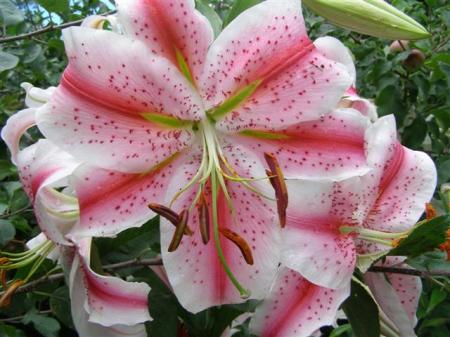
Auratum lily Flossie - one of Felix Jury's hybrids

Auratum lily Flossie - one of Felix Jury's hybrids

I don’t cut flowers to bring indoors very often. When every window of the house looks out to a garden, it doesn’t seem necessary. But as soon as the auratum lilies start to open, I reach for the kitchen scissors and head out. They are just the perfect cut flower – one stem can have up to ten flowers (sometimes even more) and put in a tall, slender vase they not only look superb, they can spread their delicious scent through an entire room.

Auratums are known as the golden-rayed lily of Japan – how lovely does that sound? The flowers are the largest of the lily family, often more than 20cm across, and they are a mainstay of our January garden. Felix Jury adored them (probably for all the same reasons that we do) and dabbled with breeding them, naming several selections. This one is the very large flowered Flossie. The upshot is that we have a lot of auratums in the garden and generally they are quite happy with benign neglect, growing in both full sun and semi shade. They prefer soils with good drainage and plenty of humus but not too rich.

The bulbs are large – fist-sized even – and we tried to get around all the plants last winter to dig and divide them. They haven’t had any attention for many, many years but when the clumps get too congested, the tops tend to fall over if they are not staked. The freshly divided patches are mostly standing up like little soldiers without any assistance. Some of the taller ones can get over 2m high and they need some support though often I will intertwine them through neighbouring plants.

You can sometimes find lily bulbs for sale in garden centres in winter. Make sure you avoid any dry, shrivelled specimens – they do not like to be dried out completely even when dormant. You may be lucky and find some auratums but they are not widely offered on the NZ market despite their spectacular summer display.

Plant Collector: Rhododendron Floral Legacy

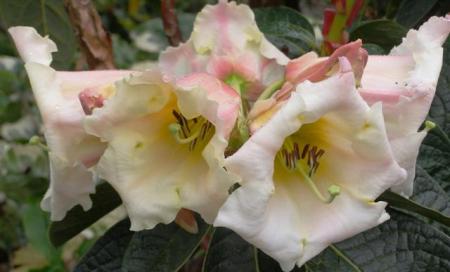
Floral Legacy - aptly named, perhaps

Floral Legacy - aptly named, perhaps

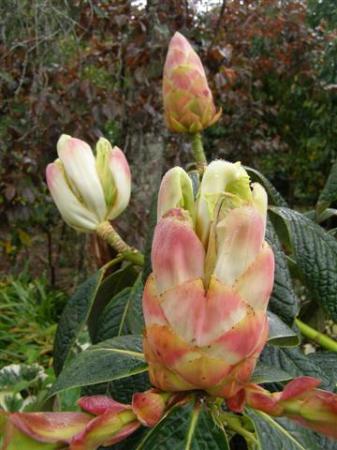
Even the buds are spectacular

Even the buds are spectacular

In honour of our Taranaki Rhododendron and Garden Festival which starts today, I had to choose a rhododendron this week and could there be a more splendid choice than the elite nuttallii family? This is like the Rolls Royce of the rhododendron world – a spectacular statement of style. The flowers are the largest of any rhododendron – each flower being about 15cm long, tubular with frilly edges and very fragrant. The leaves are large and what is called bullate – heavily textured and veined, like stiff corduroy fabric. Even the massive flower buds are spectacular. The nuttalliis come from that northern band from Upper Burma across Tibet and India, the sinonuttalliis from China (sino means Chinese in the plant world). This form is a cross between the two, which means technically it still a species and it was done here by the late Felix Jury to get better garden forms. It is quite a legacy.

The nuttallii family have been used in breeding to give cultivars like White Waves, Lady Dorothy Ella, Mi Amor and Yvonne Scott although none of the hybrids I have seen keep the size of the parent flowers and leaves. Both the species and the hybrids have a tendency to rangy, open growth but the beautiful peeling bark and cinnamon colour compensate because this is yet another feature for this handsome family. We are completely besotted with them and luckily we have very good conditions for growing them. There are large parts of the world where it is just too cold to grow these handsome plants.

Plant Collector: Magnolia Serene

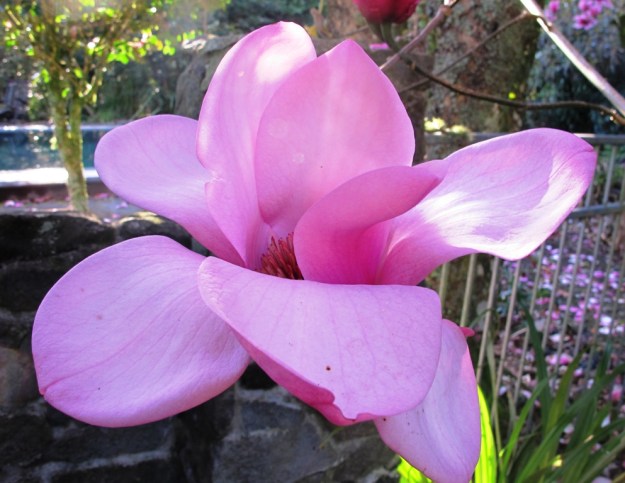
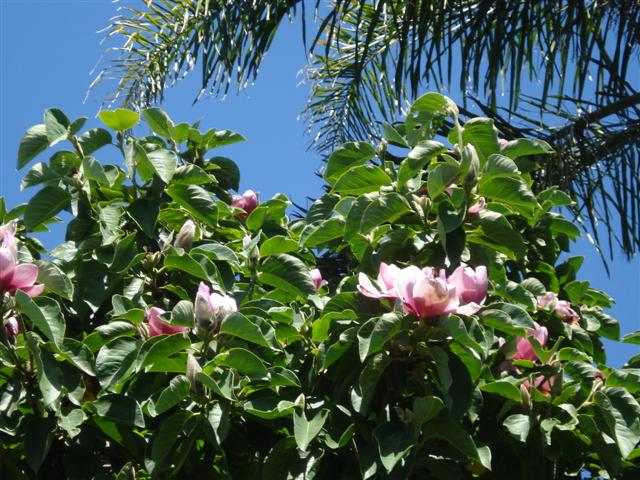
The very pink Magnolia Serene in full bloom

The very pink Magnolia Serene in full bloom

For us, Serene in full flower heralds the last chapter of the magnolia season each year. It is the latest and the last of the Jury magnolias to flower. It is also the pinkest. This is another of the series named by Felix Jury back in the early 1970s and the original tree now stands around six metres tall and is pyramidal in shape rather than spreading. In full flower, it is just a mass of large rosy pink bowl-shaped blooms.

001Being so late to flower, Serene is an excellent choice for people in colder areas or prone to late frosts. It also tends to miss the worst of the equinoctial winds. Cold conditions will make the plant adjust to blooming even later but Serene does get its flowers through before its foliage. We are picky here – we want deciduous magnolias to mass flower on bare stems before the new season’s leaves unfurl. When the leaves do come, they are a particularly good deep green and tidy in form so Serene stands out as a good summer foliage plant in a way in which few deciduous magnolias do. It will also set a flush of summer flowers which is bonus territory.
Serene was another of the series Felix bred using his wonder breeder parent, slightly embarrassingly named Magnolia Mark Jury. Its other parent is liliiflora.

The Jury Plants – Cordyline Red Fountain

CORDYLINE RED FOUNTAIN (syn. Festival Grass and Festival Burgundy).

A flagship Jury plant, this one, the result of many years of effort which started with two different plant genus altogether. Initially there was the work Felix did with coloured and variegated flaxes (phormium). One of the most successful plants internationally became Phormium Yellow Wave – widely grown to this day in British gardens. We have always joked that had Felix received just one cent royalty for every Yellow Wave sold, we would never have had to earn a living but back in the 1960s, there was no protection of intellectual property rights and no expectation that a breeder be rewarded financially. There were other coloured cultivars (including Misty Sunrise and Pinky) from the breeding flurry but these have not stayed in the marketplace as Yellow Wave has. However, these coloured phormiums perform better in other places than our climate with its high humidity. We struggle to keep good foliage and they look pretty tatty and badly marked by insect and rust damage along with growing too large for a small garden. So Felix moved on to the next plant genus which offered similar clumping habit and pointed leaves without being spiky.

Over 30 years ago, Felix and Mark were both fascinated by the habit and appearance of our native Astelia chathamica (often sold under a cultivar name of Silver Spear). There was little that needed improving in the pointed silver leaves of this clump forming plant, but both father and son saw the potential in trying to create a different colour-way with red foliage. So began a twenty year effort before Mark pulled the plug and decided that his red astelias were simply too difficult and too unreliable to market widely. We still have them in cultivation in the garden here and a few of the selected clone were released by us onto the market. Other seedlings found their way onto the market by devious means on the part of a third party (that is a story best kept in-house) but clearly others found the plant just as difficult to build up – and indeed to keep alive at all – because it has never been a huge commercial hit despite the demand. Sometimes breeding directions are more blind alley than interesting path and Mark reluctantly abandoned the red astelia.

Undeterred, Felix looked to the cordyline genus where he crossed two lesser known NZ forms – banksii and pumilio. In this country where Cordyline australis is by far and away the most common form around (called cabbage trees and an icon of our country), cordylines are expected to have trunks and grow several metres tall. When Mark raised the seed from this cross, there was the lucky break which came to be called Red Fountain in the first instance (but also marketed in the US as Festival Grass and Festival Burgundy).

It is clumping, rarely putting up a trunk much above 10cm with exceptionally good colouring in shiny burgundy red which lasts all year round. The narrow strappy leaves are relatively soft and fountain out around the base. In early summer, the tall, arching flower spikes are in pale lilac and highly fragrant.

Cordyline Red Fountain – one of our flagship plants here

We have been delighted at the success of this cultivar on the international market, thanks to the efforts of Anthony Tesselaar International in the capacity of our agent. Less delighted, one might say with the efforts of competitors to come in behind it with ring-ins and substitutes, some even raised from Red Fountain (how we wish they would show some originality and come up with their own ideas) but we are confident that nothing has yet appeared that is the equal of Red Fountain.

Mark has continued with the cordyline breeding, but with the market being flooded with different cordylines from other sources, many proving difficult and unreliable, he has put any further releases on hold.

Magnolia Diary 14, February 19, 2010

Click to see all Magnolia diary entries

Click on the Magnolia diary logo above to see all diary entries

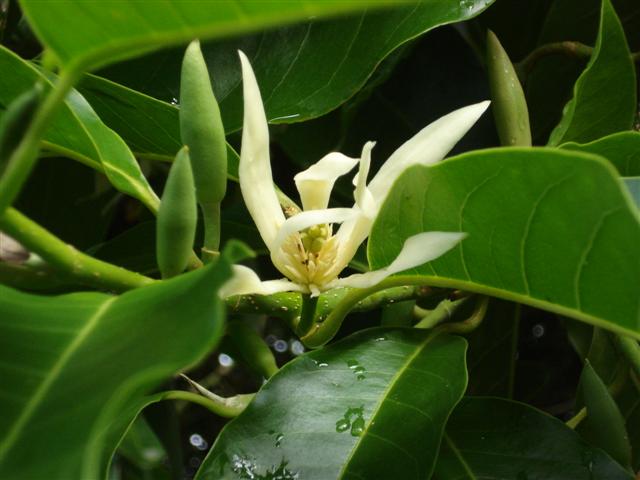
Magnolia alba - hardly spectacular flowers but an intoxicating fragance

In our southern hemisphere summer, Michelia alba is in flower. One could never describe alba as being in full flower – it just gently flowers over a long period without ever putting on a mass display. We planted it near our swimming pool so it could perfume the air in the summer months but as it grows ever larger, we are wondering if we have made a mistake. After about eight years, it is already around eight metres tall and showing no sign of slowing down. It has splendid foliage for those in warm enough climates to grow it and the flowers make up for their rather understated (almost insignificant) appearance with their heady fragrance. We have never seen any evidence that alba is fertile, either as seed parent or pollen donor and lean to the belief that it is likely that there is only one clone in existence and that is sterile. We have champaca (believed to be the seed parent of alba on the premise that alba is most likely a natural hybrid) which has attractive colour in the flowers but the forms we have seen are scruffy as garden plants.

Michelia alba, in the centre rear of the photo, has lush foliage but is growing at an alarming rate in our garden

Michelia alba, in the centre rear of the photo, has lush foliage but is growing at an alarming rate in our garden

Mark’s Fairy Magnolia Blush (the first of his michelias to be released) is also summer flowering but these are random blooms which lack the colour of the main spring season. We have decided that the move to lump all magnolia relations, including michelia and mangletia, into the magnolia group is not helpful so we are going to remain with the former nomenclature at this stage. Mark is of the view that michelias are a distinct group which warrants being kept separate. As far as he knows, nobody has yet proven that they can successfully cross michelias with magnolias, or indeed mangletias although some have claimed hybrids. We will wait for proof because we doubt that it is possible to achieve crosses between distinctly different groups without scientific intervention.

Many of the deciduous magnolias are summer flowering at this time but we never get particularly excited about these. They are bonus flowers, tucked in amongst the foliage, and they lack the impact of the spring flowering on bare wood though it should be said that Black Tulip has put up some fine dark flowers this year. Iolanthe, Apollo and Serene all have summer flowers – in fact most soulangeana hybrids will do so. With our very strong sunlight (blame the depletion of the ozone layer along with our clear atmosphere) summer flowers tend to burn.

Summer flowers on Iolanthe

Magnolia Serene has stand out dark foliage. Generally speaking, the foliage on deciduous magnolias does not excite much interest and in summer, most of them are just green trees with relatively large leaves. But when we cast our eyes around a number of trees in our garden landscape, Serene stood out as having deeper colour and appearing glossier than the others nearby. We think it has considerable merit as a specimen tree for its summer foliage as well as its form and spring flowering. Some magnolias stand the test of time and this is one of Felix’s where we are surprised that it has not been picked up more widely in the marketplace. With its later flowering (ref Magnolia Diaries 11 and 12 to see the flowers) it should perform well in cooler climates.