Tag Archives: Felix Jury

Magnolia Diary 14, February 19, 2010

Click to see all Magnolia diary entries

Click on the Magnolia diary logo above to see all diary entries
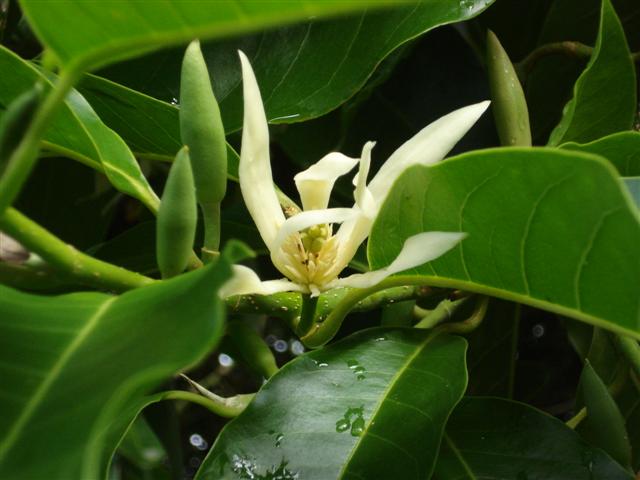
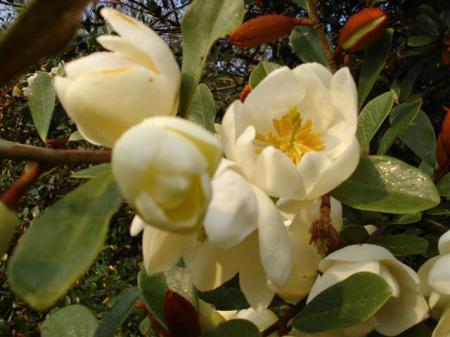
Magnolia alba - hardly spectacular flowers but an intoxicating fragance

In our southern hemisphere summer, Michelia alba is in flower. One could never describe alba as being in full flower – it just gently flowers over a long period without ever putting on a mass display. We planted it near our swimming pool so it could perfume the air in the summer months but as it grows ever larger, we are wondering if we have made a mistake. After about eight years, it is already around eight metres tall and showing no sign of slowing down. It has splendid foliage for those in warm enough climates to grow it and the flowers make up for their rather understated (almost insignificant) appearance with their heady fragrance. We have never seen any evidence that alba is fertile, either as seed parent or pollen donor and lean to the belief that it is likely that there is only one clone in existence and that is sterile. We have champaca (believed to be the seed parent of alba on the premise that alba is most likely a natural hybrid) which has attractive colour in the flowers but the forms we have seen are scruffy as garden plants.

Michelia alba, in the centre rear of the photo, has lush foliage but is growing at an alarming rate in our garden

Michelia alba, in the centre rear of the photo, has lush foliage but is growing at an alarming rate in our garden

Mark’s Fairy Magnolia Blush (the first of his michelias to be released) is also summer flowering but these are random blooms which lack the colour of the main spring season. We have decided that the move to lump all magnolia relations, including michelia and mangletia, into the magnolia group is not helpful so we are going to remain with the former nomenclature at this stage. Mark is of the view that michelias are a distinct group which warrants being kept separate. As far as he knows, nobody has yet proven that they can successfully cross michelias with magnolias, or indeed mangletias although some have claimed hybrids. We will wait for proof because we doubt that it is possible to achieve crosses between distinctly different groups without scientific intervention.

Many of the deciduous magnolias are summer flowering at this time but we never get particularly excited about these. They are bonus flowers, tucked in amongst the foliage, and they lack the impact of the spring flowering on bare wood though it should be said that Black Tulip has put up some fine dark flowers this year. Iolanthe, Apollo and Serene all have summer flowers – in fact most soulangeana hybrids will do so. With our very strong sunlight (blame the depletion of the ozone layer along with our clear atmosphere) summer flowers tend to burn.
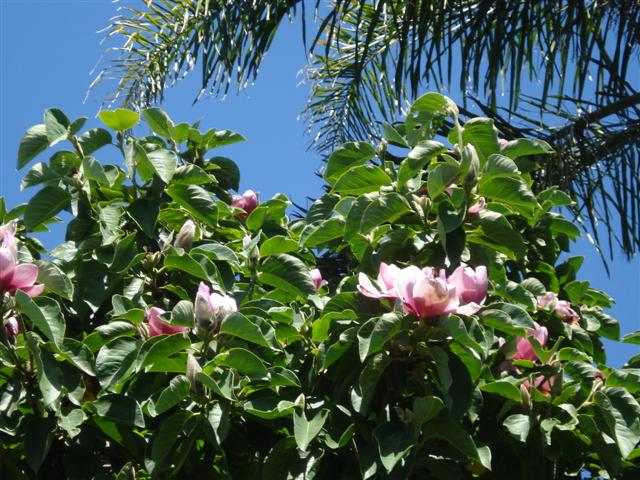
Summer flowers on Iolanthe

Magnolia Serene has stand out dark foliage. Generally speaking, the foliage on deciduous magnolias does not excite much interest and in summer, most of them are just green trees with relatively large leaves. But when we cast our eyes around a number of trees in our garden landscape, Serene stood out as having deeper colour and appearing glossier than the others nearby. We think it has considerable merit as a specimen tree for its summer foliage as well as its form and spring flowering. Some magnolias stand the test of time and this is one of Felix’s where we are surprised that it has not been picked up more widely in the marketplace. With its later flowering (ref Magnolia Diaries 11 and 12 to see the flowers) it should perform well in cooler climates.

Flowering this week: Rhododendron Bernice

Rhododendron Bernice - very local in origin and name

Rhododendron Bernice - very local in origin and name

Over the past fifty years, the quest here has been to breed rhododendrons better suited to growing in warmer climates and not inclined to the nasty silver leaves caused by thrip (a common leaf sucking insect). In its time, Bernice was an advance in colour and size in the maddenii group of rhododendrons. Its parents are polyandrum (which gave some scent and increased flower size) and Royal Flush Townhill (which contributed the colour genes). It has flat trusses of bell-shaped flowers and can give the impression of a wall of bloom with almost no foliage showing. Over the decades, we have seen many varieties come and go but Bernice has stood the test of time and remains one of our top picks for a brilliant performer right on cue every year.

Pronounced Burniss, not Ber-neice, as I can say with authority because this, arguably the best performing rhododendron Felix Jury selected, was named for his wife’s best friend – Bernice Kelly. Mrs Kelly was an old Waitara identity whom I recall well as a down to earth character who physically made the concrete blocks for the cottage she and her husband built. These days there are pensioner cottages on the site, but the memory of Mrs Kelly lives on in the rhododendron named for her.

Magnolia Diary 12, 15 September 2009

Click to see all Magnolia diary entries

Click on the Magnolia diary logo above to see all diary entries

It is Magnolia Serene which is the stand out plant here in full flower this week. Big, beautiful and very pink and signalling the impending close to the deciduous flowering season for this year. This is the original plant, as bred by Felix Jury here (liliiflora x Mark Jury). The original Iolanthe may shade our vegetable garden; the original Serene drops most of its leaves and flowers into our swimming pool. Such is life when you live surrounded by trees.

Impressively pink - the original Serene

Impressively pink - the original Serene

The early yellows are in flower. While still reasonably sought after in this country as novelty plants (New Zealanders take red magnolias completely for granted but yellows are seen as unusual), the problem with most magnolias with acuminata in the breeding is that they flower too late in the season for us and the leaves have already appeared. Elizabeth, Yellow Fever and Sundance will at least flower on bare wood and are attractive enough, but what most people here expect is a butter yellow Iolanthe (ie very large, bright flowers on bare wood) and that is not anywhere to be seen yet. Instead we have pale primrose, small flowers and strappy flower form on plants that tend to rival timber trees in their rates of growth.

Magnolia Yellow Fever planted on our roadside

Magnolia Yellow Fever planted on our roadside

In New Zealand we have a harsh, bright light and the dreaded hole in the ozone layer down near Antarctica is usually getting larger at this time of the year so our sunlight is not well filtered. We are noticing quite bad burning on the late flowers on a number of magnolias. Liliiflora burns, as do liliiflora hybrids (though not Serene at this stage). It may be that extended flowering characteristics are not all they are cracked up to be here – crispy brown blooms are not a good look.

Interlocking circles of pink michelia petals

Interlocking circles of pink michelia petals

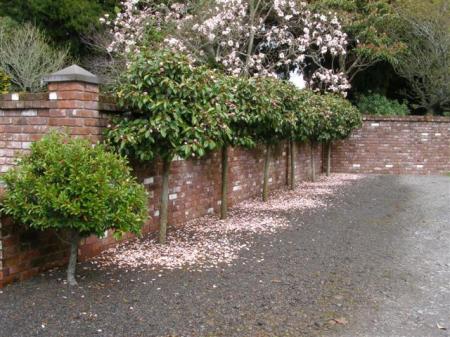
Finally, when conditions are right (no wind and light rain), we are always delighted by the sight of rings of pink petals that fall naturally around the base of our row of Fairy Magnolia Blush (Mark’s pink michelia). It is eyes down for a change, to catch this pretty sight.

Magnolia Diary 11, 9 September 2009

Click to see all Magnolia diary entries

Click on the Magnolia diary logo above to see all diary entries

Magnolia Serene, the last of Felix's selections to flower each season

Magnolia Serene, the last of Felix's selections to flower each season

Our magic spring has continued with no wind. A magnolia flowering season with a bad weather factor of only two short lived storms is a good season here. Though I am told that in the south of the province, a series of severe frosts have taken out most of the season’s display. In the deciduous magnolias, Burgundy Star flowers on and is still looking good whereas Felix’s series (Iolanthe et al) are now past their peak. Iolanthe will continue on for weeks yet, but not in her full glory. Serene is still opening. This is one variety that we have been surprised has not had more recognition overseas. Good pink colour, flower form and size, flowers later but still on bare wood and a tidy, well behaved tree. Being liliiflora x Mark Jury, it has reasonable hardiness.

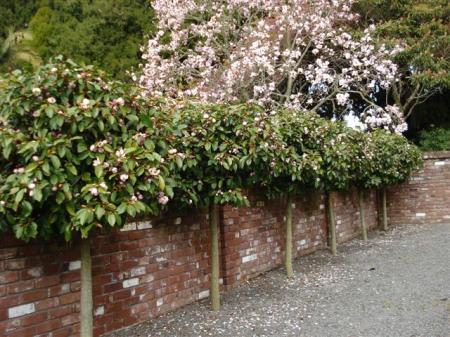
Lollipopped Fairy Magnolia Blush with Magnolia Iolanthe behind

Lollipopped Fairy Magnolia Blush with Magnolia Iolanthe behind

It is full on michelia season. Fairy Magnolia Blush continues in flower and the lollipop row on our frontage is looking good. They were planted in quite harsh conditions (compacted old driveway, in some cases) about five years ago but haven’t minded a bit. I give them a light clip twice a year to retain the shape but otherwise they are left entirely to their own devices.

Mark’s Honey Velvet is in full flower. This is a Magnolia dianica (syn: Michelia yunnanensis) selection and every nurseryman, woman and dog has their own selection made now, so easy is it to raise seed. All we can say about Honey Velvet is that it has a honey cream coloured flower (rather than white) of good size, wonderful bud set, longer flowering season than some and good dark foliage. And it does not appear to defoliate in a cold, wet spring as some of the dianicas do. Other than that, we can’t get too excited about what is just a species selection.

Honey Velvet, Mark's dianica selection

Honey Velvet, Mark's dianica selection

We can and do get excited about the michelia breeding programme and the increasing range of deeper flower colour and size we are starting to see as Mark continues down the track of ever more complex downstream crosses. We can see real progress here but that, alas, is all we can say publicly. It was a bit of a red letter day here yesterday as Mark decided that he was happy to give the go ahead on another deciduous magnolia. Mark has only ever named three magnolias in a breeding programme which has built on his father’s work and thus spans close to five decades now with many hundreds of magnolia plants raised. So to make the decision on a fourth one is no light matter. It is still a long haul from here through final trialling and production before it ever gets anywhere near the marketplace but all we will say officially is that this one is not red.

Flowering this week – Magnolia Iolanthe

Iolanthe - unsurpassed this week

Iolanthe – unsurpassed this week

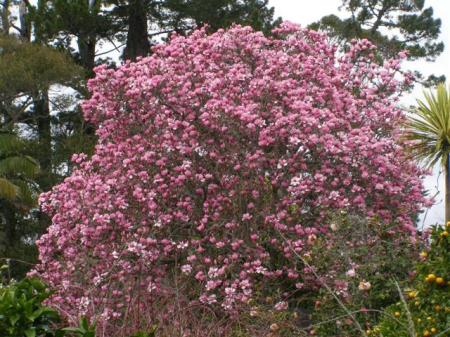
Yes, I admit it we are rather dominated by magnolias at the moment but at this time of the year we live and breathe them and the current all-round-simply-astounding plant has to be the original Magnolia Iolanthe. It is a tree of grand proportions after nearly fifty years and in full flower, it really can take your breath away. We describe it as the original Iolanthe because it really-o truly-o is the first plant, grown from a seed of a controlled cross by Felix Jury. A controlled cross is a deliberately managed hybrid, as opposed to a chance seedling. He heeled a number of the resulting seedlings into his vegetable garden, intending to plant them out to beautify Waitara but Iolanthe popped open a flower. And even that first flower indicated it was pretty special. So special in fact that the plant remained where it was heeled in and these days Mark is moving the vegetable garden rather than attacking the tree. All other Iolanthes around New Zealand and the world have been propagated in the first instance from the tree that graces our driveway.

We still rate Iolanthe as a top variety in the soft lilac-pink and cream colour range. It has a very large flower and because it sets flower buds down the stem, the flowering season is long. If one set of blooms is damaged (the hail storm on Tuesday last week wasn’t great and nor was the follow up last Sunday), within a week a fresh set of buds opens. And there is a second flowering in summer. We did once see Iolanthe plants being sold in a garden centre with labels describing it as a small tree to two metres. I don’t think so, but if you have sufficient space, Iolanthe is unlikely to disappoint..

The inspiration for the name came from the late Iolanthe Small, the dedicated plantswoman who spent the better part of her lifetime working in the Fernery at Pukekura Park.