Tag Archives: garden quotes

Garden Lore

“I fear I am a little impatient of the school of gardening that encourages the selection of plants merely as artistic furniture, chosen for colour only, like ribbons or embroidery silk. I feel sorry for plants that are obliged to make a struggle for life in uncongenial situations, because their owner wishes all things of those shades of pink, blue or orange to fit in next to the grey or crimson planting.”

Edward Augustus Bowles My Garden in Spring (1914)
OLYMPUS DIGITAL CAMERA

Garden Lore: arum lilies

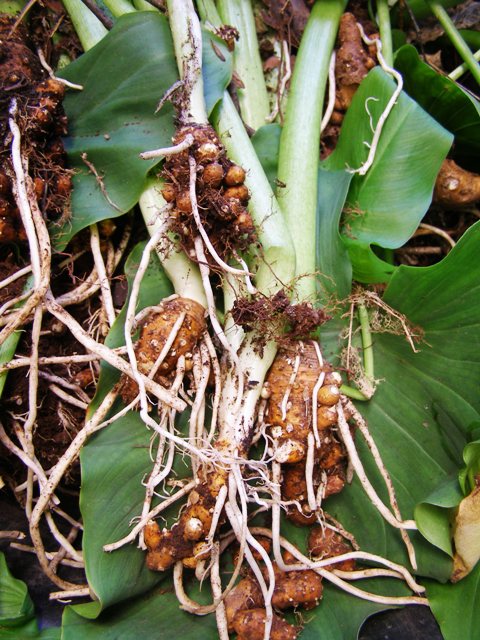
Arum lilies are something of a scourge in this country. These are the remains of a selected white splashed-green flowered form called ‘Green Goddess’. I have just done what I hope is the final clean up in my eradication efforts. You can imagine the hollow laugh of disbelief from Mark when I informed him that ‘Green Goddess’ has an Award of Merit from Britain’s prestigious Royal Horticultural Society. It is clearly not a weed there, no sirree.

The common weedy arum here is from South Africa and is Zantedeschia aethiopica, although Z. italicum is also a problem. The issue is that these plants just do too well here. They are tolerant of a very wide range of conditions and, being toxic, stock won’t touch them so they can multiply even on grazed land. Not only do they spread by seed but you can see from the root system why they can be difficult to eradicate. The rhizome below ground has numerous offsets and every one has the potential to grow to a separate plant.

I eradicated by digging carefully and thoroughly gathering all the baby offsets. Don’t risk composting them. Either dry and then burn them or put them out in the rubbish for deep burial at landfill. Never, ever dump them on the roadside. I have just done what I hope is the final follow-up to root out the remaining stragglers after 3 years. If you want to go the chemical way, the Weedbusters website recommends metsulforon-methyl with glyphosate and penetrant (to make it stick). Or Escort is what Mark recommends – that is the metsulforon-methyl bit.

The smaller growing, coloured zantedeschias that are often known as calla lilies are generally derived from different species and do not show the same weedy inclination, being prized as cut flowers and making excellent garden plants. However, they are apparently all equally toxic so take care when handling them as their sap can burn.

First published in the Waikato Times and reprinted here with their permission.

Garden Lore

“Nature is the gardener’s opponent. The gardener who pretends he is in love with her, has to destroy her climaxes of vegetation and make…an alliance with her which she will be the first to break without warning, in the most treasonable way she can. She sneaks in, she inserts her weeds, her couch-grass, her ground elder, her plantain, her greenfly and her slugs behind his back. The bitch.”

Geoffrey Grigson “Gardenage” 1952.

051Garden lore: raising dahlias from seed

These cheerful single dahlia blooms all came from open pollinated seed gathered from a simple yellow variety. While dahlias are easy to increase by lifting and dividing the tubers when dormant in winter, any new plants raised that way will be identical to the original plant. Raising seed gives variation and in some situations, that variation is interesting to have. We didn’t start with many dahlias here so we were surprised at the range of colour from near white, through yellow, orange, bright pink to deep red. Some of the seedlings flowered in the first year from sowing and all flowered by the second summer so it is an economical way of building up numbers for planting larger areas.

“Open pollinated seed” just means that we left the bees to pollinate the flowers and gathered the seed when it was ripe. It is what happens every day in the natural environment. It is not likely that we will ever get a brilliant seedling through – something stand-out, different and worth commercialising, but that is not what we are after. Nor will we get some of the remarkable forms that are prized by dahlia aficionados – collerette, pompom, cactus, anemone and others. The vast majority of seedlings will be singles but the percentage of doubles will increase if you are collecting the seed from a double parent. We just wanted them as fillers for the summer garden and we personally prefer the single blooms which also feed the bees and the butterflies.

First published in the Waikato Times and reprinted here with their permission.

Garden Lore

“A U garden need not be large. Herbaceous borders are U, and so are weeds. Neat beds of annuals and yellow conifers, especially the dwarf species, are non-U. But yew is always U.”

Robin Brackenbury What are U? (1969)

005 (2)
Garden Lore: Moving plants

It is possible to move relatively large plants, though this row is an example of doing it all wrong. Hauled out by rope in late spring – some are visibly ring barked – then reportedly left to lie for weeks with exposed roots and no watering before replanting. They were probably never trimmed to reduce stress. Plants are not that tough.

The best time to relocate large plants is in late autumn or winter and the process should be started six weeks in advance by wrenching the plant. This is cutting the roots on one side at a time every couple of weeks and allowing the plant to rest and recover from the shock. The root mass needs to be left as large as possible and the hole should have been prepared in advance so the plant is moved straight to its new location. That way the roots don’t dry out and the long lead in time allows the plant to start forming new roots.

Chances of a successful transplant are increased if the top is trimmed by maybe a third. If you take out entire branches to shape the tree, it usually looks better than giving a chainsaw haircut all over and it means you can keep a central leader or trunk. Moving in late autumn or winter means the plant is not in full growth so it is less shocked and there is generally enough rain to avoid the need to water over the next months.

If you don’t have the means to do it properly, it can be faster to start with a much smaller plant and to give it optimal conditions to grow rapidly. There is a bit of wasted work in this row down the road from where I live.

First published in the Waikato Times and reprinted here with their permission.

Garden Lore

“Now that all the other many-hued flowers have scattered without a trace, the dead white head of the miscanthus remains alone in the fields until the end of winter. As it stands there so gracefully, not realising that it has entered its dotage, and bending its head as if in memory of past glories, it looks exactly like a very old person, and one cannot help feeling sorry for it.”

Sei Shonagon The Pillow Book of Sei Shonagaon (tenth century, translated by Ivan Morris 1967)

023Garden Lore: Mulching with lawn clippings
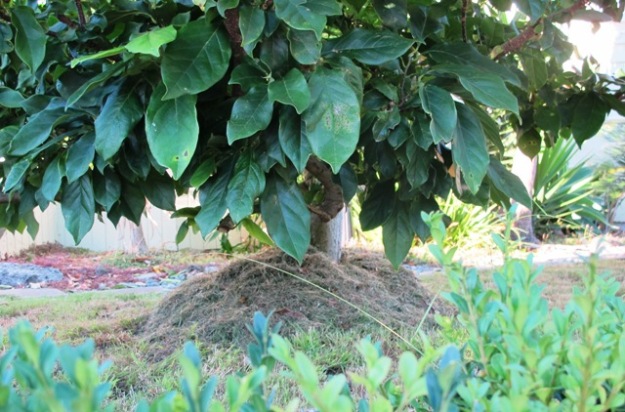
Naturally I stopped to look at this magnolia tree in a garden in Auckland. I was trying to work out if it was our Magnolia Black Tulip, bred here by my Mark. I think it was but I was so disturbed by the grass clippings beneath that I wanted to knock on their door and proffer advice. There is nothing wrong with using grass clippings as a mulch but with two provisos.

Most importantly, keep the clippings clear of the trunk of the tree. The main risk is opening up the tree to collar rot by encasing the trunk in warm, moist material. This enables fungal disease to get in, damaging the outer tissue of the stem or trunk. This can be fatal over time and the tree is likely to show damage by dying from the top down.

Keep the clippings to a relatively shallow depth, maybe 10cm. Grass can generate quite a bit of heat as it starts to compost and few plants appreciate their roots and trunks or stems being heated. In this case, I think they have the grass clippings piled on much too deeply and they are probably adding to them regularly. At the very least, clearing a breathing space of a few centimetres around the trunk would be good practice to avoid potential problems. Prevention is always better than scrambling to find a cure when one suddenly realises the tree is looking sick.

First published in the Waikato Times and reprinted here with their permission.

Garden Lore Friday Jan 31 ,2013

“By the time you have grown two thousand species you could believe that you had exhausted Nature’s imaginative variability; by the time you have grown five thousand you realise you never will.”
Geoffrey Charlesworth, The Opinionated Gardener (1988)
OLYMPUS DIGITAL CAMERA
Garden Lore: wheelbarrows
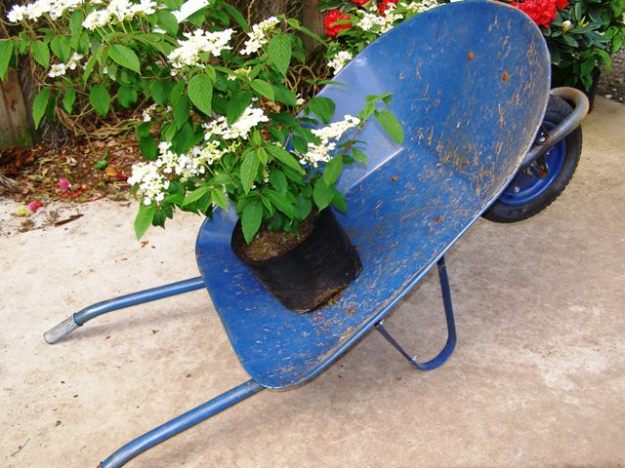
Quite possibly, you may not have pondered the origins of the wheelbarrow but when you think about it, it is a design of some genius – a single wheeled cart with great manoeuvrability which enables the pusher to move pretty heavy loads and to tip them out easily. Its origins go back in the mists of time. Chinese history often attributes its invention to Chuko Liang around AD 200, when records show it being used to transport military equipment and supplies. There is some evidence that it dates back even earlier and there is a school of thought that it may even go back as far as Ancient Greece around BC 400. It did not come into wide use in Europe until the Middle Ages but when it did, it must have made life a lot easier.

The position of the wheel varied from the middle to the front throughout history but has now settled on the latter. The whole principle of the single wheeled barrow is the even distribution of weight. After 2000 years, you would think we could get this right every time but that is far from true. There are too many barrows – particularly at the cheaper end of the market – which will tip over easily unless you load them perfectly, starting from their centre point of balance. If you are buying a new barrow, try placing something a little weighty right at the back and then at the side. A well designed barrow won’t tip.

First published in the Waikato Times and reprinted here with their permission.