Tag Archives: gardening

Rather too much winter firewood has arrived

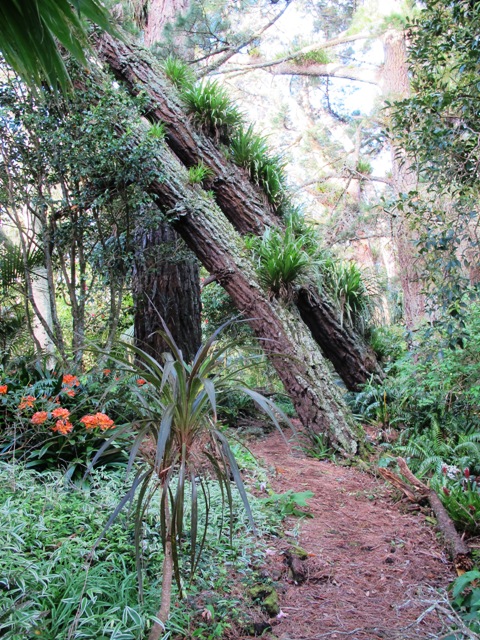
Over the decades, the angle of lean increased past the point of balance. After 80 years, these two pines fell.

Over the decades, the angle of lean increased past the point of balance. After 80 years, these two pines fell.

There I was mentally prepared to write on an entirely different topic this week when yet another tree fell here yesterday. One large old tree falling is bothersome and relatively major. Four in under four months is unprecedented here. While we possibly have more very large trees in our garden than most, thanks to Mark’s forbears, my conversations on the social medium of Twitter last night made me realise that there are a fair number of other people who are worried about large specimens at their places.

First to go here were two 80 year old Pinus radiata last October. They had been on a lean for decades but one Saturday I suggested to Mark that the lean had increased. He scoffed but on the Sunday, he conceded I might be right. On Monday he thought maybe we should be barricading off the area because our garden was still open to the public but they fell by lunchtime. We did the immediate clean up but the large trunks are still blocking one path and need some attention.

At least when the gum tree fell over, it ripped its roots out. A brave clump of clivias is unscathed.

At least when the gum tree fell over, it ripped its roots out. A brave clump of clivias is unscathed.

Ten days ago I heard a crash in the night but no whump at the end (falling trees crack, crash and then whump when they hit the ground) so I thought it must be a large branch. Mark heard nothing and was sure I had imagined it until we found the fallen gum tree the next morning. It had been planted by his great grandfather around the late 1870s so it was quite large but it fell down the hill, mostly out of harm’s way, although another path is now blocked.

Yesterday I heard the ominous sound of cracking and looked up to see one of our largest pines coming down. These are about 50 metres tall and 140 years old. That is a lot of pine. It is a bit more problematic to clean up because it has not uprooted but instead snapped without fully detaching, maybe 6 metres up where Mark’s grandfather had topped the pines back around 1900.
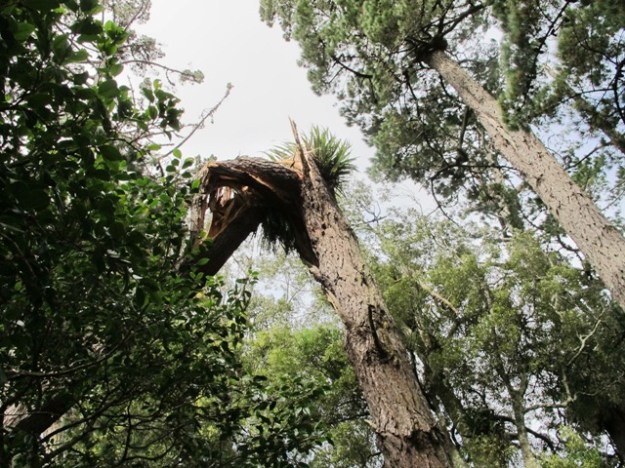
The latest pine to fall, failed to snap off cleanly, maybe 6 metres up.

The latest pine to fall, failed to snap off cleanly, maybe 6 metres up.

Even I am surprised at the philosophical and matter of fact approach adopted by the two menfolk in my life (the one I am married to and the one we pay wages to). The cleanup has started. We will have sufficient pine cones to last us several winters and there is no fear of running out of firewood here despite the fact we burn prodigious amounts.
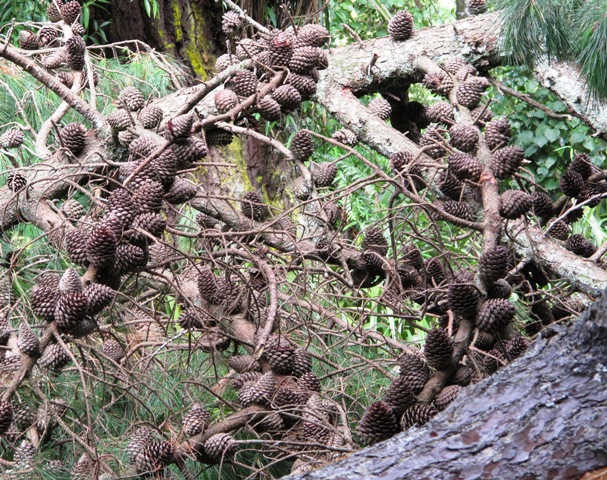
 We have pine cones for eternity here. Or at least several years.

We have pine cones for eternity here. Or at least several years.

We have so many big trees, we let them fall in situ. Mind you, we have had discussions as to what to do should one start to go beside us. Run to the trunk, is my as yet unproven theory, and jump left or right at the last minute. I say this because the trunk is the narrowest part. I am hoping we never have to test this theory.

In a smaller garden, the damage from a falling tree will probably be much larger than here and the damage from the clean up may well be greater still. We avoid this by doing a reduced clean up. We do not try and remove the trunks. We remove the side branches and the litter and tidy up any plants damaged in the fall. Paths need to be cleared but, once stripped, the main trunk remains where it fell and we garden around it. It is part of nature’s cycle. Trunkeries, I have decided to call these areas – a variation on the idea of stumperies. They give height to otherwise flat areas of the garden.

It is a different matter entirely when large trees threaten either buildings or power lines. The lines companies would, of course, like all trees over the height of about 3 metres felled immediately. While it can’t be fun being a linesman called out in atrocious conditions to restore power cut by falling trees, I recoil from the thought that overhead power lines be allowed to dominate our landscape. Our lines company will do the first trim at their cost to trees that are threatening their lines but after that it becomes the landowner’s responsibility, even when they don’t have a legal easement to have their lines crossing private property. We know quite a bit about this because we have problematic power lines taking a short cut across our place and have sought legal opinion. I don’t know if this is standard policy with other lines companies.

Sadly, unless you are highly skilled with chainsaws and tree felling, if you are in the position of an at-risk tree endangering your house or power lines, you are going to have to pay someone to deal with it and it is likely to be very expensive. In this case, get some good advice first on the stability and health of the tree and get it from a tree person, not a chainsaw operator. There are truly terrible stories about amateurs with chainsaws so make sure you employ a reputable operator to do potentially dangerous tree work. The consequences of getting it wrong can be extremely expensive or even fatal in worst case scenarios.

For all their problems, we would not be without our big trees. They give shelter and add stature to the landscape. Some are magnificent specimens in their own right. I do not want to live in an environment where nothing is allowed to grow more than 2 or 3 metres high.

First published in the Waikato Times and reprinted here with their permission.
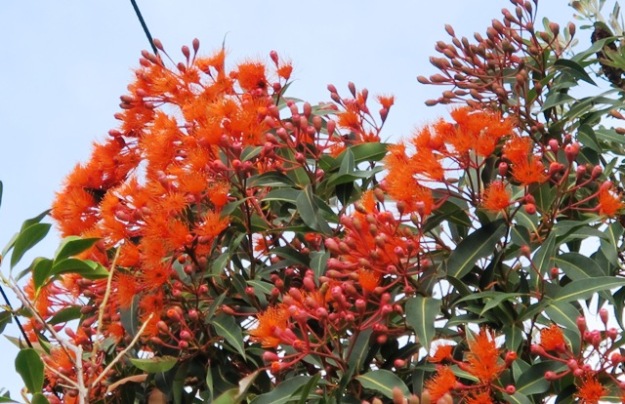
Plant Collector: Corymbia ficifolia

Techically Corymbia ficifolia but more commonly known as the flowering gum

Techically Corymbia ficifolia but more commonly known as the flowering gum

When is a gum tree not a eucalyptus? When it is a flowering gum, apparently. This came as something of a surprise to us. It is no longer Eucalyptus ficifolia but is now named Corymbia ficifolia. It is still a very close relative and will likely continue to be referred to in the grouping of eucalypts or gums. The vast majority of eucalypts are Australian. This one hails from a small area a relatively long way to the south east of Perth. While its natural habitat means it is accustomed to poor, sandy soils it has proven both popular and reliable as a street tree internationally – anywhere which is not consistently humid or suffering from extreme frosts. This specimen is just on the end of one of our shelter belts and remains relatively anonymous until it suddenly bursts into glorious bloom.

As it is notoriously difficult to root from cutting or to graft, flowering gums are almost always produced from seed which means there will be variation. They take several years to flower and it is pot luck what colour they will be. While orange and red shades are the most common, they can also be close to white and the full gamut of pinks. They are rated as small trees, taking a long time to get much past 3 or 4 metres tall. As trees go, these are a pretty easy-care variety and are available for sale in NZ.

According to Wikipedia, Hamilton’s very own Princes Street boasts the largest known single-trunked specimen of Corymbia ficifolia in the world. I could not see it on Google street view so I wonder if it is still there. Did somebody fell the world’s biggest?

Postscript: My Waikato Times features editor sent out a photographer, armed with my photo, and I am delighted to report that the world’s largest, single-trunked specimen is still present and correct.

First published in the Waikato Times and reprinted here with their permission.
A very public garden

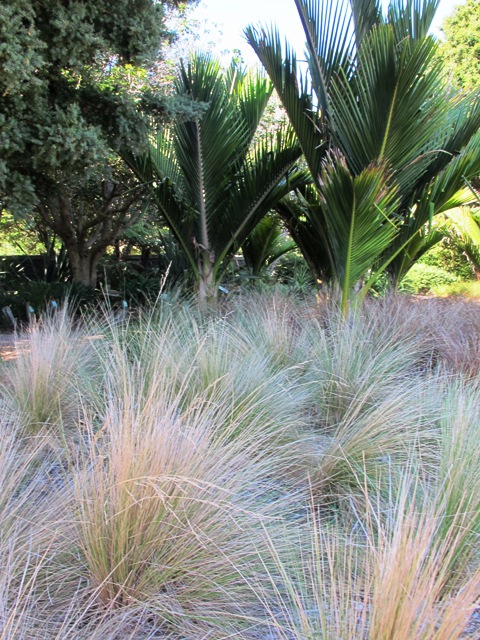
Shimmering grasses in the lightest of breezes.

Shimmering grasses in the lightest of breezes.

Monday this week found me wandering the Auckland Botanic Gardens in Manurewa. It is a few years since I have been there and I was curious to see if they were experimenting with ideas from the New Perennials Movement which I referenced in last week’s column. I felt sure they would be because the staff and management there are pretty innovative and on-trend. They weren’t, as far as this went.

No matter, there is always plenty else to look at. The Auckland Bot Gardens are still young. When you think about it, most botanical gardens go back a long way and have a backbone of very mature trees. I can remember when we first started to notice the new plantings from the motorway and how barren, windswept and inhospitable the site appeared. That was back in the early 1980s. There are easier sites to work with than this one.

Readers who have been to the famed Wisley Gardens south of London, may recall the background hum of noise from the adjacent motorway. That hum reaches a roaring crescendo when one gets to the trial grounds there. When I found the trial grounds (somewhat dominated by penstemons) where the sound track is the nearby Auckland motorway, I realised there are certain parallels between the Auckland Bot Gardens and Wisley.

It is not just the motorway noise, though. It is the very strong educative function that is threaded throughout that interested me.

Always a sucker for the ducks

Always a sucker for the ducks

Public gardening is a very different kettle of fish to private gardening and it has to meet many different needs. We have never forgotten Jack Hobbs, Director at Auckland, telling us that their extensive visitor surveys had just yielded the information that the single biggest reason visitors came was to feed the ducks. These days, lycra-clad exercise fiends may possibly have taken over the top spot but the gardens are there for a range of purposes – recreation, entertainment, education, plant conservation, even inspiration. I have a great deal of respect for those whose job is to keep all those threads together and still present an aesthetically pleasing, well maintained environment.

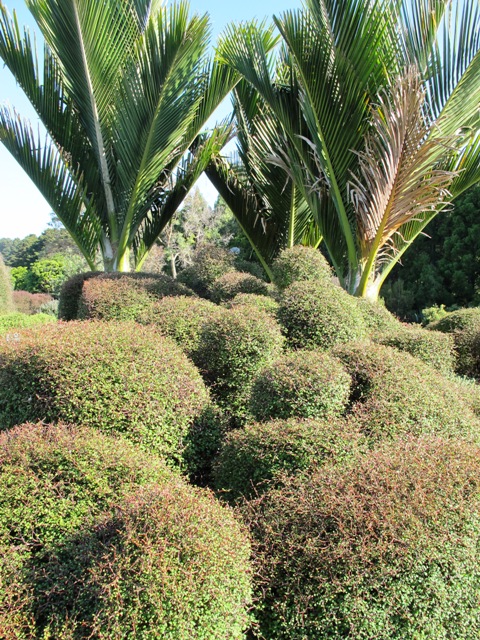
Clipped Muehlenbeckia astonii and nikau palms show native plants are not boring at all

Clipped Muehlenbeckia astonii and nikau palms show native plants are not boring at all

Personally, having found the perennial plantings pleasant but not all I had hoped for in terms of inspiring contemporary styles, it was the native plantings that brought a gleam to my eye. Here were ideas that take the use of native plants beyond the bush or forest context of the wild. The abstract shapes of clipped muhlenbeckia were nothing short of inspirational in terms of domestic gardening, as were some of the plant combinations. And the grasses in the children’s gardens set against nikau palms brought to life all I had read about the charm of movement when the lightest of breezes ripples through the fine foliage of these plants. It is time we shed once and for all those awful clichés about native plants being boring. Any plant can be dull or uninspiring in certain situations. It is how we use them in a garden or landscaping context that makes the difference.

Others may take more from the display area dedicated to trees suited to small urban gardens or maybe the environmentally friendly process of dealing with storm water run-off or the roof garden. There is the large rockery – more hot-climate desert than traditional rockery, rose gardens that I didn’t go too and plenty more. Some may even enjoy the large beds of garish red blooms – begonias, from memory. Gardens like these have to cater for all types and that includes dog walkers.

I politely admired two, elderly, plump chihuahuas (not corgis)

I politely admired two, elderly, plump chihuahuas (not corgis)

I have not mentioned the temporary sculpture trail. While I saw one or two pieces that I quite liked, there were others that I thought tacky (it’s a fine line to tread between whimsy and tack) and others that I felt did not enhance the environment at all. Sticking out like dogs’ balls came to mind but I am more interested in design and plants than ornamentation. Others feel very differently as evidenced by the enormous popularity of outdoor sculpture exhibitions.

Botanic gardens and leading parks are expensive to run without many means of cost recovery. But when you look at how widely used these urban spaces are, how many different roles they fill, at the often passionate attachments local residents have to their gardens, at the huge contribution they make to the quality of urban life, I guess most of us feel the costs are fully justified.

Ratepayers can get up in arms about many issues, but fortunately it is rarely about the cost of running these city gardens. Long may that last.

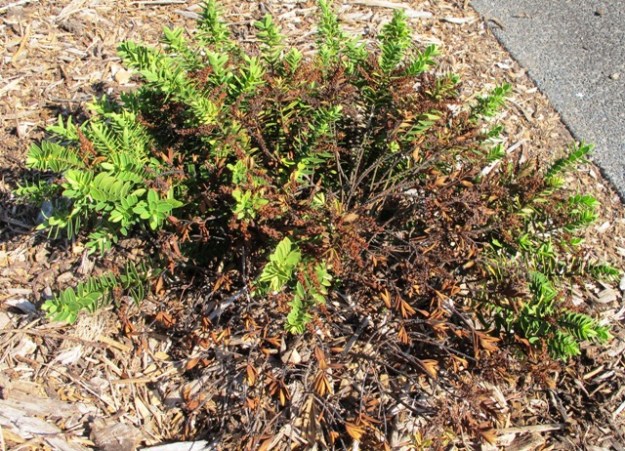
It is impossible to get everything right all of the time. The sign by this sad plant read “Better than box. Little leaves and lots of new growth from the base make Hebe ‘Wiri Mist’ a great little hedge.” I think not.

It is impossible to get everything right all of the time. The sign by this sad plant read “Better than box. Little leaves and lots of new growth from the base make Hebe ‘Wiri Mist’ a great little hedge.” I think not.

First published in the Waikato Times and reprinted here with their permission.

Plant Collector: Crocosmia “Lucifer”

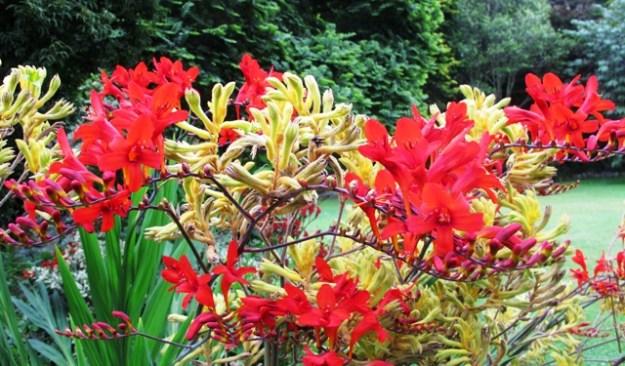
Red Crocosmia 'Lucifer' with yellow anigozanthus

Red Crocosmia ‘Lucifer’ with yellow anigozanthus

When they are roadside weeds, these bulbs are often referred to as montbretia. Treading on thin ice, I admit that we have orange-red ones growing amongst agapanthus on our roadside. At least it is better than the dreaded bristle grass that is the scourge in our area. “Lucifer” is a superior form, a hybrid with bigger flowers and stronger colour, making it popular as a garden plant. It is strong growing and both the pleated leaves and the flower spikes can get above waist height and it is almost indestructible. I like to keep it confined but it makes an attractive display beneath the apple trees and also alongside an equally strong growing yellow anigozanthus (kangaroo paw) which we have at the front of the rockery.

The bulbs are not unlike gladiolus corms and form chains below ground. It is the ability to grow when the chains are separated that makes these both easy and verging on weedy in some situations. We have a much larger flowered golden orange form which may be “Star of the East”. I say we have it, but we are waiting to see if indeed it is still here because it has been nowhere near as vigorous as “Lucifer” and each year we worry we have lost it.

Crocosmias are a small group of South African bulbs belonging to the iridaceae family. They are winter dormant, but their one drawback as a garden plant is that it takes a long time for the foliage to die down and they can be unattractive in autumn. That said, they are such toughies that I often trim the foliage off early to tidy them up.

First published in the Waikato Times and reprinted here with their permission.
The answer truly lies in the soil

005 (2)Who has never complained about the absence of flavour in supermarket tomatoes, particularly when out of season? Almost without exception we laud the merits of homegrown produce as being much more flavourful, even more so if crops have been grown from heritage varieties. Very hipster these days. Many people believe that the flavour has been sacrificed in commercial crops in the quest for high production.

Things are never that black and white. For some years, we have been pondering the triggers for flavour. I cite my experience with tomatoes in Southern Italy. A taste treat beyond compare, so full of flavour were they. But it was only the first week of June so it wasn’t a hot, dry summer that determined the quality of the taste. Nor, indeed, was it the variety. In recent years there has been an explosion of heirloom or heritage seed varieties becoming available in this country. We have tried growing a fair number of different ones and, to be ruthlessly honest, while better than the wishy washy supermarket ones, they all fall well short of those I ate in Italy. That leaves the soil as the key variable.

The answer may indeed lie in the soil. Unfortunately the solution is not as simple as scattering fertiliser with added trace elements, which is the usual recommended treatment. We have taken good care of our soils here and believed that we made good, balanced compost to nourish them. I use the past tense – believed. Summer reading here is “The Intelligent Gardener” by Steve Soloman. That is to say, Mark is reading it and sharing the highlights as he goes. While some of the book drives him nuts, the underlying premises make a lot of sense. Our soils are almost certainly nowhere near as good as we thought.
008
The subtitle of the book is “Growing Nutrient-Dense Food”. Nutrient density has been hovering on the periphery of our lives ever since Kay Baxter started writing about it. It is the principle that you can have two apparently similar crops but one has a much higher nutritional value than the other. Kay Baxter is the leading light of the Koanga Institute and a true pioneer of organics and the preservation of heirloom and heritage varieties in this country. She advocates the use of Brix measures to determine nutrient density. Brix are commonly used in the wine industry to measure sugar content.

It may be something of a leap to link flavour to nutrient density, but it seems logical that there may well be such a link and certainly both go back to the nature of the soil.

As a country, New Zealand has some widely recognised soil deficiencies. Insufficient naturally-occurring iodine is why we have iodised salt in this country. Prior to that, goitre was very common in humans and indeed in animals. “Bush sickness” is a widely recognised problem attributable to cobalt deficiencies on pumice soils. Selenium is deficient. At the risk of treading on sensitive ground in the Waikato, I understand that the trace element fluorine is deficient in NZ which is a major contributor to why New Zealanders have long been renowned for poor teeth. According to my father, who was a medico in the British army in WW2, they could pick the NZ soldiers at time of autopsy because most had false teeth. Correspondingly, pre-dental bleaching, all those beaming white toothy smiles of many Americans were apparently attributable to higher levels of naturally occurring fluorine.

If you are really keen on running a closed system of food production with no external inputs, it matters a great deal that you understand the exact composition of your soils in considerable detail. Even then, it is not as simple as topping up a certain element because there are reactions and inhibitors which can affect the ability of soils to incorporate additions. But most of us get our food from a variety of sources, which means deficiencies don’t usually have dire effects on human health because there is a degree of balancing out which occurs.

Mark is planning to delve further into the exact compositions of our soils. We are interested to see whether better balanced soils will give us better flavoured food. We will be watching to see if the link between flavour and nutrient density is proven. Certainly, it is disconcerting to have our existing notions about the quality of our soil and compost turned upside down. But this is not a once over lightly project which will appeal to all gardeners.

If you want to know more, the Koanga website is: http://koanga.org.nz/ The book referred to is “The Intelligent Gardener” by Steve Soloman. (New Society Publishers; ISBN:978 0 86571 718 3). Elder daughter purchased it for her father from the bookshop of Canberra Botanic Gardens. In this country, you may need to order it, in which case the ISBN number is important.

First published in the Waikato Times and reprinted here with their permission.