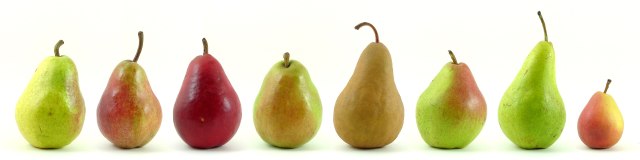
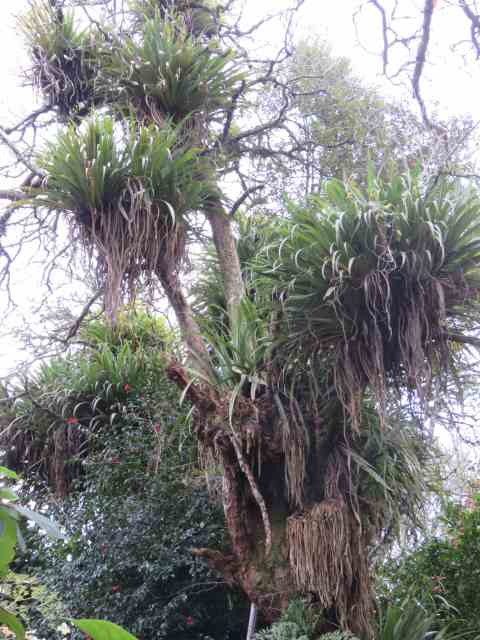
I planned to write about our pear tree this week, mostly because I remembered to take before and after photos this time and the weight of epiphytes was astonishing, This is a multi-grafted pear, presumably not on dwarfing stock, planted by Mark’s father many decades ago. Mark thinks it came with four or five different pear varieties on it to start with, of which there may be two or three left. The most successful is a delicious little honey pear that we harvested most years. But over the years, the tree has grown ever taller, requiring the extension ladder at full reach to pick the fruit, and we have grown correspondingly older and more cautious around ladders.
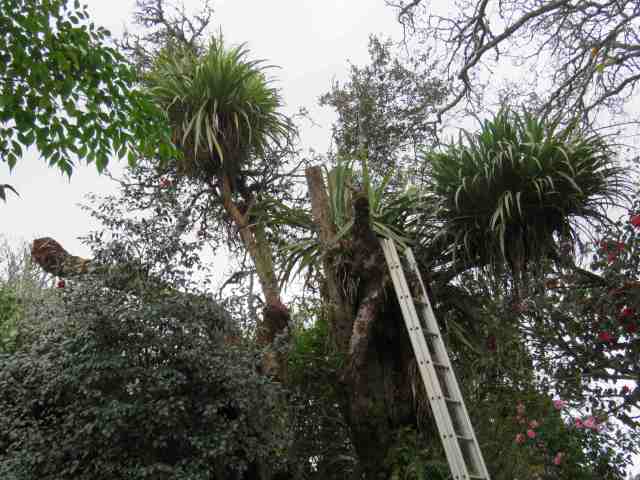
Time for drastic action and this required our friendly, neighbourhood arborist. Only time will tell how much the tree will respond in spring with fresh growth. In the meantime, with the ladder still in place and the tree reduced in height, I have asked Zach – as the youngest here – to dislodge the remaining epiphytes.
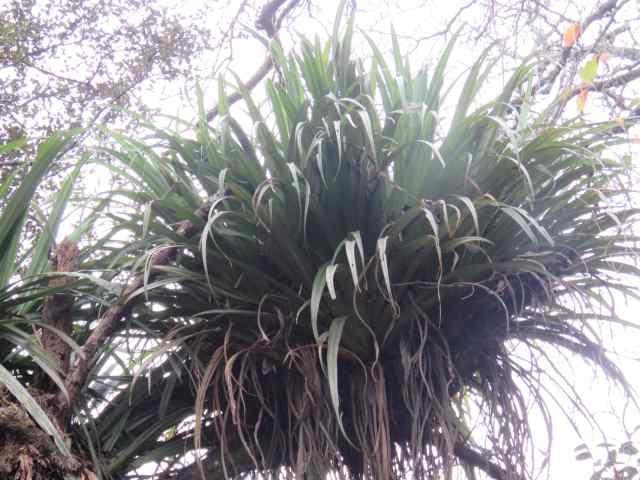
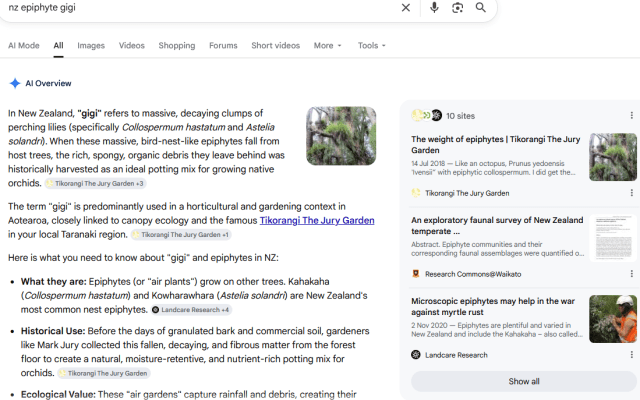
Our epiphytes here are largely seed spread by birds and wind, dominated by native astelias and what we have known as collospermum. “I think that has been reclassified as an astelia,” Mark said. I went to check and he is right – now Astelia hastata. I was hugely amused when checking that fact to find that the deeply irritating AI answer that pops up first whenever I do a net search now, appears to have decided that I, yes – moi, yours truly, is an expert to be quoted on the subject of epiphytes, based largely on this piece I wrote back in 2018. I am very aware of my limitations and it confirmed for me that the unsolicited AI pop up is totally untrustworthy. Skim past it to original and credible sources for better information.
 Tikorangi The Jury Garden
I would not trust AI for anything! And I’m sure all your farming neighbours knew it as the common abbreviation for “artificial insemination.”
I hope your pear can continue to produce sweet fruit.
Yes! What if AI stood for Artificial Information rather than intelligence?