Tag Archives: gardening

Our towering pines

The rich tapestry epiphytes that has developed over many decades

The rich tapestry epiphytes that has developed over many decades

If asked to name the tree least likely to be planted in a garden today, I bet most New Zealanders would say Pinus radiata. Is it our most despised plant? Maybe it is just that familiarity breeds contempt since we have made this tree our own utility, forestry tree. Believe it or not, back in 1838 you would have had to pay between 21 shillings (an old fashioned guinea, no less) and 100 shillings (or 5 pounds sterling) to buy one in England.

I have a personal interest in the humble pine tree because we have an avenue of them which are now somewhere over 140 years old. I looked at them with new respect when colleague, Glyn Church pointed out to me that all the really old Pinus radiata and the old man macrocarpas in this country would have protection orders slapped on them in their native territory. For these two species, so strongly represented here, are native to a small part of the Monterey Peninsula in California where they are referred to respectively as the Monterey Pine and the Monterey Cypress. They grow somewhat larger in our conditions.

The tops are not things of great splendour, but these Pinus radiata are now over 140 years old

The tops are not things of great splendour, but these Pinus radiata are now over 140 years old

The tallest of our pines must be around 50 metres now. They’re a motley bunch of trees. One or two are handsome from top to bottom. A couple are dead and have become skeletons. Some have much better crowns than others and many of them lean out at odd angles. There are masses of interesting epiphytes which have taken up home on the branches and forks in the trees, mostly collospermum and astelias spread by the birds and ferns dispersed by the wind. We have nigh on 40 of them in one area of the garden, planted originally as wind-break in double rows at about 3 metres spacings.

There is nothing at all unique about our pine trees here beyond the fact they are still standing and we have turned the area beneath into long avenue gardens. Ours are by no means the oldest in the country. That honour goes to a single pine tree at Mount Peel Station in Canterbury. It was apparently planted as a three year old seedling in 1859 so is at least 15 years older than our ones.

It did not take long for the earliest trees of Pinus radiata in this country to start showing their potential as a timber source, especially as our new colony had been ripping out the native forests at a rate that was alarming even back then. In the 1870s, large quantities of pine seed, mostly P. radiata but also other species, were imported and distributed widely. It is likely that our pines date back to these seed importations. If so, they were merely a few dozen among anything up to 500 000 seed distributed.

Pinus muricata, lesser known here and probably the same age as the radiata pines

Pinus muricata, lesser known here and probably the same age as the radiata pines

There were actually about 48 different species of tree introduced at that time through official channels. One of them was the lesser known Pinus muricata, or the Bishop Pine, also from California. We happen to have a little row of four P. muricata. To the untrained eye, they look like slightly more compact, smaller growing radiata pines. We don’t know anything about the history of our muricata but it would seem likely that they, too, date back to those 1870 seed importations.

Would I ever recommend anybody these days to plant Pinus radiata as an avenue? Well, no. Our avenue of rimu trees dating from the same time are much more impressive, rock solid and long-lived. But we see some merit in our crusty old pines which have wonderful fissured bark and add a solid presence to the landscape of our property. Fortunately, Pinus radiata tends to break up and drop in pieces over time, rather than keeling over in its entirety. We get a fair amount of firewood on an ongoing basis and the pine cone production is prodigious.

Zephyr the dog photobombs yet another garden shot - the leaning trunks of the old pines

Zephyr the dog photobombs yet another garden shot – the leaning trunks of the old pines

In the past four decades, three have fallen. The only really alarming one was the latest a few years ago which snapped off at about 5 metres up. Turns out the trees have all been topped at that height – maybe a century ago.

We have lost count of the number of garden visitors (all older men) who have surveyed our pines and said: “Oh, they’re a problem. They’re at the end of their life. How are you going to get those out?” Of course the general view in this country is that any Pinus radiata over the age of about 40 is past its life span.

We can’t take them out even if we wanted to. We can’t get heavy machinery in. They would have to be done by huge Russian logging helicopters and we aren’t millionaires. We plan to just leave them to their own devices and to continue cleaning up the fallen branches. Common old pines they may be, but they are part of the history of our place and part of the history of this country, too.

We have, however, had a discussion on what to do should one of us be standing in the wrong place if one falls. Run towards the trunk, is my theory, because that is the thinnest section, and then decide at the last second whether to throw oneself to the right or to the left.

References:
http://friendswbg.org.nz/PINUSRADIATA.html (Friends of the Wellington Botanic Gardens).
Horticulture in NZ 1990 Vol 1, No 1 republished on http://friendswbg.org.nz/PinusRadiatatoNewZealand.pdf

First published in the Waikato Times and reprinted here with their permission.

Plant Collector – Acer griseum

Acer griseum - it's mostly about the wonderful bark

Acer griseum – it’s mostly about the wonderful bark

Mention maples and most people think of the fresh spring foliage, the burgundy lacy look of some patio maples all summer and the glorious autumn colour. It is all about the foliage but not with Acer griseum which has nondescript green leaves all summer. No, it is primarily about the bark.

Often called the paper bark maple, Acer griseum is one of the best ornamental bark trees in the world. The old bark peels back in shiny, curled layers to reveal a matt skin below and it is all in glorious copper tones, often described as cinnamon in colour. The sight of light glowing through these bark curls is nothing short of magical and it is a visual delight which lasts all year.

It comes from Central China and it was not introduced to the west until the turn of last century, 1901 to be precise. It was clearly an immediate success because within 21 years, it had been given an Award of Merit by the Royal Horticulture Society in the UK. While it will get some height, maybe 8 metres over time, it remains generally narrow in form so doesn’t take up much space. The bark starts to show within 3 or 4 years of planting. Apparently it will colour up much better and put on a good autumn show of scarlet in cooler climates though I can’t say I have ever noticed it colour here.

First published in the Waikato Times and reprinted here with their permission.

At the end of a golden summer come the autumn bulbs

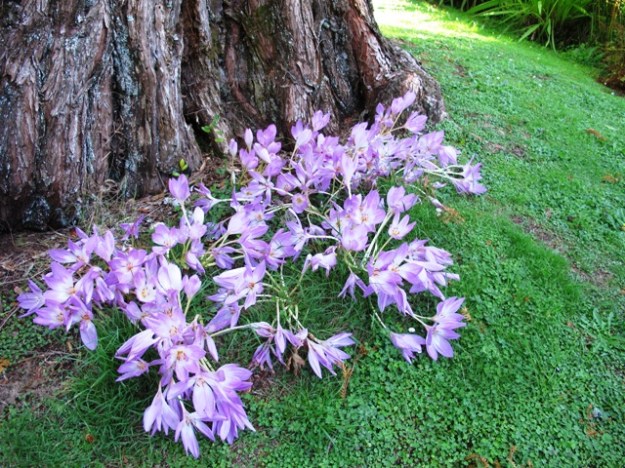
Colchicums, not autumn crocus

Colchicums, not autumn crocus

Autumn. It is indubitably autumn. I can no longer pretend it is just the summer slowly waning and that winter is still a long way off. For most people, autumn is synonymous with leaves colouring to fiery hues.

However those of us in coastal areas may carry that mental image but the reality can fall well short. Inland areas get much better autumn colour because the nights cool down more rapidly and it is the sharp drop in temperatures which triggers the colouring response in most deciduous plants as much as the declining day length. The moderating effect of the sea means we drift far more slowly between seasons and the leaves are inclined to turn brown and fall, skipping much of the colouring process.

Our extensive use of evergreen plants in this country also mitigates against fantastic mass displays of autumn colour. Our native plants are all evergreen and in a generally benign gardening climate, we tend to favour evergreen exotics as well. I have met many gardeners who shun deciduous plants because they are allegedly messy and lack winter interest, which has always seemed a bit myopic to me. We are never going to rival countries like Canada with its native maples when it comes to a mass blaze of autumn tones.

It is the autumn bulbs that signal the change in season for me. There are so many pretty seasonal flowers coming through now. These are triggered into bloom by a drop in temperature, declining day length and some by late summer rain – don’t laugh at that last one.

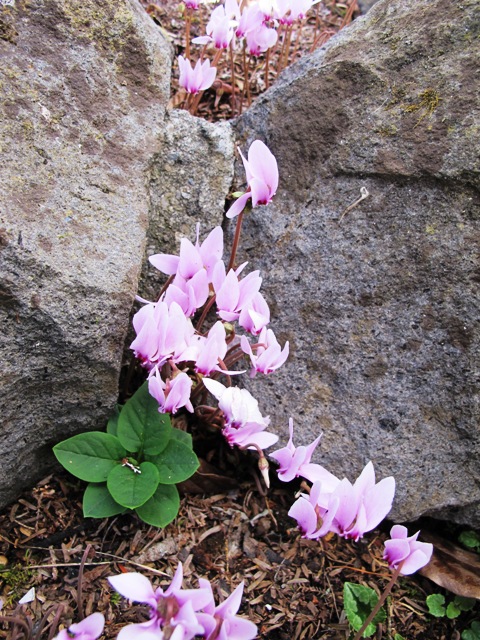
The charm of carpets of Cyclamen hederfolium

The charm of carpets of Cyclamen hederfolium

Gardeners in this country tend to focus on the spring bulbs – from the early snowdrops through the snowflakes, bluebells, tulips, daffodils, anemones and ranunculus. These are readily available and marketed widely. They also flower at a time when the majority of trees and shrubs are blossoming forth.

The autumn bulbs have never captured the market in the same manner yet they bring freshness to the garden at a time when many plants are looking tired or passing over. I find them a wonderful antidote to the autumnal despondency of declining day length. There they are, all pretty and perky, just coming into their prime.

I often feature selected autumn bulbs in Plant Collector because this is their time to shine. As I wander around the garden, I see carpets of Cyclamen hederafolium (flowers only so far – the leaves have yet to appear) and taller spires of the autumn peacock iris, Moraea polystachya, which is inclined to seed itself around a little. This lovely lilac moraea has one of the longest flowering seasons of any bulb I know. The common old belladonnas are already passing over but I enjoy their blowsy display while it lasts. We use them in less tamed areas on the road verge.
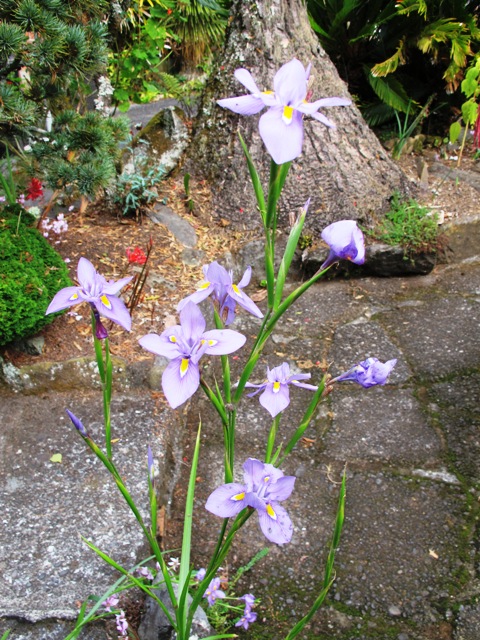
Moraea polystachya - the autumn flowering peacock iris

Moraea polystachya – the autumn flowering peacock iris

Over the years, I have waged a campaign to convince people of the merits of the ornamental oxalis, many of which are autumn stars. Call them by their common overseas name of wood sorrel, if the mere mention of oxalis makes you shudder. The range of different species is huge. By no means are all of them nasty weeds and many are not the slightest bit invasive. We have them flowering in white, yellow, apricot bicolour, a whole range of pinks, lilac, lavender and even crimson. Some are perfectly garden-safe. I can vouch for their good behaviour after decades in the garden here. Others I keep in pots – preferably wide, shallow pots for best display.
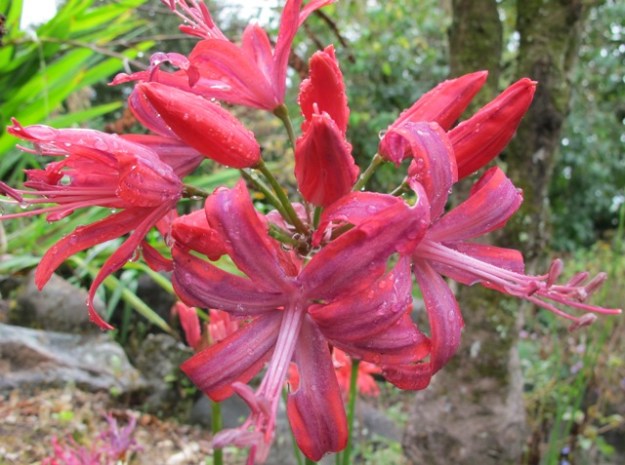
We are big fans of the Nerine sarniensis hybrids

We are big fans of the Nerine sarniensis hybrids

And nerines are the major feature of our autumn rockery. The majority of these are sarniensis hybrids with big heads of flowers. By no means are all of them the common red of Nerine fothergillii or the strong growing pink Nerine bowdenii which comes later in the season. We have some lovely smoky tones, reds deepening to violet hues, a remarkable lolly pink – the colour of a highlighter felt pen, two tone sugar candy and even heading to apricot. Nerines are renowned as a good cut flower but I never cut them. There is only one stem per bulb and I would rather admire them in the garden than indoors.

Then there are the bold colchicums which, contrary to popular belief, are not autumn crocus but certainly put on a splendid show with a succession of flowers from each corm. You have to go a long way back in the botanical family tree to get any relationship between colchicums and the proper autumn crocus. The latter is a much more delicate and transient performer whose flowers appear at the same time as its foliage. Currently, we are enjoying both in bloom.

Some bulbs are quite transient in flower but no less delightful for all that. If I am ever forced by declining health and aged frailty to trade down from a large garden, I can see that it would bulbs that I would chose to grow. I love the way they mark the seasons and how there can always be a different one coming into its time to star.

First published in the Waikato Times and reprinted here with their permission.
Plant Collector: Syagrus romanzoffiana

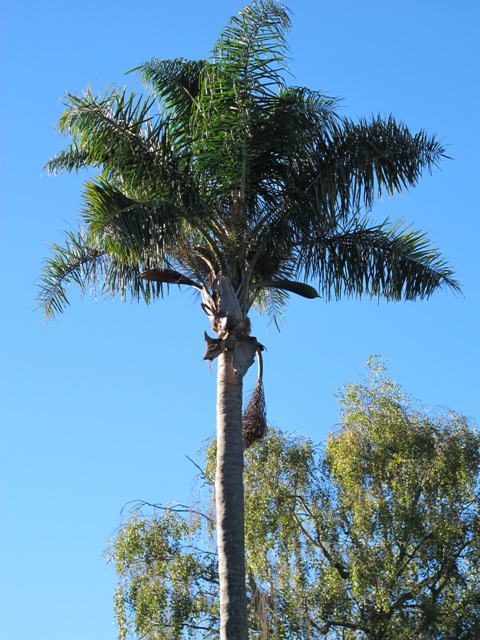
The towering Queen Palm, or Syagrus romanzoffiana growing in coastal Taranaki

The towering Queen Palm, or Syragus romanzoffiana growing in coastal Taranaki

I asked Mark how tall he thought our queen palms are. Mentally I was stacking 2 metre men on top of each other which is how I estimate tree heights. “About eighty feet,” Mark replied, “to the top of the crown.” I leave it in imperial feet because it sounds more impressive than 25 metres. They are tall, these handsome palms, and we have three of them. All were planted in the late 1950s by Felix Jury, from seed given to him by one of the Australian botanic gardens. Not that they are an Australian native. These are South American palms, coming from that mid band where Argentina, Brazil and Bolivia meet.

The single trunks are tall and slender and the impressive top knot houses an entire condominium of nesting birds. In spring time, there are often small, lightly feathered corpses at the base because fledglings are not going to survive a fall of that magnitude. It is mostly sparrows with the occasional starling. We often sit in a spot which looks out to one palm and the amount of comings and goings are prodigious.

I read advice on line that said: “the fronds die early and must be pruned to keep the tree visually pleasing”. No, we do not get the extension ladder out to groom our queen palms. Fronds do indeed die but they detach themselves in time and crash to the ground. As the sheaf of the frond is quite substantial, you don’t want special plants beneath and you certainly wouldn’t want one of these beside a building or near the car.

S. romanzoffiana is a suitable substitute for the common bangalow palm. While there are reported incidents of it escaping into the more tropical wilds of Australia, it has nowhere near the weed potential of the bangalow and we have never heard of it being a problem in NZ.

First published in the Waikato Times and reprinted here with their permission.
Garden lore

“What is a weed? I have heard it said that there are sixty definitions. For me, a weed is a plant out of place.”

Donald Culross Peattie, (1896 -1964).

Weed plants
After my recent faux pas with Lilium formasanum, I was contacted by Carolyn Lewis, the national coordinator of Weedbusters, an organisation with support from many interested parties, dedicated to raising awareness of the problem weeds in this country. Too many of these are garden escapes and gardeners need to take some responsibility for unleashing vegetable time bombs. The website http://www.weedbusters.org.nz gives extensive information on individual weeds including how to eradicate each species in your area and useful suggestions of alternative plants to use instead.

Weedbusters are not covering the plants included in the National Pest Plant Accord (which are the banned ones) although there is a link through to the Ministry for Primary Industries section on these agreed pests. Some of the inclusions surprise me (Bartelttina sordida for one), others don’t. The arum lily, aristeas and agapanthus are widely recognised as problematic. I would have liked to have seen more information on where these plants are problems (national, regional or specific to just one area) because one region’s weed can be another region’s valued garden plant.

Without becoming too paranoid, take notice of those that seed down too freely or spread rampantly in your domain. If they are popping up all round the place, threatening to invade well beyond their allotted space and choking out other plants, or are extremely difficult to eradicate then you are probably looking at plants with significant weed potential for your conditions. While purists may advocate total eradication, in some cases we choose to manage such plants. We don’t want to be without our campanulata cherries that feed the tuis but we take responsibility for the seedlings and are vigilant weeders. The vegetable garden is not exempt either. We rated strawberry spinach as downright dangerous and went for eradication.

We don’t need more weeds in this country.

First published in the Waikato Times and reprinted here with their permission.