Tag Archives: gardening

Garden lore

I fear I am a little impatient of the school of gardening that encourages the selection of plants merely as artistic furniture, chosen for colours only, like ribbons or embroidery silk. I feel sorry for plants that are obliged to make a struggle for life in uncongenial situations because their owner wishes all things of those shades of pink, blue or orange to fit in next to the grey or crimson planting.

Edward Augustus Bowles My Garden in Spring (1914)

If you don’t want to use chemical weedkillers, boiling water can be a simple alternative, particularly between pavers or on cracks or joins in concrete. The boiling water not only kills weeds instantly, it also sterilises the soil to reduce more weed seeds germinating in the area. However, don’t use it near the base of plants that you want to continue growing. Obviously you need to be extremely careful and avoid carting the hot water jug when you have pets or small children around. Wearing covered footwear is also a good safety precaution.

Dealing with maturity (in garden terms)

First published in the spring issue of “Our Gardens”, the quarterly magazine of the Garden Clubs of Australia

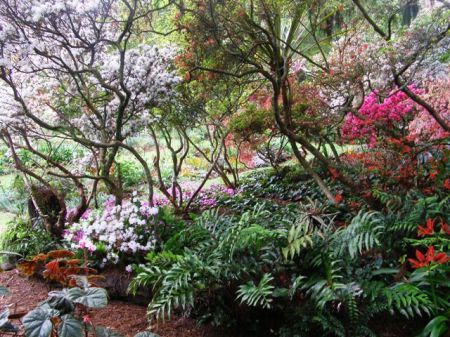
Sculpted kurume azaleas

Sculpted kurume azaleas

In gardening terms, I guess most people would agree we are blessed. Our climate is mild, never very hot and never very cold. We have regular rain all year round, good sunshine hours and the soils are friable and volcanic. Added to that, we are fortunate to be on a family property where the oldest trees were planted by Mark’s great grandfather in 1880. These give a wonderful mature backbone to the garden and how obliging of him to have planted an entire avenue of our majestic native rimu trees.

Notwithstanding the big trees, the majority of our plantings date back to the 1950s and having a mature garden offers its own challenges. Finding space for new plants can be problematic, even though we have reasonable acreage (we open about seven acres to the public). But the biggest challenge of having a mature garden is to stop it all melding together and becoming walls of foliage which choke out the less vigorous plants. Increasingly we find ourselves doing more lifting and limbing, shaping and clipping.

We like to use plants as focal points and features. Our garden is light on ornamentation. You won’t find anything armless, legless or white lighting up a dark corner. We prefer to place garden seats where we will sit on them, rather than using them as focal points. When sculpture is used in gardens, we think it becomes the dominant feature, forcing the garden setting and the plants into the background. We want the plants to be the stars.

There is no shortage of candidates for clipping or shaping but we do not want the Italian formality where almost every plant is manipulated. This is not about topiary so much as it is about finding the natural shapes within the plants and featuring them.

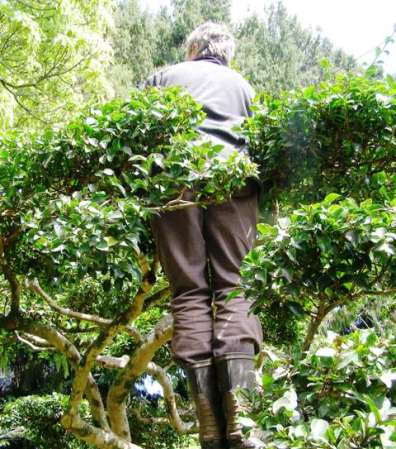
Clipping Mine No Yuki

Clipping Mine No Yuki

Maples can develop a wonderful form over time which just needs cleaning up. Loropetalums also clip and shape well. We keep our small flowered Kurume azaleas limbed up so that it is possible to look through them. The trunks naturally grow white lichen and, in season, the undulating tops of the azaleas form a carpet of colour, while we have species cyclamen planted beneath around the white trunks.

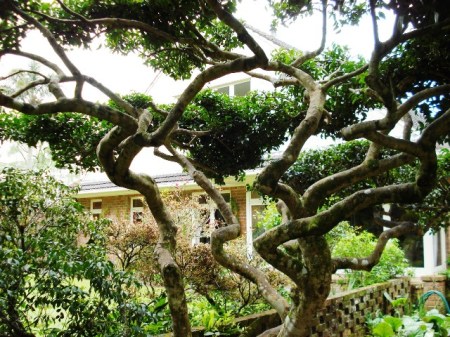
Camellias are wonderful for clipping because their growth rates are not too fast and, if you make a mistake, they will sprout again from bare wood. We have a massive plant of the white sasanqua, “Mine No Yuki”, which looks wonderful with its pristine white blooms until we have a heavy downpour to turn them to brown sludge. These days we regard any flowers as a bonus and the plant justifies its garden space because of its shape. We keep it tightly clipped into layered mounds – generally referred to as cloud pruning in a technique associated with Oriental gardens.

The finished product

The finished product

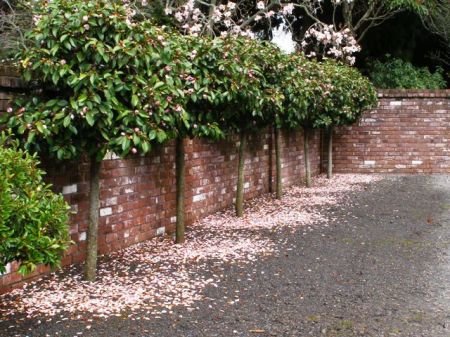
Fairy Magnolia Blush

Fairy Magnolia Blush

Michelias also lend themselves to shaping and the lollipop Fairy Magnolia Blushes at our entranceway are a more recent addition. A light pruning twice a year with secateurs keeps them to a tidy shape and we have been able to stop them getting too large.

It is all much more fun than weeding and gives us the detail and focal points we want.

Mark and Abbie Jury garden at Tikorangi, The Jury Garden in Taranaki on the west coast of the North Island of New Zealand. Like his father before him, Mark is a plant breeder, probably best known in Australia for his Fairy Magnolia Blush, Camellia Volunteer, Magnolias Black Tulip and Felix Jury and his joint venture plant with his father, Cordyline Red Fountain. Abbie is a garden writer for national and regional publications. Their garden opens for the magnolia display at the start of August and remains open until the end of March.
Website: http://www.jury.co.nz
Facebook: facebook.com/thejurygarden
Twitter: @Tikorangi

Tikorangi Notes: Friday 24 August, 2012

Perched on the very top - the dainty silvereye or tauhou

Perched on the very top – the dainty silvereye or tauhou

Fifty eight seconds of video, captured with much delight and good fortune, of kereru feeding on plum blossom. The colours of a Tikorangi springtime.

Magnolia Black Tulip

Magnolia Black Tulip

Somewhat slowed down by a bout of flu and heavy cold this week (the last time this happened would be over a decade ago), I have spent some time photographing birds and magnolias this week. Still tui in abundance, but also kereru, waxeyes (syn. silveryeyes or tauhou) and even the elusive bellbird, all feeding at the same time from Prunus Mimosa. The tui usually chase the bellbirds away. This must surely be one of the most beautiful times of the year here. If you use Facebook, *liking* our garden page will see the magnolia updates arriving on your news feed.

The garden is now open daily. No appointment is necessary. If we are not around, there is an honesty box.

The shy bellbird or korimako

The shy bellbird or korimako

Biodynamics – the homeopathy of the gardening world

A mutinous threat from Zephyr and Spike

A mutinous threat from Zephyr and Spike

Being a SNAW (that is a Sensitive New Age Woman, but of course you knew that), I am all for religious tolerance. That is, as long as nobody comes knocking on my door thinking I may need to be converted of a Saturday morning. I could perhaps do with being renovated, but not converted.

Similarly, when the personal faiths of others start to intrude on me, especially by claiming to occupy the higher moral ground, I get a little twitchy and few are worse at this than homeopaths, lunar planters and biodynamics converts.

Adding to my twitchiness, Spike and Zephyr, our surviving pets, are seeking legal advice. They are threatening to take out an injunction to prevent us exhuming their former colleagues for preparation 505. That is the one where a skull of a domesticated animal is stuffed with oak chips and immersed in fresh water for three months. Spike and Zephs are appalled at the thought that we may be wanting to stuff skulls with oak chips. Not only do they want to protect their former colleagues, but they are not offering to make the ultimate sacrifice, proffering up their own skulls to test the efficacy of this soil conditioner. They have been known to harumph and suggest that in this country, we should surely be stuffing bird skulls with totara chips seeing as we lack both native mammals and oak trees. And don’t be thinking any old oak tree will do. It has to be Quercus robur which is of course native to Rudolf Steiner’s homeland of Austria.

Preparation 502 is giving me much anxiety. That is the one where you stuff the bladder of a red deer with achillea flowers and bury it for months on end. There is a definite shortage of fresh deer bladders (or even frozen ones) here and local supermarkets don’t seem to stock them. I notice there is a stag where I buy my free range eggs and I pondered asking the owner how she would feel about donating its internal organ to improve our soils. But I am not sure that it is a red deer (it appears to make a difference to compound 502) and as she was hand feeding the stag when I called in one day, I feared she may not react well to my request. I think we may do better with preparation 503 (that is chamomile blossoms stuffed into the small intestines of cattle and overwintered in the ground – must remember to mark where I bury it). And preparation 506 looks manageable – dandelions stuffed in the peritoneum (sounds nasty) of cattle and similarly overwintered.

Prep 501 has powdered quartz stored in the horn of a cow (minus the cow) and buried over summer (note: summer burial, not winter, for this one). In autumn you dig it up and mix it with water at a dilution rate of one tablespoon of quartz powder to 250 litres of water (starting to sound dangerously homeopathic…). But before you spray it, you have to stir the solution for an hour and the method and direction of stirring is prescribed. You can not stint on the stirring because some see the vortex created by methodical stirring as acting like a funnel to imbue the solution with cosmic energy, making it more efficacious. Quartz is largely insoluble in water and spraying a chemically inert substance in microscopic traces over a wide area is of no discernible value whatever but let not these facts get in the way of passionate belief.

The best known prep 500 (a cow horn stuffed with the excrement of a lactating cow and buried over winter in the ground) receives similar treatment to 501 and is diluted to the same extent. Preps 502 to 508 are added to the compost heap at a rate, give or take, of around a teaspoon per cubic metre. Faith goes a long way. Apparently.

Rudolf Steiner was a philosopher and it is most unlikely that he ever got his hands in the soil. Put succinctly, Steiner came from a strong background of esoteric theosophy and when he split from the European theosophical mainstream at the turn of last century, he evolved his own world view which he styled anthroposophy. And that might be described simplistically as an attempt to synthesize mysticism and science. Lost? Don’t worry. I don’t think it matters. I would guess that Steiner, a man who spent his life thinking and in philosophical discourse, likely saw his theories on agriculture and care for the soils as merely part of a much larger universal whole. He might be slightly stunned were he around today to see how this particular side shoot to his core philosophies has taken on a life of its own as biodynamics.

Biodynamics seems to have taken a greatly simplified interpretation of Steiner’s elaborate world view and repackaged it as pseudo science to give it a credibility which it lacks. You really are back in the realms of mysticism without the science once you are into focusing cosmic rays to harness the spiritual energy of the universe. Cows’ horns and deer antlers are apparently particularly good receptors acting as a cross between a satellite dish and a storage battery for cosmic energy and cosmic wisdom. Yet, if you set aside the biodynamic preparations, the other underpinning principles of modern biodynamics are sound organics. You can not fault practices such as:
* Stocking with several different animal species to vary grazing patterns and reduce pasture borne parasites.
* Widening the range of pasture species.
* Planting trees for multiple purposes.
* Crop rotation designs to enhance soil fertility and control weeds and plant pests which include the use of green manures.
* Recycling of organic wastes, where possible, by large scale composting.
* Changing from chemical pest control to prevention strategies based on good plant and animal nutrition and careful cultivar selection.

There is nothing flaky in any of that. There is nothing spiritual either. It is just good, sustainable practice applicable to all aspects of gardening and agriculture.

I respect the right of bioydynamic converts to believe in cosmic energies and a holistic interpretation of their position in the universe. But I do wish they wouldn’t try and package it as science and, like lunar planting and homeopathy, such practices have gained a level of mainstream acceptance which is not founded on any scientific credibility at all. It can make it hard to disentangle what is sound environmental practice from what is religion.

Plant Collector: Narcissus x Odorus

The heady fragrance of Narcissus x odorus

The heady fragrance of Narcissus x odorus

I wish you could smell this lovely daffodil. It has the most divine scent which is commonly found in the fragrant jonquils (or N. jonquilla as they are known botanically). That is because this one is a natural hybrid which was found in the wild in Southern Europe, a cross between a jonquil and N. pseudonarcissus). It is pure bright daffodil yellow (otherwise known as acid yellow) with a very short trumpet surrounded by a skirt of wavy petals in the same colour. While the flower isn’t large, it is held up on relatively tall, wiry stems. The number of blooms to each stem can vary from one to three. They appear to be totally sterile which prolongs the life of the flowers. As the foliage is fine, this is a narcissus that passes over quite gracefully.

If you search out as many different types of daffodils as you can find, you can extend the season from mid winter through to early or mid spring rather than having them all come in a flash over a week or two.

First published in the Waikato Times and reprinted here with their permission.