Tag Archives: gardening

Grow it Yourself: runner beans

Bushy, low growing beans are usually referred to as dwarf beans. Runner beans are climbing beans and there are both perennial and annual types. The traditional climbing bean in this country is the Scarlet Runner. It is a perennial plant so it goes dormant over winter and rockets into growth as soon as temperatures rise. Perennial beans tend to be better in cooler climates because they stop cropping as soon as the temperature rises over summer. When treated as an annual and sown afresh each year, they have more vigour so many gardeners prefer to do this.

You can build a permanent climbing frame, though this means you can not rotate the crop. We have used chicken netting secured to side posts as a frame. Others like the look of trellis but these days we find movable tepee constructions more flexible.

The annual climbing beans crop more heavily. These are direct sown in spring to a depth of about 2.5cm at 10cm spacings. Depending on the variety, you will be picking in 2 to 3 months. It is the usual soil story for most crops that grow above ground – full sun, well cultivated, well fertilised soils and mulch the crop to retain moisture. The plants will simply stop producing new beans if they come under stress from summer drought.

It is the over mature, older style runner beans that become stringy. Picking every few days encourages the plant to continue producing and avoids the fiddly strings that need to be cut out. Try Kings Seeds catalogue for a wide selection of different bean varieties.

First published in the Waikato Times and reprinted here with their permission.

Tikorangi notes: Friday July 20, 2012

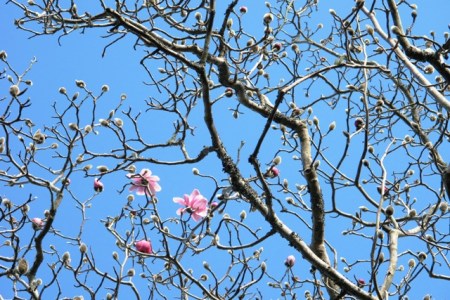
The very first flowers of the season on Magnolia campbellii

The very first flowers of the season on Magnolia campbellii

Latest posts:

1) Modern perennial plantings, more in the style of Braque than Mondrian.

2) When only one plant is ever found, it could be said that this is as close to extinct as anything could be – Pennantia baylisiana.

3) Grow it yourself: cauliflower (not that we will be. Growing them, that is)

4) Floods earlier this week – on Monday in fact. These events happen here. It certainly was not the worst flood we have had but these things are still quite exciting when they occur.

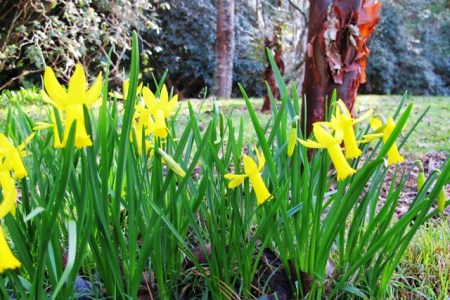
Narcissus cyclamineus at the base of Acer griseum

Narcissus cyclamineus at the base of Acer griseum

July is usually the bleakest winter month here, but aside from a few cold days and torrential rain on Sunday and Monday, it has not been too bad at all. Last summer was one of the least memorable ever, but autumn and winter (so far) have been significantly better than usual.

The first magnolia flowers have opened on M. campbellii and on Mark’s earliest flowering hybrids and more will open every day. The snowdrops are flowering and more and more of the narcissi are opening. Last week it was just the hoop petticoats (N. bulbocodium citrinus), this week there are various cyclamineus types opening. More camellias open every day. The cymbidium orchids are in flower (and need staking) and Cyclamen coum blooms on It is a magical time of the year and will just keep getting better as we progress into spring. We could never complain that winter is bleak here.

Lloyd is doing a major reconstruction of our steep path down to the park which has eroded badly with heavy rain. I am nearing the end of the major makeover on the rose garden – after the earlier satisfaction it has morphed into hard graft now. Three more fine days and it should be done.

Officially, we reopen the garden at the beginning of August but wait a few more weeks if you want to see the magnolias in full flight.

Modern perennial plantings – more in the style of Braque than Mondrian

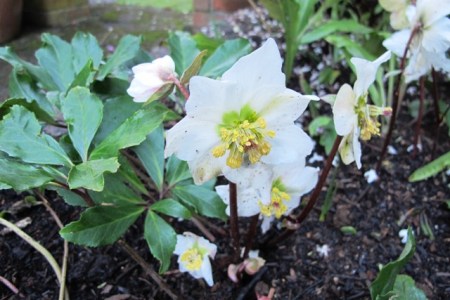
A simple but very pleasing combination of Helleborus niger for winter flowers, Calanthe arisarnensis for  spring, some random dwarf narcissi - and interesting foliage all summer

A simple but very pleasing combination of Helleborus niger for winter flowers, Calanthe arisarnensis for spring, some random dwarf narcissi – and interesting foliage all summer

Last week, I wrote about the major makeover in the rose garden and mentioned the fun I was having with the perennials. While the rains have interrupted progress (it is difficult to dig and divide in waterlogged conditions), we have spent a great deal of time discussing perennials and their use here. Indeed, we even dedicated a gardening trip to the UK to look at techniques.

Traditionally, English perennial gardening has been dominated by the herbaceous border organised on what I had been calling the mix and match approach but which I have just seen described as tapestry gardening. And that seems appropriate – it is like building up an entire picture but from a multitude of different plants instead of coloured threads. At its best, it is magnificent but it is also very labour intensive and takes a lot of skill to put together well. Too often both the ongoing labour and the skill levels are lacking and it just looks a mess.

In the nineties when we saw the gardening scene hijacked by the landscape fraternity in this country, that sort of detailed gardening was thrown out. “The Look” became the dominant feature. Gone was tapestry gardening and any value placed on plantsmanship or plant detail. Now perennial gardening became “underplanting” and just as patterned carpets have been shunned in favour of the same plain carpet throughout the entire house, so too was underplanting to be a utility carpet, usually comprising only one plant variety. So rose gardens were carpeted with nepeta (catmint), or maybe stachys (lamb’s ear). Liriope was fine as long as it was en masse, or any other utility perennial that could form a reliable carpet. It is an approach to gardening that we have shunned as deathly dull.

Piet Oudolf’s rivers of perennials at Wisley were a revelation to us. Here was a contemporary take on perennial planting on a large scale. Each river or stripe is composed of three or four different plants, often repeated in other combinations elsewhere in the border. Tom Stuart-Smith’s plantings in the same RHS garden were a reinterpretation of the type of block planting first espoused by Gertrude Jekyll, especially with her later work when her eyesight was failing and she needed more defined form. When I use the word “blocky”, we are talking more freeform shapes than geometric, more Braque than Mondrian.

The upshot of this thinking was that when Neil Ross suggested I look to reorganising the perennial plantings in our rose garden to more contemporary blocky plantings with simple combinations, I had a mental framework to fit it into. While the area is hard landscaped into a formal design, I didn’t want formal geometric plantings. We strive for a spring and summer froth of pretties – roses and perennials – with touches of plant interest to extend the seasons into autumn and winter. So my blocks are random but nothing less than a square metre and nothing more than three square metres. And each block has three, sometimes four different plants in it. The fun has been in deciding the combinations block by block. It is a bit like creating a multitude of mini gardens and linking them together.

I have bought no new plants. All I have done is to lift, divide and recompose what I had in the garden. So they are just arranged differently. In each block, I have tried to combine plants which I think will be compatible in close company with each other – in other words nothing that is going to overwhelm its companions above ground by smothering them or underground by over-competing. I have considered the time of the season that each plant peaks to try and cover a good span of the year and also to get interesting combinations of foliage and flowers within each block.
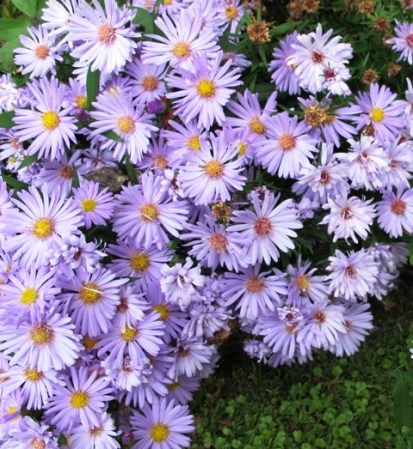
A carpet of blue asters in late summer and autumn

A carpet of blue asters in late summer and autumn

Nothing is more boring than endless plant lists so I will just give a couple of examples. One block is the common liriope (grassy foliage and blue flowers in summer) with a taller, pure white Siberian iris (for spring flowers) and one of the strong growing, mat-forming Kippenberg asters with lovely blue daisy flowers in autumn. Elsewhere, I have another block which repeats the white iris but this time combining it with a compact bright blue campanula and a little pure white scuttelaria which flowers most of the time.

If one block doesn’t work, then it will be easy to address the problems in that section. Some will need lifting and dividing more often than others. The whole area has been dug over thoroughly so the plants are in friable and fluffy soil which most perennials appreciate and I have laid a mulch of compost on top. These are optimal conditions and, while the area is very new right now, I have planted divisions and plants close together so I expect rapid results as soil temperatures rise in spring. If it doesn’t close up and fill the beds with a riotous froth in time for our peak garden visitor season, I may have to be in there with emergency plugging of gaps but I hope that is not going to be required. I am also expecting that the self seeded annuals will also come away quickly and fill gaps. The pretty nigella (love in a mist), linaria pink and lilac, blue poelmonium (Jacob’s Ladder) and common old blue pansies are all welcome to stage a return wherever they wish, to soften the divisions between the blocks.

Now it is just a question of waiting to see the results.

First published in the Waikato Times and reprinted here with their permission.
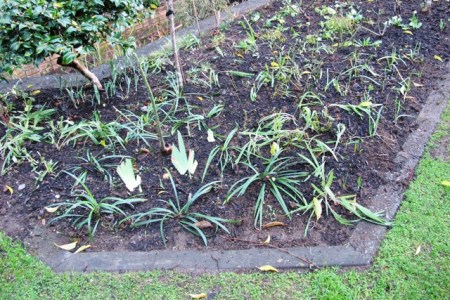
Planted - patience is now required as I wait for soil temperatures to rise

Planted – patience is now required as I wait for soil temperatures to rise

Plant Collector – Pennantia baylisiana (they don't come any more endangered than this ONE was)

Pennantia baylisiana - just the one single plant has ever been found

Pennantia baylisiana – just the one single plant has ever been found

If ever there was a strong argument for putting plants into commercial production in order to save them, it is this rare, native tree. Along with our native climbing Tecomanthe speciosa, only one plant of each has ever been found in the wild. In fact both the tecomanthe and pennantia are from Manawa Tawhi, the Great Island of the Three Kings group, where goats threatened their very survival as a species. Both were found around 1945-6. Duncan and Davies Nurseries succeeded in growing the pennantia from cutting and distributing the plants. Our plant dates back to that – probably in the early 1960s. It is still only a small tree, maybe 4 metres tall, with handsome, large, shiny recurved leaves. Being a subtropical plant from a mild climate, it needs to be largely frost free.

The problem with there being only one known specimen and reproducing it from cutting is that no matter how many plants you distribute, they are all identical clones so lacking any genetic variation. However, the original plant finally set viable seed in 1989 and there are now seedling grown plants in existence which should strengthen the genetic base. Penanntias are dioecious which means there are male plants and female plants. Fortunately the last known plant on the planet was female and occasionally, female dioecious plants can produce a little pollen and therefore self pollinate and produce seed. Our tree has set seed but as there appears to be a plant of Pennantia corymbosa in the neighbourhood, most of the seedlings have proven to be hybrids between the two, which is not what we are after at all. Mark was thrilled to finally get one seedling which seems to be true to P. baylisiana.

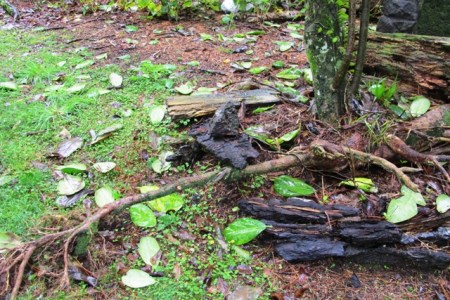
Our pennantia does not appear to be deep rooted - or it didn't appreciate recent strong winds

Our pennantia does not appear to be deep rooted – or it didn’t appreciate recent strong winds

First published in the Waikato Times and reprinted here with their permission.

Grow it Yourself – cauliflower

There is a finite number of vegetables and I am nearing the end of them in this column, which must be why cauliflower is still left. It is, I am afraid, amongst my least favourite of vegetables (palatable in cheese sauce with walnuts but little going for it otherwise). However, it has stood the test of time so clearly others view it more kindly. It is a brassica, like cabbage and broccoli, so in our milder areas, it is better to avoid growing the crop through summer when the cabbage white butterfly will wreak havoc and make the heads even less appealing. It will also bolt to flower too quickly in warmer temperatures. This means planting late winter and early spring to get through before summer (it can take up to 4 months to mature), or any time from early autumn onwards for winter harvest.

Because you only want a small number to mature at once, it is often easier to buy a few seedlings at a time from the garden centre though if you are an organised gardener, you could successionally sow half a dozen seeds in small pots each month or two. Being a leafy style veg, cauliflower wants rich soil full of nutrients. If you are using animal manure, make sure it is well rotted. We prefer compost to add nutrition and texture to the soils. Plant at around 50cm spacings to allow room to develop. Most modern varieties no longer require the heads covered to keep them white, as older varieties did, but it does no harm to bend over the top leaves to give some protection if you wish. If you actually enjoy cauli, there are trendy purple, golden and green options to try and there is some evidence that these coloured veg bring even greater health benefits to the standard white form.

First published in the Waikato Times and reprinted here with their permission.