Tag Archives: gardening

Tikorangi Notes: Saturday 23 April, 2011

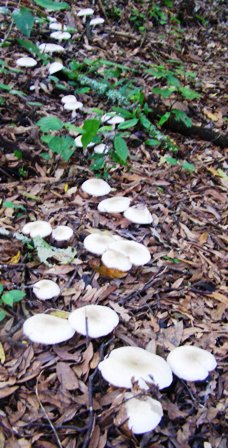
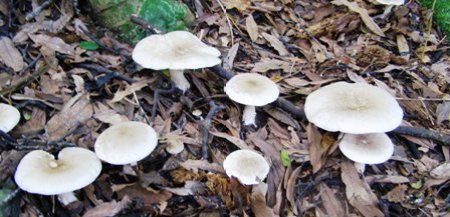
Our identified woodland mushroom in a fairy path

Our identified woodland mushroom in a fairy path

Latest posts:

1) Paradise Found in New South Wales– or our attempts to find gardens to visit around Sydney from bats at the Bot Gardens to Bob Cherry’s dreams in Kulnura.

2) Plant Collector this week looks at two tidy, compact evergreen shrubs with berries: Ilex cornuta “Burfoodii” and Raphiolepsis indica “Enchantress”.

3) Garden tasks for the week as autumn marches on inexorably. Still, we have only had one really cold day so far.

Tikorangi Notes: Saturday 23 April, 2011 When it comes to wild fungi in New Zealand, we are terribly conservative. Generally it is only the field mushroom that is harvested for eating, although the magic mushroom used to attract experimental youth in search of a free hallucinogenic experience. Possibly it still does, but there are a host of other wild mushrooms that go untouched. I have bought the up to date publications on fungi found here, but it appears that nobody has done the work on which forms are edible. I am not so keen on doing the experimental taste test. Apparently the basket fungi, puffballs and elephant ear fungi are all perfectly safe to eat, but I want a definitive tome to tell me which are safe and delicious before I get adventurous. With death caps also common, the gap between fatal and edible seems a little too small to me. And we can’t even get an identification on this woodland fungi from our books. Cascading down through our tawa bush, these mushrooms are currently abundant and growing, not so much in a fairy ring, but more akin to a fairy path.

Paradise Found in New South Wales

The quixotic creations of Bob Cherry

The quixotic creations of Bob Cherry

If you ever have any doubts about the quality of service at our local information centres, try going to the tourist information office at The Rocks in Sydney and ask about gardens to visit in the area. If you wandered into our I-sites, it would be reasonable to expect them to come up with maybe six or more options which would include a mix of both private and public gardens. Not so in Sydney. The staffer resorted to Google (which I had already tried at home) and merely pulled up real estate open homes in areas with garden type names. It remains a mystery to us as to whether there are in fact no open garden options beyond the botanic gardens. If there are, we failed to find them.

We did find the Royal Botanic Gardens which are very close to the Sydney Opera House in a magic location. The parking metre fee of about $26 made me wince and the café where we had lunch was downright ordinary. The wonderfully decorative ibis who have clearly adapted to café fare were the best part of lunch. Mark was particularly impressed by the palm collection and chose to linger there, studying mature specimens of varieties he has here to put into his planned Palm Walk but in the end it was the bats which provided the most vivid memory. Many large bats, hanging about in trees. I had been under the misapprehension that bats slept during the day. Not so, at least not these Sydney bats. They merely hang around upside down, bickering, squabbling, fighting and generally making a lot of noise. While the bats are vital for pollinating certain plants in the gardens there, numbers had built up to such a high level that they were also responsible for doing a lot of damage to many trees. I think we were told the current population is estimated to be around 16000, and that was not in a large area. The gardens’ management have permission to try and reduce the population but, this being Australia with a laudable commitment to their indigenous fauna, there is to be no cull. Instead they will attempt to drive the bats out by emitting a particular frequency of sound which only the bats can hear. Lucky neighbours. The bats do not apparently fly very far so upwards of 16000 displaced bats are likely to settle nearby.

We had to drive upstate to find a garden – in this case, one created by leading Australian plantsman, Bob Cherry. The garden he and his wife, Derelie, own is called Paradise and is located in Kulnura. Readers may not know the name Bob Cherry but many will know of Paradise camellias, particularly the Paradise sasanquas which completely dominate the markets both in Australia and New Zealand. However his interests go well beyond camellias and he was working with bidens, amongst many other plants, in search of new garden varieties. What is a bidens, you may ask? Closely related to cosmos and the orange and yellow so-called cosmos that turned up in a packet of pink and white cosmos seed here are in fact bidens. There are also common weeds that are bidens. Beyond bidens, begonias, Camellia sinensis, michelias, polyanthus and many other plant varieties were undergoing the Cherry touch in the quest for better garden plants.

Camellia changii - reputed to flower throughout the better part of the year

Camellia changii - reputed to flower throughout the better part of the year

Bob has made over 40 trips to China since it opened up to the west in the early 1980s and has been responsible for introducing a wide range of new species and plants to the west. We were fascinated to see Camellia changii in flower – in early March. Apparently it flowers all year round and its March flowers were certainly eyecatching, being a true scarlet red with no pink tones at all. Camellia changii is also sometimes referred to as Camellia azalea, although I have failed to find any explanation for that name. In the wild, changii is rated as extremely endangered but it has been distributed around the world and it opens up possibilities for breeding a new race of camellias that flower outside the time when petal blight hits. Of course they don’t have petal blight in Australia. Yet. Bob told us that he point blank refuses to visit New Zealand during camellia season. He thinks it is probably only a matter of time before petal blight reaches Australia but there is no way that he wants anybody to be able to claim that it was first found in his garden or nursery.

Bob and Derelie garden on a pretty grand scale and, typical of most Australasian gardens, they do it themselves with minimal input from outside labour. We didn’t even look at Derelie’s extensive rose gardens, but there is an extraordinary range of woody trees and shrubs, including some of the best foliaged Michelia yunnanensis (syn. Magnolia laevifolia) that we have seen. But the other stand out features of this garden called Paradise were Bob’s structures. I am not sure I can convey the full scale of these. We built a pretty large brick wall here in our garden and it took 16000 bricks. Bob has so far used an estimated half a million bricks on his structures. And that does not include the extensive stonework and ironwork. He gets in a brickie whenever his budget allows but he does all the stonework himself. We are not talking brick paths and dinky little structures here. This is grand vision stuff. The pillared walkway shown in the photograph is as yet unfinished. There are now 50 of these massive brick columns and it is to be an extension of the wisteria walkway. There is something bravely compulsive about some of the constructions – a vision the creator is determined to get well underway, knowing that he may never see completion. His property is on the market and he yearns for retirement to a smaller piece of land in Tasmania. Bob Cherry is one of the gardening world’s modern quixotic gems.

Derelie has published a book on the garden which is available in New Zealand. “Two Dogs and a Garden” is a beautifully produced book, full of pretty photographs (very pink, but how could it be otherwise when camellias play a large role in their lives?) and a personal interpretation of the lives they lead in their own piece of paradise.

Finally back to Sydney, we were delighted by the crepe myrtles used as street trees and in full flower in Chinatown. The crepe myrtle or lagerstroemia is a small tree, mainly from Asia, with beautiful bark. They can look remarkably dead when they are dormant in winter. We saw some in northern Italy, completely dormant, with bark which resembled piebald ponies. They will grow here, but they rarely flower well. We are just a bit too wet and lush for them. They tend to do better in drier climates with hot summers and more seasonal variation than we can give. Being a small tree with a light structure, they make a well behaved street specimen. In flower, they look a little like trees covered in crepe paper blossoms which seemed entirely appropriate to the ambience of Chinatown.
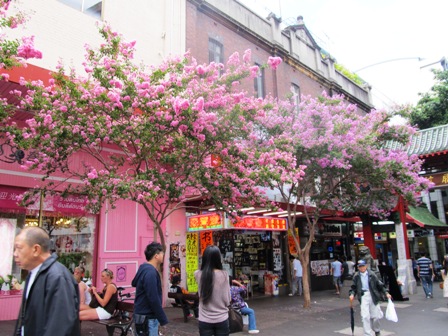
Crepe myrtles in Sydneys Chinatown

Crepe myrtles in Sydneys Chinatown

In the Garden this week: Saturday 23 April, 2011

• I was wrong. The first wintery blast did not wait for Easter but arrived last Monday morning. Fortunately we should not stay cold for a while yet, but it was a good reminder to make the most of remaining mild autumn weather in the garden. Nothing saps gardening motivation faster than cold, wet conditions.

• Easter should signal the time to be out doing the autumn clean up. Tell yourself that you are working off the extra calories consumed by most of us at this time. Remove spent crops in the vegetable garden and do a weeding round. If you don’t need to use all the area for winter and spring crops, either sow down bare areas in a green crop or at least mulch it to keep the invading weeds at bay.

• Silver beet is a rewarding vegetable to grow for those who are willing to eat it (and apparently some people like it) because you can continue harvesting repeatedly from the same plants. It is also hardy so makes a good winter stand-by. It is best to put in small plants this late in the season. There is not a lot of growing time left before winter.

• In the ornamental garden, the time for autumn feeding is over in colder, inland areas and fast running out in milder parts. The idea of feeding now is to allow the plant to take up the goodness before growth slows down or stops during winter. There is no point in feeding dormant plants.

• Last gasp, too, for perennial cuttings this season. After this, perennials need to be increased by division, not cuttings.

• Slugs and snails are undeterred by the cold. Watch for signs of them around emerging spring bulbs and set up bait stations if need be. We often use a low-sided plastic bottle top such as those from milk containers with a paua shell covering it to stop the bait from dissolving.

• Wrench plants which you intend to move to another site. Wrenching involves making straight cuts down two sides of the plant’s roots now, following up with cutting the other sides in two or three weeks’ time. This reduces the stress on the plant but is only necessary for well established plants which have been in the ground for some time (as in more than a year or two). Plan to take as large a mass of roots as you can physically manage.

• If you have not yet given hedges a tidy up trim, don’t delay on it. Trimming forces a new flush of growth and you don’t want it so fresh and tender that the first hint of frost will burn it off.

Tikorangi Notes: Friday 15 April, 2010
Latest posts: Friday 15 April, 2010:

1) Plant Collector this week is about Rhopalostylis sapida, better known to New Zealanders as the nikau palm – in this case the Pitt Island version of same. The Pitts are one of our more remote islands and the nikau is the world’s southernmost palm tree – and one of great beauty.

2) Garden tasks for the week with particular reference to autumn treatment for hellebores and a note about kang kong (which is an Asian green veg as opposed to a misprint of a giant ape).

3) Outdoor Classroom this week is the second instalment on garden mulches. We look at options which are usually available free but what you save in dollars across the counter, you will likely spend on your time assembling these options.

Tikorangi Notes: Friday 15 April, 2010
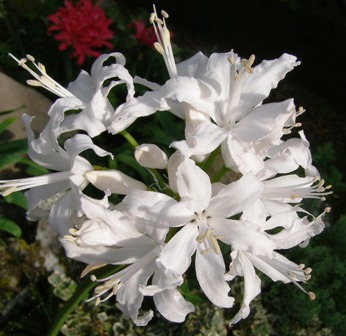
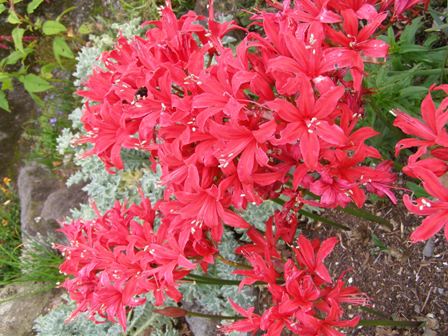
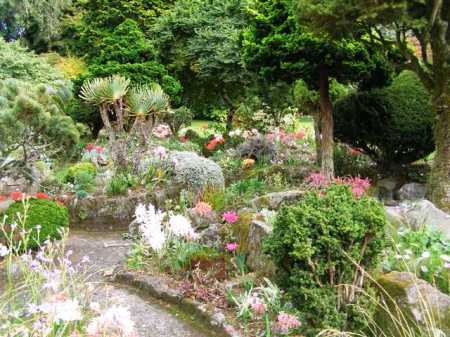
Our magic run of autumn weather continues. Dead calm days (always appreciated in a windy climate), mild daytime temperatures in the early 20s (Celsius) and cool nights. Rain is forecast, which is good because all my recent efforts on dividing perennials and relocating shrubs need watering in. Our avenue gardens consist of five parallel borders around 50m in length (each). I have finished three borders plus the one across the end. Just two to go so, realistically, I may have finished in another fortnight. In the meantime, the rockery continues to please. Nerines have a good long flowering season and they continue to look splendid. While we grow some of the species, it is the sarniensis hybrids which are the showstoppers. I will forgive them their foliage which hangs on until late spring, looking ever tattier. Our autumn flowering would be so much the poorer without them.

The rockery in autumn

The rockery in autumn

Plant Collector: Rhopalostylis sapida

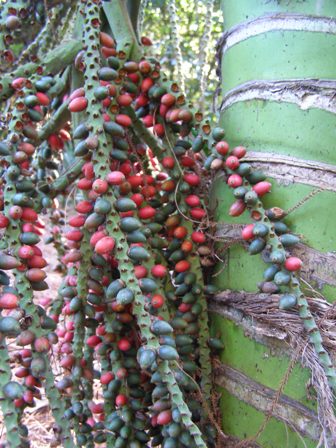
The ripening seed on the Pitt Island nikau palm

The ripening seed on the Pitt Island nikau palm

The botanical name for this native plant does not trip off the tongue easily. It is much easier to refer to it as a nikau palm. And yes, it is indeed a palm. In fact it is the world’s southernmost palm. This form is even more south eastern than most, as it is from Pitt Island. Nikaus are often regarded as very slow growing but it is curious fact that the variation that is endemic to the Chatham Islands (which includes Pitt) is much faster growing and sets viable seed years earlier than the mainland form. They are hardy throughout most of New Zealand (except for deep inland or alpine areas) but not widely seen internationally because they don’t like extremes of heat, dry conditions or the cloaking of cold, dry arctic air which is very different to the chilly air movement that we get with wintery blasts.

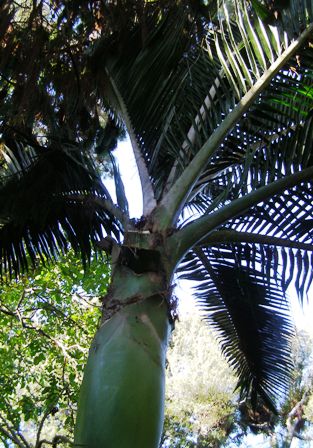
The handsome crown of the nikau palm

The handsome crown of the nikau palm

Nikaus are exceptionally handsome plants but they get large. This plant is already around eight metres to the top of its crown and the arching fronds are about four metres long. It will keep growing and get larger. In the juvenile stage, the unfurling fronds wrap around the whole plant and the shape is reminiscent of an old fashioned shaving brush or feather duster but that hardly does justice to these handsome plants. We find that they seed down very readily throughout our garden and we just dig out those plants in inappropriate places. They are not the easiest plant to transplant as they get larger. Their roots go straight down and you have dig well below the base plate to extricate them without damage. The seed turning red is a sign that it is ripe.