Tag Archives: Mark and Abbie Jury

A mildly controversial opinion

Read down for my comments about staged photos

I have decided I just can’t get excited about hellebores. The most common hellebore – Helleborus orientalis – in particular, but not exclusively so. Not in our conditions with its mild climate and the explosion of spring flowers we get before winter has even officially ended. I have seen them in colder climates and they are way more rewarding than here.

Orientalis as a garden plant just doesn’t spark joy for me

I have tried and so has Mark. I have mollycoddled them, replaced inferior performers with better selections, weeded out endless seedlings, scrupulously dead-headed them to reduce unwanted seeding and to hold the infestations of aphids at bay, removed unsightly foliage (it takes years for scruffy spent foliage to drop and decay of its own accord), given them compost, bought new selections and still they are underwhelming. Mark has raised many seedlings of controlled crosses to get cleaner colours and flower spikes that stand above the foliage and they can look very promising in nursery pots and very average in the garden.

I don’t know how many H. niger we have raised and planted out. It is the pretty, low-growing white with the upward-facing flowers held just on the foliage. It is a one season wonder for us. I was delighted with ‘Angel Glow’ but after three very pretty seasons, it has all but disappeared this year.

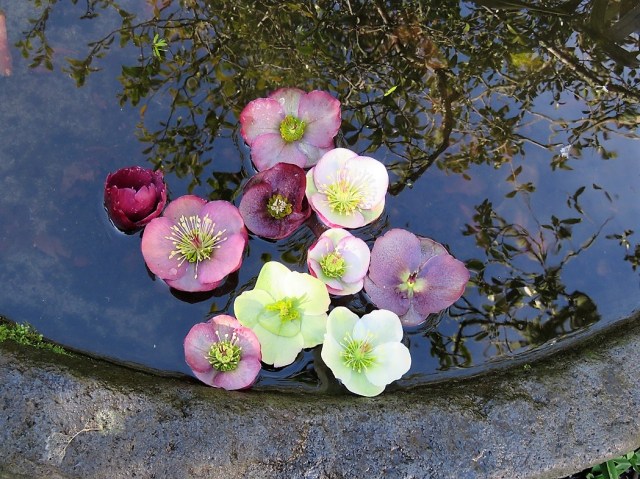
The temptation was too great. I floated flowers from the ‘Marbled Group’ but it is their all round performance as garden plants that impress.

They are not all without merit. I remain sold on the ‘Marbled Group’ from UK breeder, Rodney Davey. ‘Anna’s Red’ and ‘Penny’s Pink’ remain the best of that series in our garden but we also have ‘Molly’s White’, ‘Ruby Daydream’ and ‘Sophie’s Delight’. Just a word of warning: ‘Anna’s Red’ made a big and luscious plant so I thought I would divide it to use it further. It did not appreciate this treatment and has been slow to recover- as in a few years, not months. Mark informs me that hellebores do not generally like being dug and divided in the same way as other perennials. They can sulk somethin’ chronic.

Helleborus x sternii
Helleborus foetidus
Helleborus argutifolius

Helleborus x sternii is a mainstay in the woodland garden and very easy care. All it ever needs is the spent flower spikes removed at the end of the season. So too with H. argutifolius which is one of the parents of x sternii. H. foetidus is fine – more utility than exciting and it can spread a bit but it has interesting foliage. What these three have in common is that they all have green flowers but hold their flower spikes up above the foliage.

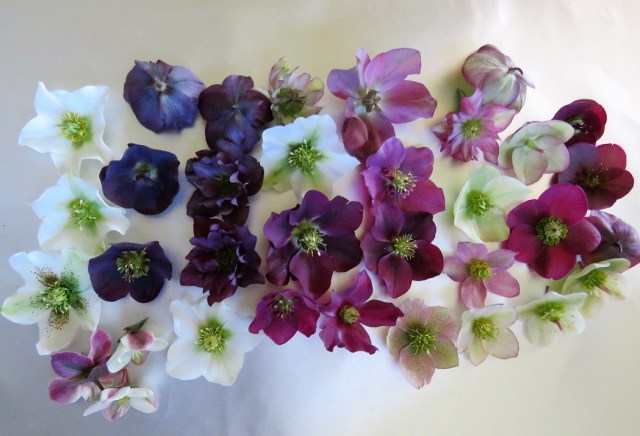
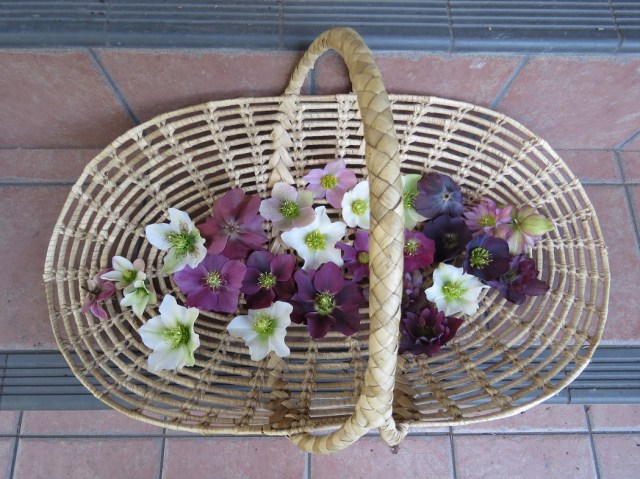
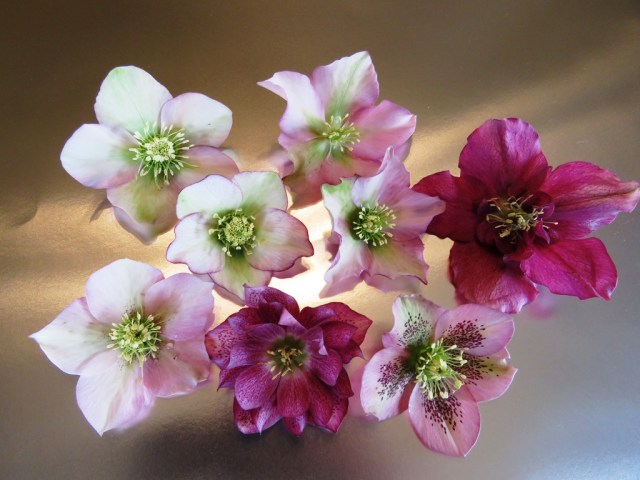
The staged photo of cut blooms shows they are individually pretty but I do not generally rate them as garden plants in our conditions

And therein lies the problem. There are many lovely staged photos of picked blooms arranged to face upwards. I have done a few myself. But that is not what they look like in the garden where H. orientalis is characterised by downward facing blooms. And as soon as one gets into the popular double blooms, the extra weight drags them over even further. Also, the interest in the dark slate colours – the deeper purplish-black the better – is based on picking a flower and looking at it facing upwards. As a garden plant with those dark flowers, they just tend to meld into the backgound. The best I can say is that orientalis opens a wider colour range than the other types we grow.

This sight sparks more delight for me than rather lacklustre H. orientalis – and comes at the same time of the season

While I am in awe at the far-reaching and long-standing enthusiasm that has made H. orientalis such a popular plant, they are best in cold climates which don’t have the same options we have. Colder, drier climates are even better. With calanthe orchids and Hippeastrum aulicum both in full bloom at the same time, I am not convinced that the utility hellebores that grow in similar conditions are worth more effort on my part. If you really want to grow them in softer climates like ours, keep them in a pot. They seem to perform better in controlled conditions. I don’t love them enough to give them that sort of special attention.

Yet another staged photo. I see I have done a few of these over the years.

Nau mai, haere mai. Welcome to Festival 2021

Believe it or not, the Taranaki Garden Festival has run every year for 34 years. It started life as a rhododendron festival and we still have a few rhododendrons in the garden, quite a few in fact, including the lovely sino nuttallii.

The official programme for the Taranaki Garden Festival was launched this week.

Last year, when we reopened for the first time in seven years, it coincided with the domestic tourism boom after our short lockdown. The numbers were astounding but we managed, bar the poocalypse. This year, I thought visitor numbers might receive a further boost from Australian garden-lovers starved of other travel destinations. Chance would be a fine thing.

We follow Australian Covid closely with our immediate family spread across three states there. We had hoped for an extended weekend get-together in August. Somewhere more northerly in Australia we thought – maybe the Whitsundays or even the Sunshine Coast, thereby introducing a fourth state into already complicated travel plans. For overseas readers, this was because of the introduction of a quarantine-free travel bubble between NZ and Australia. That is not going to happen since the arrival of the Delta variant into Australia and the suspension of the travel bubble. Clearly planning ahead with any certainty is not an option at this time, though I have pointed out to our children that when the bubble reopens, it does appear that there is less likelihood of getting trapped on this side than on the Australian side. But I am guessing only a few intrepid Australians who can risk getting trapped away from home by a Covid outbreak may turn up for our garden festival.

The world may be sick of Covid but Covid is not done with us yet.

Hippeastrum papilio in the Rimu Walk

Back to the festival. We are reopening but only for the ten days of from Friday 29 October to Sunday 7 November. I was so shellshocked last year, I wasn’t sure we would reopen but the addition of Zach to our small team has taken the pressure of preparation right off me and the garden has never looked better. We have never been so advanced in our preparation this early before. There will be no neglected areas or tasks unfinished, the way we are going. It brings the pleasure back to gardening when the anxiety and pressure of getting it to opening standard is relieved by an extra pair of very capable hands.

The Court Garden in early November – one of a series of five new summer gardens we have created in the years we spent closed

Following the success of the workshops Mark and I offered last year (well, mostly me, to be honest but I am reliant on Mark as my in-house technical advisor and resident expert), we are offering more this year. So many people missed out on  ‘New Directions with Sunny Perennials’ that we are offering it twice this year, with another valuable year of experience under our belts. The blurb reads:

New Directions with Sunny Perennials

For over a decade, Mark and Abbie have been looking at modern trends in perennial gardening, variously described as ‘Dutch New Wave’, ‘New Perennials’ and the ‘New Naturalism’. This has culminated in the planting of the summer gardens. Join them for morning tea and a talk on key points they have distilled from visiting over 90 gardens in England, France and Italy, tracking the work of six contemporary designers and how they have applied this in their own garden.

Monday 1 Nov and Saturday 6 Nov 10.15am – 12.00

Are you looking for gentler ways to garden?

Instead of repeating the meadow workshop, we have expanded it to take in managing a wild garden as part of our personal commitment to finding softer, more naturalistic and sustainable ways to manage our garden.

A Gentler Way to Garden

The Jurys have been exploring strategies to ensure their garden is not only beautiful but also sustainable in the longer term and biologically friendly. Join them to learn about meadow styles and management and the techniques underpinning their new Wild North Garden and their park meadow.

Sunday 31 October 10.15am – 12.00

We are well on the way to being ready to open the Wild North Garden

All the information is online here and you can request a hard copy of the programme. Bookings for our workshops are essential and can be made through that link to the Festival Office.

We would love to see some of you here this spring.

Melding the old gardens with the new into a single garden experience

Of weather, early magnolias, possums and rats

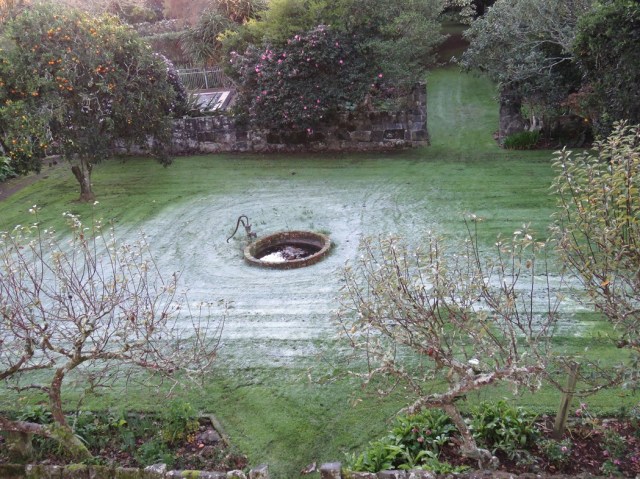
Frosty mornings from Wednesday to Saturday showing up the lawnmower lines

We had to drive to Wanganui and back on Tuesday morning – a five hour round trip. On the way down, we drove through snow (inland from here), sleet and hail as the first polar blast of winter hit. By the time we drove back the sun had appeared but with a biting cold wind that felt as if it had come straight off the ice caps of Antarctica. Wednesday dawned bright, clear, frosty and calm though cold and that has been the pattern in subsequent days – cold mornings and sunny days.

Sunrise on Wednesday morning

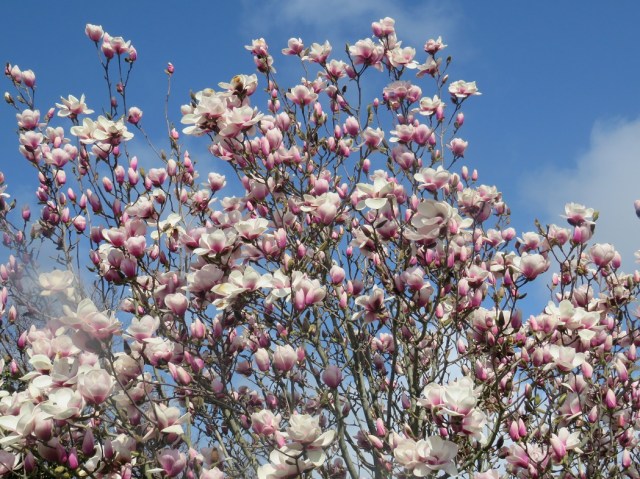
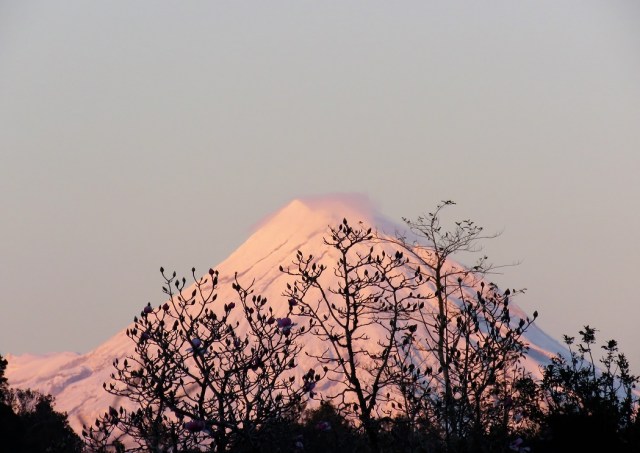
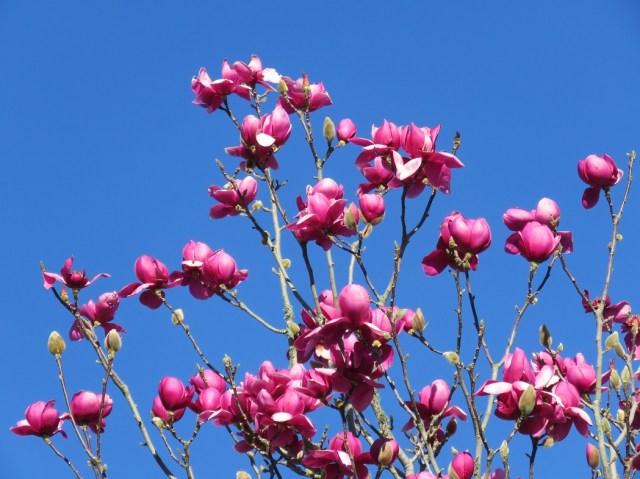
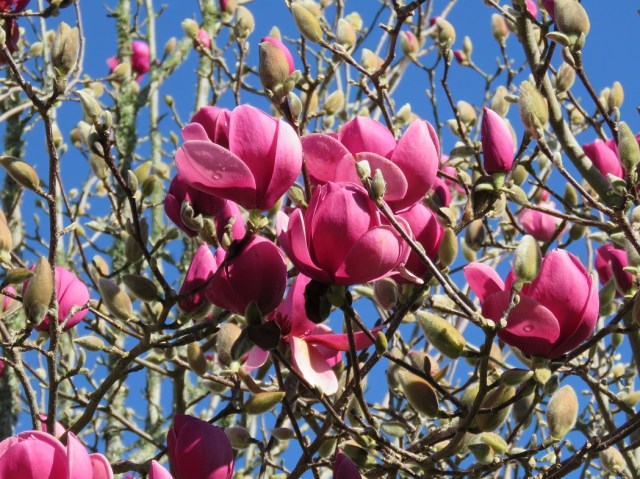
The magnolias are undeterred. Matariki[i] is underway and the plants agree that this is the time to celebrate the start of a new year.  It will be another few weeks before the Magnolia campbellii in our park will be in full bloom but my annual pastime of photographing the magnolia and te mounga[ii]  has started.

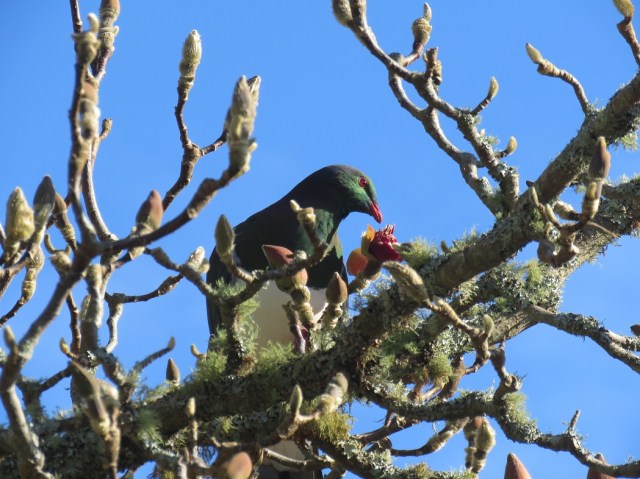
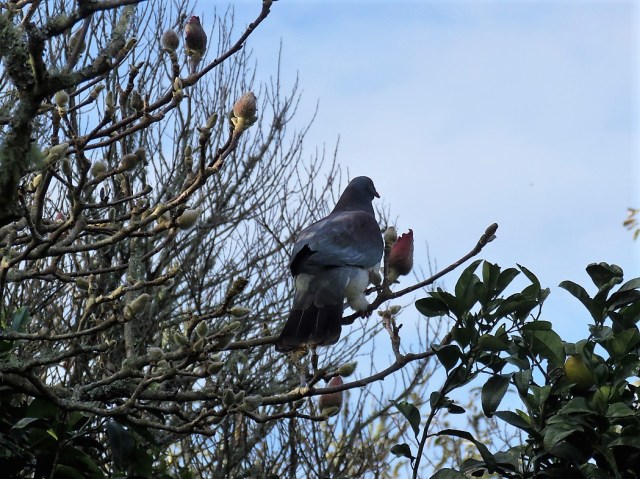
Absolutely shameless, this kereru was, eating the magnolia buds as we watched

By 10am, it is warm enough for us to sit outside for morning coffee and this shameless – shameless, I tell you – kereru[iii] took up its position in a magnolia a few metres away, eating the petals of the first buds showing colour. It may have been its mate just down the driveway that was doing the same to the first buds on Magnolia Vulcan. We are more charmed than miffed. Soon the trees will open so many blooms that they will outpace the kereru. We would rather have resident kereru all year round than perfect first magnolia blooms. I am told kaka – our big native parrot – can do the same but we have not had a mob of kaka descend on us. A reader tells me she once watched them strip every bud off a magnolia. The only two kaka we have seen here arrived singly in different years and while Mark saw one of them pulling buds off Magnolia Iolanthe to hurl at the tui who were protesting its presence, it takes more than one to strip a tree. Rosella parrots – a showy Australian intruder – are also reputed to cause damage up north but we haven’t seen them doing it here and we do have them turn up in small groups. 

Just an unnamed seedling, as we say

The only magnolias in full bloom so far are seedlings from the breeding programme that will never be released. We only ever name magnolias that are going into commercial production and these first ones are just too early, too vulnerable to winter’s icy blasts to put on the market. They exist solely to give us pleasure on our own property. Some of them are such good performers that an identifying reference name evolves. So it is with Hazel’s magnolia. We get asked for funeral flowers from time to time, or we offer to do informal casket arrangements for people we know. This magnolia formed the centrepiece of an arrangement for Hazel, the mother of a close friend of Mark’s and a dear lady who meant a great deal to him in his younger years.

Hazel’s seedling at its best
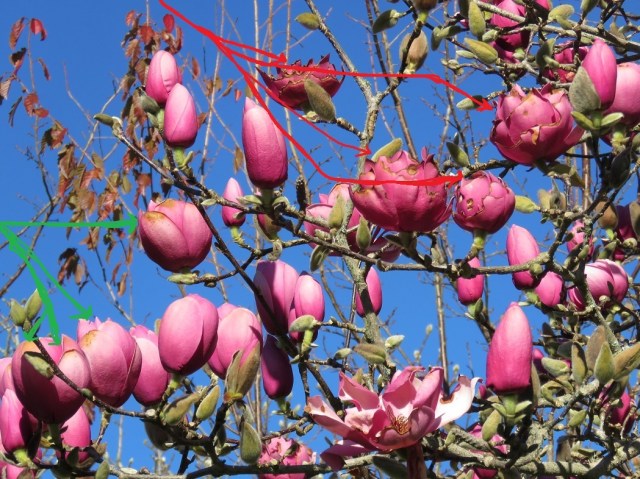
Hazel’s seedling this week. The red arrows show what is likely to be damage from a kereru eating the young petals. The green arrows to the left show burning from the frosts this week.

Hazel’s magnolia makes a pretty picture every year. It performs well and, we found, also holds well when cut. In the world of magnolias, it is not remarkable. There are prettier colours, more distinctive forms and it flowers way too early for most growing conditions. It just happens to be the first of the season for us, standing out in bloom where it is growing in the shelter belt that protects one of our open paddocks.  Yesterday, it looked great from a distance. Close-up, it revealed two problems. The chewed blooms are almost certainly the result of kereru feeding on the sweet, young petals. The browning is frost damage and if it gets damaged in our mild climate, it will get destroyed in colder conditions.

Magnolia buds that will never open to good blooms. Every one of them has had the centre nipped out of them.

We have long assumed that the chewing out of young buds which then open to distorted blooms can be attributed to the pesky possums that Mark wages war on all year round. We certainly could have done without the early settlers introducing the brushtail possum which is a noxious pest, optimistically slated for eradication in this country, though protected in its Australian homeland. Mark is now wondering whether it is a combination of rats and possums.

Possum guilt. That red is a stomach full of magnolia buds. Our magnolia buds.

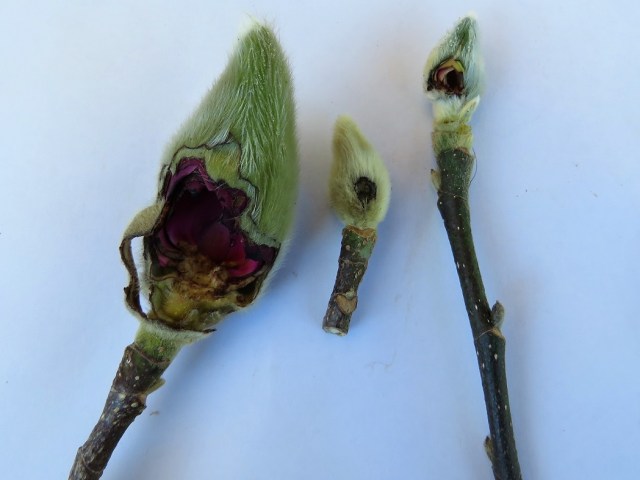
We know possums are guilty. Mark has shot enough of them in magnolia trees and the proof lies in an examination of their stomach contents. All that red? Those are magnolia buds. Rats are harder to prove because we never seen one in the act and we don’t have the corpses to perform a forensic analysis of stomach contents. But when all the buds failed on a plant of Honey Tulip last year and closer examination showed that every single bud had a neat incision in it, he thought it may be rat damage, not possums. We know possums eat out the centre of larger buds with colour already developed. It seems like the very small nips in the less well-developed buds are rats.

Our pick is that the large bud on the left has been eaten out by a possum. The two smaller buds are more likely to have been attacked, ever so neatly, by rats. Possums don’t attack the buds at that early stage.

In the meantime, how many photos of the magnolia and te mounga do I need? I shall stop now until more blooms are open. But glory be, how I love big, beautiful magnolias against a blue sky or snow.

Thursday morning
and Friday afternoon. At least the frosts aren’t bad enough to take out the Magnolia campbellii blooms

[i] Matariki – the Maori new year, determined by the rise of the Pleiades star formation. 

[ii] Te mounga – the mountain in local dialect. In standardised Maori, mounga is more commonly seen as maunga. Otherwise known as Mount Taranaki.

[iii] Kereru – native wood pigeon. It is fully protected because its numbers are declining due to loss of habitat and its very slow rate of natural increase – most breeding pairs only raise a single chick each year.

An unrepentant kereru eating the first buds on Magnolia Vulcan

On another topic, rather than a postscript, those who read my May post about Mrs Wang’s garden (and there were many of you. I know this from my site stats) may enjoy this delightful and affirming update. I feel vindicated. Mrs Wang is indeed a first-generation New Zealander, she declares herself to be a digger and she did indeed experience the devastating famine in China during her childhood. I did not, I admit, pick her as a professional civil engineer. Those whose ugly response when the story broke was to defend the establishment by attempting to discredit Mrs Wang with vile speculation based entirely on their own prejudices, need to take a good hard look at their own racism. I am not referring to comments on my post – readers here are in a different league but I saw some pretty awful speculation and accusation coming through on other social media. There is much that is good in this world for those who choose to see it.

The first bloom of the season opening yesterday on Magnolia Felix Jury. We get the best colour on the early blooms.

Remembering Lara Bingle

Work is underway on taming the Wild North Garden in readiness for finally opening it

It is official. We have agreed to open the garden again but just for the ten days of the Taranaki Garden Festival – Friday 29 October to Sunday 7 November. I wasn’t at all sure we would during the months of preparation last year which took a high toll, but the addition of a new member to our team makes it all look more manageable. Besides, we want to show off our Wild North Garden, a 4 acre extension to the garden that has been in development for the last 30 years.

Last year was the biggest year ever for the Festival, exceeding all our expectations with New Zealanders on the move. It may not be very different this year as offshore travel remains extremely restricted. The full programme won’t be released until July but the initial information can be found on the Taranaki Garden Festival website.

At its best, the Wild North Garden can be very pretty but had grown steadily wilder until recently

The news of the trans-Tasman bubble opening this week is exciting for us personally. At last, we can plan on seeing our three children and only grandchild this year, after a long gap. All are currently living in Australia. For overseas readers, the trans-Tasman bubble is the first major quarantine-free travel bubble between two countries with no Covid in the community. If it works out and proves that we can keep NZ safe, I am assuming travel may open up again to other safe countries – many of our Pacific Island neighbours, Taiwan and Vietnam – later in the year. I do not think we will be opening to the rest of the world any time soon.

Mark and I are not rushing to book tickets to Australia just yet. We would like to be vaccinated first (I think our demographic is scheduled for next month) and we want to see what happens when there is a community outbreak either side of the bubble. This will happen and when it does, flights will be frozen and borders closed in a flash. Being stranded across the ditch (as the Tasman Sea is oft referred to here) for an extra 3 days would be fine but if it stretches into many weeks, that would be problematic. We have waited over a year already, we can wait another couple of months until the picture is clearer.

The bubble, however, will not just reunite families. It is also to kickstart tourism on both sides and it may be that some Australians would like to come over for our Taranaki Garden Festival.

So who is Lara Bingle, you might ask? For some reason, her name has stuck in my memory. She is the charming young woman in a bikini asking ‘So where the bloody hell are ya?’ at the end of the only Tourism Australia advertisement I remember. It came to mind as I was thinking about whether Australians may come over to our garden festival. The idea that it would be ripe for a spoof in the garden is one of those ideas that may have sounded better after a couple of glasses of wine.

Notwithstanding that, we would love to welcome any Australians as well as New Zealanders who wish to come and see us at the end of October. Going into public situations with no need for masks or physical distancing, no restrictions and no fear is a privileged position for those of down here in the South Pacific.

The Court Garden this week in autumn. It will look very different again in November when we reopen for ten days only

From a tsunami threat and Covid to calliandra and Mark’s low meadow

I would like to suggest that Dudley is asking NZers not to be grumpy moaners but really he was wondering whether it would be worth the effort to follow me down to the Wild North Garden. Not one for wasting energy, he decided it wasn’t.

It has been a discombobulating week. Not at a personal level, but nationwide. The tsunami threat on Friday rather capped it off. In a country where the majority of people live within a few kilometres of the coast, the potential catastrophe of a tsunami on the scale of the 2004 Boxing Day one in the Indian Ocean is very real. Three large earthquakes to the north of us were seen as having the potential to create such waves.

For overseas readers, this resulted in major evacuations across wide areas (“get to higher ground or head inland”), a general warning to coastal residents around the rest of the country and wall to wall coverage on all major media for several hours. Fortunately, the threat passed with no tsunami –  just some unusual wave and current activity – and we all learned that our Civil Defence protection is efficient and effective in the face of real threats. That, at least, is reassuring.

Calliandra flowering this week with ox-eye daisies and Stipa gigantea in the Court Garden

As we are coming up to the first anniversary of Covid in NZ, Auckland is just coming out of another week of Level 3 lockdown. This is comparable to the general level of lockdown in many other countries but somewhat short of the Level 4 lockdown of last year when we managed to get the country Covid-free. It was also for one week only, to isolate the latest community cluster which has been kept to just nine people – against all odds given that it is the highly contagious UK strain. The thing about lockdowns is that they bring out the best in many people and the worst in a strident few and that makes them even more wearing.

Honestly, NZers whinging about being ‘sick of lockdowns’, ‘suffering from Covid fatigue’, and bleating that ‘we can not keep yo-yoing in and out of lockdowns’ are so selfish when you look at the rest of the world, most of which has been in some form of lockdown for the better part of the last year. The whole world is ‘sick of Covid’ but it is not going to end any time soon and we NZers have had more freedom than almost every other country. But there is a price to pay for the freedoms we take for granted and that price is doing what is required to keep Covid out of our communities.

Just please, stop complaining, grit your teeth and keep your eyes on the goal of a return to those freedoms of activity and movement over the next week or so. And keep watching what is happening in the rest of the world and be grateful for where we are.

When everything looks to be going to hell in a handbasket there are still flowers – the pink candyfloss calliandra

I was delighted to see the calliandra in flower this week. I wasn’t sure how it would perform in a garden situation here, given that it is native to Arizona, Texas and Mexico and that it was a very neglected specimen when I planted it. Now I feel I should go and retrieve the remaining neglected specimens languishing in an unloved state in the former nursery area. Maybe I could revive them and have more of these starburst wonders in the hot Court Garden.

We have a large front lawn, now Mark’s low meadow

Mark was almost chortling in delight – except that he is not generally a chortler- at the candyfloss piece about letting your lawns grow on TV’s Seven Sharp show this week. Mark asked Lloyd to stop mowing our large front lawn after Christmas. Lloyd is too discreet to express an opinion on this matter but I suspect it galls him to look at it as he mows the other lawns. Mark was curious to see what would happen if we let it grow and he is quite delighted by what he calls his ‘low meadow’. The quail, who enjoy the clover, are equally pleased. There are areas carpeted in white clover flowers and yellow from the lotus major but more patches than carpets of blue from the self-heal (Prunella vulgaris). I was hoping for more blue.

Equal parts lotus major, clover and lawn grass with some self heal
It would have photographed better had the grass on the mown paths and edges been caught rather than left to lie

After a few weeks, I asked Lloyd to mow a strip around the edges and paths through the middle and that gave it a more acceptable definition – more meadow than neglected, rank grass. There is still an open verdict here on the merits. It is certainly more environmentally friendly. As far back as 2006, I have been writing about the environmental travesty that is our obsession with ‘perfect’ lawns. We will mow again when the flowering finishes and the first cut may be more like making hay. In the meantime, it is not a look that will appeal to everybody but we are interested in experimenting with gentler ways to garden. And at least we are in good company with this concern.

We are in good company – the best in fact. RHS Rosemoor Garden in Devon where they have stopped mowing all the grass all of the time.