Tag Archives: Mark and Abbie Jury

Tikorangi notes: this, that and the next thing too.

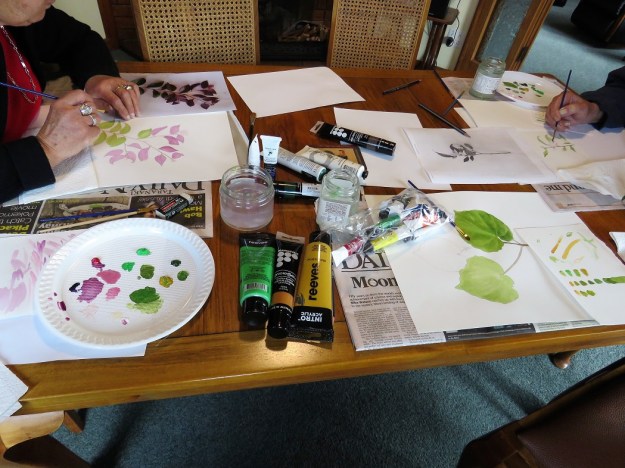
A beginner’s class in botanical art, day two

A reminder about the botanical art workshops being offered in our garden next weekend , November 2 and 3 with an intermediate class the following weekend, subject to enrolments. More details here if you are interested.

Last week was busy. In this life of ours, we are always active and on the move but generally free from external commitments, in charge of our own pressure points. But last week we had two tours through. Despite the garden being closed, we still accept the occasional group.

The IPPS group. I was too busy to take any photos at all of the Oregon Hardy Plants group.

First up was the IPPS conference (the NZ chapter of the International Plant Propagators Society) so former colleagues, essentially. They were followed by the Oregon Hardy Plants  tour where we like to go the extra mile and roll out the welcome mat, given the huge distance they have travelled.

It takes a bit of work to lift the garden back to opening standard. I start about six weeks out and do a complete round of the garden – all weeds out, dead plants removed, any bare patches sorted and the major tidy up. Lloyd does the big annual clip on the hedges – with a string line, powered hedge trimmer and hand clippers – and he removes any piles of garden debris we (mostly *I*) have accumulated around the place. Two weeks out, all three of us start the second round of the garden attending to the details that make it look sharp including edges, sweeping and motor-blowing, leaf raking woodland tracks, scooping up sludgy camellia blooms on the lawns, mulching where necessary and a final weed. Other projects have to go on hold at this time.

The  interview was filmed indoors as rain was threatening outdoors

We put physical energy into preparing for tours but that can pale beside the mental energy that goes into hosting them in person so the day after the Oregon people, I headed into town for a pleasant luncheon with friends. I knew we had a film crew coming in that afternoon but I wasn’t worried. We were not the subject of the filming and the garden was to be just a back drop. They were filming a documentary on a good friend of mine who is an artist and she had asked me if I would be interviewed. I expected a low-key crew of maybe two enthusiastic young people filming something that not a lot of people would ever see. I was wrong. When they arrived, it was way more major and professional than that. That’ll l’arn me. I had thought they might just talk to me casually for five or ten minutes but it was closer to a full 45 minutes of filming me talking and then filming us walking around the garden. I am delighted to see this external recognition of my friend, Fiona Clark. I was just surprised that the filming was not the low-key event I had anticipated. I am assuming (hoping?) that the footage of me will be edited down to maybe 3 minutes in the final documentary but I felt I had earned a stiff gin at the end of it.

Now it is back into the garden, between the pesky showers that dog our typical spring. And any pressure is self-imposed. The greatest pressure is the thought that we are entering the stage when it has been too cold and wet to enjoy planting out suddenly morphing into the point when it is too late before temperatures rise, the sun is strong and the winds too drying to risk it any longer.

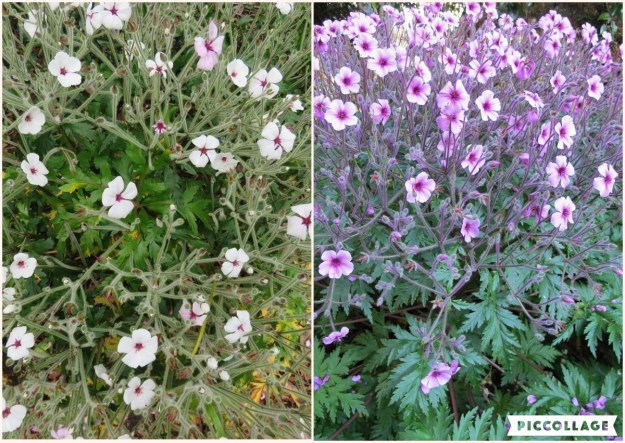
Geranium madarense – white(ish) to the left, the more usual cerise pink to the right

When I was given the Geranium madarense, I was pleased. We have plenty of the common cerise form seeding around but the white sounded interesting. Because it is not a pure white, it is not as interesting as I hoped. It may even be deemed a little insipid. At least I can afford to let it seed around so time will tell if it has merit.

Ever so small at this stage, but I have high hopes of the one veronicastrum 

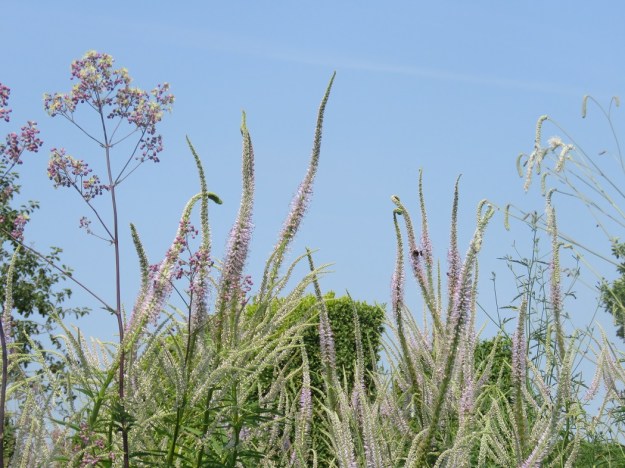
This is what I am hoping for, photographed at Le Jardin Plume in France. We even have the thalictrum to the left as well, although it is currently somewhat smaller in stature, too.

European readers will laugh at my delight at the plant of Veronicastrum virginicum that I am carefully nursing through. It is a mainstay of UK gardens in particular. New Zealanders who have come back from seeing this handsome, large plant in gardens overseas but rarely here, may appreciate our efforts. The seed is so fine that it looks like specks of dust and we only managed to get one plant to germinate. The bamboo cage is to protect it from rabbits. I have no idea if our pesky bunnies will actually eat it but I am not willing to risk it. I was talking to Kate Jury of Seaflowers Nursery on the IPPS visit and we agreed that there are good reasons why it is not seen much here. It is not an easy plant to get started. I assume once it gets going, it may romp away but I had a bad moment in winter when it disappeared altogether as I had not realised it was fully deciduous. I see it now has more than one growing shoot so I am hoping it will be a dig and divide type of perennial once established. Gardeners learn to thrive on optimism and patience as well as perspiration.

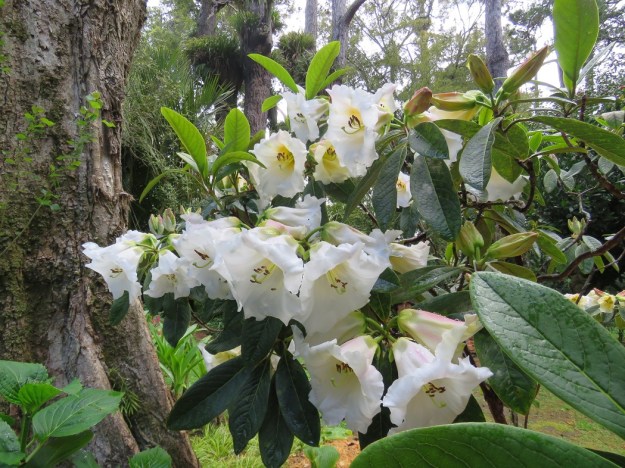
‘White Waves’, I think.

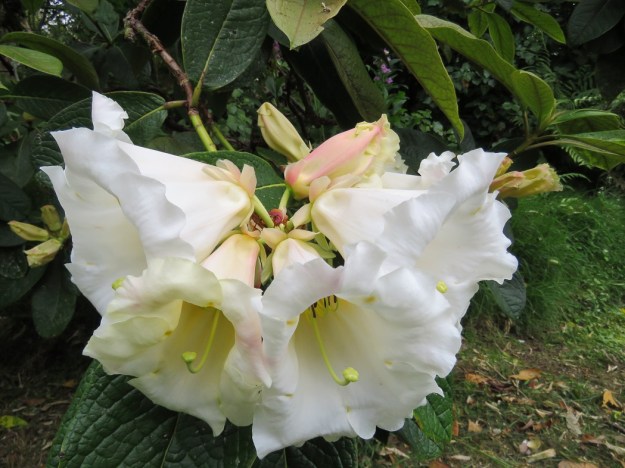
At this point of mid spring, it is all about the rhododendrons and clivias. I am guessing that this handsome rhododendron that we relocated from the old vegetable garden six weeks ago is ‘White Waves’. It is one of the easier, scented nuttalllii hybrids to grow (R. nuttallii x {R. lindleyi x dalhousiae}) and a quick net search tells me it is still available for sale in NZ.  We are very fond of the big nuttallii trumpet types though they are too tender for cold climates.

The bamboo gatherers are coming in to do the final pick of the season so I gathered a few to prepare for ourselves and they made a welcome addition to a stir fry last night. I have frozen most of the prepared shoots but am also trying pickling one jar, just to see whether we like them pickled.  I may report later if they are delicious.

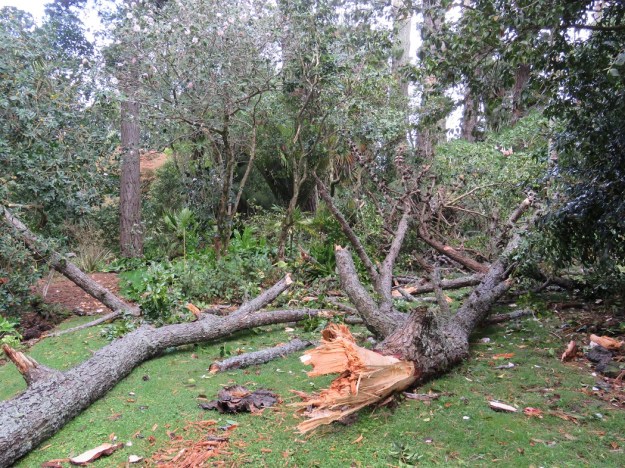
The top blew out this morning 

At least it fell considerately, mostly on the grass paths and not so much on the garden

Today is too windy with a cold southerly for me to garden but it snapped off another of our old man pines (P. radiata). As our treemageddons go, this is not a major one and most of it fell on the grass paths. We were drinking our morning coffee in the house when we heard it fall. In conditions like this, we do not linger long beneath these swaying, towering behemoths. We get through a prodigious amount of firewood each winter but I feel we should be onto storing away for the winter of 2022 by now.

Planning a trip

I loved my one, limited trip to Greece in 2004 but didn’t see a lot of vegetation

I like travelling. I am also mindful that in these rapidly changing times, the ability to fly across the world on a whim may be a privilege with days that are numbered. In fact, I feel defensive about even owning up publicly to planning another trip. But I am and it is very exciting.

The sight of wildflowers growing in their natural habitats can fairly be described as thrilling, for some of us at least. We haven’t seen a lot of it but I have been casting around for a tour that would suit us and I wasn’t overly keen on travelling to alpine meadows as they break into spring. A chance remark from a visiting friend put us onto a small tour company whose speciality is wildflower tours. The company is led by Christopher and Basak Gardner whom some readers may know as the authors of a beautiful book “The Flora of the Silk Road”. Another NZ colleague whose opinion we trust gave a ringing endorsement, having gone on two different tours with them.

Just look at the enticing small tours Vira Natura offer.  We are opting for the summer tour of the Pindos Mountains in Greece where the temperatures will be cooler than down on the coast at that time of the year. Lots of summer wildflowers, including Lilium chalecedonicum, and a  small group, staying in traditional hotels, led by a botanist.

Patmos, not Pindos, in 2004 but Greek at least

I have only been to a small part of Greece – an island-hopping trip in the Dodecanese with Second Daughter who was living in London at the time. I absolutely loved it and have longed to return. But Mark’s interest in arid island landscapes and swimming in the warm Mediterranean sea might last two days at the most before he became bored. And I could never inflict an island-hopping tour on him when he can get seasick out snorkelling, let alone travelling on ferries and catamarans. A land-based wildflower trip, however, is something that will delight both of us.

Because we are travelling so far, we will likely tack another week or ten days on to the end of the trip and head over to England (despite Brexit and all that). We are really keen to track how some of the naturalistic plantings we have seen have matured with the passage of a few more years. It is all very well to look wonderful for the first year or two, but how is it five years or more down the track? The Missouri Meadow at Wisley that so enchanted us in 2009 did not fare well but no doubt lessons have been learned. Meadows, prairies, wildflowers and naturalistic plantings may not need the heavy maintenance input of more traditional garden styles but they still need skilled management.

I offer our tentative list with the thought that some readers may have recommendations or comments to make. This will be mid-July, so heading into high summer.

London – I want to revisit the Nigel Dunnett planting at the Barbican that so delighted us on a previous visit and I can’t think why we have never been to see the Oudolf plantings at Potters Fields. Then up to Trentham Gardens near Stoke-on-Trent, primarily to see how the Dunnett plantings are maturing and to see the more recent additions he has made. We are particularly interested in his work. There is also a major magnolia planting there and we would like to see if any of ours have been used.

Wildside, a very special private garden in our opinion

Heading further north than we have been before, we are thinking of visiting Lowther Castle in Cumbria, mostly to see the gentle romance of Dan Pearson’s recent work. While up there, we would add in the outrageous, historical topiary of Levens Hall and probably pay a return visit to Arabella Lennox-Boyd’s lovely garden, Gresgarth (if it is open). Heading south, there has been so much talk about Piet Oudolf’s plantings at the Hauser and Wirth Gallery in Somerset that it would be a pity to miss them, even though we have a fairly good understanding of the Oudolf style now. Then to North Devon to see Keith and the late Ros Wiley’s particularly special garden called Wildside. We have been twice before but it remains our absolutely all-time favourite garden other than our own. It is worth the journey. We will go as far as arranging the dates and itinerary around Wildside’s limited opening days.

Heading back towards London, I would like to see Derek Jarman’s garden, even if it is only a brief stop en route. His book about the making of his garden is the best personal account I have read of any garden.

I am not sure how well we understood Great Dixter back in 2009

Finally, on this whistle-stop tour, we may revisit Sissinghurst to see what changes the outgoing head gardener, Troy Scott Smith and advisor, Dan Pearson have wrought in recreating the romance of Vita Sackville-West and Harold Nicholson’s original creation, which had become largely a distant memory in the face of ever-growing crowds of visitors. And we probably should have a second look at Great Dixter. We would look with different eyes now and it is time to lay to rest the most enduring memory of our one previous visit when we encountered some gardening underling who had clearly failed at Gardeners’ Charm School. It is not fair to judge the life’s work of Christopher Lloyd and, more recently, Fergus Garrett on the shortcomings of one graceless underling. Besides, on our only other visit, rather of a lot of what we were looking at seemed like serendipity. I think now we may have fine-tuned our observation skills and understanding to the point where we can discern what role careful editing (in modern parlance) plays in creating this experience of happy chance when it comes to keeping a light but skilled hand on garden maintenance.

Mark’s comment is that it should be really interesting to look at real wildflowers in the wild and follow it up with looking at the application of that naturalistic style in the more managed context of gardens and amenity plantings.

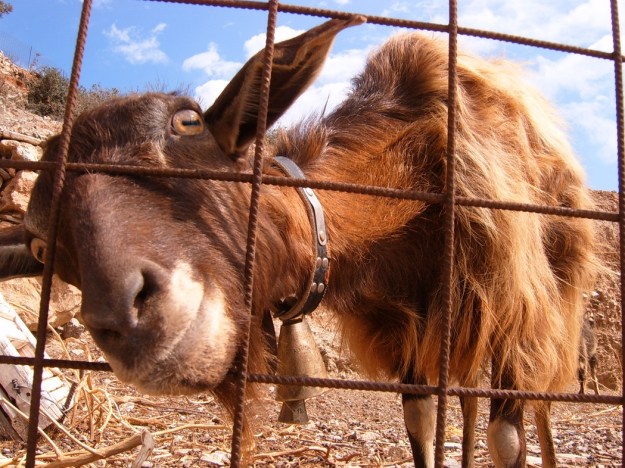
Finally, Greek goat, as seen on the tiny island of Lipsi

From cob to cracker

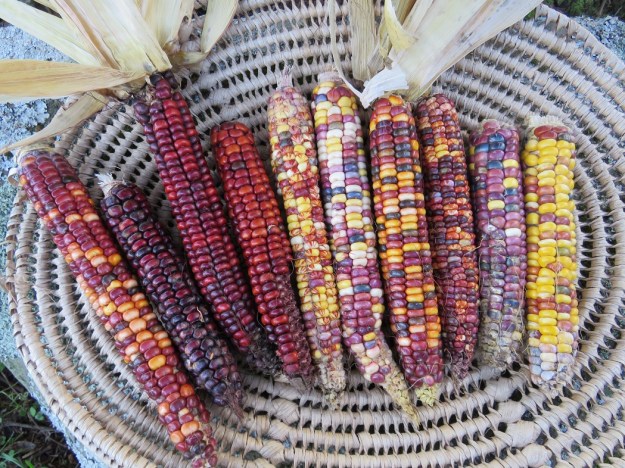
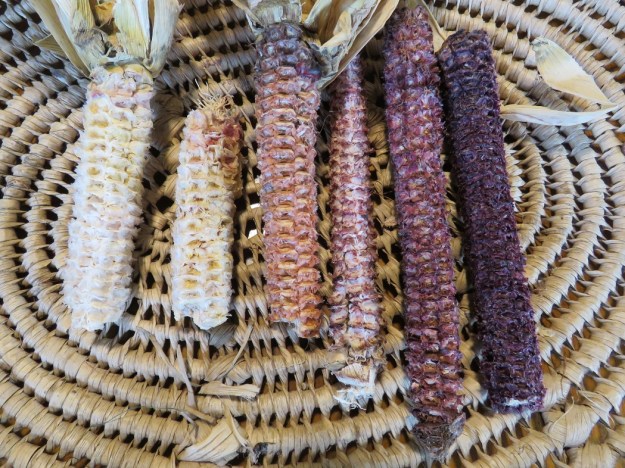
Indian corn or flint corn

Really, I wanted to show the photo of Mark’s pretty corn cobs. This is commonly called Indian corn or flint corn. It is maize, not sweetcorn so not suitable for eating as corn on the cob. Modern sweetcorn is a very different crop after a great deal of selection to get strains with very high sugar content – so much so that I often find them too sweet.  I think Mark just grew the Indian corn out of curiosity the first time. This year he put in a bigger row of it because we used all the previous crop and he is looking for grain crops that we can grow, harvest and use here.

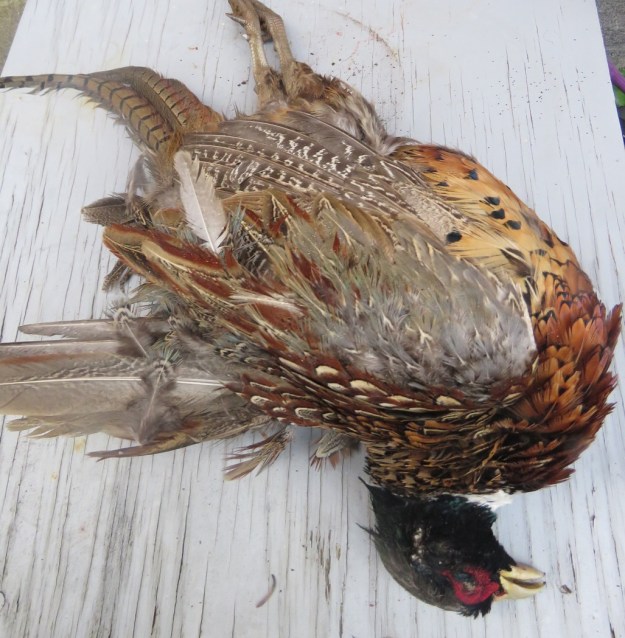
I only have a photo of dead pheasant. We found two which had been hit on the road but he counted more than that in the patch.

He was loving the presence of the growing population of beautiful pheasants in his cropping area across the road until he realised they had quietly consumed about a third of the Indian corn. We are still delighted to have a local population of exotic-looking pheasants but he hastily harvested the remaining cobs.

Curiously, when I dehusk the dried cobs, the remaining core also shows colour variation. Red kernels usually mean a red or purple cob.
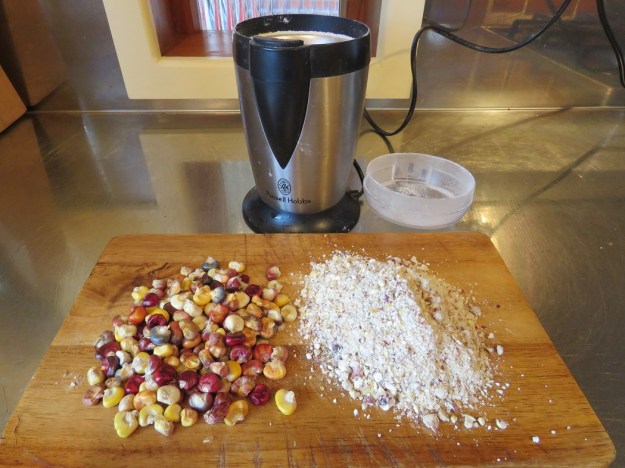
Kernels, maize flour and the handy old coffee grinder I kept in case it was needed again one day

What do we do with the corn? Home made corn crackers! I first tried grinding the kernels in the food processor and it had to work hard to achieve a fairly coarse result. I worried the meal may crack tooth fillings. Then I remembered the old electric coffee grinder I put away in a top cupboard when we upgraded to a burr grinder for coffee beans. It does an excellent job. The texture is not completely consistent and I don’t think I can manage the process to get polenta meal out of it, but it is fine for crackers. I have stopped buying corn chips and taco shells. My thin crackers make a more than acceptable substitute, though I would be lying if I said they tasted the same. I have learned that the kernels need grinding immediately before they are used because the flour goes mouldy really quickly.

I doubt that many readers have a crop of maize or Indian corn sitting around waiting to be used, but just in case, I offer you my recipe which I adapted from a great recipe I was given for making seedy crackers.

About 1 ¾ cups of fresh ground maize flour

¾ cup of spelt flour

2 tbsp chia seeds

1 tsp salt

1/3 cup olive oil

½ cup water

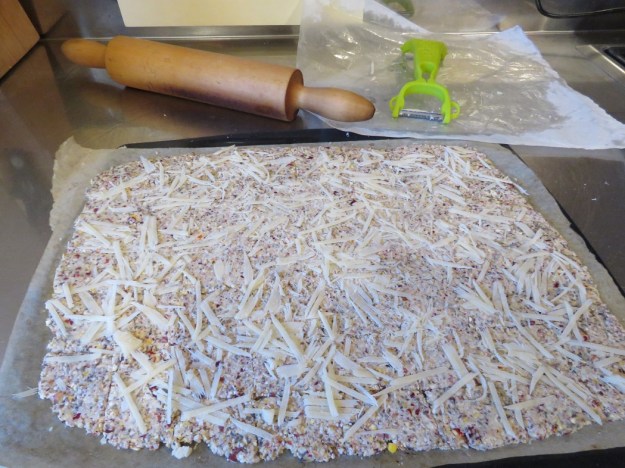
Mix and then roll out thinly on baking paper with another sheet of paper on top. Sprinkle the top with coarse salt flakes and grated parmesan cheese or similar (I used grana padano because that was what I had) and cut the sheet of cracker into suitable sized squares but leave it as a sheet.

Bake in a medium low oven (about 130 on fanbake) until it is golden brown and crisp (about 30 mins but keep an eye on it).

That is it. From grinding the corn to getting crispy, tasty crackers out of the oven takes about 40 minutes. We ate them this evening with chilli beans (homegrown, of course) and will continue to eat them during the week as a snack, with or without toppings.

Rolled and ready for baking 

The finished crackers

Botanical art for beginners in the garden here

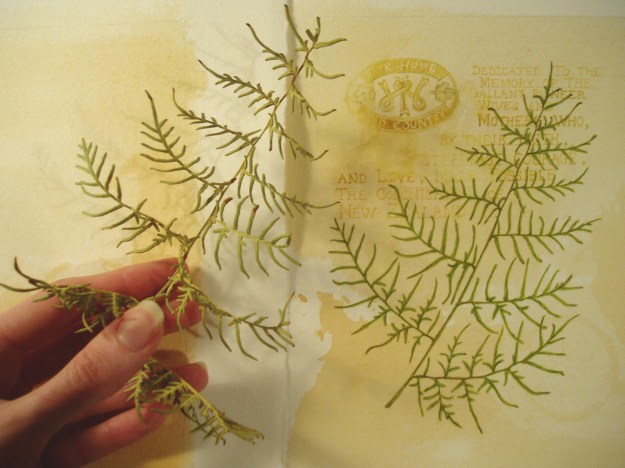
copyright T.Forbes 2006 

Do you dream of being able to paint and draw plants and flowers? Mark does and that is how we came to meet Tabatha Forbes. Dr Tabatha Forbes, thank you. She has a PhD in fine arts from Elam Art School at Auckland University.

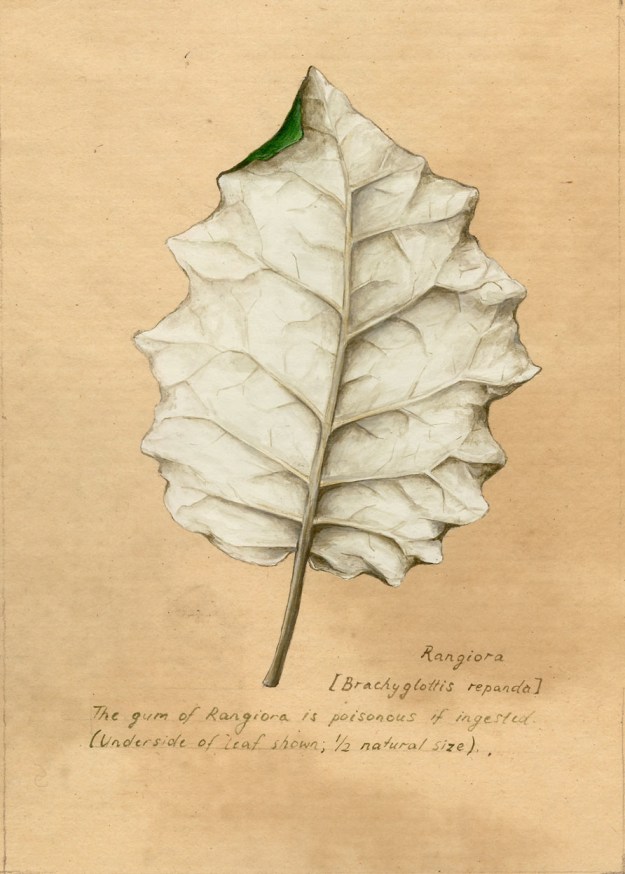
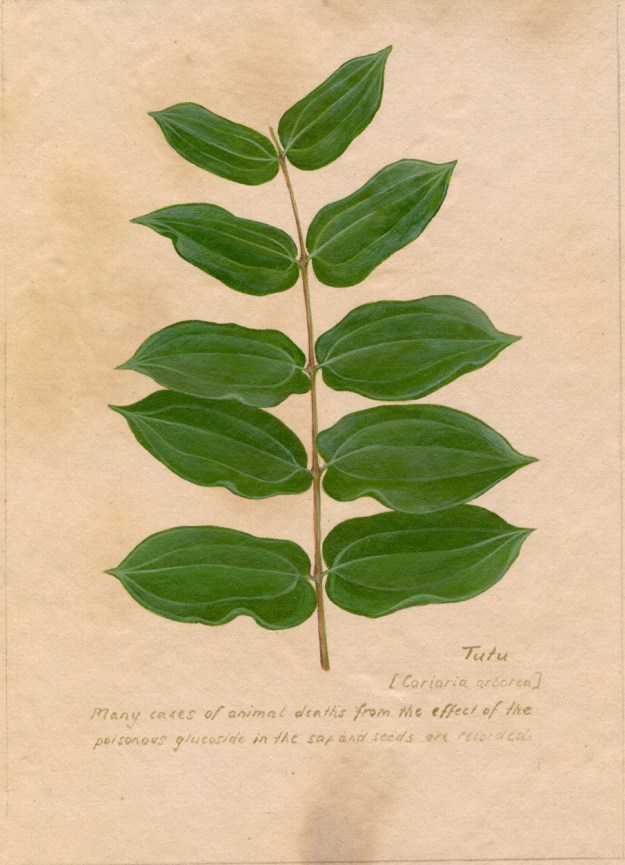
Tabatha tutors botanical art for beginners. This is a very specific branch of art combining both accurate botanical depiction with the skills and aesthetics of painting and drawing. Mark says that he just wants to be able to paint pretty flower pictures while realising that some level of skill in both close observation and translating that to paper is required to achieve that goal. He is hoping that his time with Tabatha at an August workshop will get him started (again) on drawing and painting.

Rangiora. copyright T.Forbes 2006

Later in November, Tabatha is offering two small-group workshops in our garden during this year’s garden festival. Our garden isn’t open for the festival this year but participants will have the run of the place while here. The first workshop is on the first weekend of the festival – Saturday 2 and Sunday 3 November from 10am -3pm each day. She starts beginners with leaves – observing and drawing in detail on the first day, moving onto acrylic painting on the second day.

The second workshop on the weekend of November 9 and 10 is a follow-up – progressing onto painting berries and fruit, so more colour and added detail.

If you want to know more, Tabatha has a comprehensive website which showcases her own work, her interests and experience and current projects.

The Taranaki Daily News recently published a profile on her here: The soothing art of retreating into nature. 

For more information and bookings, please email Tabatha at drtab72@gmail.com. We will be delighted to meet you should you attend either or both of her workshops here.

Toxic tutu (Coriaria arborea) copyright T.Forbes 2006

Waiting for hippeastrum flowers

We only have two species of hippeastrum in the garden. And one hybrid that bravely lives on in the rockery despite never receiving any praise and I don’t even appear to have photographed it. Most people probably grow the hybrids rather than the species and they are a genus that lends itself to novelty status – enormous flowers and some odd variations that are not necessarily creations of beauty.

Hippeastrum aulicum in the garden

Hippeastrum aulicum in particular is a mainstay of our early spring woodland. I have always described it as looking more like a Jacobean lily. Because it thrives with us, we have a lot of aulicum though we don’t get seed on the plants in the garden. Mark says this is because we are not hot enough but it will set seed if brought under cover.

Hippeastrum papilio. It has taken a while to increase it from a single bulb but we now have two patches like this.

It has taken a while to build up H. papilio but we are on track now with quite a few flowering in the same woodland conditions that suit H.aulicum. They certainly have a wow factor as a garden plant but we don’t get seed. Whether this is temperature related or they are not self-fertile, we do not know.

Mark wondered if we would get any interesting variations if he crossed the two species, while acknowledging that it was more a cross of convenience rather than one based on using the best possible parents. He did it so long ago that he can’t remember now which species he used as the seed-setter. Nor can I remember how many years it is since I grew tired of the pots of seedlings kicking around the nursery so took it upon myself to plant them out. Maybe about eight years?

The plants have done absolutely nothing in the garden except grow larger in the intervening years. Until this week! Two are flowering, well over a decade after the cross was made. Curiously, they are flowering before either of their parents: H. aulicum is only just putting its flower spikes up and is still some way off showing colour and it will be October before H. papilio blooms. I probably planted out a tray of 40 pots all up so there are a whole lot more to come. Eventually.

Nothing to get excited about

So what did we get? I was a bit underwhelmed by the first one. It only has two flowers to the stem and really just resembles a larger version of H. aulicum, maybe with more prominent green veining. I prefer the original species at this stage.

It is big – much bigger than its parents. And showy. But is it an improvement as a garden plant?

The second one is certainly larger, showing considerable hybrid vigour. The flower spike is over a metre tall and the spike has five big blooms opening on it. It is another red with green veining. So it looks as though it will be big and showy, if big and showy is how you like your bulbs. We would be happy with smaller and more interesting. Mark’s only comment so far has been that it never was a brilliant cross in the first place but it was just to get some variation in the garden.

Maybe the other 38 or so will show more interesting variations over the next few years? A large part of gardening is optimism.

I see there are about 90 species of hippeastrum though most of the hybrids are from just six of the species – including H. aulicum which surprised us, but not H. papilio.