

49 different cultivars in bloom at this early time of the season
It was a bit bleak outdoors today and I could not find the motivation to grub around in the soil so I entertained myself looking at the camellias in bloom. It is very early in the season for us and most are still in tight bud but I found 49 different ones with open flowers.
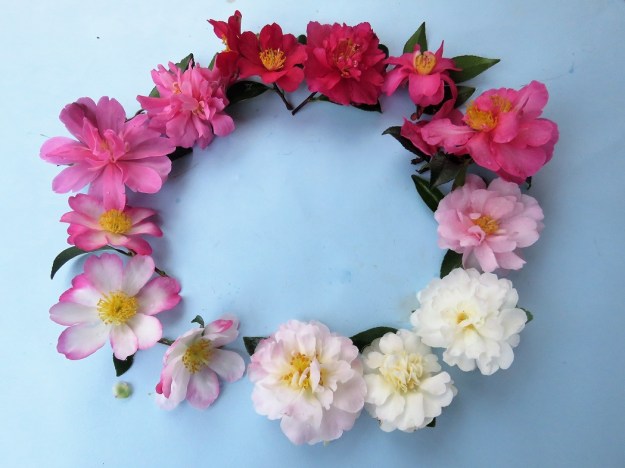
A collection of sasanquas
The early sasanquas are past their peak now but still very pretty. All the above are different named cultivars and typical, with their rather loose form and a readiness to shatter when they fall. This is helpful because it means the mass of fallen blooms break down quickly. Sasanquas used to be somewhat spurned as lacking flower form, useful mostly for hedges and sunny positions but fashions change. They are not afflicted by petal blight here which is a huge plus and these days, we find we prefer those looser flowers which have a pretty charm of their own.
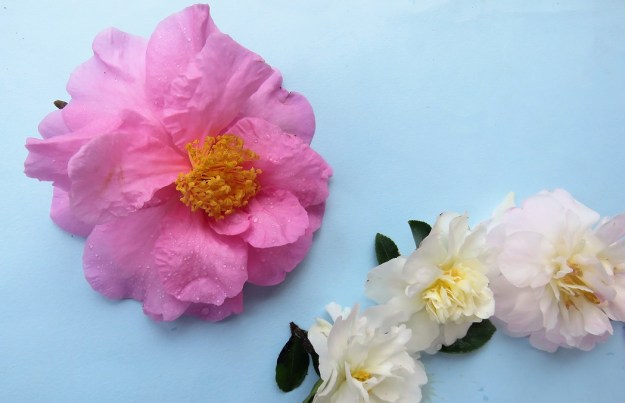
Show Girl!
I didn’t add Show Girl to the sasanqua flower ring because it is so out of scale. It is a most unusual cross between a sasanqua and a reticulata and it comes into full flower early, with the sasanquas. The individual blooms are nothing special but it is lovely both on the tree or falling to a carpet of petals beneath.

The earliest flowering species
We have gathered up a reasonable collection of camellia species over the years – most of what has been available in this country. But it appears that this early in the season, you can have any colour you like as long as it is white. Or the one, minuscule pink C. puniceiflora. In the centre is C. yunnanensis already showing its unfortunate trait of the stamens turning black with age. Camellias where the stamens stay yellow are far more desirable.
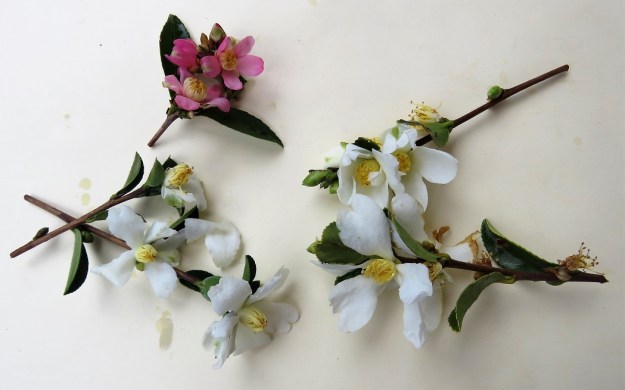
Three different species or all variants of the one?
These three species came to us under the names of C. brevistyla (left), C. microphylla (right) and C. puniceiflora (top). Australian camellia expert, Bob Cherry, advanced the theory to Mark that they are all just different forms of the same species and Mark has come to the conclusion that he is probably right after several seasons of examining them with his hand lens. Species in the wild can vary considerably. In time, DNA testing will prove it either way. Of these three camellias, the form of C. microphylla that we have is easily the best as a garden plant.

Hybrids, seedlings and a few japonicas
These are a mix, some named cultivars and some seedlings. Mark has used camellias extensively for hedging and shelter around the perimeters of the garden, on our roadside and separating different areas. You can see how desirable it is for the stamens to stay yellow as they age. Generally, it is the ones with visible stamens that provide an important source of food for the birds and the bees through winter. The fully double, frilly blooms are purely ornamental. The majority of the japonicas and all the reticulatas are still just at bud stage and, alas, will be hit by camellia petal blight when they do come into bloom.
There is a whole lot more to choosing a camellia than just a pretty flower. The habit of growth, ultimate size, length of time in flower, how the blooms age and fall, colour of the foliage, reliability and more come in to play as well. Sometimes everything else is so good that a pretty ordinary flower is still acceptable. One of the red singles above is worth its place simply because it feeds our native tui (birds) – a sight that brings us pleasure every year.
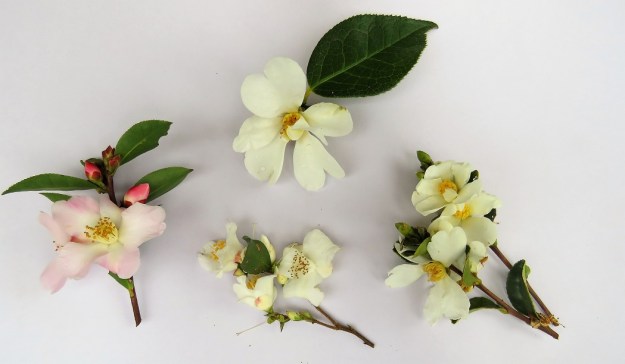
We have literally hundreds, if not into the thousands camellias all over the property. Some are named, many more are just seedlings from the breeding programme. But they are almost all just one-off plants. I can think of only four that we have planted in quantity. The three bottom ones above, we have used as hedging. From left to right, they are Mark’s first named cultivar, ‘Fairy Blush’, C. transnokoensis and C. minutiflora. All three have small leaves that respond well to clipping, good foliage colour, dense growth and masses of dainty flowers.
The flower in the top centre is C. yuhsienensis – not a hedging camellia but one we like so much that we have chosen to feature it repeatedly in two different areas of the garden. In bloom, at its best, it resembles a pretty michelia but with bullate (heavy textured) foliage.
Mark says he found the first incidence of camellia petal blight today. This is later than usual, which we put down to a drier than usual autumn. I admit I lose enthusiasm for camellias as the season progresses and blight hits badly but these early season bloomers gladden my heart on a winter’s day.
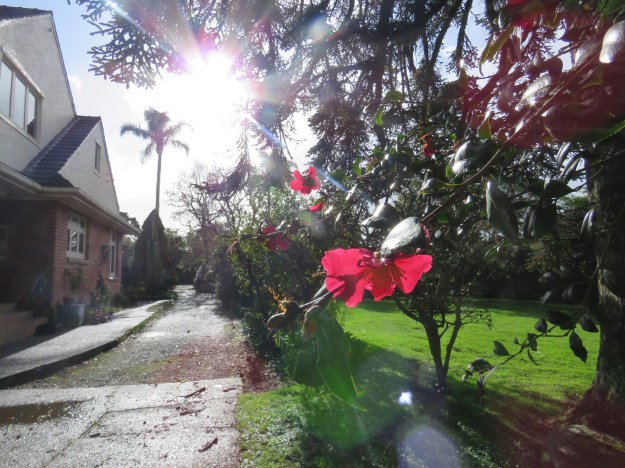
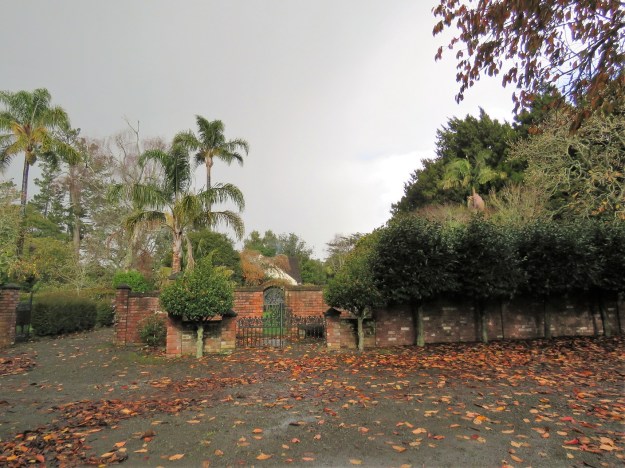
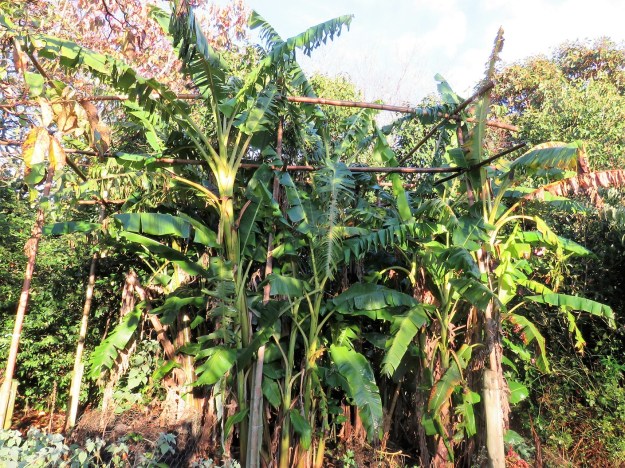 This too will pass. Generally the worst of our winter weather hits after the winter solstice – June 22nd to be precise – and today, June 2, has dawned fine and sunny, albeit with a chilly temperature. Mark is taking heed of this sudden drop. Today’s task, he declared, is to cover the bananas. You can see the semi-permanent bamboo frame in the photo. He needs the extension ladder these days to get the windbreak sheltering cover in place for the bananas have grown to a substantial size. At least we get a crop from them these days but we wouldn’t if he didn’t spend a day shrouding them for winter. That is as far as battening down the hatches goes here. We don’t wrap anything else up for winter.
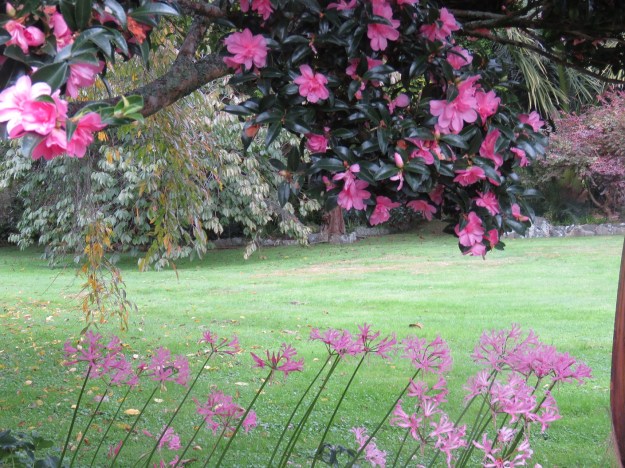


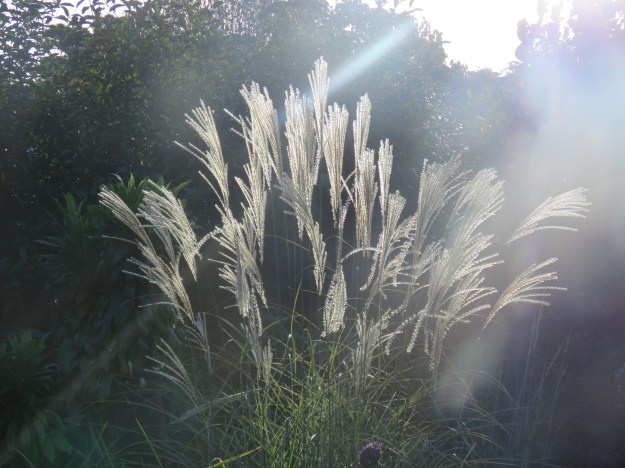
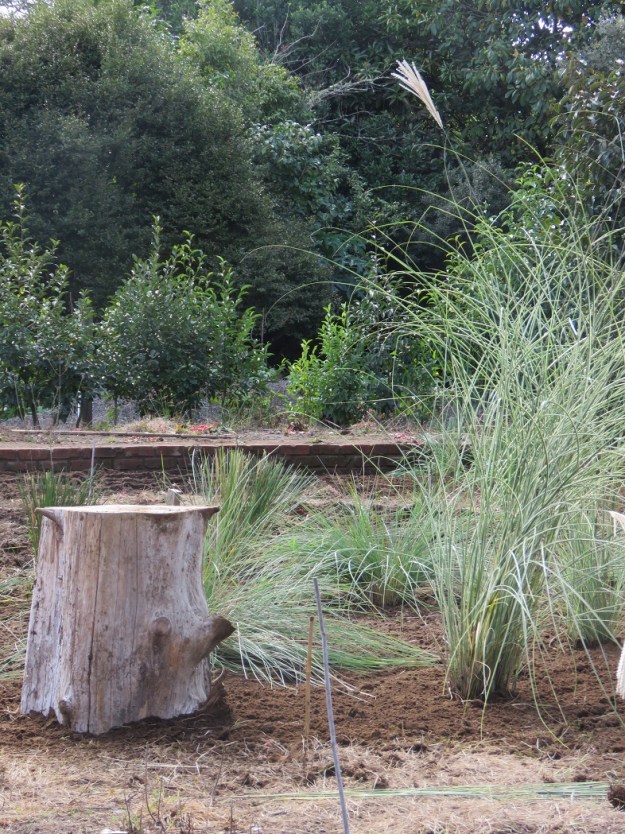 It is a blank canvas, what we refer to as the court garden, on account of it looking like a tennis court when it was just an open space. We have talked about it a lot, stood and looked at the space and mentally envisaged the possibilities – which were pretty much endless – for this open, sunny area. Having narrowed down the plan, I set about refining the plant palette and building up the material to go in. As Mark has observed in the past, ours started as a poor man’s garden. His father could not afford to buy in all the material to plant up the large garden across several acres so applied himself to raising a lot of it. These days, rather than a poor man’s garden, it is an economical couple’s garden. It would cost a lot to buy in all the plants needed to fill over 450 square metres and they would arrive as small specimens. I have been gently building up plants for a few years now so what are going in are reasonable large divisions. Instant effect, Mark calls it.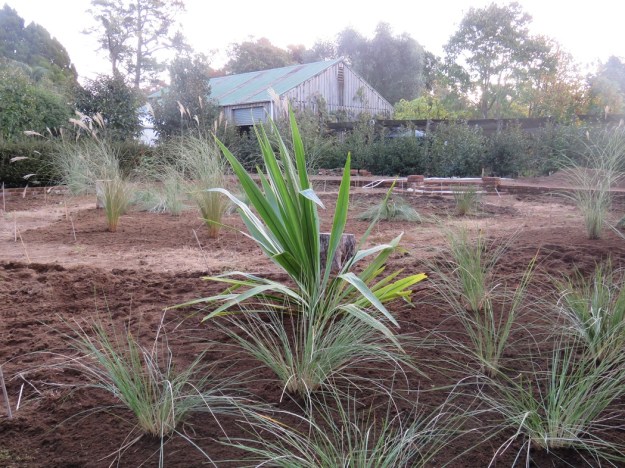

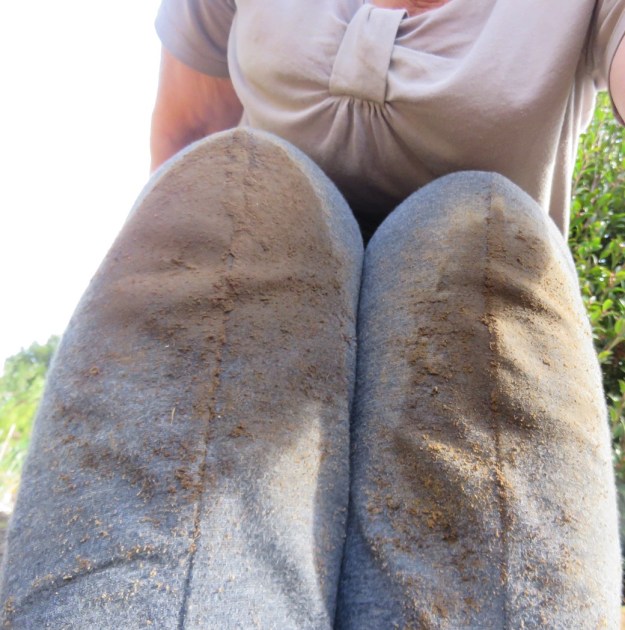 Postscript: I am a dirty-kneed gardener. Mark laughs at me and regularly tells me I should not be allowed indoors. Indeed, I often shed my trousers in the laundry before I enter the house. Don’t tell me about knee pads. I have tried them and they don’t suit me. I have an abundance of kneeling pads but unless it is wet, muddy and cold, I find it easier to wash my clothes than constantly re-position the kneeling pads.










 Tikorangi The Jury Garden