
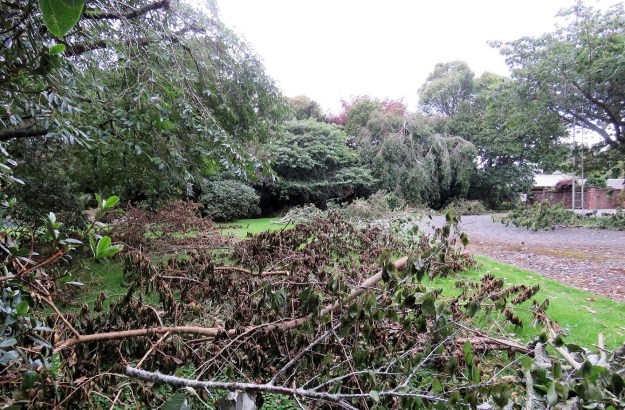
Just one view of Mark’s pruning efforts this week
In a garden with many trees, ladders are a part of our life. While our son, Theo, and I have been down in the park clearing the ponds and the stream of invasive weeds (lots of heavy raking), Mark has been up the top doing a round of summer pruning. Particularly cherry trees which need to be pruned right now, since summer is already morphing into autumn. You can see the extension ladder up Prunus Pearly Shadows to the right of the photo.
I am always in awe of how much material Mark can remove when pruning, without it showing except to the most discerning eye. This is a high level and under-appreciated skill though he does say it takes him a great deal of time looking before he ever makes the cuts. And he is forever up and down the ladders to look again from all angles and locations. For you cannot glue a branch back on if you get it wrong and find that you have just destroyed the shape of the tree by taking the wrong piece off.
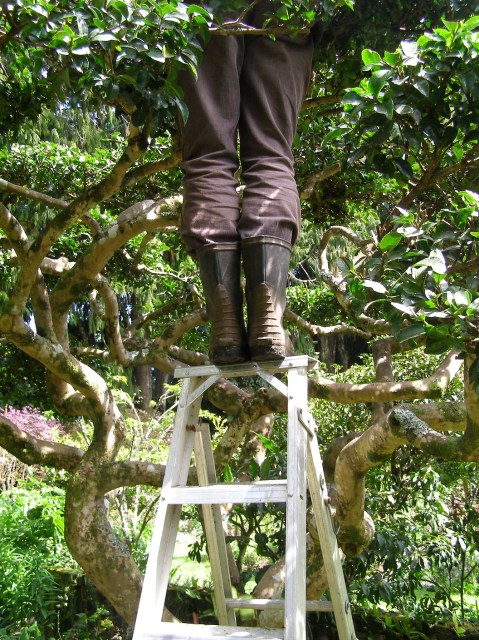
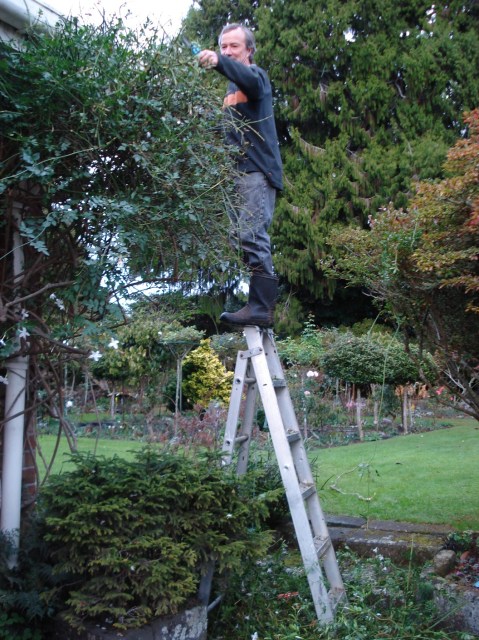 Mark, being an agile and wiry man with very good balance, has given me the most alarming photos of how not to use ladders. Do not try this at home. He would like a disclaimer added that he is not stupid. He only does this with the ladder in a stable position and with something firm to hand that he can grab should anything go awry. Never with the chainsaw. He is extremely mindful of safety and caution with the chainsaw when mistakes can be fatal.
 Because ladders play such a role in our lives, we were pretty interested in this permanent ladder structure seen attached to a tree in a tourist park in Jinghong, near China’s southern border. Presumably this tree is climbed regularly to warrant the construction of a ladder, although the reason why was not clear to us at the time. It can’t be that good for the long term health of the tree to have the wooden pegs bored into its trunk but at least they are not nails.
Who needs ladders, anyway? A friend shared this link via Facebook this week – how a Vietnamese tactical police unit climbs the outside of buildings with just a length of bamboo. No, it does not involve pole vaulting. We were pretty impressed, I tell you, and it has given Mark a new range of jokes about how we can dispense with ladders here and follow their lead. Who needs aluminium ladders when we have a wonderful resource of bamboo growing here? It would solve the problem of the oft-asked question here of where the ladders are when one of us need one and there are none in the shed.

 We spent Christmas in Canberra. Why Canberra, you may wonder. Or you may not. We are one of those New Zealand families where all three of our children have headed off into the merry blue yonder and the daughter with our first and only grandchild lives there.
 It was protection from the abundant and intrusive birdlife that saw the next door garden shrouded in white netting. The owners, Croatian migrants who escaped then-Yugoslavia in the 1960s for a better life in free Australia, were keen food producers growing many fruits and vegetables. It was an interesting visual effect, the shrouding of the garden, though you wouldn’t be able to expect a fruit crop in our humid conditions with the tree foliage compressed into tight domes.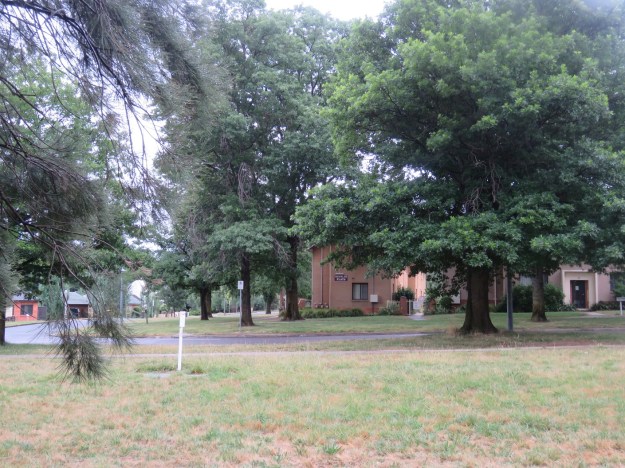





 It is
It is 
 Tikorangi The Jury Garden