Tag Archives: Mark and Abbie Jury

The January Garden

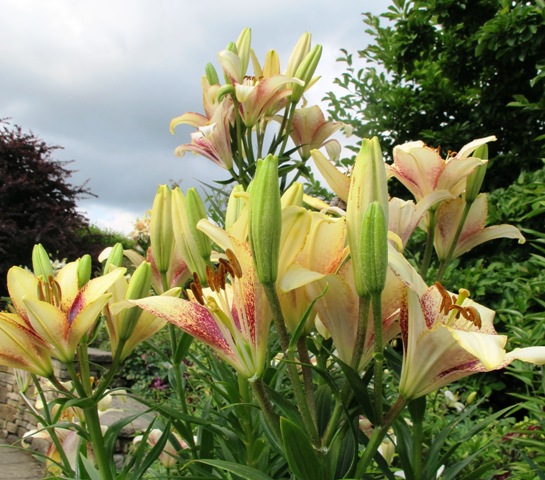
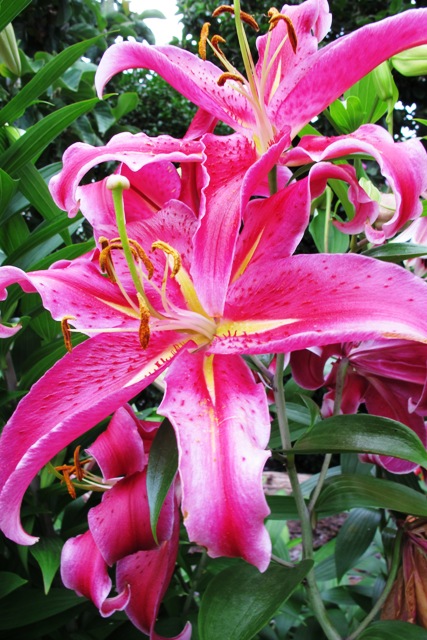
Auratums and pink lobelia

Auratums and pink lobelia

I don’t cut many flowers to bring indoors. It feels a bit like murdering them to sever them in their prime and bring them indoors to die. We were lucky that Mark’s parents had the foresight to plan the garden so there is a different view from every house window and we have plenty of flowers in sight all year round. The lilies are different. In summer I love to bring in huge stems to scent the house. They are big. They are bold. They are beautiful. Lilies define our summers.

You need quite a lot of lilies to justify cutting the entire stem off and, after many decades, we have a few. Mark’s father Felix started breeding auratums maybe four or five decades ago and Mark has continued. This was never for commercial reasons. It was to build up plants for the garden, to extend the colour range and the season and particularly to get outward facing blooms rather than the upward facing ones which are preferred in floristry. Constantly replenishing with newly raised plants is also a safeguard against the potential ravages of lily virus. Not that we have had a problem with lily virus and disease, but if we ever do, we are prepared.

The lily we scorned at Wisley

The lily we scorned at Wisley

We noticed a floriferous new lily at the Royal Horticultural Society Wisley Gardens last June. People were admiring it and but Mark took one look and said: “Gross. No good as a garden plant. Look at those upward facing blooms waiting to mark.” Not only are the upward facing blooms more vulnerable to weather damage, but the pollen falls internally and spoils it sooner. So I photographed it, but not for the same reason as the admirers. It was showy but we wouldn’t give it garden space.

Although you can to leave auratum lilies in the ground year after year, lifting and replanting deeper on a regular basis saves having to stake every stem. They work their way upwards over time. In our free draining soil, if I put them anything up to 20cm down, they are much better at holding themselves upright. The other technique to save forever staking (and then de-staking at the end of the season) is to grow them through shrubs which can act as supports. Apple trees and azaleas work well for us. When I do have to stake, I prefer to harvest my own bamboo lengths and leave the leaf axils in place to grip the flower stem. It saves tying to a smooth stake.

Just another unnamed seedling (or JAUS, as we call them here)

Just another unnamed seedling (or JAUS, as we call them here)


Auratum bulbs do not respond well to drying out, even in their dormant season. This is why they are usually sold in bags of sphagnum moss or sawdust. Always try and buy them as soon as they come into garden centres in early winter and get them into the ground as soon as possible.
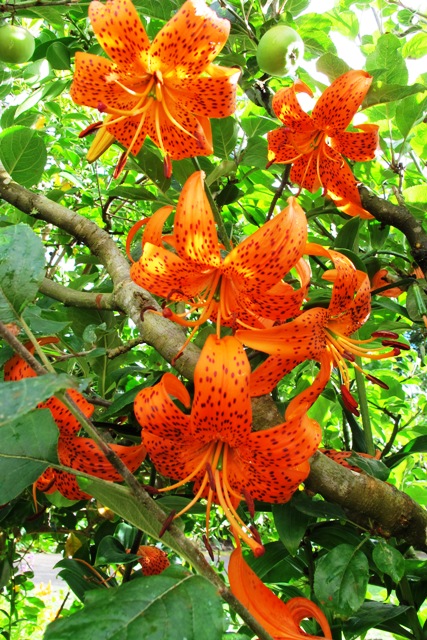
Orange tiger lilies growing through the espaliered apple trees

Orange tiger lilies growing through the espaliered apple trees

Our lily season starts with what we call the Christmas lily, or Lilium regale from China. It even Others sometimes refer to L. longiflorum as the Christmas lily. It is typically pure white and hails from Japan whereas L. regale has deep pink petal backs fading out to white. The orange tiger lilies with their reflexed petals follow soon after. They lack scent but they are a showy addition to the summer garden and very easy to grow. Next we get the aurelians – scented trumpet lilies in pretty gold and apricot shades. Most of ours have been raised from seed. They have a lovely elegance to them both in the garden and as a cut flower. You will notice their trumpets face outwards and downwards.
Aforementioned JAUS

Aforementioned JAUS

These are all but an overture to the main event – the glory of the auratums which take us through January and well into February. There is nothing subtle or understated about the flower power. Their common name is the “golden rayed lily of Japan”. How lovely is that?

???????????????????????????????First published in the New Zealand Gardener and reprinted here with their permission.
A forest of cycads

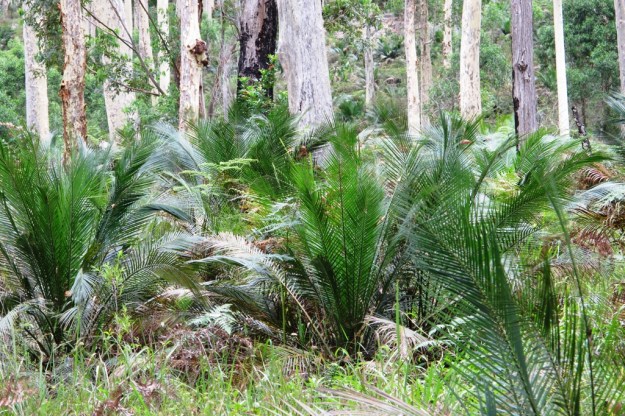
I admit not everybody will find a woodland understory of native cycads exciting but we were pretty taken with this natural phenomenon

I admit not everybody will find a woodland understory of native cycads exciting but we were pretty taken with this natural phenomenon

We drove through a cycad forest. It was so exciting – in a low-key sort of way. Most of us have gardens which are the botanical equivalent of the United Nations. While some of us may know in theory where at least some of the plants originate, to see them in their natural habitat can be a thrill.

Our New Zealand bush is thick, dense and verdant. Overseas visitors are frequently amazed by our ferns, particularly our tree ferns which we take for granted. Our dicksonias (the common pongas) are particularly highly prized overseas. When we had the garden open, I used to like shocking overseas visitors by commenting that they just seed down here and we chainsaw out those that are in the wrong place. Familiarity can breed contempt.

The Australian bush is different. It is much more open in character but it had never occurred to us to consider that of course their native cycad, Macrozamia communis, must have its natural habitat somewhere. At least one place is in the eucalyptus woodland heading inland from Bateman’s Bay on the coast south of Sydney.

We know the cycads as expensive, designer plants much favoured by Auckland landscapers in recent decades. Most are very slow growing plants and they show little seasonal change so they fit well into the near-static designer garden mode favoured by some. They have always been expensive because you are paying for the years of growth to get them to a large enough size to have visual impact.

Botanically, they are even more interesting, having undergone little evolutionary change down the centuries. These are ancient plants, traced 200 million years which takes them back considerably earlier than the dinosaur era. Individual plants can be long lived too – anything up to 1000 years. While they are often grouped with palms and there is a certain passing resemblance in form to some ferns, there is only a remote botanical connection to either at best.

Many cycads are rare and endangered around the world but not Macrozamia communis. It is common enough in New Zealand gardens because it is a species that can adapt to our cooler temperatures. We have several in our garden where they thrive.

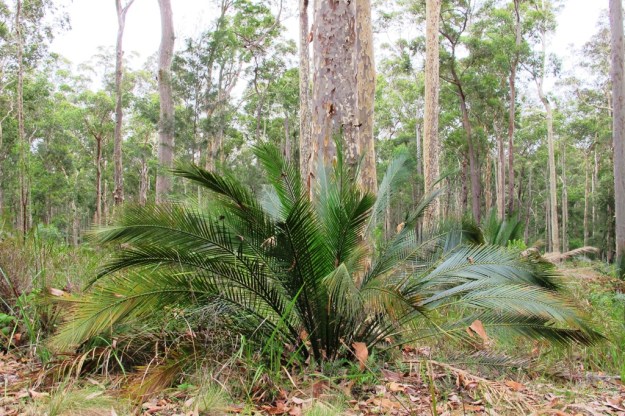
In the wild, eucalypts and Macrozamia communis near the coast south of Sydney. Notice the lovely mottled bark on the gum tree

In the wild, eucalypts and Macrozamia communis near the coast south of Sydney. Notice the lovely mottled bark on the gum tree

But to see them in the wild was a different experience. They form the lower canopy beneath the spotted gum (what used to be known as Eucalytus maculata but has now been reclassified as Corymbia maculata) and there were hectares of them at various stages of maturity. They seed down and some had babies growing at their feet. One reason they have survived is that they are adapted to cope with bush fires sweeping through. Even if all the foliage is removed (either by fire or when cut off), the trunk and bulbous base are capable of pushing out fresh growth.

A carpet of bark, leaves and debris from the top layer of eucalypts creates conditions which discourage many other plants

A carpet of bark, leaves and debris from the top layer of eucalypts creates conditions which discourage many other plants

Being squeamish New Zealanders, we found the Aussie bush challenging. Even on the coast where we were staying in Vincentia, quiet strolls along well-trod paths by the scenic beaches took on new fears after we found the first ticks taking up residence on both humans and the two little dogs that were with us. Mark’s one brief foray off piste (to look at a native orchid in flower) resulted in a leach latching onto his foot. He was unaware of it until, replete, it fell off him on the kitchen floor. We missed seeing – by a matter of a minute – the red belly snake which freaked out another party. Truly our native bush and forest is benign compared to the natural hazards in Australia. So we were not going to go far off the track to explore the macrozamia wonderland but viewed it from the rough vehicle access. Their woodland lacks competition from a wide range of different plants. The top canopy of eucalypts drops vast amounts of foliage and bark which sits around taking a very long time to decompose. That, allied to the extremely dry soil conditions which result from the gums getting down on available moisture, creates inhospitable conditions. The macrozamias can coexist in this environment but not a lot else can.

I have a treasured memory of seeing natural bluebell woods in Scotland. Mark got all excited finding Helleborus niger and hepaticas growing wild in their homelands in Northern Italy. The cycad woodland of south eastern Australia ranks up with these experiences.

The macrozamia is equally popular as a garden plant

The macrozamia is equally popular as a garden plant

First published in the Waikato Times and reprinted here with their permission. 
 

Plant Collector – Brachychiton

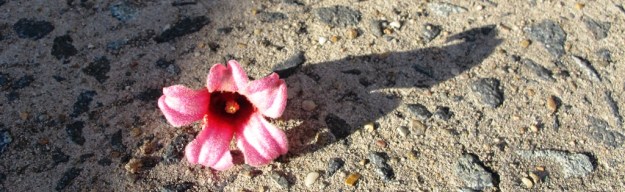
Brachychiton - a showy Australian native

Brachychiton – a showy Australian native

Across the road from our daughter’s Sydney apartment was this eyecatching tree that I had never seen before. Being a better plantsperson than I am, Mark immediately identified it as a brachychiton. Common names are kurrajong and bottletree.

This one is summer deciduous, dropping its leaves before flowering. We are used to magnolias and flowering cherries blooming on bare wood in spring but I can’t think we have any fully summer deciduous trees here. From looking at the internet, I am putting my money on it being B. discolor rather than B. bidwillii. If I am right, it places its natural habitat amongst the eastern rain forests. There are 31 different brachychiton species, 30 from Australia and a solitary specimen from New Guinea. The Illawarra flame tree is perhaps the best known variety (B. acerifolius) but as these are large trees (anything up to 40 metres in their natural habitat although they won’t get that big in less than ideal conditions), these highly ornamental trees are not much favoured in suburban gardens in this country, even in areas where they could be grown. Some can also be very prickly.

The showy brachychiton does at least give lie to the idea that all Australian native trees are either gum trees or something with greyish foliage and bottlebrush flowers.
???????????????????????????????
First published in the Waikato Times and reprinted here with their permission.

December in the garden

Kevin and Sharon - the reindeer - at the base of the toetoe Christmas tree

Kevin and Sharon – the reindeer – at the base of the toetoe Christmas tree

December is the month of rituals for us. It is all about countdown and preparation. Will there be new potatoes, fresh peas, strawberries and raspberries ready for Christmas Day? I think we have only ever missed one set of homegrown new potatoes. If my memory serves me right, it was an advanced season and we had eaten all the first crops and hit a lull.

???????????????????????????????

Peas are more problematic and require some precision of timing and management. I adore fresh peas though I lose interest when they are podded and boiled. Browsing from the plant is my preference, followed by raw in salads. Peas generally do better in cooler climates. I admit the ones in the photograph are English. Ours never crop that heavily. In fact they take up quite a bit of space for a meagre to moderate crop here. There are more productive options where space is limited, not the least being beans. But nothing can replace the taste delight of fresh peas. We never have a Christmas turkey here, but we do peas if we can.

???????????????????????????????

Some years, the raspberrries will ripen in time for Christmas Day. The week or two after Christmas they come on stream at an alarming rate, needing to be picked every day but whether those early ones make the deadline for dessert is entirely beyond our control. Even with our raspberry cage, it is an ongoing battle between humans and birds, mostly blackbirds. The pie seems a fairly good option for the birds, in my opinion. They will scout out the slightest weakness in the cage, squeezing through tiny gaps in their determination to help themselves. The wretches will also breach the cloche defences to take out the strawberries we guard for Christmas breakfast. It is a war out there as Christmas approaches.

Christmas trees, we’ve had a few. The DIY ethos rules unchallenged. We have never bought a tree and never had a tinsel one. Generally we have wildling pines harvested from the property. If we are lucky, Mark has preselected the wildling pine and actually given it a couple of trims to get the growth denser than usual. More often, he resorts to wiring in additional branches in a vain attempt to create something akin to the commercially trimmed pines, or the Northern European abies with their wonderful conical shapes. The thought is there even if the reality is a little different.

By far our most creative tree was the one our second daughter made out of toetoe a few years ago. Home from London, she was inspired by an illustration she had seen of one created from the plumes of pampas grass. No pampas here. It is on the absolutely banned list as a noxious weed. But toe toe (which used to be a cortaderia but has now been reclassified as an austroderia) is our native substitute.

Should you wish to try this at home, be warned. It takes many more toe toe plumes than you think. Many, many more. They will moult through your car boot, even more in the construction area and they will then gently shed in the house all Christmas. But then so do pine needles and they are a more difficult to vacuum up. The toe toe tree was a tour de force. It had a certain Pacifica vibe going, combined with European style. If you want to try it yourself, there are step by step instructions on my website. https://jury.co.nz/2010/12/24/construct-your-own-christmas-tree-with-abbie-camilla-jury/

???????????????????????????????

All this is entirely academic for us this year. After more than three decades of building our own family traditions and keeping them the same as assorted offspring migrated home for Christmas, this is the first time we will not be celebrating at home. We are heading over to join the Australian-domiciled daughters and their families this year. I guess it may even be prawns on the barbie. It will be different as the next generation build their traditions for the festive and family season.

First published in The New Zealand Gardener and reprinted here with their permission.

Garden lore: a Flower Fairy Christmas

001 - Copy

The little Christmas Tree was born
And dwelt in open air;
It did not guess how bright a dress
Some day its boughs would wear;
Brown cones were all, it thought, a tall
And grown-up Fir would bear.

O little Fir! Your forest home
Is far and far away;
And here indoors these boughs of yours
With coloured balls are gay,
With candle-light, and tinsel bright,
For this is Christmas Day!

Fairies of the Trees by Cicely Mary Barker (1940)
???????????????????????????????Garden lore: A Flower Fairy Christmas
Despite having an English mother, the flower fairy books were not a part of my childhood. It took Mark and his mother to introduce them to our daughters. A friend squealed in delight when she saw them again and commented that she learned all she knew about wild flowers and native plants of Britain from them in her childhood. Today’s quote is from this little series of seven books.

Our own little sweet pea fairy with her Nana Jury from three decades ago

Our own little sweet pea fairy with her Nana Jury from three decades ago


To be honest, the poetry isn’t great by any manner of means and it is very girly-girly. These days there is an entire industry of fairy memorabilia spawned by the series. At its best, that memorabilia is ethereal-faerie in nature, at its worst it lacks both charm and subtlety. But the books holds special memories for our family. I have a photo of our eldest aged 3 at the Playcentre Christmas party dressed as the sweet pea fairy. A few years ago she made me a quilted Christmas table runner based on the flower fairies and every year it makes me smile as we look at the fairies of winter in a New Zealand summer Christmas.

Happy Christmas to readers. Maybe there is somebody out there with greater poetic skills who could do a flower creatures book for our native flora?

First published in the Waikato Times and reprinted here with their permission.